ATI Proctored Fundamentals Questions & Answers, 100% Correct-what are the health care regulatory agencies
- joint commission
state boards of nursing
food and drug administration
what are the federally funded
...
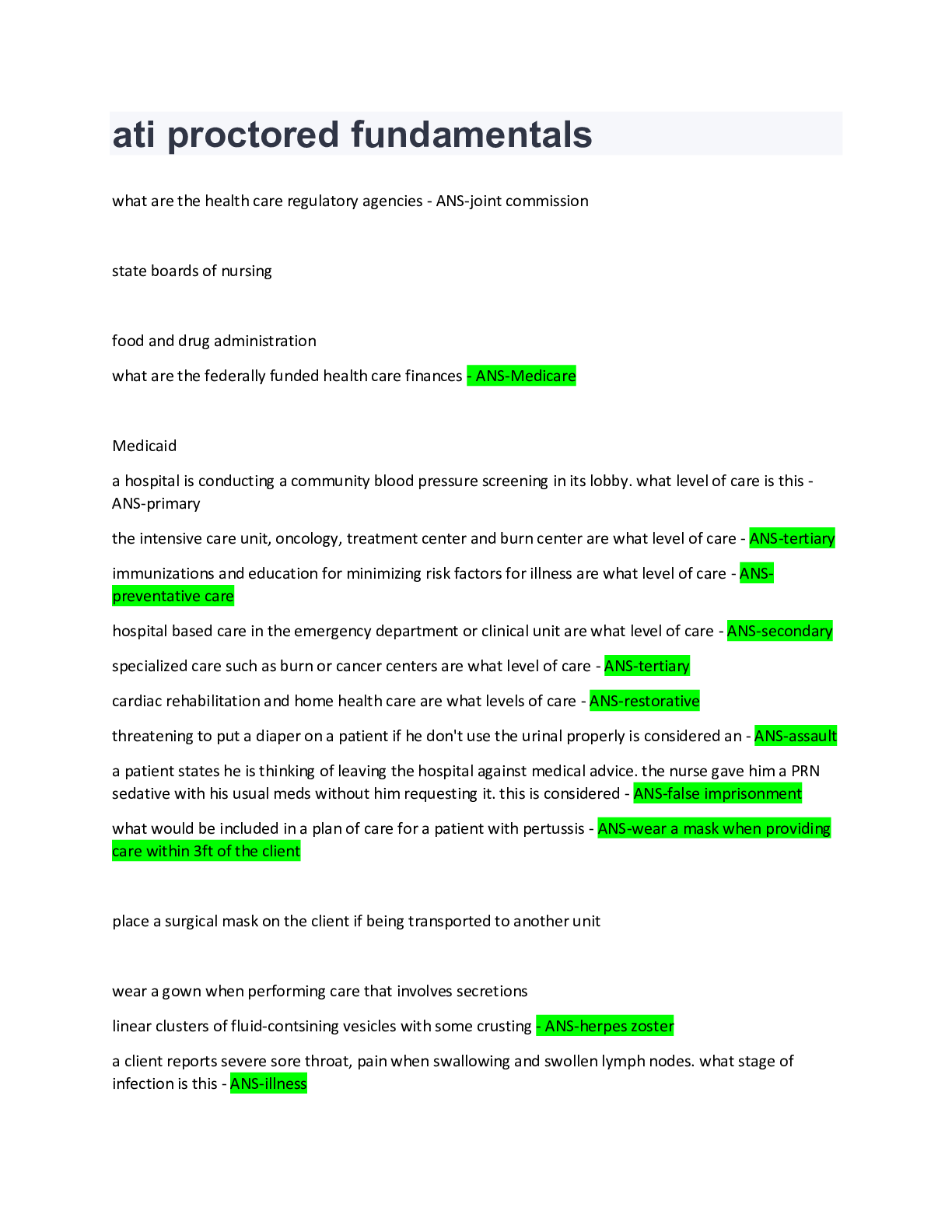
ATI Proctored Fundamentals Questions & Answers, 100% Correct-what are the health care regulatory agencies
- joint commission
state boards of nursing
food and drug administration
what are the federally funded health care finances
- Medicare
Medicaid
a hospital is conducting a community blood pressure screening in its lobby. what level of care is this
- primary
the intensive care unit, oncology, treatment center and burn center are what level of care
- tertiary
immunizations and education for minimizing risk factors for illness are what level of care
- preventative care
hospital based care in the emergency department or clinical unit are what level of care
- secondary
specialized care such as burn or cancer centers are what level of care - tertiary
cardiac rehabilitation and home health care are what levels of care - restorative
threatening to put a diaper on a patient if he don't use the urinal properly is considered an - assault
a patient states he is thinking of leaving the hospital against medical advice. the nurse gave him a PRN sedative with his usual meds without him requesting it. this is considered - false imprisonment
what would be included in a plan of care for a patient with pertussis - wear a mask when providing care within 3ft of the client
place a surgical mask on the client if being transported to another unit
wear a gown when performing care that involves secretions
linear clusters of fluid-contsining vesicles with some crusting - herpes zoster
a client reports severe sore throat, pain when swallowing and swollen lymph nodes. what stage of infection is this - illness
what are clinical manifestations of localized versus a systemic infection - fever
malaise
increase in pulse and respiratory rate
what actions should be taken to reduce risk of falls - call light in reach
provide nonskid footwear
complete fall risk assessment
what are actions for a patient who has had a seizure - place patient on side
administer meds as prescribed
be prepared to insert airway
do not leave client alone during a seizure
what is the priority action for a client with a history of falls - complete a fall risk assessment
what are interventions for seclusion and restraints - assess restraints every 2 hours
assess food, fluids, comfort, and safety and document every 15-30 mins
what should be included in a teaching about carbon monoxide poisoning - carbon monoxide binds with hemoglobin in the body
a client who has a heat stroke will have what - hypotension
who is at risk for complications from food poisoning - immunocompromised individuals
clients as risk for food poisoning are instructed to eat and drink what - only pasteurized milk, yogurt, cheese and other dairy products
what bed position should the bed be in for a client receiving eternal tube feeding due to dysphagia - semi-fowlers
a client asks to move from the bed to the chair what is the priority action - assess the clients ability to help with the transfer
21 year old with a sore throat tells doctor he has not seen the doctor since highschool. what screening should be done - testicular exam
what should be included in health promotion and primary prevention for a school-aged child - child obesity
substance use disorder
scoliosis
stranger awareness
what is the first sign of maturation in boys - enlargement of the testes and the scrotum
what are the recommended immunizations for adolescents 12-22 - varicella
human papilloma virus
seasonal influenza
scoliosis is more common with who and when should screening be done - girls and during adolescents growth spurts
what vaccines are appropriate for young adults 20-35 - human papilloma virus
measles, mumps, rubella
varicella
what is an example of a middle aged adults psychosocial development - expressing concern about the next generation
welcome opportunities to be creative and productive
become involved with community issues
what are expected decreases in physical function of a middle age adult - metabolism
gastric secretion
glomerular function
what immunizations are recommended for a middle aged adult 35-65 - varicella
herpes zoster
influenza
what should be asked for a older adult who loses weight - do you eat alone or with someone
have you started any new meds
what have you eaten in the last 24 hour
are you on a fixed income
what immunizations are recommended for an older adult 65 and older - pneumococcal immunizations
eye exam
mental health screening
DEXA scanning
what nutritional interventions are recommended for older adults - increase calcium and fiber
decrease sodium
what are expected changes in aging - decreased height
nail thickening
decreased bladder capacity
a client who is on bed rest should do what to maintain latency of airways - use incentive spirometer
what interventions should be used to reduce the risk of a dvt for a patient post-op - apply elastic stockings
change position frequently
what does a sequential compression device SCD do - keeps blood pumping in legs
what instructions should be given to a client who is recovering from a minor musculoskeletal injury of the left lower extremities - hold cane on the right side
keep two points of support on the floor
after advancing cane, move weaker leg forward
[Show More]