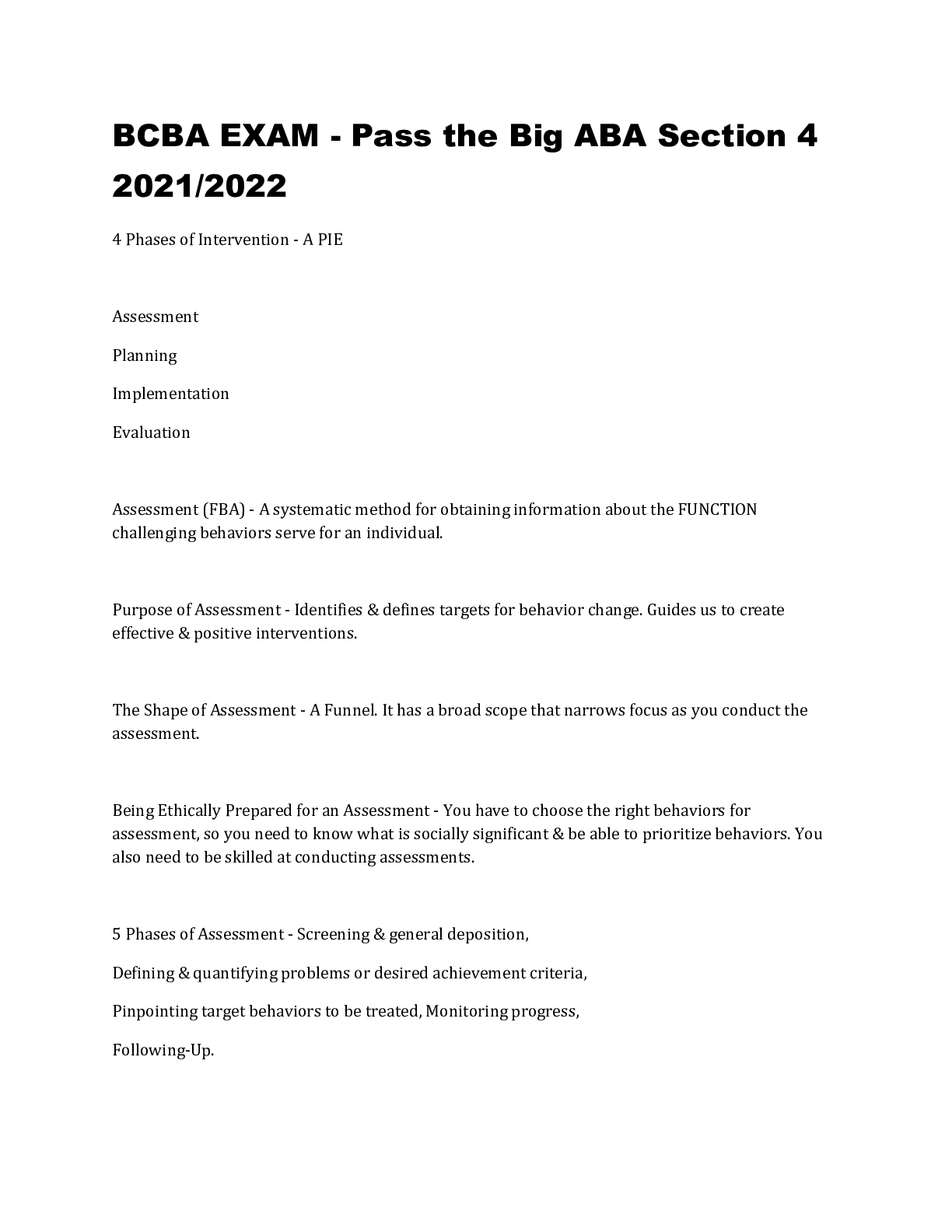
AWOHNN Module 3 Exam Questions and Answers 100% Scored
Document Content and Description Below
The developmental task of the first trimester of pregnancy is - ANSWERS: movement from conflict and ambivalence to acceptance.
During pregnancy, maternal hepatic glucose and pancreatic insulin production increase to m
...
[Show More]
Last updated: 2 years ago
Preview 1 out of 3 pages
Instant download
Buy this Document to get the Full Access Instantly
Provided by Students Who Aced it
We Verify Document Content to Gurantee Accuracy
Reviews( 0 )
Document information
Connected school, study & course
About the document
Uploaded On
Dec 07, 2023
Number of pages
3
Written in
All

Additional information
This document has been written for:
Uploaded
Dec 07, 2023
Downloads
0
Views
123
Topic Tags
Recommended For You
Get more on EXAM »


$15.5
28 Pages
ATI NR 507 MIDTERM COMPLETE TEST EXAM 2026 ALL STUDY QUESTIONS...
$6
4 Pages
NUR 321 VCE #5 Fluid and Electrolyte Balance QUESTIONS AND ANS...

$15
278 Pages
TEST BANK for Saunders Comprehensive Review for the NCLEX-RN®...

$15
347 Pages
TEST BANK For COMMUNITY AND PUBLIC HEALTH NURSING 10TH EDITION...

$15
1061 Pages
Test Bank for Fundamentals of Nursing 12th Edition (Elsevier,...


More related documents below
 Questions and Answers Complete Exam Solution.png)
.png)
 QUESTIONS AND ANSWERS WITH COMPLETE SOLUTION GRADED A.png)
 A GRADED.png)
.png)