Telemetry (EXAM 1) 31 Questions with Verified Answers
What do the SA & AV nodes contract? - CORRECT ANSWER SA-->AV=atrial contraction
AV-->bundle of HIS-->purkinje fibers=ventricular contraction
Normal intervals -
...
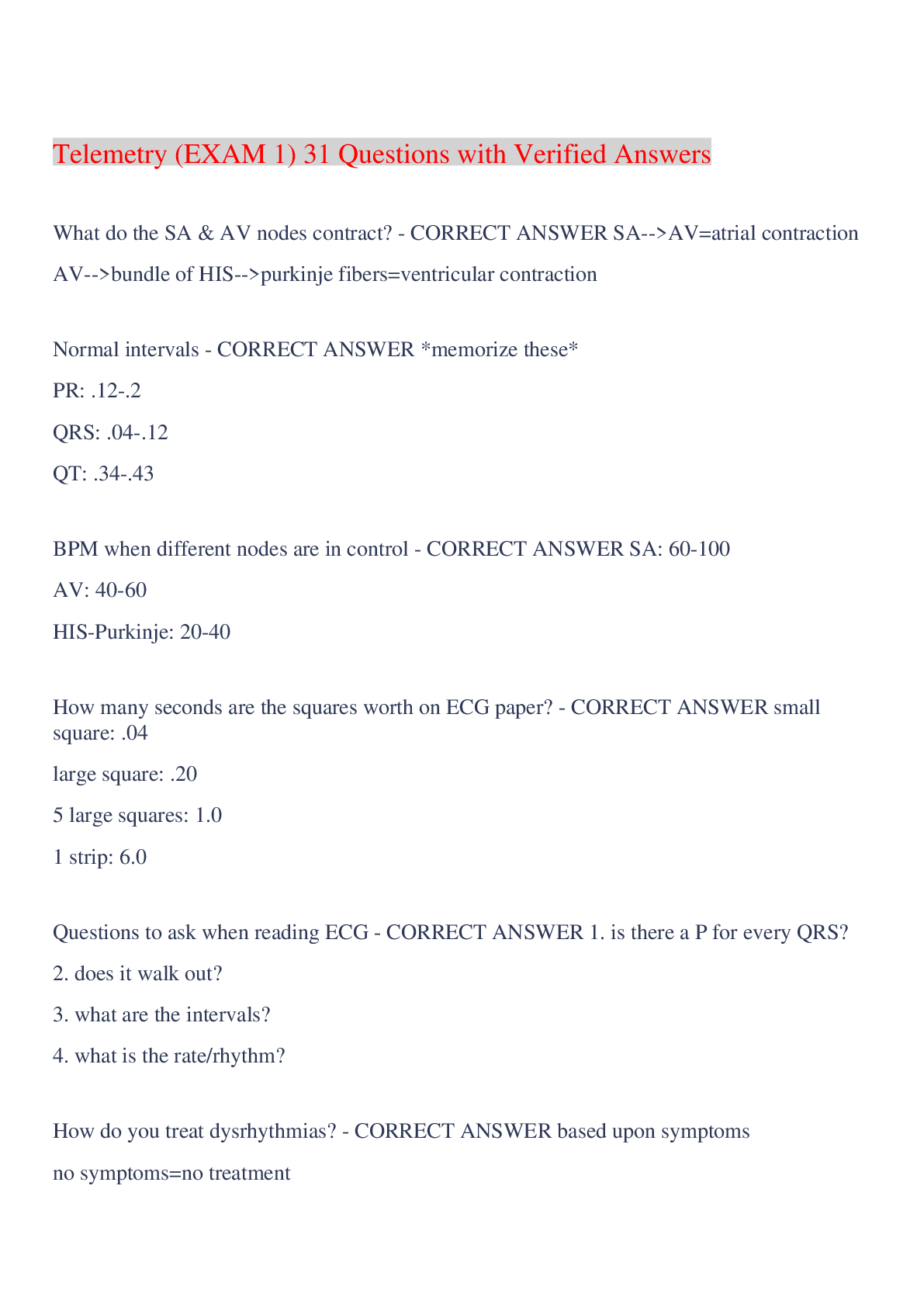
Telemetry (EXAM 1) 31 Questions with Verified Answers
What do the SA & AV nodes contract? - CORRECT ANSWER SA-->AV=atrial contraction
AV-->bundle of HIS-->purkinje fibers=ventricular contraction
Normal intervals - CORRECT ANSWER *memorize these*
PR: .12-.2
QRS: .04-.12
QT: .34-.43
BPM when different nodes are in control - CORRECT ANSWER SA: 60-100
AV: 40-60
HIS-Purkinje: 20-40
How many seconds are the squares worth on ECG paper? - CORRECT ANSWER small square: .04
large square: .20
5 large squares: 1.0
1 strip: 6.0
Questions to ask when reading ECG - CORRECT ANSWER 1. is there a P for every QRS?
2. does it walk out?
3. what are the intervals?
4. what is the rate/rhythm?
How do you treat dysrhythmias? - CORRECT ANSWER based upon symptoms
no symptoms=no treatment
Sinus Bradycardia - CORRECT ANSWER <60bpm
-walks out
-SA node in control
-causes: hypoxia, hypothermia, sleep, athletes, meds
-symptoms: syncope, chest pain, hypotension, SOB, diaphoresis
-treatment: atropine, underlying cause
Sinus Tachycardia - CORRECT ANSWER >100bpm
-walks out
-SA node in control
-causes: fever, anemia, hypotension, pulmonary embolism, MI
-symptoms: dizzy, syncope, SOB, diaphoresis, anxiety, palps
-treatment: underlying cause, vagal maneuvers, meds
Atrial fibrillation (AFIB) - CORRECT ANSWER -no identifiable P wave
-AV node in control
-does not walk out
-causes: cardiomyopathy, pericarditis, HTN, CAD, cardiac surgery
-symptoms: palps, fatigue, SOB, dizziness, chest pain
-treatment: meds, cardioversion (eval for clots 1st), anticoagulants
Atrial flutter - CORRECT ANSWER -Sawtooth pattern
-AV node in control
-one random cell firing
-does not walk out
-causes: acute MI, chest surgery, mitral valve disease, digoxin toxicity
-symptoms: palps, SOB, dizziness, chest pain/discomfort
-treatment: meds, cardioversion, anticoagulants
Supraventricular tachycardia (SVT) - CORRECT ANSWER -AV node in control
-one cell firing rapidly
-QRS can be narrow or wide
-can look similar to sinus tach
-causes: infection/fever, hypovolemia, hypoxia, ischemia, drug toxicity
-symptoms: dizziness, syncope, SOB, diaphoresis, palps
-treatment: adenosine, underlying cause
Junctional rhythm - CORRECT ANSWER -AV node in control
(40-60bpm)
-inverted/no P wave
-walks out
-causes:
MI, HF, meds
-treatment: underlying cause, atropine, external pacemaker
-symptoms: dizziness, syncope, SOB, diaphoresis, anxiety
Accelerated junctional - CORRECT ANSWER -AV node in control
-no P wave
-faster than 60bpm
-walks out
treatment: underlying cause, external pacemaker
Causes of heart blocks - CORRECT ANSWER angina, acute MI, meds
Second degree type 1 heart block - CORRECT ANSWER PR interval gets longer & longer until a QRS gets dropped
"Longer, longer, longer, drop, then you have a Wenckebach"
First degree heart block - CORRECT ANSWER -PR interval greater than .20
-QRS & QT are normal
-rate is slow or normal
-usually no symptoms
Second degree type 2 heart block - CORRECT ANSWER -PR is prolonged but remains the same until QRS is dropped
-"same, same, drop"
Third degree heart block - CORRECT ANSWER -medical emergency
-P & QRS have no correlation
-walks out
20-30bpm
-only fix is pacemaker
-"if P's & Q's don't agree, then you have a third degree"
Bundle branch block - CORRECT ANSWER -delayed conduction in ventricle (rather than atria)
-wider QRS
Premature atrial contraction (PAC) - CORRECT ANSWER -SA fired prematurely
-looks like early beat
-often called normal sinus w/ PAC
-caffeine can be stimulant
-flutter in chest
Premature ventricular contraction (PVC) - CORRECT ANSWER -looks like random QRS without P
-unifocal or multifocal
-electrolyte imbalance & caffeine can be stimulant
Bigeminy - CORRECT ANSWER a pattern of PVC's occurring every second beat
Trigeminy - CORRECT ANSWER a pattern of PVC's occurring every third beat
What does an atrial pacemaker do? - CORRECT ANSWER -works as the SA node
-looks like a spike before a P wave
What does a ventricular pacemaker do? - CORRECT ANSWER -works as the AV node
-looks like a line before QRS
-P wave can be present
What does an antrioventricular pacemaker do? - CORRECT ANSWER -works as the SA & AV nodes
-looks like a line before both P and QRS
Ventricular tachycardia (V-tach) - CORRECT ANSWER -SA or AV not in control
-1 ectopic cell firing in ventricle
-looks like constant PVC's
-3 or more PVC's
-with pulse: amiodarone
-without pulse: CPR, defibrillation, epi/vasopressin
Ventricular fibrillation (V-fib) - CORRECT ANSWER -SA & AV not in control
multiple ectopic cells firing in ventricle
-coarse vs fine
-CPR, defibrillation within 2-3mins, epi/vasopressin/amiodarone
Torsades - CORRECT ANSWER -V-tach but with "twists" along baseline
-can lead to V-fib
-does not look uniform
-must give Mg
Asystole - CORRECT ANSWER -heart is doing nothing
-CPR, epi
Pulseless Electrical Activity (PEA) - CORRECT ANSWER -heart is not pumping
-leftover electricity looks like a beat but there's not
[Show More]