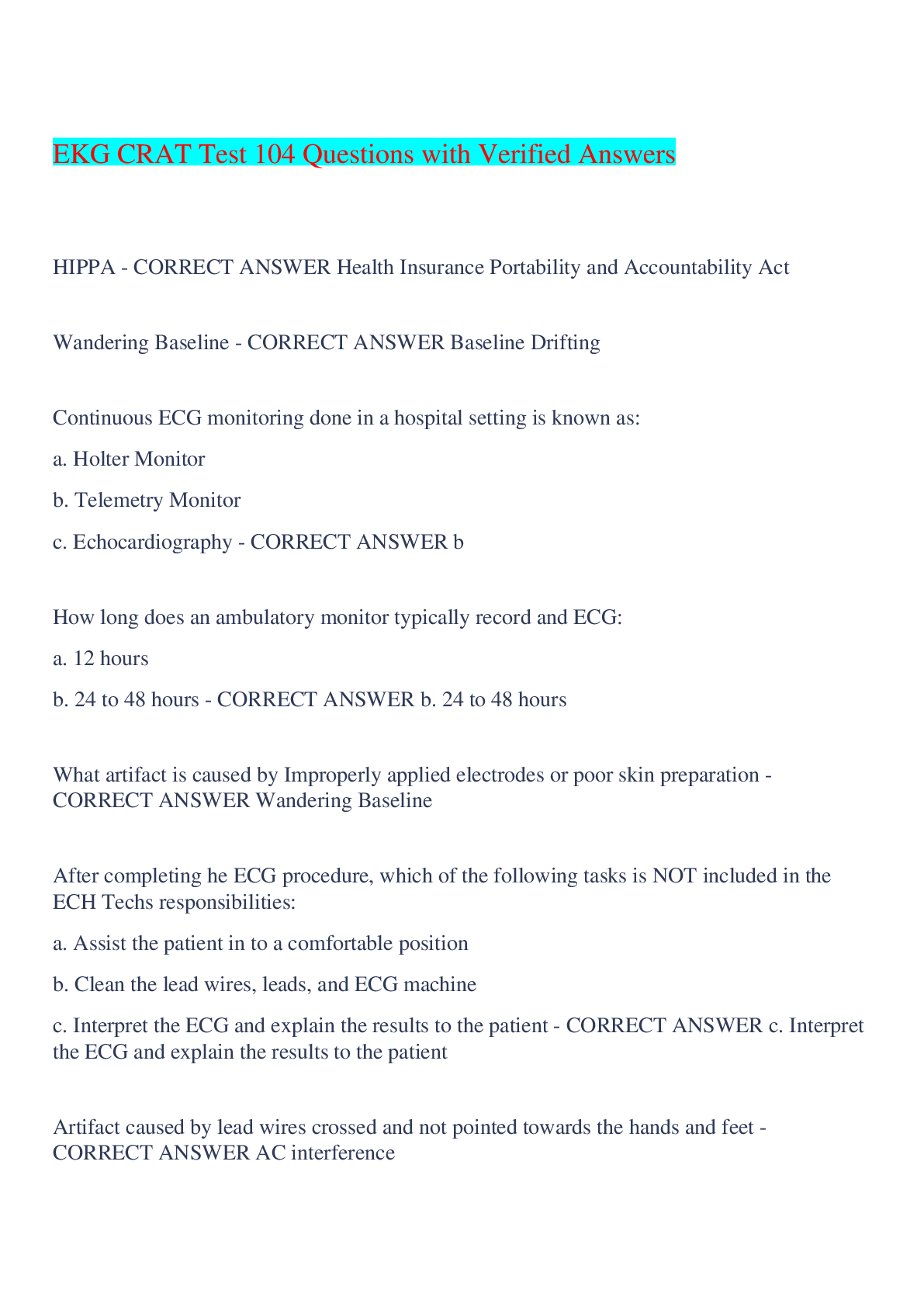
EKG CRAT Test 104 Questions with Verified Answers
HIPPA - CORRECT ANSWER Health Insurance Portability and Accountability Act
Wandering Baseline - CORRECT ANSWER Baseline Drifting
Continuous ECG monitoring done
...
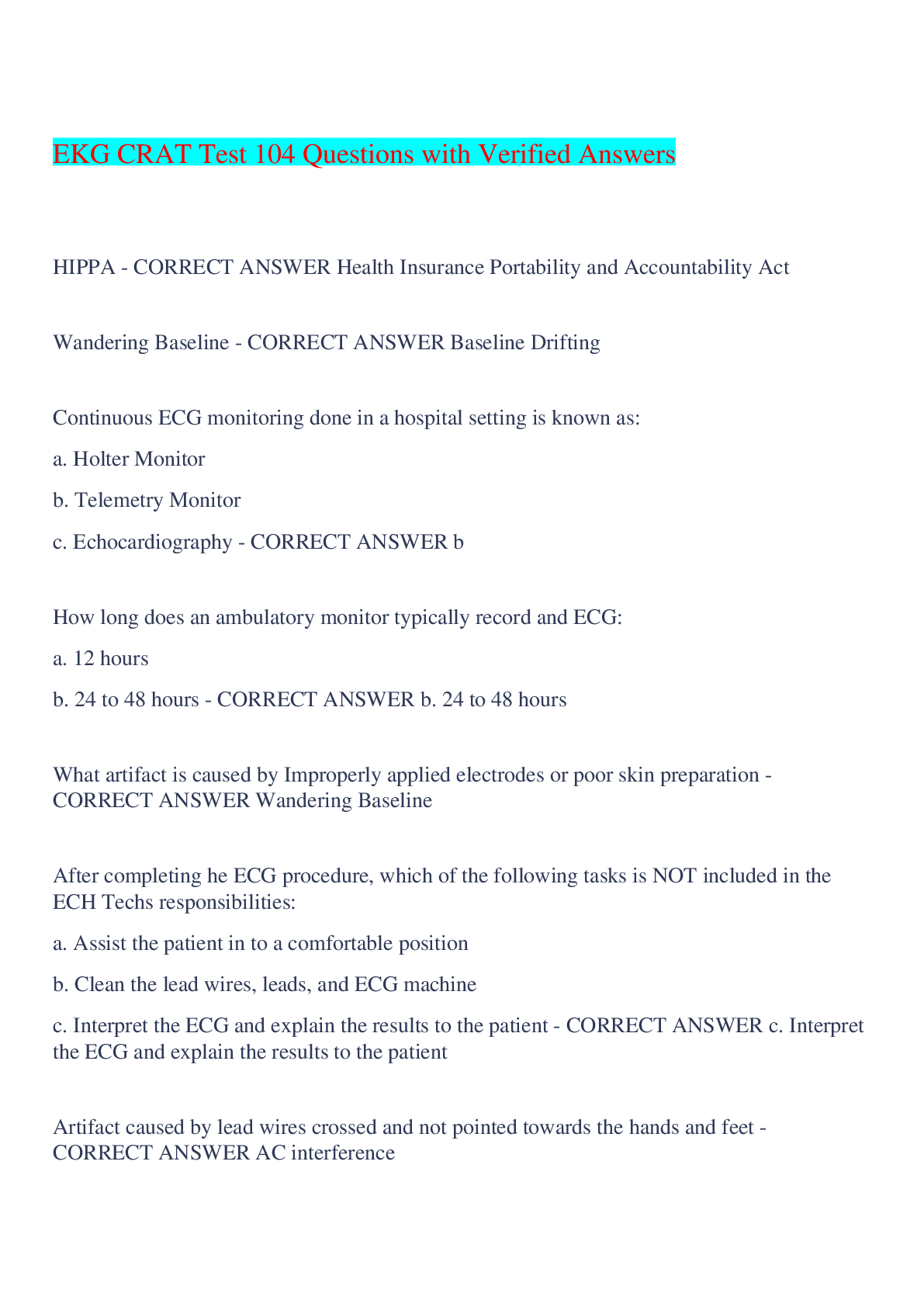
EKG CRAT Test 104 Questions with Verified Answers
HIPPA - CORRECT ANSWER Health Insurance Portability and Accountability Act
Wandering Baseline - CORRECT ANSWER Baseline Drifting
Continuous ECG monitoring done in a hospital setting is known as:
a. Holter Monitor
b. Telemetry Monitor
c. Echocardiography - CORRECT ANSWER b
How long does an ambulatory monitor typically record and ECG:
a. 12 hours
b. 24 to 48 hours - CORRECT ANSWER b. 24 to 48 hours
What artifact is caused by Improperly applied electrodes or poor skin preparation - CORRECT ANSWER Wandering Baseline
After completing he ECG procedure, which of the following tasks is NOT included in the ECH Techs responsibilities:
a. Assist the patient in to a comfortable position
b. Clean the lead wires, leads, and ECG machine
c. Interpret the ECG and explain the results to the patient - CORRECT ANSWER c. Interpret the ECG and explain the results to the patient
Artifact caused by lead wires crossed and not pointed towards the hands and feet - CORRECT ANSWER AC interference
Which device recognizes an abnormal rhythm and can deliver and electric shock to the heart if necessary
a. ECG
b. CAD
C. AED - CORRECT ANSWER C. AED
Patients with permanent pacemakers may require monitoring for 30 days or more. What type of ambulatory monitoring is most commonly used in these patients?
a. telemetry monitoring
b. 24 ambulatory monitoring
c. transtelephonic monitoring - CORRECT ANSWER c. transtelephonic monitoring
Artifact caused by involuntary movement / patient talking during procedure - CORRECT ANSWER Somatic tremor
What type of ambulatory monitoring is performed in a hospital? - CORRECT ANSWER Telemetry monitoring
Ambulating
a. performing daily activities
b. breathing
c. walking - CORRECT ANSWER c. walking
NOT a basic function of the electrocardiograph
a. input
b. analysis
c. signal processing - CORRECT ANSWER b. analysis
signal processing, which occurs in side the ECG machine,
a. amplifies the electrical impulse
b. directs impulses to the ECG instrument
c. notifies the operator of input errors - CORRECT ANSWER a. amplifies the electrical impulse
HOw many leads are attached to a patients chest with ambulatory monitoring?
a. 2 leads
b. 3-5 leads
c. 10 leads - CORRECT ANSWER b. 3-5 leads
Post-symptom event monitors are used primarily to document what type of dysrhythmias ?
a. occasional PVCs
b. Heart murmurs
c. Sv tachycardias, atrial fibrillation, and atrial flutter - CORRECT ANSWER c. Sv tachycardias, atrial fibrillation, and atrial flutter
Angina - CORRECT ANSWER Pain in the heart region caused by lack of oxygen
Ischemia - CORRECT ANSWER Lack of oxygen to the muscle tissue
QT interval time frame - CORRECT ANSWER .36 - .44 secs
Gain - CORRECT ANSWER Changes the height of ECG training
Separates the left ventricle - CORRECT ANSWER Interventricular septum
Conducts the impulse for the left side of the interventricular septum - CORRECT ANSWER Left bundle branch
Normal conduction pathway between the atria and ventricles - CORRECT ANSWER Bundle of HIS
Tip or point of the heart - CORRECT ANSWER Apex
Helps relay impulse to the left atria - CORRECT ANSWER Bachman
Connection between the SA node and the AV noce - CORRECT ANSWER Internodal paths
The gain control is normally set at:
a. 20mm/mv
b. 25mm/mv
c. 10mm/mv - CORRECT ANSWER c. 10mm/mv
Which of the following is not a basic function of the electrocardiograph?
a. analysis
b. signal processing
c. output display - CORRECT ANSWER a. analysis
the most common setting for standard speed rate on the ECG machine is:
a. 10mm/sec
b. 25mm/sec
c. 50 mm/sec - CORRECT ANSWER b. 25mm/sec
Often difficult to read the ECG tracing if a patients rate is fast. Where should you set the speed control to be able to interpret the ECG tracing more easily?
a. 25mm/sec
b.100mm/sec
c.50mm/sec - CORRECT ANSWER c. 50mm/sec
the usual setting for the artifact filter is:
a. 10 to 20hz
b. 100 to 250 hz
c. 40 to 150 hz - CORRECT ANSWER c. 40 to 150hz
how many boxes per minutes with 25mm/sec paper speed
a. 450 boxes per min
b. 300 boxes per min
c. 150 boxes per min - CORRECT ANSWER b. 300 boxes per min
What does retrograde mean:
a. horizontal
b. backward
c. flattended - CORRECT ANSWER b. Backward
You have performed an ECG on a patient at the walk-in clinic. The ECG tracing shows that the patient is in 3D. What is your FIRST responsibility to this patient?
a. mount and identify the rhythm strips for documentation
b. initiate emergency procedures if needed
c. observe the patient for symptoms of low cardiac output - CORRECT ANSWER c. observe the patient for symptoms of low cardiac output
Which of the following actions occurs during systole?
a. the tricuspid and mitral valves open
b. the pulmonary and aortic valves open
c. the heart muscle relaxes - CORRECT ANSWER b. the pulmonary and aortic valves open
the average volume of blood pumped each minute sin a normal heart is:
a. 3 liters
b. 1 liter
c. 5 liters - CORRECT ANSWER c. 5 liters
Blood that leaves the right ventricle is considered
a. visceral
b. systemic
c. deoxygenated - CORRECT ANSWER c. deoxygenated
Largest vein - CORRECT ANSWER Vena Cave
P wave represents:
a. atrial relaxation
b. ventricular contraction
c. atrial contraction - CORRECT ANSWER c. atrial contraction
What pacemaker complication occurs when the pacemaker does not sense the patients inherent cardiac electrical activity?
a. malfunctioning
b. oversensing
c. malsensing - CORRECT ANSWER c. malsensing
which of the following statements about the bundle branch block is true?
a. bundle branch block overrides the patients underlying heart rhythm
b. bundle branch block is a life threatening condition
c. any sinus, atrial, or junctional rhythm can be affected by bundle branch block - CORRECT ANSWER c. any sinus, atrial, or junctional rhythm can be affected by bundle branch block
Which of the following terms describe what happens when a pacemaker fails to detect any cardiac electrical activity and fires?
a. oversensing
b. triggering
c. undersensing - CORRECT ANSWER
When malsesning occurs, a pacemaker may send impulses to the heart during the relaxation phase. What condition may the patient experience if malsensing occurs in aventricular pacemaker?
a. Idioventricular rhythm
b. premature junctional complexes
c. Ventricular fibrillation - CORRECT ANSWER c. ventricular fibrillation
A bundle branch blocks has which of the following characteristics:
a. delayed conduction through the ventricles due to a blockage which causes a widened QRS complex
b. it causes narrowed QRS complexes to appear on the ECG
c. it causes a prolonged PR interval - CORRECT ANSWER a. delayed conduction through the ventricles due to a blockage which causes a widened QRS complex
The patient on which you are about to perform an ECG tells you that she sometimes feels a thumping in her chest. Which of the following might you expect to see on the ECG training?
a. idioventricular rhythm
b. ventricular fibrillation
c. PVCs - CORRECT ANSWER c. PVCs
Which factor is least important regarding crash carts?
a. the crash cart must be nearby and ready to go
b. the crash cart must be well stocked with emergency supplies
c. a list of currently stocked emergency medications must be present on the cart - CORRECT ANSWER c. a list of currently stocked emergency medications must be present on the cart
in whcih ventricular dysrhythmia are the ventricles in a continous contraction-relaxation pattern with no period of delay between depolarizations?
a. ventricular tachycardia
b. ventricular fibrillation
c. accelerated idioventricular rhythm - CORRECT ANSWER a. ventricular tachycardia
What heart block is known as classical heart block?
a. Third-Degree AV Block
b. Second-Degree AV Block, Mobitz type II
c. Second-Degree AV Block, Mobitz type I - CORRECT ANSWER b. Second-Degree AV Block, Mobitz type II
What is the typical heart rate with accelerated idioventricular rhythm?
a. less than 20bpm
b. 20 to 40bpm
c. 100 to 150bpm
d. 40 to 100bpm - CORRECT ANSWER d. 40 to 100 bpm
After you report a second degree AV block, mobitz type II, to a licensed practitioner Second-Degree AV Block, Mobitz type I, what should you do?
a. an ambulatory monitor and an echocardiogram
b. an angiogram and laboratory tests
c. continue to monitor the patient until a licensed practitioner arrives - CORRECT ANSWER c. continue to monitor the patient until a licensed practitioner arrives
What is the term for a fast, irregular heartbeat sensation felt by a patient?
a. palpitation
b. palpation
c. paresthesia - CORRECT ANSWER a. Palpitation
What is the origin point of an SVT?
a. Left ventricle
b. atria or junctional region
c. purkinjee fibers - CORRECT ANSWER b. atria or junctional region
What type of heart rate is characteristic of a patient who has junctional escape rhythm?
a. normal
b. faster than normal
c. slower than normal - CORRECT ANSWER c. slower than normal
What is the ventricular heart rate range for accelerated junctionka rhythm?
a. 60 to 100 bpm
b. 40 to 60 bpm
c. 20 to 40 bpm - CORRECT ANSWER a. 60 to 100bpm
if ectopic impulses are occurring in the heart at a rate that us faster than the SA node
a. the SA node impulses control the atria and the ectopic impulses control the ventricles
b. the rate at which the SA node fires controls the ectopic rate
c. the ectopic impulses override the SA nose and causes the atria and ventricles to depolarize - CORRECT ANSWER c. the ectopic impulses override the SA nose and causes the atria and ventricles to depolarize
Which rhythm is often a transient dysrhythmia that will lead to a more serious atrial dysthymia if not treated?
a. Wandering atrial pacemaker (WAP)
b. Multifocal atrial tachycardia (MAT)
c. Atrial flutter - CORRECT ANSWER c. Atrial flutter
What caused the different P waves morphologies in an ECG tracing that shows wandering atrial pacemaker?
a. the rate at which the ectopic impulses are generated
b. the varying sites of the ectopic impulses
c. the variable strength of the atrial contraction caused by each impulse - CORRECT ANSWER c. the variable strength of the atrial contraction caused by each impulse
Which portion of the ECG tracing is primarily affected by atrial dysthymias?
a. T waves
b. ST Segment
c. P Waves - CORRECT ANSWER C. P Waves
Some patients can tolerate the loss of atrial kick if the heart remains between
a. 60 to 100bpm
b. 100 to 150 bpm
c. 150 to 250 bpm - CORRECT ANSWER a 60 to 100 bpm
What occurs immediately prior to ventricular systole when blood is ejected from the atria into the ventricles?
a. contractility
b. atrial kick
c. automaticty - CORRECT ANSWER b. atrial kick
Pacemiker spikes without P waves or QRS complexes are seen.
a. Oversensing
b. Loss of capture
c. Failure to pace - CORRECT ANSWER b. Loss of capture
Which valves prevent the back flow of blood from the aorta and pulmonary arteries into the ventricles during diastole?
a. semilunar
b. sinoatrial
c. eustachian - CORRECT ANSWER a. semilunar
Another name for second degree AV block type 1 is
a. thorell
b. einthoven
c. wenckenbach - CORRECT ANSWER c. wenckenbach
A characteristic of a third degree av block is
a. an aberrant pathway in the left atrium
b. an aberrant neuro pathway in the right atrium
c. the conduction of the atrial impulses failing to reach the ventricle - CORRECT ANSWER c. the conduction of the atrial impulses failing to reach the ventricle
in standard calibration ECG Graph paper, a deflection of the tracing upward or downward by one large ox (outlined by thick, dark lines) from the baseline represents
a. 0.25 millivolt
b. 0.5 milivolt
c. millivolt
d. volt - CORRECT ANSWER b. 0.5 millivolt
Which of the following rhythms be characterized by regular P-P and R-R intervals occuring at different rates?
a. wenckebach
b. atrial fibrillation
c. complete heart block - CORRECT ANSWER c. complete heart block
The relationship between the conducted P waves and the QRS complexes in a sinus arrhythmia is
a. not discernable
b. one p wave per qrs complex
c. displaying varying conduction patterns - CORRECT ANSWER b. one p wave per qrs complex
a patient with a transtelephonic monitor suddenly begins his words and complaining that he has tingling in his left arm. What is the most appropriate action?
a. Activate EMS
b. Drive to the hospital
c. call the referring doctor - CORRECT ANSWER a. Activate EMS
The normal gain setting for ECG acquisition is ____ mm/mV
a. 5
b. 10
c. 15 - CORRECT ANSWER b. 10
a regular rythm with a rate of 158 bpm and with a narrow qrs complex is best described as
a. ventricular tacycardia
b. supraventricular tachycardia
c. Paroxysmal atrial tachycardia - CORRECT ANSWER b. supraventricular tachycardia
A regular rhythm with a narrow qrs complex with no noted p waves and rate between 40 - 60 bpm is known as
a. junctional escape rhythm
b. accerlated junctional rhythm
c. premature ventricular contractions - CORRECT ANSWER a. junctional escape rhythm
During sinus rhythm, an early narrow complex beat without a p wave preceding it would be interpreted as a
a. first degree AV block
b. premature atrial contraction
c. premature junctional contraction
d. premature ventricular contraction - CORRECT ANSWER c. premature junctional contraction
where is the most appropirate location to place a '"patch cardiac monitor"
a. right upper chest
b. left side mid axilla
c. center of chest mid sternum
d. left side under the diaphragm - CORRECT ANSWER c. center of chest mid sternum
If a dual chamber pacemaker's ventricular lead senses a non-cardiac signal, what is most likely to occur?
a. atrial under sensing
b. failure to ventricular pace
c. failure to capture ventricle - CORRECT ANSWER b. failure to ventricular pace
A PVC that occurs during the relative period is referred to as
a. bigeminy
b. a couplet
c. bundle branch block
d. R-on-T Phenomenon - CORRECT ANSWER d. R-on-T Phenomenon
atrial fibrillation with a slow ventriular response has a(n)
a. atrial rate less than 60bpm
b. ventricular rate less than 60 bpm
c. junctional rate greater than 60bpm - CORRECT ANSWER b. ventricular rate less than 60 bpm
What occurs when a ventricular pacemaker senses electrical current from a source other than the heart?
a. oversensing
b. failure to capture
c. pacemaker turns off
d. increasing pacing rate - CORRECT ANSWER a. oversensing
Sinus Rhythm rate - CORRECT ANSWER 60-100
Sinus Bradycardia Rate - CORRECT ANSWER less than 60 bpm
Sinus Tachycardia rate - CORRECT ANSWER >100 bpm
ATV - CORRECT ANSWER > 1 p wave per qrs; p map; 100-200
A beat that occurs earlier than expected and disrupts the normal rhythms regularity The beat originates ina n irritable, ectopic pacemaker site. - CORRECT ANSWER Premature beat
A beat that originates some place other than the SA node. An abnormal hear beat - CORRECT ANSWER Ectopy
Sudden, witnessed onset/offset of arrhythmia - CORRECT ANSWER Paroxysmal
abnormal conduction - CORRECT ANSWER Aberrant
An ectopic/irritable site in the atrium fire before the next SA node impulse is due causing an early beat - CORRECT ANSWER PAC
True / False
The morphology of the QRS complex of the PAC is like that of the underlying rythm - CORRECT ANSWER True
True / False
The P Wave morphology will appear the same as Sinus P Wave. - CORRECT ANSWER False: The P wave morphology will appear different from the Sinus P Wave
Atrial Run is a run of
a. 2-5 PACs
b. 3-5 PACs
c. >5 PACs - CORRECT ANSWER b. 3-5 PACs
Atrial Bigeminy - CORRECT ANSWER PAC every other beat
Occurs when an ectopic site in the atria initiates a very early electrical impulse and that impulse fails to reach the ventricles
a. NCPAC
b. Trigeminy PAC
c. PAT - CORRECT ANSWER a. NCPAC
Originating above the ventricles
a. PVT
b. SVT
c. WAP - CORRECT ANSWER b. SVT
SVT rate: - CORRECT ANSWER 150-250BPM
True / False
P Wave in SVT is retrograde - CORRECT ANSWER False: P wave in SVT is hidden
True/False:
At higher rates, sustained SVT will require a notification to the doctor - CORRECT ANSWER True
True/False
PSVT is sudden, rapid, and regular and 6 or more PACs - CORRECT ANSWER True
Occurs when an ectopic site in the atria takes over as the pacemaker and rapidly fires, causing the atria to beat too quickly. Survival tool for the heart to maintain cardiac output. BPM? - CORRECT ANSWER ATV 101-200
Atrial rhythms - CORRECT ANSWER Atrial Flutter, Atrial Fibrillation, AVT, SVT
True / False
AF can have ABR - CORRECT ANSWER True
If electrical impulse occurs high u in the AV junction the atria depolarize first, The P wave will appear? - CORRECT ANSWER The P wave will appear before the QRS and wil be inverted
Junctional Rhythm:
1) Rate
2) Reg/irr
3) Nomenclature - CORRECT ANSWER 1) 40-59.9
2) Regular
3) JR
Accelerated Junctional Rhythm
1) Rate
2) Reg/irr
3) Nomenclature - CORRECT ANSWER 1) 60-99.9
2) Regular
3) AJR
Junctional Tachycardia
1) Rate
2) Reg/irr
3) Nomenclature - CORRECT ANSWER 1)100-149.9
2) Reg
3) JT
True/False
Junctional Rhythm QRS is narrow - CORRECT ANSWER True
[Show More]