CPSI Exam 195 Questions with Verified Answers
Without alternate means of egress, max. difference in height between stepped platforms for Pre-School age and School-Age - CORRECT ANSWER Pre-School: 12 inches
School-Age
...
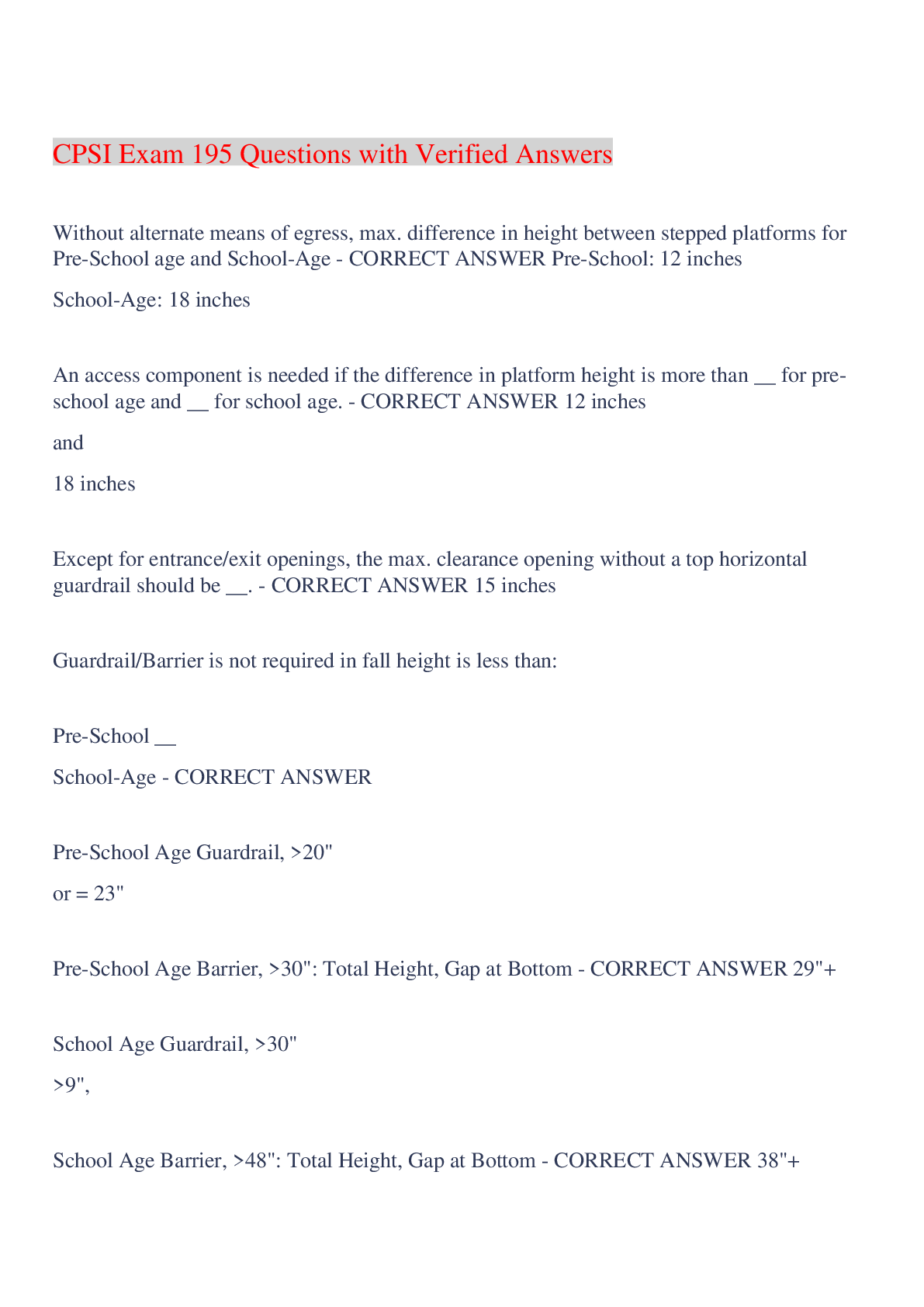
CPSI Exam 195 Questions with Verified Answers
Without alternate means of egress, max. difference in height between stepped platforms for Pre-School age and School-Age - CORRECT ANSWER Pre-School: 12 inches
School-Age: 18 inches
An access component is needed if the difference in platform height is more than __ for pre-school age and __ for school age. - CORRECT ANSWER 12 inches
and
18 inches
Except for entrance/exit openings, the max. clearance opening without a top horizontal guardrail should be __. - CORRECT ANSWER 15 inches
Guardrail/Barrier is not required in fall height is less than:
Pre-School __
School-Age - CORRECT ANSWER <20 inches
<30 inches
Pre-School Age Guardrail, >20" < or = 30": Total Height, Gap at Bottom - CORRECT ANSWER 29"+
<9", > or = 23"
Pre-School Age Barrier, >30": Total Height, Gap at Bottom - CORRECT ANSWER 29"+
<3.5"
School Age Guardrail, >30" < or = 48": Total Height, Gap at Bottom - CORRECT ANSWER 38"+
>9", < or = 28"
School Age Barrier, >48": Total Height, Gap at Bottom - CORRECT ANSWER 38"+
<3.5"
Access platforms over __ should provide intermediate standing surface so child can pause and make decision to keep going up or go down. - CORRECT ANSWER 6'
Handrails- Preschool/Schoolage: should have a diameter or max. cross-section between __ and __. Preferred diameter is __. - CORRECT ANSWER .95" and 1.55"
1.25 inches
Continuous handrails extending over the full length of the access should be provided on both sides of all _____ and _____. - CORRECT ANSWER stairways and stepladders
Handrail Height: The vertical distance between the top front edge of a step or ramp surface and the top surface of the handrail above should be (Preschool, Schoolage) - CORRECT ANSWER P: between 22 and 26"
S: between 22 and 38"
Transition Point - CORRECT ANSWER Point where child must transition from access component to play structure platform
(T/F) Handrails or handholds are recommended at all transition points. - CORRECT ANSWER True
Balance Beams should be no more than __ (P/S) - CORRECT ANSWER P: 12 inches
S: 16 inches
Use Zone- Climbers: Should extend a min. of __ in all directions. (MAY/MAY NOT) overlap with neighboring equipment, if allowed by that equipment type
AND
-there is at least __ between equipment when adjacent designated play surfaces are no more than __ .
OR
There is at least __ between equipment when adjacent play surfaces are more than __. - CORRECT ANSWER 6'
MAY
6'
<30 inches
9'
>30 inches
Climbers should not have climbing bars or other rigid structural components in the interior of the climber onto which a child may fall from a height of __. - CORRECT ANSWER >18 inches
(T/F) Arch climbers should be used as the sole means of access to other equipment for preschoolers. - CORRECT ANSWER False
(T/F) Free Standing climbers are not recommended for toddlers or preschool age children. - CORRECT ANSWER True
Climbers: Rung Width, Vertical Rise, Slope, Diameter (Preschool/Schoolage) - CORRECT ANSWER Preschool:
RW: > or = 12"
VR: > or = 12"
Slope: 75-90 degrees
Dia: .95"-1.55"
School-Age:
Preschool:
RW: > or = 16"
VR: > or = 12"
Slope: 75-90 degrees
Dia: .95"-1.55"
(T/F) Free-standing flexible climbers are not recommended on playgrounds intended for toddlers and preschoolers. - CORRECT ANSWER True
Free-standing flexible climbers: The perimeter of any opening in a net structure should be less than __ or greater than __. - CORRECT ANSWER 17 inches
28 inches
Horizontal Ladders: The horizontal distance out to the first handhold should be:
-No greater than __ but not __ the platform, when access is from a platform.
-At least __ but no greater than __ when access is from climbing rungs. - CORRECT ANSWER 10 inches
directly above
8 inches
10 inches
Horizontal ladders intended for preschool age children should have rungs that are __ and __. - CORRECT ANSWER parallel
evenly spaced
The max. height of a horizontal ladders (measured from center of grasping device to top of protective surfacing) should be __ (Preschool/School-age - CORRECT ANSWER P (4 and 5 yrs old): 60 inches max.
SA: 84 inches max.
Horizontal Ladders: The center-to-center spacing of horizontal ladder rungs should be __ (Preschool/School-age) - CORRECT ANSWER P (4 and 5 yrs old): 12 inches max.
SA: 15 inches max.
Horizontal Ladders: The max. height of the take-off/landing platform above the protective surface should be __ (Preschool/School-Age) - CORRECT ANSWER P (4 and 5 yrs old): 18 inches max.
SA: 36 inches max.
Overhead Rings: The horizontal distance out to the first handhold should be:
-No great than __ but not __ the platform when access is from a platform.
-At least __ but no greater than __ when access is from climbing rungs. - CORRECT ANSWER 10 inches
directly above
8 inches
10 inches
Overhead Rings: The max. height of overhead rings measured from the center of the grasping device to the protective surfacing should be __ (Preschool/School-age) - CORRECT ANSWER P: 60 inches
SA: 84 inches
If overhead singing rings are suspended by chains, the max. length of the chains should be __. - CORRECT ANSWER 7 inches
Overhead Rings: The max. height of the take-off/landing platform above the protective surfacing should be __ (Preschool/School-age). - CORRECT ANSWER P: 18 inches max.
SA: 36 inches max.
(T/F) Sliding poles are not recommended for toddlers/preschool since they generally do not have the upper body/hand strength to slide. - CORRECT ANSWER True
Sliding Poles should be __ with not __ or __ along the sliding surface. - CORRECT ANSWER Continuous
Protruding welds or seams
(T/F) Sliding Poles should not change direction alone the sliding portion. - CORRECT ANSWER True
The horizontal distance between a sliding pole and any structure used for access to the sliding pole should be between __ and __. - CORRECT ANSWER 18 inches
20 inches
A Sliding Pole should extend at least __ above the level of the platform or structure used for access to the sliding pole. - CORRECT ANSWER 60 inches
The diameter of a Sliding Pole should be no greater than __. - CORRECT ANSWER 1.9 inches
(T/F) Sliding Poles: Upper access should be from one level only. - CORRECT ANSWER True
The upper access area through the guardrail or barrier should be __ at most. - CORRECT ANSWER 15 inches.
For sliding poles accessed from platforms, the fall height is the distance between the __ and the __. - CORRECT ANSWER platform
protective surfacing
For sliding poles not accessed from platforms, the fall height is the distance between a point __ the highest point of the pole and the protective surfacing. - CORRECT ANSWER 60 inches
(T/F) The top of the sliding pole's support structure should not be a designated play surface. - CORRECT ANSWER True
(T/F) Track Rides should not be used on playground for toddlers/preschool. - CORRECT ANSWER True
Two Track Rides next to each other should be at least __ . - CORRECT ANSWER 4 feet apart
Track Rides: The handle should be between __ and __ from the surfacing and follow standard gripping recommendations. - CORRECT ANSWER 64 inches
78 inches
(T/F) Track Rides: Rolling parts do not need to be enclosed. - CORRECT ANSWER False
Enclose to prevent crush hazards.
Track Rides: The fall height is the distance between __ and the protective surfacing. - CORRECT ANSWER max. height of the equipment
(T/F) Track Rides, Fall Height: Equipment support posts with no designated play surfaces are exempt from fall height rule. - CORRECT ANSWER True
The highest point of a log roll should be a max. of __ above the protective surface below. - CORRECT ANSWER 18 inches
Use Zone- Log Rolls: When not part of a composite structure should extend a min. of __ in all directions. (MAY/MAY NOT) overlap with neighboring equipment, if allowed by that equipment type
AND
-there is at least __ between equipment when adjacent designated play surfaces are no more than __ .
OR
There is at least __ between equipment when adjacent play surfaces are more than __. - CORRECT ANSWER 6'
MAY
6'
< 30 inches
9'
>30 inches
The fall height of a lot roll is the distance between the __ and the protective surfacing. - CORRECT ANSWER highest portion of the rolling log
Merry-Go-Round recommendations apply when it is a least __. - CORRECT ANSWER 20 inches in diameter.
The standing/sitting surface of a Merry-Go-Round platform should have a max height of __ (preschool/school-age) - CORRECT ANSWER P: 14 inches max.
SA: 18 inches max.
The surface of a Merry-Go-Round platform should not have any openings between the axis and the periphery that permit a rod having a diameter of __ to penetrate completely through surface. - CORRECT ANSWER 5/16 inch
The difference between a min. and max. radius of a non-circular Merry-Go-Round platform should not exceed __. - CORRECT ANSWER 2 inches
The underside of the perimeter of a Merry-Go-Round platform should be no less than __ above protective surfacing. - CORRECT ANSWER 9 inches
(T/F) No components of a Merry-Go-Round apparatus, including __, should extend beyond perimeter or platform. - CORRECT ANSWER True
handgrips
Merry-Go-Round: A means should be provided to limit the peripheral speed of rotation to a max. of __. - CORRECT ANSWER 13 feet per second
(T/F) Merry-Go-Round's may have up and down ocillatory motion. - CORRECT ANSWER false
Merry-Go-Round Use Zone: __ beyond perimeter of platform. - CORRECT ANSWER 6 feet
Merry-Go-Round Use Zone MAY/MAYNOT overlap with other use-zones, unless the rotating equipment is less than __ and the adjacent equipment allows overlap. - CORRECT ANSWER MAY NOT
20 inches
Seesaws ARE/ARE NOT recommended for preschool - CORRECT ANSWER ARE NOT
Seesaws: The fulcrum should not present a __. - CORRECT ANSWER Crush Hazard
Seesaws: The max. attainable angle between a line connecting the seats and the horizontal is __. - CORRECT ANSWER 25 degrees
Seesaws: There SHOULD/SHOULD NOT be any footrests. - CORRECT ANSWER SHOULD NOT
Pre-school age children are capable of using __ seesaws. - CORRECT ANSWER Spring Centered Seesaws
Seesaws, Use Zone: Should extend __ from each outside edge of seesaw. - CORRECT ANSWER 6 feet
Use Zone- Seesaws: Should extend a min. of __ in all directions. (MAY/MAY NOT) overlap with neighboring equipment, if allowed by that equipment type
AND
-there is at least __ between equipment when adjacent designated play surfaces are no more than __ .
OR
There is at least __ between equipment when adjacent play surfaces are more than __. - CORRECT ANSWER 6'
MAY
6'
< 30 inches
9'
>30 inches
Seesaw, Handholds: Should be provided at each sitting position for gripping with __ and should not __. Handholds should not __. - CORRECT ANSWER Both Hands
Turn when grasped
Extend beyond the sides of the seat
The fall height of a Seesaw is the distance between the __ and the protective surfacing. - CORRECT ANSWER highest point any part of the seesaw can reach
F1487
Range of Users __ to __ - CORRECT ANSWER Standard Consumer Safety Performance Specification for Playground Equipment for Public Use.
5th percentile 2 year old to 95th percentile 12 year old
F2373 - CORRECT ANSWER Standard Consumer Safety Performance Specification for Public Use Play Equipment for Children 6 Months through 23 Months.
F1292 - CORRECT ANSWER Standard Specification for Impact Attenuation of Surface Systems Under and Around Playground Equipment.
F2075 - CORRECT ANSWER Standard Specification for Engineered Wood Fiber for Use as a Playground Safety Surface Under and Around Playground Equipment.
F2223 - CORRECT ANSWER F2223 Standard Guide for ASTM Standards on Playground Surfacing.
F2479 - CORRECT ANSWER F2479 Standard Guide for Specification, Purchase, Installation and Maintenance of Poured-In-Place Playground Surfacing.
F1951 - CORRECT ANSWER Standard Specification for Determination of Accessibility of Surface Systems Under and Around Playground Equipment.
F1816 - CORRECT ANSWER F1816 Standard Safety Specification for Drawstrings on Children's Upper Outerwear.
Designated Play Surface - CORRECT ANSWER Any elevated surface for standing, walking, crawling, sitting or climbing, OR a flat surface greater than 2 inches wide by 2 inches long having an angle less than 30 degrees from the ground.
Playground Layout: Key Factors - CORRECT ANSWER Accessibility
Age Separation
Conflicting Activities
Sight Lines
Signage/labeling
Supervision
Moving equipment, such as swings or merry-go-rounds, should be located __. - CORRECT ANSWER Toward a corner, side or edge of play area
maintain use-zone.
The diameter of a projection should not __ in the direction __ from the surrounding surface toward the exposed end. - CORRECT ANSWER increase
away
Bolts should not be exposed more than __ beyond the end of the nut. - CORRECT ANSWER 2 threads
An S-hook is considered closed if there is no gap or space greater than __. About the thickness of a __. - CORRECT ANSWER .04 inches
dime
Certain openings could present an entrapment hazard if the distance between any interior opposing surfaces is greater than __ and less than __. - CORRECT ANSWER 3.5 inches
9 inches
Angles formed by two accessible adjacent parts should be greater than __ unless the lowest led is horizontal or below horizontal. - CORRECT ANSWER 55 degress
Suspended components can become hazards when they are __ of horizontal and are less than __ above protective surfacing. - CORRECT ANSWER 45 degrees
7 feet
Suspended components should not be able to loop back on themselves or other ropes, cables, or chains to create a circle with a __ perimeter. - CORRECT ANSWER 5 inch or greater
Suspended components should be fastened at both ends unless they are __ or __. - CORRECT ANSWER 7 inches or less longs
attached to a swing seat.
Suspended component hazard recommendations do not apply if the suspended component is more than __above protective surfacing and is a min. of __ at its widest cross section. - CORRECT ANSWER 7'
1 inch
6 Types of Playground Hazards - CORRECT ANSWER 1. Crush and Shearing Points
2. Entanglement and Impalement
3. Entrapment
4. Sharp Points, Corners and Edges
5. Suspended Hazards
6. Tripping Hazards
Slide platform should be at least __ deep. - CORRECT ANSWER 14 inches
Embankment slide : Slide chute should have a max. height of __ above the underlying ground surface. - CORRECT ANSWER 12 inches
Roller Slides: The space between adjacent rollers and between the end of the rollers and the stationary structure should be __. - CORRECT ANSWER less than 3/16 inch
Flat open chutes should have sides at least __ extending along both sides of the chute for the entire length of the inclined sliding surface. - CORRECT ANSWER 4 inches
Slides may have an open chute with a circular, semicircu- lar or curved cross section provided that:
The vertical height of the sides is no less than __ when measured at right angles to a horizontal line
that is __ when the slide is intended for preschool/school-age.
OR
For any age group, the vertical height of the sides is no less than - CORRECT ANSWER 4 inches
P: 12 inches
SA: 16 inches
4 inches minus two times the width of the slide chute divided by the radius of the slide chute curvature
H=4-[(2x slide chute width)/slide chute radius]
For preschool/school-age:
The average incline of a slide chute should be no more than __ (that is the height to horizontal length ratio does not exceed __). - CORRECT ANSWER 30 degrees
0.577
For preschool/school-age:
No section of the slide chute shall have a slope greater than __. - CORRECT ANSWER 50 degrees
Tube Slides: The min. diameter of the tube should be no less than __. - CORRECT ANSWER 23 inches
Slide chute exit region should be between __ and __ as measured from a plane parallel to the ground. - CORRECT ANSWER 0 degrees
-4 degrees
Slide Chute Exit, Toddlers: Should be between __ and __ long if any portion of the chute exceeds a __ slope. - CORRECT ANSWER 7 and 10 inches
24 degree
Slide Chute Exit, Toddlers: Should be no more than __ above protective surfacing. - CORRECT ANSWER 6 inches
Slide Chute Exit, Toddlers: Should have a transition from the sliding portion to the exit region with a radius of curvature of at least __. - CORRECT ANSWER 18 inches
Slide Chute Exit, Preschool/School Age: Should be at least __ long. - CORRECT ANSWER 11 inches
Slide Chute Exit, Preschool/School Age: Should be no more than __ above the protective surfacing if slide is no greater than __. - CORRECT ANSWER 11 inches
< 4 feet
Slide Chute Exit, Preschool/School Age: Should be at least __ but no more than __ above protective surfacing if slide is over __. - CORRECT ANSWER 7 inches
15 inches
> 4 feet
Slide Use-Zone, Preschool/School-Age: Use zone in front of the access and to the side of a slide should extend a min. of __ from the perimeter of the equipment. This recommendation does not apply to __ and __ slides. - CORRECT ANSWER 6 feet
embankment
composite structure
Slide Use-Zone, Preschool/School-Age: The use zone MAY/MAY NOT overlap with use zone of other equipment; two or more slide use-zones may overlap if their sliding paths are __. - CORRECT ANSWER MAY NOT
parallel
Slide Use-Zone, Preschool/School-Age: For slides less than or equal to __, use zone in front of the exist should be at least __. - CORRECT ANSWER < or = 6 feet
Slide Use-Zone, Preschool/School-Age: For slides greater than __, use zone in front of the exist should be at least __. - CORRECT ANSWER > 6 feet
8 feet
Slide, Entanglements: Projections up to __ in diameter should not stick up more than __ from the slide. - CORRECT ANSWER 3 inches
1/8th inch
Slide, Entanglements: There should be no __ where the slide chute connects with the platform that can entangle clothing or strings. - CORRECT ANSWER gaps at the tops of slides
Spring Rockers, Preschool: Seat height should be between __ and __. - CORRECT ANSWER 14 and 28 inches
Spring Rockers: Each seating position should be equipped with __ and __. - CORRECT ANSWER handgrips
footrests
Swings: Distance from chain to structure when measured at 60 inches above surfacing. - CORRECT ANSWER 30 inches
Swings: Distance between chains of adjacent swings when measured 60 inches above surfacing - CORRECT ANSWER 24 inches
Swings: Distance from seat surface to protective surface (Toddlers (full bucket), Preschool, Schoolage) - CORRECT ANSWER T: 24 inches
P: 12 inches
SA: 12 inches
Swings: Distance between chains suspending single swing - CORRECT ANSWER 20 inches
Full Bucket Seat pivot points should be at least __ but no more than __ above protective surfacing. - CORRECT ANSWER 47 inches
96 inches (8 feet)
Multi-Axis Swing: The minimum clearance between the seating surface and the uprights of the support structure should be __ when the tire is in a position closest to the supports. - CORRECT ANSWER 30 inches
Multi-Axis Swing: The minimum clearance between the bottom of the seat and the protective surfacing should be not less than __. - CORRECT ANSWER 12 inches
Multi-Axis Swing: Use should extend a distance of __ plus the __ in any direction - CORRECT ANSWER 6 feet
length of suspended members (pivot point to top of seat surface)
No protrusions, including bolts or other parts, on the front back or underside of a swing should stick out more than __. - CORRECT ANSWER 1/8 inch
Major causes of death and seriously debilitating injury:
1-4 - CORRECT ANSWER 1. Entanglement
2. Falls
3. Head/Neck Entrapment
4. Impact
Hazard Priority is based on these 3 factors - CORRECT ANSWER Possibility
Probability
Consequence
There must be no overhead obstructions within __ above designated playing surface - CORRECT ANSWER 84 inches
Torso Probe: Dimensions are based on __. - CORRECT ANSWER 5th percentile 2 year old
Head Probe: Dimensions are based on __ - CORRECT ANSWER 95th percentile 5 year old
Head/Torso probe must be inserted at least __. - CORRECT ANSWER 4 inches
Partially Bounded Opening Template, "B" is considered fully inserted if it goes below the top of the opening more than __. - CORRECT ANSWER 3/4 inch
Partially Bounded Opening Entrapment Exception:
Where contact with side of the opening is less than __ inches above protective surfacing
OR
Lower leg of opening is __ or pointed __. - CORRECT ANSWER 24 inches
horizontal or downward
Smallest projection gauge is based upon __. - CORRECT ANSWER Thickness of a child's skull at temple region
Middle projection gauge protects child from __. - CORRECT ANSWER Projection entering brain through eye-socket
Largest projection gauge prevents __. - CORRECT ANSWER Soft tissue damage such as bruised or ruptured organs in abdominal area.
Test procedure for Completely Bounded Nonrigid Openings: apply a force of __ to the probe to attempt to pass it through opening. - CORRECT ANSWER 50 lb/ft (222N)
If the unbounded part of a partially bounded opening is between __ and __ in width when measured perpendicular to each surface, the opening can be considered accessible and must meet specified conditions. - CORRECT ANSWER 1.875 inches
9.0 inches
Suspended members, such as rings on upper body equipment, shall have a min. radius of __ on corners and edges. - CORRECT ANSWER .25 inches
Ramps that are a component of a play structure and intended to provide wheelchair access shall have a horizontal run between landings not to exceed __. - CORRECT ANSWER < 144 in.
Landings with play components shall include space for a wheelchair user to park and play with an adjacent circulation path not less than __ wide. - CORRECT ANSWER 36"
The depth of the outer edge of the tread on spiral stairways shall be __ or greater (Preschool/Schoolage). - CORRECT ANSWER p: 7"+
SA: 8"+
Platforms, landings, walkways, ramps and similar transitional play surfaces that are elevated above protective surfacing and that are accessible to wheelchairs shall provide a clear width of not less than __. Clear width may be reduced to __ for not more than __ along the path of travel. - CORRECT ANSWER 36"
32"
24"
Turning spaces and parking spaces provided at a transfer point on wheelchair accessible platforms MAY/MAYNOT overlap. - CORRECT ANSWER MAYNOT
Wheelchair accessible ramps less than or equal to __ above the protective surface for preschool or __ for school-age, shall have two handrails on each side of the ramp that are __ to __ and __ to __ high. - CORRECT ANSWER < or = 30"
< or = 48"
26" to 28"
12" to 16"
Wheelchair accessible ramps must have a curb projecting above the ramp a min. of __ at both edges when any of the following conditions are present:
-Guardrails of barriers not extending to within __ of ramp surface
-Ramps with __ and no barrier
-Ramps where the barrier is __ of the ramp surface. - CORRECT ANSWER 2"
1"
two rails
beyond the edge
On stairways, all steps greater than __ above protective surfacing shall require protective barriers. - CORRECT ANSWER 48"
Wheelchair-accessbile ramps that require barriers shall have a handrail __ to __ high on each side of the ramp. - CORRECT ANSWER 26" to 28"
Upper body equipment intended for users in wheelchairs shall have grasping devices no greater than __ above accessible surface. - CORRECT ANSWER 54"
The radius curvature of the sliding surface in the exit region shall be __ or greater. - CORRECT ANSWER 30"
Suspended elements shall to impart a peak acceleration in excess of __ and shall have a HIC score not to exceed __ when tested in accordance with impact attenuation requirements. - CORRECT ANSWER 100g
500 HIC
How many multiple occupancy suspended elements can be mounted within a single swing bay. - CORRECT ANSWER only one
Seesaws/Spring Rockers: Handgrips intended to be gripped by one hand shall have a min. length of __. Handgrips for two hand shall have a min. length of __. - CORRECT ANSWER 3"
6"
Seesaws shall be constructed so the maximum attainable seat height is __. - CORRECT ANSWER 60 inches
Spring Rockers: Footrests shall have a min. width of __. - CORRECT ANSWER 3.5 inches
Track Rides: The lowest portion of the hand gripping component shall be a min. of __ and max. of __ above protective surfacing. - CORRECT ANSWER 64 inches min.
78 inches max.
Track Rides: When elevated surfaces are used they shall include a landing space with a min. length of __ and min. width of __. - CORRECT ANSWER 36 inches
32 inches
Roof that are an integral part of a play structure may be at any angle, provided that the roof line (lowest edge), excluding support members, is at least __ above underlying designated play surface. - CORRECT ANSWER 84 inches
Stepping Forms: Shall contain a min. designated play surface of __ and shall have a surface slope no greater than __ from horizontal. - CORRECT ANSWER 10 inches
30 degrees
Stepping forms shall be no greater than __ above protective surface (Preschool/School Age).
Above than hand supports are required at heights between __ and __ above stepping surface. - CORRECT ANSWER P: 20 inches
SA: 30 inches
22" and 38"
These two stepping form shall be stationary __ and __. - CORRECT ANSWER Those intended for Preschool
and those above 30 inches
Distance between stepping forms (Preschool/School Age) - CORRECT ANSWER 12 inches
18 inches
The use zone for springing/rocking equipment on which the user in intended to stand shall be no less than __. Other allowed use zones MAY/MAYNOT overlap. - CORRECT ANSWER 84 inches
MAY NOT
Vertical Projection Gauge - CORRECT ANSWER 1/8" (.12)
Roller Slides: Size of Crush/Shear Test Probe - CORRECT ANSWER 3/16" (.19)
Merry-Go-Round: Size of crush/shear test probe - CORRECT ANSWER 5/16" (.30)
Openings with movement size of crush/shear test probe - CORRECT ANSWER 5/8" (.62)
Partially Bound Opening Probe- min. insertion depth - CORRECT ANSWER 3/4" (.75)
Torso Probe Thickness/Min. insertion depth - CORRECT ANSWER 3.5"
4"
Head Probe Diameter - CORRECT ANSWER 9"
Max. clear opening without top horizontal guardrail - CORRECT ANSWER 15"
Elevated Structures- max. height without guardrails - CORRECT ANSWER 20"
Guardrail 2-5: max. height of lower rail - CORRECT ANSWER 23"
Guardrail 5-12: max. height lower rail - CORRECT ANSWER 28"
Guardrail 2-5: max. height upper rail - CORRECT ANSWER 29"
Barriers 2-5: min. height upper rail - CORRECT ANSWER 29"
Elevated structures for 2-5: max. height without barriers - CORRECT ANSWER 30"
Elevated Structure 5-12: max. height without guardrails - CORRECT ANSWER 30"
Guardrail 5-12: min. height upper rail - CORRECT ANSWER 38"
Barriers 5-12: min. height upper rail - CORRECT ANSWER 38"
Elevated structures for 5-12: max. height without barriers - CORRECT ANSWER 48"
Check painted equipment installed before __ for lead paint. - CORRECT ANSWER 1978
A projection is not an entanglement unless 4 conditions are present: - CORRECT ANSWER 1. must fit within projection gauge
2. must be above horizontal plane
3. must have perpendicular sides
4. must extend > .12 (1/8") form initial surface
Slide Non-Entanglement Zone: Projections greater than __ are note allowed within the __ (measured from __) regardless of their __. - CORRECT ANSWER 1/8"
21"
inside chute wall
orientation
Exceptions to Crush Shear Criteria - CORRECT ANSWER 1. Chain and its method of attachment
2. attachment area of coil springs
3. Area between top rail and swinging element
4. area between lightweight moving parts
Height for Transfer platform - CORRECT ANSWER 11"-18"
Openings in platform and between edge and railing may not exceed __. - CORRECT ANSWER 1/2"
Reduced Gradient Exit (length/orientation) - CORRECT ANSWER 11 inches
0 to -4 degrees
Slide Clearance Zone is __ above bed way for entire bed way and __ through the exit use zone - CORRECT ANSWER 60"
continues
Signage must communicate: - CORRECT ANSWER 1. age appropriateness
2. supervision recommended
3. warning to remove helmets, drawstrings or accessories around the neck
4. warning message regarding hot surfaces/surfacing
All signs must meet ANSI/UL 969 criteria
ASTM 1292 Test Method: Gmax threshold and HIC benchmark - CORRECT ANSWER 200 Gmax
1000 HIC
critical height relates to __, fall height relates to __ - CORRECT ANSWER surfacing
equipment
Accessbile Route: Min. Clearance, min. width, max. slope - CORRECT ANSWER 80"
60"
1:16 (6.25%)
Only surfacing exemption - CORRECT ANSWER where a ramp or elevated walkway connects to the perimeter of the play area
Elements of a comprehensive risk management plan - CORRECT ANSWER 1. Playground Safety Policy (establish standard of care)
2. Leadership (safety coordinator)
3. Documentation
4. Safety Audit
5. Inspectors and Maintenance
When should an audit be performed - CORRECT ANSWER 1. Prior to opening new playground
re-audit
-after installation of new equipment
-after major repairs or medication to existing equipment
-when standards or guidelines change
-if state playground laws change
Factors effecting inspection frequency - CORRECT ANSWER -Use Factors (extent, age, vandalism, accidents)
-Equipment/Surfacing Factors (type, age, static v. moving)
-Environmental Factors (drainage/soil, location, climate)
[Show More]