Telemetry Test 88 Questions with Verified Answers
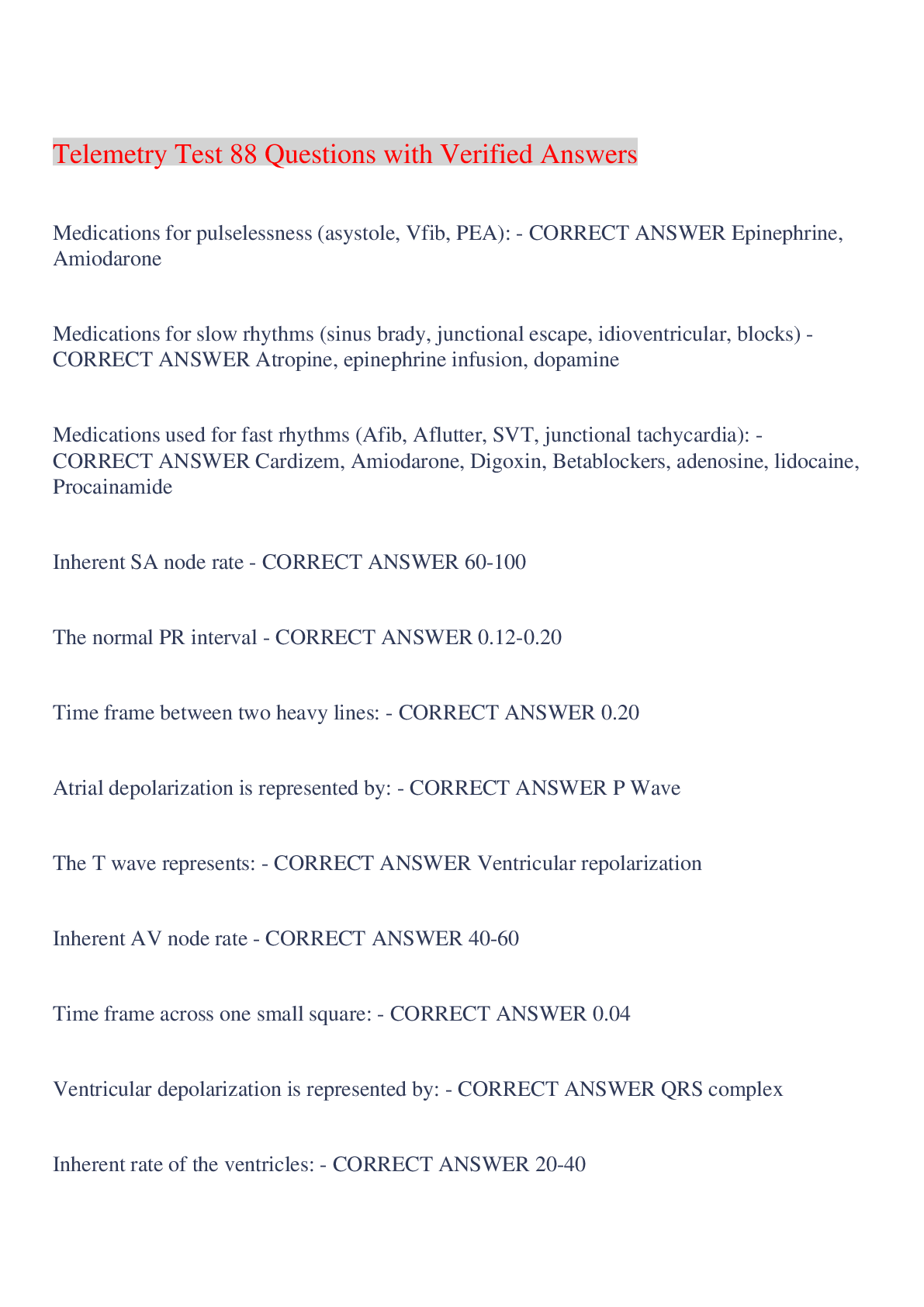
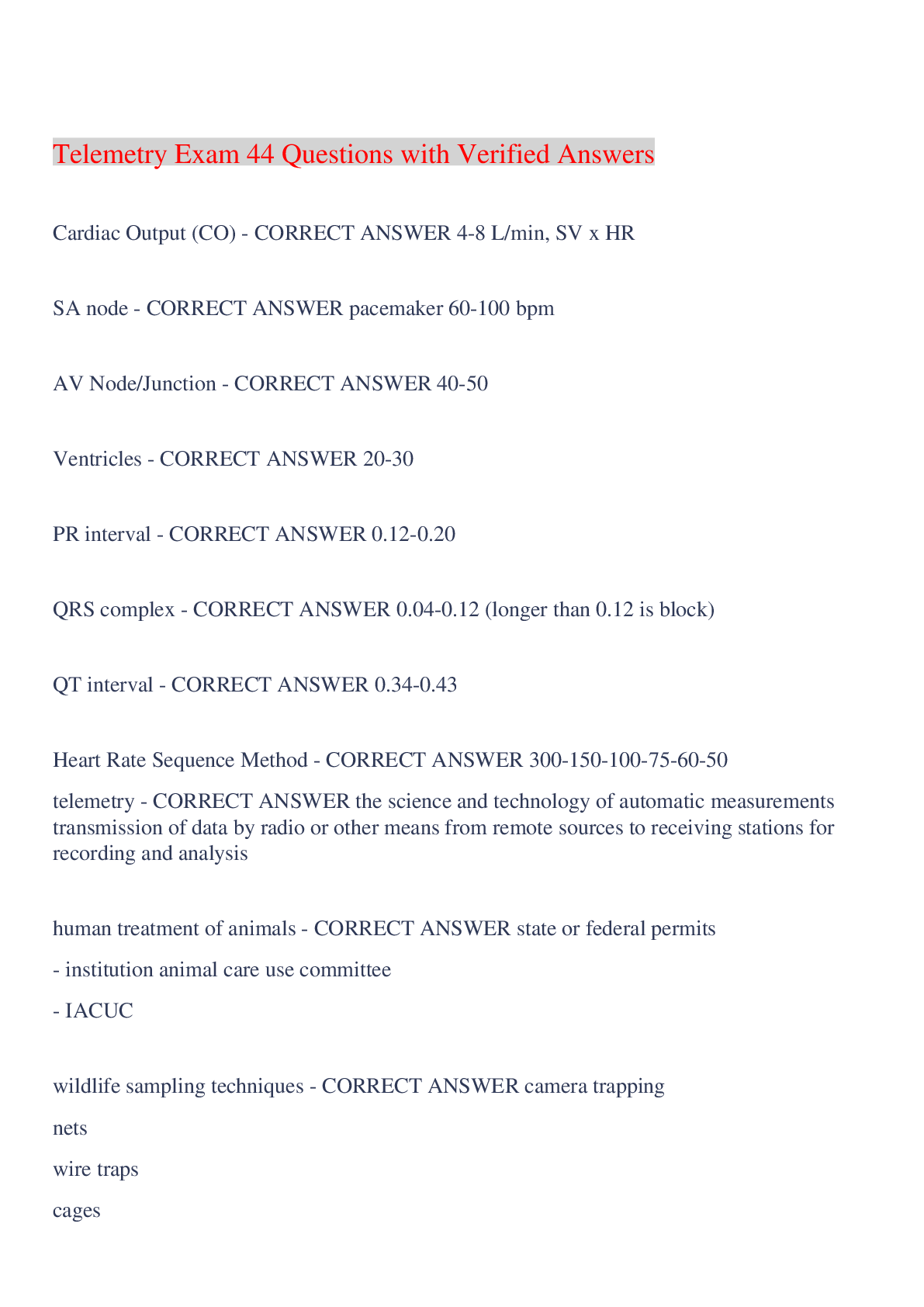
Medications for pulselessness (asystole, Vfib, PEA): - CORRECT ANSWER Epinephrine, Amiodarone
Medications for slow rhythms (sinus brady, junctional escape, idiovent
...
Telemetry Test 88 Questions with Verified Answers
Medications for pulselessness (asystole, Vfib, PEA): - CORRECT ANSWER Epinephrine, Amiodarone
Medications for slow rhythms (sinus brady, junctional escape, idioventricular, blocks) - CORRECT ANSWER Atropine, epinephrine infusion, dopamine
Medications used for fast rhythms (Afib, Aflutter, SVT, junctional tachycardia): - CORRECT ANSWER Cardizem, Amiodarone, Digoxin, Betablockers, adenosine, lidocaine, Procainamide
Inherent SA node rate - CORRECT ANSWER 60-100
The normal PR interval - CORRECT ANSWER 0.12-0.20
Time frame between two heavy lines: - CORRECT ANSWER 0.20
Atrial depolarization is represented by: - CORRECT ANSWER P Wave
The T wave represents: - CORRECT ANSWER Ventricular repolarization
Inherent AV node rate - CORRECT ANSWER 40-60
Time frame across one small square: - CORRECT ANSWER 0.04
Ventricular depolarization is represented by: - CORRECT ANSWER QRS complex
Inherent rate of the ventricles: - CORRECT ANSWER 20-40
The normal QRS complex duration is: - CORRECT ANSWER 0.10-0.12 or less than 0.12
The interval that measures all electrical activity above the ventricle is called: - CORRECT ANSWER PR interval
Electrical activity traveling to a positive pole will have P, QRS, and T waves that are: - CORRECT ANSWER upright
The wave representing atrial repolarization: - CORRECT ANSWER Hidden in the QRS complex
Cardiac output is determined by the rate of the: - CORRECT ANSWER Ventricles
The interval that measures all activity below the atria: - CORRECT ANSWER QT interval
A sinus rate rhythm with a rate that varies with respirations: - CORRECT ANSWER Sinus Dysrhythmia
A conditions where the PR interval is always greater than 0.20: - CORRECT ANSWER First degree AV block
An irregular rhythm with no visible P's where the atria are fibrillating: - CORRECT ANSWER Atrial fibrillation
A regular rhythm witha rate of 40-60 and either inverted or no visible P's, resulting from a falure of the SA node: - CORRECT ANSWER Junctional Escape
A single, early ectopic beat characterized by an upright but abnormal P wave: - CORRECT ANSWER Premature Atrial contractions
A typically slow, regualar rhythm where there are more P's than QRS's, and there is no relationship between P's or QRS's: - CORRECT ANSWER Third degree heart block
A type of heart block where the AV node delays each impulse slightly longer than the previous one until an impulse is blocked completely, causing "clusters" of beatings: - CORRECT ANSWER Wenckebach
A rhythm with no P waves but, instead, "saw-toothed" appearing waves originating from a single irritable focus in the atria. - CORRECT ANSWER Atrial flutter
An early, single ectopic originating in the ventricles, typically wide and bizarre with a QRS greater than 0.12: - CORRECT ANSWER Premature ventricular contraction
A regular rhythm with upright P waves, normal PR intervals and QRS duration, and a rate greater than 100: - CORRECT ANSWER Sinus tachycardia
A single, early ectopic characterized by the absence of or an inverted P wave: - CORRECT ANSWER Premature Junctional contraction
Anxiety, fatigue, chest pain, SOB, diaphoresis, cool, hypotension, syncope, cyanosis, clammy skin, decreased loc, exercise intolerance: - CORRECT ANSWER signs and symptoms of decreased cardiac output
Constant R-R interval is regular, 60-100 beats per minute, and PRI is 0.12-0.2: - CORRECT ANSWER normal sinus rhythm
Constant R-R interval, rhythm is regular, rate is less than 60, PRI is 0.12-0.2 - CORRECT ANSWER Sinus bradycardia
A single premature ectopic beat will interrupt the regularity of the underlying rhythm and the R-R interval, P wave is hidden, notched or flattened: - CORRECT ANSWER Premature atrial contraction (PAC)
Rate is 150-200, A-V rates equal, typically paroxysmal, sudden onset. P waves: one for every QRS, may be flattened or notched or hidden in the T waves, decreased ventricular filling time which means decreased cardiac output: - CORRECT ANSWER Atrial tachycardia
What is the first line of treatment for atrial tachycardia?A - CORRECT ANSWER beta blockers
Atrial rate is 250-350, saw-tooth appearance: - CORRECT ANSWER atrial flutter
What is the treatment for atrial flutter: - CORRECT ANSWER cardioversion, anticoagulation, ablation
Irregular irregularity pattern, atrial rate cannot be measured; may exceed 350 - CORRECT ANSWER atrial fibrillation
What is the treatment for atrial fibrillation? - CORRECT ANSWER cardioversion, TEE, beta blockers, calcium channel blockers, digoxin, antiarrhythmics
P-waves can be before, after, or hidden in the QRS, if visible the p waves will be inverted: - CORRECT ANSWER Premature junctional contraction
QRS will be wide and bizarre, measuring at least 0.12 seconds, will differ from the configuration of the underlying QRS complexes, the T wave is frequently opposite direction from the QRS complex, p wave is dissociated: - CORRECT ANSWER Premature ventricular contraction
P waves represent - CORRECT ANSWER atrial depolarization
QRS represents - CORRECT ANSWER ventricular depolarization
T wave represents - CORRECT ANSWER ventricular repolarization
List three functions of the AV node - CORRECT ANSWER 1) Slows conduction
2) Secondary pacemaker
3) Blocks some impulses when atrial rate is rapid
Explain wide/bizarre QRS morphology - CORRECT ANSWER Aberrant conduction resulting in wide complex
List properties of cardiac cells - CORRECT ANSWER 1) Automaticity
2) Excitability
3) Contractility
4) Conductivity
Asystole: definition, confirmation, interventions - CORRECT ANSWER Definition: cessation of electrical and mechanical activity of the heart
Confirmation: check for pulse on patient
Primary Interventions:
1) CPR
2) Treat reversible causes
3) Epinephrine
Depolatization - CORRECT ANSWER the electrical activation of the cells of the heart that initiates contraction of the heart muscle, more positive value
Repolarization - CORRECT ANSWER Return of the cell to resting state, negative value
Polarized - CORRECT ANSWER Resting state of heart muscle
Identify the path electrical impulses travel through the heart starting from the SA node - CORRECT ANSWER 1) SA node sends out the electrical impulse
2) Atria contract
3) AV node sends impulse to ventricles
4) Ventricles contract (pump)
5) SA node sends another signal to atria to contract - begins again
Intrinsic rate of sinus - CORRECT ANSWER 60-100 bpm
Intrinsic rate of junctional - CORRECT ANSWER 40-60 bpm
Intrinsic rate of Purkinge fiber (ventricular) - CORRECT ANSWER 20-40 bpm
How does AV dysfunction lead to 1st degree block? - CORRECT ANSWER Takes too long for heartbeat to travel from top to bottom of heart
How does AV dysfunction lead to 2nd degree type 1 block? - CORRECT ANSWER prolongation of PR interval until an atrial impulse is completely blocked
How does AV dysfunction lead to 2nd degree type 2 block? - CORRECT ANSWER infra-nodal conduction system problem, no progressive slowing
How does AV dysfunction lead to 3rd degree block? - CORRECT ANSWER electrical impulse no longer travels through AV node at all
Differentiate how electrical impulses travel during junctional rhythms compared to sinus rhythms - CORRECT ANSWER In a junctional rhythm, heartbeat originates from AV node or His bundle and sinus rhythm originates from SA node
Premature beat - CORRECT ANSWER Spontaneous electrical discharges of the ventricles
Escape beat - CORRECT ANSWER more broad; impulse can not travel quickly via normal electrical conduction system
Which arrhythmia poses the highest risk of thrombus formation? - CORRECT ANSWER Atrial fibrillation
Interventions for rhythms that are too slow and the patient is not tolerating will be treated with... - CORRECT ANSWER Atropine and pacemaker
2 types of capture - CORRECT ANSWER Atrial and ventricular
Pacemaker wave morphology - CORRECT ANSWER Pacer spikes followed by P wave or QRS wave
What kind of complications may occur with a pacemaker? - CORRECT ANSWER DVT, lead displacement, pacemaker dysfunction (failure to sense and failure to capture), infection
Know 5 lead placement - CORRECT ANSWER RA - 2nd intercostal R mid clavicular line, below clavicle
LA - 2nd intercostal L mid clavicular line, below clavicle
V - R of sternum at 4th intercostal space
RL - 6th & 7th intercostal on R mid clavicular line
LL - 6th & 7th intercostal on L mid clavicular line
Causes of sinus tachycardia - CORRECT ANSWER Fever, anemia, hypotension, PE, MI, exercise, anxiety, dehydration, pain, shock, stimulants, caffeine, alcohol
Causes of artifact - CORRECT ANSWER 1) Patient movement
2) Loose electrodes (R/T hairy chest or dried gel)
3) Muscle tremors, shivering
4) Electrical equipment in room
Components of cardiac output - CORRECT ANSWER Stroke volume and heart rate
Signs and symptoms of decreased cardiac output - CORRECT ANSWER Abnormal presence of S3 & S4, angina, anxiety, hypotension, tachycardia, bradycardia, fatigue, change in LOC, crackles
Why is cardiac output decreased in bradycardia? - CORRECT ANSWER Decreased filling time to decrease stroke volume - decreases CO
Why is cardiac output decreased in tachycardia? - CORRECT ANSWER Reduces stroke volume because of decreased ventricular filling time, decreased preload
What is the contributing concern in tachycardia beside beside the decrease cardiac output? - CORRECT ANSWER Heart failure
Three treatments for SVT - CORRECT ANSWER 1) Vagal stimulation or Valsalva manuever
2) Adenosine
3) Unstable - cardioversion
Which coronary artery supplies blood to a majority of the conduction system? - CORRECT ANSWER R coronary artery
EKG changes with cardiac ischemia - CORRECT ANSWER ST segment deviates, T wave inversion
EKG changes with cardiac infarction - CORRECT ANSWER large peaked T waves, ST elevation
What is the name of the sinus rhythm thats rate is affected by the respiratory cycle? - CORRECT ANSWER Sinus arrhythmia
What can make PVCs more concerning? - CORRECT ANSWER If they happen more frequently
Which arrhythmias is defibrillation the treatment of choice? - CORRECT ANSWER 1) Ventricular tachycardia
2) Ventricular fibrillation
What two types of cardiac function are affected by electrolytes? - CORRECT ANSWER Depolarization and repolarization?
1) Conduction
2) Development of arrhythmias
Best placement for defibrillator pads - CORRECT ANSWER Anterior - Above R nipple and L side of chest just below the chest area
Bigeminy - CORRECT ANSWER Every other beat is a PVC
Couplet - CORRECT ANSWER Two consecutive PVCs
Unifocal - CORRECT ANSWER Arising from a single site; identical
Multifocal - CORRECT ANSWER Arising from many locations, NOT identical
[Show More]