NFPA 10 Exam 99 Questions with Verified Answers
(SI) - CORRECT ANSWER International System of Units
1 in=. mm - CORRECT ANSWER 25.4
Approved - CORRECT ANSWER Acceptable to the authority having jurisdiction.
(
...
NFPA 10 Exam 99 Questions with Verified Answers
(SI) - CORRECT ANSWER International System of Units
1 in=. mm - CORRECT ANSWER 25.4
Approved - CORRECT ANSWER Acceptable to the authority having jurisdiction.
(AHJ) - CORRECT ANSWER Authority Having Jurisdiction
O rganization, office or individual responsible for enforcing requirements of a code or standard, or for approving equipment, materials, an installation or procedure.
Shall - CORRECT ANSWER Indicates a mandatory requirement.
Should - CORRECT ANSWER Indicates a recommendation or that which is advised but not required.
Dry Chemical - CORRECT ANSWER A powder composed of very small particles, usually sodium bicarbonate-,potassium bicarbonate-, or ammonium phosphate based with added particulate material supplemented by special treatment to provide resistance to packing, resistance to moisture absorption (caking), and the proper flow capabilities
Wet Chemical - CORRECT ANSWER Normally an aqueous solution of organic or inorganic salts or a combination thereof that forms an extinguishing agent
Clean agent - CORRECT ANSWER Electrically nonconducting, volatile, or gaseous fire extinguishant that does not leave a residue upon evaporation
Dry Chemical Closed Recovery System - CORRECT ANSWER A system that does not introduce foreign material into the agent being recovered and has a means of visually inspecting the recovered agent for contaminants
Halogenated Closed Recovery System - CORRECT ANSWER A system that provides for the transfer of halogenated agents between fire extinguishers, supply containers, and recharge/recovery containers so that none of the halogenated agent escapes to the atmosphere.
(ODP) - CORRECT ANSWER Ozone Depletion Potential
Closed recovery systems for halogenated agents with an ODP of ____________ or greater should be listed for use with that agent - CORRECT ANSWER .2
High pressure cylinders contain pressure greater than _______ PSI at _______*F - CORRECT ANSWER 500 PSI at 70*F
Low pressure cylinders containing a service pressure at or below _______ PSI at _______*F - CORRECT ANSWER 500 PSI at 70*F
Dry Powder - CORRECT ANSWER Solid materials in powder or granular form designed to extinguish Class D combustible metal fires by crusting, smothering, or heat-transferring means
Film-forming foam agents - CORRECT ANSWER Aqueous film-forming foam (AFFF) and film-forming fluoroprotein foam (FFFP).
HFC - CORRECT ANSWER Hydrofluorocarbon
HCFC - CORRECT ANSWER Hydrochlorofluorocarbon
Halocarbons - CORRECT ANSWER Include HCFC HFC PFC and FIC types of agents and other types of halocarbons that are found acceptable under the Environmental Protection Agency Significant New Alternatives policy program
FIC - CORRECT ANSWER Fluoroiodocarbon
PFC - CORRECT ANSWER perfluorocarbon
Halons - CORRECT ANSWER Include Halon 1211 and 1301 and mixtures of the two
Halon 1301 - CORRECT ANSWER Bromotrifluoromethane
Halon 1211 - CORRECT ANSWER Bromochlorodifluoromethane
Hydrostatic testing - CORRECT ANSWER Pressure testing of the extinguisher to verify its strength against unwanted rupture.
Loaded Stream Charge - CORRECT ANSWER A water based extinguishing medium that uses an alkali metal salt as a freezing point depressant.
Extinguisher service pressure - CORRECT ANSWER The normal operating pressure as indicated on the nameplate or cylinder of a fire extinguisher
Factory test pressure - CORRECT ANSWER The pressure shown on the nameplate at which a shell was tested at time of manufacture.
wetting agent - CORRECT ANSWER A concentrate which, when added to water reduces the surface tension and increases its ability to penetrate and spread
Water Mist Fire Extinguisher - CORRECT ANSWER A fire extinguisher containing "distilled or de-ionized" water and employing a nozzle that discharges the agent in a fine spray
Standard for carbon-dioxide fire extinguishers - CORRECT ANSWER ANSI/UI
154
CAN/ULC-S504
Standard for Dry Chemical fire extinguishers - CORRECT ANSWER ANSI/UL 209
CAN/ULC-S504
Standard for Water fire extinguishers - CORRECT ANSWER ANSI/UL 626
CAN/ULC-S507
Standard for Halogenated Agent Hand and Wheeled fire extinguishers - CORRECT ANSWER CAN/ULC-S512
Standard for Water Based (Film-Forming) fire extinguishers - CORRECT ANSWER ANSI/UL 8
CAN/ULC-S554
Standard for Halocarbon Clean Agent fire extinguishers - CORRECT ANSWER ANSI/Ul 2129
CAN/ULC-S566
Each fire extinguisher should be marked with - CORRECT ANSWER 1. Identification of listing and labeling organization
2. Product category indicating type of extinguisher
3. Extinguisher Classification
4. Performance and fire test standards that the extinguisher meets or exceeds
Fire extinguishers manufactured prior to ____________ shall not be required to comply with 4.1.2. - CORRECT ANSWER January 1 1986
MSDS - CORRECT ANSWER Material Safety Data Sheet
A fire extinguisher shall have a label, tag, or stencil attached to it and provide what information - CORRECT ANSWER 1. Contents product name as it appears on manufactures safety data sheet
2. Listing of hazardous material ID in accordance with HMIS
3. List of any hazardous materials that are in excess of 1.0% of the contents
4. List of each chemical in excess of 5.0% of contents
5. Information as to what is hazardous about the agent in accordance with the MSDS
6. Manufacturers or service agencies name mailing address and phone number
HMIS - CORRECT ANSWER Hazardous Material Identification System
Obsolete fire extinguishers (7) - CORRECT ANSWER 1. Soda Acid
2. Chemical Foam (excludes Film Forming)
3. Vaporizing liquid (Carbon tetrachloride)
4. Cartridge operated water
5. Cartridge operated loaded system
6. Copper or Brass Shell (exclude pump tanks) joined by soft solder or rivets
7. Carbon Dioxide extinguishers with metal horns
8. Pressurized water prior to 1971
9. Any stored pressure prior to 1955
Dry chemical stored pressure extinguishers manufactured prior to _______ shall be removed from service at 6 year maintnence or hydrotest - CORRECT ANSWER October 1984
Class A fires - CORRECT ANSWER Fires involving ordinary combustible materials such as wood,
cloth, rubber and plastics.
Class B fires - CORRECT ANSWER Fires involving flammable and combustible liquids, oils, greases, tars, oil-based paints, lacquers, and flammable gases.
Class C fires - CORRECT ANSWER Involve live electrical equipment
Class D Fires - CORRECT ANSWER Fires involving combustible metals such as magnesium, titanium, zirconium, sodium, and potassium.
Class K Fires - CORRECT ANSWER Fires in cooking appliances that involve combustible cooking
media (vegetable or animal oils and fats).
The classification of fire extinguishers shall consist of a letter that indicates what? - CORRECT ANSWER The class of fire on which a fire extinguisher has been found to be effective
Fire extinguishers classified for use on Class A or Class B are required to have a what? - CORRECT ANSWER Rating number preceding the classification letter that indicated the relative extinguishing effectiveness
What classes of extinguishers use numerical ratings? - CORRECT ANSWER A and B
What classes of extinguishers are not required to have numbers preceding the Classification letter? - CORRECT ANSWER Class C, D, and K
Use of halon agent fire extinguishers shall be limited to what? - CORRECT ANSWER Applications where a clean agent is necessary to extinguish fire efficiently without damaging the equipment or area being protected or where the use of alternative agents can cause a hazard to the personnel in the area
Placement of portable fire extinguishers containing halogenated agents shall conform to - CORRECT ANSWER Minimum confined space volume requirement warnings listed on extinguisher nameplate
Wheeled fire extinguishers should be considered when - CORRECT ANSWER High hazard areas are present
Limited personnel are present
When limited personnel is available, a fire extinguisher shall have what features? - CORRECT ANSWER 1. High agent flow rate
2. Increased agent steam range
3. Increased agent capacity
Light hazard - CORRECT ANSWER Total quantity of Class A and Class B is less than 1 gallon in an area
Ordinary Hazard - CORRECT ANSWER Total quantity of Class A and Class B is from 1 Gallon to 5 Gallons
Extra Hazard - CORRECT ANSWER Total quantity of Class A and Class B is more than 5 Gallon
Selection by occupancy - CORRECT ANSWER Extinguishers should be provided for both the building structure and the occupancy hazards contained within them regardless of any fixed fire suppression systems
Required building protection shall be provided by fire extinguishers for Class ______ Fires - CORRECT ANSWER A
Buildings having an occupancy hazard subject to Class B or Class C Fires should have a standard complement of Class ______ fires for building protection ________ additional Class B or Class C fire extinguishers - CORRECT ANSWER A
Plus
Selection of fire extinguishers for Pressurized Liquids and Pressurized Gas fires should be made on the recommendations __________ - CORRECT ANSWER By the manufacturer of the equipment
Water-Soluble Flammable Liquid Fires are also known as - CORRECT ANSWER Polar Solvents
_________ and _________ types of extinguishers shall not be used for theprotection of Water-Soluble Flammable Liquid Fires - CORRECT ANSWER AFFF
FFFP
Class K Fire extinguishers manufactured after January 1, 2002 shall not be equipped with - CORRECT ANSWER Extended wand type discharge devices
Where a hazard is protected by an automatic fire protection system, a ___________ should be placed near the extinguisher stating that the FPS shall be _________ prior to using the extinguisher - CORRECT ANSWER Placard
Actuated
___________ fire extinguishers shall not be installed for the protection of electronic equipment - CORRECT ANSWER Dry Chemical
Dry chemical fire extinguishers shall not be installed for the protection of __________ - CORRECT ANSWER Electronic Equipment
Only _______ type extinguishers shall be installed in areas containing oxidizers (Pool Chemicals) - CORRECT ANSWER Water
___________ __________ Fire extinguishers shall not be installed in areas containing oxidizers - CORRECT ANSWER Multipurpose Dry Chemical
The installation of extinguishers should be __________ of whether the building is equipped with ______ ________, _______ and _______, or other _____ ________ _________ - CORRECT ANSWER Independent
Automatic sprinklers
Standpipe and hose
fixed protection equipment
Extinguisher readiness - CORRECT ANSWER Extinguishers should be maintained in a fully charged and operable condition and shall be kept in their designated places at all times when not being used
Fire extinguishers shall be located on ______ ______ __ _______ including ______ from areas - CORRECT ANSWER normal paths of travel
Exits
Fire extinguisher shall not be ______ from view - CORRECT ANSWER obstructed
In large rooms and locations where visual obstructions cannot be completely avoided....... - CORRECT ANSWER Means shall be provided to indicate the extinguisher location
Signs that indicate fire extinguisher locations should
1
2 - CORRECT ANSWER Be located in close proximity of the extinguisher
Be visible from the normal path of travel
Extinguishers with a gross weight not exceeding 40 lbs should be installed so that the top of the extinguisher is not....... - CORRECT ANSWER More than 5 ft above the floor
extinguishers with gross weight greater then 40 lbs should be installed so that the top of the extinguisher is....... - CORRECT ANSWER No more than 3 1/2 feet above the floor
The clearance between the bottom of the floor and extinguisher should never be less than..... - CORRECT ANSWER 4 inches
Extinguisher operating instructions should be located on the ________ of the extinguisher - CORRECT ANSWER Front
HMIS labels, 6 year maintenance, hydrostatic test labels or other labels should not be located or placed on ........ - CORRECT ANSWER The front of the extinguisher
Cabinets housing fire extinguishers shall not be locked, except where fire extinguishers are subject to _________ ___ and include a means of emergency access - CORRECT ANSWER Malicious use
Extinguishers mounted in cabinets or on the walls shall be placed so that the ...... - CORRECT ANSWER Operating instructions face outward
Closed cabinets containing extinguishers that are exposed to elevated temperatures should be provided with ______ ______ and _______ - CORRECT ANSWER Screened openings and drains
Extinguishers containing only plain water shall be protected to temperatures as low as _________ - CORRECT ANSWER -40F
________ helps protect plain water extinguishers from freezing temperatures - CORRECT ANSWER Antifreeze
_______ ________ ________ should not be used in stainless steel extinguishers - CORRECT ANSWER Calcium Chloride Solutions
Minimum number of Extinguishers for Class A Hazards on each floor is determined by - CORRECT ANSWER Dividing total floor area by maximum area to be protected per extinguisher
Extinguishers should be located so that the maximum travel distances shall not exceed _________ - CORRECT ANSWER 75ft
Smaller fire extinguishers that are rated on Class B and Class C fires but do not have a minimum 1-A rating shall ________ be used to meet the requirements for 6.2.1. - CORRECT ANSWER not
When the area of the floor of a building is less than table 6.2.1 specifies, at least ___ extinguisher of the _______ size shall be provided - CORRECT ANSWER 1
Minimum
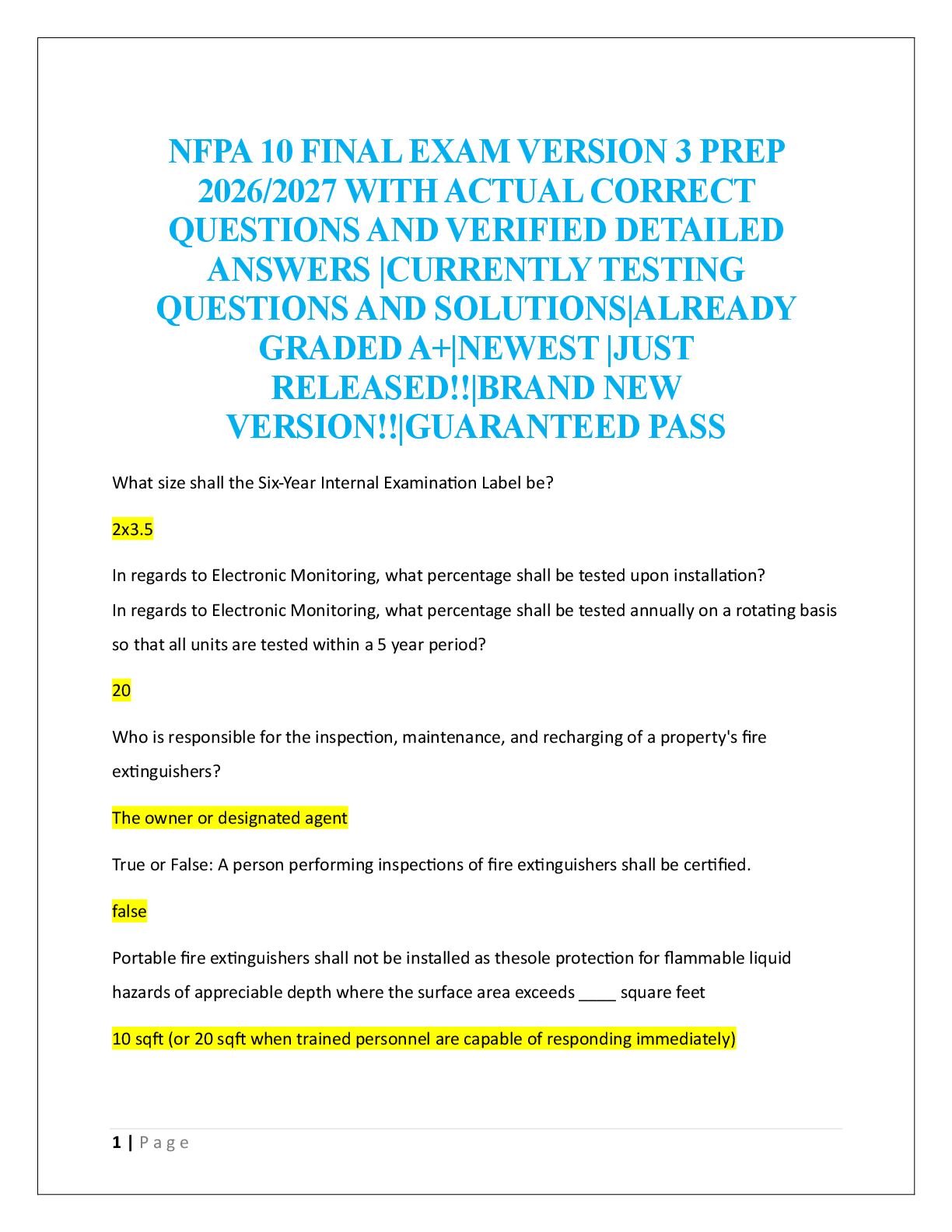
Extinguishers shall not be installed for the sole protection for flammable liquid hazards of appreciable depth where the surface area exceeds _________ - CORRECT ANSWER 10ft^2
If personnel who are trained in extinguishing fires in the protected hazards are located on the premises and can respond quickly, the Maximum surface area must not exceed ________ - CORRECT ANSWER 20ft^2
for flammable liquid hazards of appreciable depth, a Class B extinguisher should be provided that has at least _____ numerical units of Class B extinguishing potential per 1ft^2 of flammable liquid surface of the _______ hazard area - CORRECT ANSWER 2
Largest
Travel distances for portable fire extinguishers should not exceed - CORRECT ANSWER 50 ft
A hand portable fire extinguisher positioned for obstacle, gravity/3d, ir pressure fire hazards, should not have an actual travel distance of more than _______ft - CORRECT ANSWER 30ft
Wheeled fire extinguishers weighing 125lb or more are installed or positioned for obstacle, gravity/3d, the actual travel distance should not exceed _________ft - CORRECT ANSWER 100ft
[Show More]