NFPA 10 Exam 75 Questions with Verified Answers
A colorless, odorless, electrically nonconductive inert gas that is a suitable medium for extinguishing Class B and Class C fires - CORRECT ANSWER Carbon Dioxide
A po
...
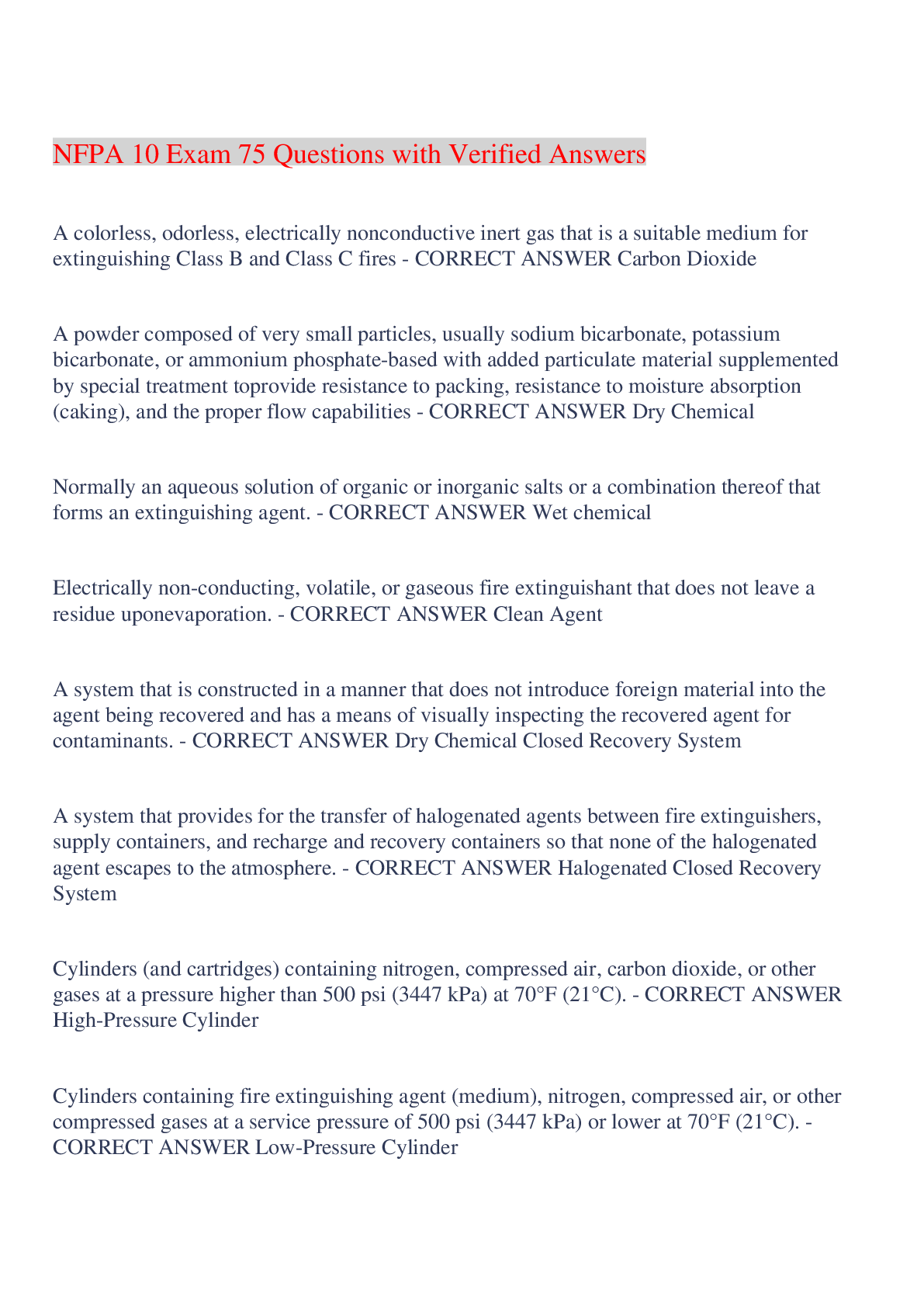
NFPA 10 Exam 75 Questions with Verified Answers
A colorless, odorless, electrically nonconductive inert gas that is a suitable medium for extinguishing Class B and Class C fires - CORRECT ANSWER Carbon Dioxide
A powder composed of very small particles, usually sodium bicarbonate, potassium bicarbonate, or ammonium phosphate-based with added particulate material supplemented by special treatment toprovide resistance to packing, resistance to moisture absorption (caking), and the proper flow capabilities - CORRECT ANSWER Dry Chemical
Normally an aqueous solution of organic or inorganic salts or a combination thereof that forms an extinguishing agent. - CORRECT ANSWER Wet chemical
Electrically non-conducting, volatile, or gaseous fire extinguishant that does not leave a residue uponevaporation. - CORRECT ANSWER Clean Agent
A system that is constructed in a manner that does not introduce foreign material into the agent being recovered and has a means of visually inspecting the recovered agent for contaminants. - CORRECT ANSWER Dry Chemical Closed Recovery System
A system that provides for the transfer of halogenated agents between fire extinguishers, supply containers, and recharge and recovery containers so that none of the halogenated agent escapes to the atmosphere. - CORRECT ANSWER Halogenated Closed Recovery System
Cylinders (and cartridges) containing nitrogen, compressed air, carbon dioxide, or other gases at a pressure higher than 500 psi (3447 kPa) at 70°F (21°C). - CORRECT ANSWER High-Pressure Cylinder
Cylinders containing fire extinguishing agent (medium), nitrogen, compressed air, or other compressed gases at a service pressure of 500 psi (3447 kPa) or lower at 70°F (21°C). - CORRECT ANSWER Low-Pressure Cylinder
Solid materials in powder or granular form designed to extinguish Class D combustible metal fires by crusting, smothering, or heat-transferring means. - CORRECT ANSWER Dry Powder
Either a local alarm device to indicate when an extinguisher is removed from its designated location or a method of electronic communication (data transmission) between an in-place fire extinguisher and an electronic monitoring device/system. - CORRECT ANSWER Electronic Monitoring
Extinguisher retention device designed to mount and secure a specific extinguisher model onto various surfaces by incorporating releasable straps or bands to secure the fire extinguisher. - CORRECT ANSWER Extinguisher Bracket
An identifiable and readily accessible fire extinguisher housing device designed to store and protect fire equipment. - CORRECT ANSWER Extinguisher Cabinet
Extinguisher mounting device designed for mounting a specific extinguisher model onto stationary vertical surfaces. - CORRECT ANSWER Extinguisher Hanger
A quick check that a fire extinguisher is in its designated place, that it has not been actuated or tampered with, and that there is no obvious physical damage or condition to prevent its operation. - CORRECT ANSWER Extinguisher Inspection
A thorough examination of the fire extinguisher that is intended to give maximum assurance that a fire extinguisher will operate effectively and safelyand to determine if physical damage or condition will prevent its operation, if any repair or replacement is necessary, and if hydrostatic testing or internal maintenance is required. - CORRECT ANSWER Extinguisher Maintenance
A solution that will form an aqueous film on liquid fuels - CORRECT ANSWER Film-Forming Foam
A solution based on fluorinated surfactants plus foam stabilizers to produce a fluid aqueous film for suppressing liquid fuel vapors. - CORRECT ANSWER Aqueous Film-Forming Foam (AFFF)
A protein-foam solution that uses fluorinated surfactants to produce a fluid aqueous film for suppressing liquid fuel vapors.
Study These Flashcards - CORRECT ANSWER FFFP
Flammable liquids at least 1/4" deep - CORRECT ANSWER Flammable liquids of appreciable depth
Pressure testing of the extinguisher to verify its strength against unwanted rupture. - CORRECT ANSWER Hydrostatic testing
A water-based extinguishing agent that uses an alkali metal salt as a freezing point depressant. - CORRECT ANSWER Loaded stream extinguisher
All steel shells other than stainless steel and steel shells used for high-pressure cylinders. - CORRECT ANSWER Mild Steel Shell
The normal operating pressure as indicated on the nameplate or cylinder of a fire extinguisher. - CORRECT ANSWER Extinguisher Service Pressure
The pressure shown on the nameplate at which a shell was tested at time of manufacture. - CORRECT ANSWER Factory Test Pressure
Fires resulting from liquids that are forced, pumped, or sprayed. - CORRECT ANSWER Pressurized Flammable Liquid Fires
The replacement of the extinguishing agent (also includes the expellant for certain types of fire extinguishers). - CORRECT ANSWER Recharge
The actual walking distance from a point to the nearest fire extinguisher fulfilling hazard requirements. - CORRECT ANSWER Travel Distance
A concentrate that, when added to water, reduces the surface tension and increases its ability to penetrate and spread. - CORRECT ANSWER Wetting Agent
Surfactant
A fire extinguisher in which the expellant gas is in a separate container from the agent storage container. - CORRECT ANSWER Cartridge/Cylinder Operated
A fire extinguisher that is intended to be used one time and not capable of or intended to be recharged and returned to service. - CORRECT ANSWER Nonrechargable
A fire extinguisher in which the agent has sufficient vapor pressure at normal operating temperatures to expel itself. - CORRECT ANSWER Self Expelling
A fire extinguisher in which both the extinguishing agent and expellant gas are kept in a single container, and that includes a pressure indicator or gauge. - CORRECT ANSWER Stored Pressure
A fire extinguisher containing distilled or de-ionized water and employing a nozzle that discharges the agent in a fine spray. - CORRECT ANSWER Water Mist
A fire extinguisher containing water-based agents, such as water, film-forming foam agents (AFFF, FFFP), antifreeze, loaded stream, and wet chemical. - CORRECT ANSWER Water Type
What is the Conversion Factor for Millimeter? - CORRECT ANSWER 1 in. = 25.4 mm
Low pressure cylinders contain how much service pressure? - CORRECT ANSWER 500 psi
Bromo-chloro-Di-fluoromethane - CORRECT ANSWER Halon 1211
Bromo-TRI-fluoromethane - CORRECT ANSWER Halon 1311
System constructed in a manner that DOES NOT introduce foreign material into the agent being recovered. - CORRECT ANSWER Dry Chemical Closed Recovery System
Indicates a mandatory requirement - CORRECT ANSWER Shall
Acceptable to the authority having jurisdiction - CORRECT ANSWER Approved
The PROVISIONS of this standard apply to the selection, installation, inspection, maintenance, recharging, and testing of portable fire extinguishers. - CORRECT ANSWER Scope
This STANDARD is prepared for use by and guidance of persons charged with selecting, purchasing, installing, approving, listing, designing and maintaining portable fire extinguishers . - CORRECT ANSWER Purpose
Fire Equipment Dealer who does not want to engage in servicing halon equipment must file what affidavit? - CORRECT ANSWER Fire equipment dealer Halon exempt
what are the General Requirements for the selection of fire extinguishers? - CORRECT ANSWER Type
Size
Hazard
Hazards where quantity and combustibility of Class A combustibles and Class B flammables are low and expected - CORRECT ANSWER Light Hazard (Low)
Required building protection shall be provided by fire extinguishers for? - CORRECT ANSWER Class A Fires
______________ protection shall be provided by fire extinguishers for such Class A, B, C, D, or K fire potentials as might be present. - CORRECT ANSWER Occupancy Hazard
Extinguishers for Pressurized Flammable Liquids and Pressurized Gas Fires selection shall be made on the basis of recommendations by - CORRECT ANSWER Manufacturer
Large-capacity dry chemical extinguishers of 10 lb (4.54 kg) or greater and a discharge rate of 1 lb/sec (0.45 kg/sec) or more shall be used to protect these hazards. - CORRECT ANSWER 3 Dimensional fires
Aqueous film-forming foam (AFFF) and film-forming fluoro-protein foam (FFFP) shall not be used for the protection of water-soluble flammable liquids, such as alcohols, acetone, esters, ketones, and so forth unless specifically referenced on the
Study These Flashcards - CORRECT ANSWER Nameplate
Only water-type extinguishers shall be installed in areas containing oxidizers, such as - CORRECT ANSWER pool chemicals
A colorless, odorless, electrically non-conductive inert gas that is a suitable medium for extinguishing Class B and Class C Fires. - CORRECT ANSWER Carbon Dioxide/CO2
Fire Extinguishers classified for use on Class A or Class B hazards shall be required to have a ______ ______ preceding the classification letter. - CORRECT ANSWER Rating Number
Fire extinguishers installed specifically for the protection of cooking appliances that use combustible cooking media (animal or vegetable oils and fats) without a Class K rating shall - CORRECT ANSWER be removed from service
Two water-type extinguishers, each with 1-A rating can be used to fulfill the requirements of - CORRECT ANSWER one 2-A rated extinguisher
What is the maximum travel distance for Class A, Class B, Class D and Class K fire extinguishers - CORRECT ANSWER Class A and D is 75ft
Class B is 50ft
Class K is 30ft
What is the maximum travel distance for a Class C hazard? - CORRECT ANSWER its based on the Class A or Class B hazard
Fire extinguishers and Class D extinguishing agents shall be inspected either manually or by means of an electronic monitoring device/system at intervals not exceeding - CORRECT ANSWER 31 days
Wetting Agent Extinguishers shall be disassembled on __________ basis and subjected to complete maintenance. - CORRECT ANSWER Annual
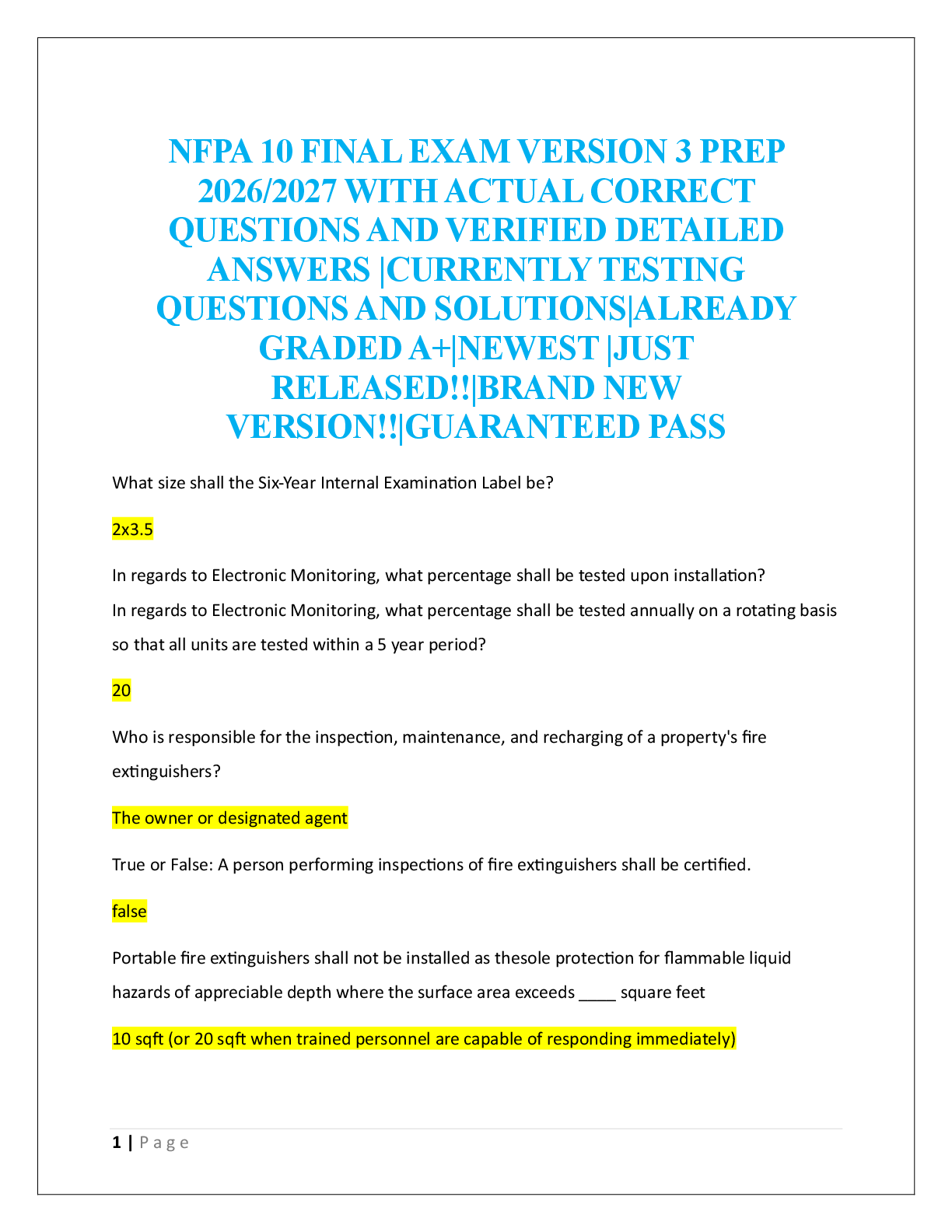
What size shall the Six-Year Internal Examination Label be? - CORRECT ANSWER 2x3.5
In regards to Electronic Monitoring, what percentage shall be tested upon installation?
In regards to Electronic Monitoring, what percentage shall be tested annually on a rotating basis so that all units are tested within a 5 year period? - CORRECT ANSWER 20
Who is responsible for the inspection, maintenance, and recharging of a property's fire extinguishers? - CORRECT ANSWER The owner or designated agent
True or False: A person performing inspections of fire extinguishers shall be certified. - CORRECT ANSWER false
Portable fire extinguishers shall not be installed as thesole protection for flammable liquid hazards of appreciable depth where the surface area exceeds ____ square feet - CORRECT ANSWER 10 sqft (or 20 sqft when trained personnel are capable of responding immediately)
For wheeled fire extinguishers of 125 lb agent capacity or larger that are installed for obstacle, gravity/three-dimensional, or pressure fire hazards, what is the max travel distance to the hazard? - CORRECT ANSWER 100 feet
At what level of work may a permittee be limited to? - CORRECT ANSWER The level of the license held by the Qualifier
What is the period of time that a license or permit good for? - CORRECT ANSWER From January 1, Even number year until December 31 off number year
What is the minimum age to obtain a Fire Equipment Dealer's License? - CORRECT ANSWER 18
If the SFM requires a license holder to show proof of insurance, how long does the license holder have to produce this insurance policy? - CORRECT ANSWER 30 days
How many trainee's are allowed to work under a single permit holder at any one time? - CORRECT ANSWER 2
The sale of an obsolete fire extinguisher is a __ degree misdemeanor? - CORRECT ANSWER 2nd
On a first offense of license or permit violation, calling for revocation and when the offense does not call for mandatory loss of license, a fine of $____ per offense may be levied, up to $10,000 - CORRECT ANSWER 1,000
Vapor density is the comparison of which two elements? - CORRECT ANSWER Gas
Air
The three methods of heat transfer are - CORRECT ANSWER conduction, convection, radiation
[Show More]