Business > EXAM > NFPA 10 Standard PFE 2018ed (1-7) Exam 246 Questions with Verified Answers,100% CORRECT (All)
NFPA 10 Standard PFE 2018ed (1-7) Exam 246 Questions with Verified Answers,100% CORRECT
Document Content and Description Below
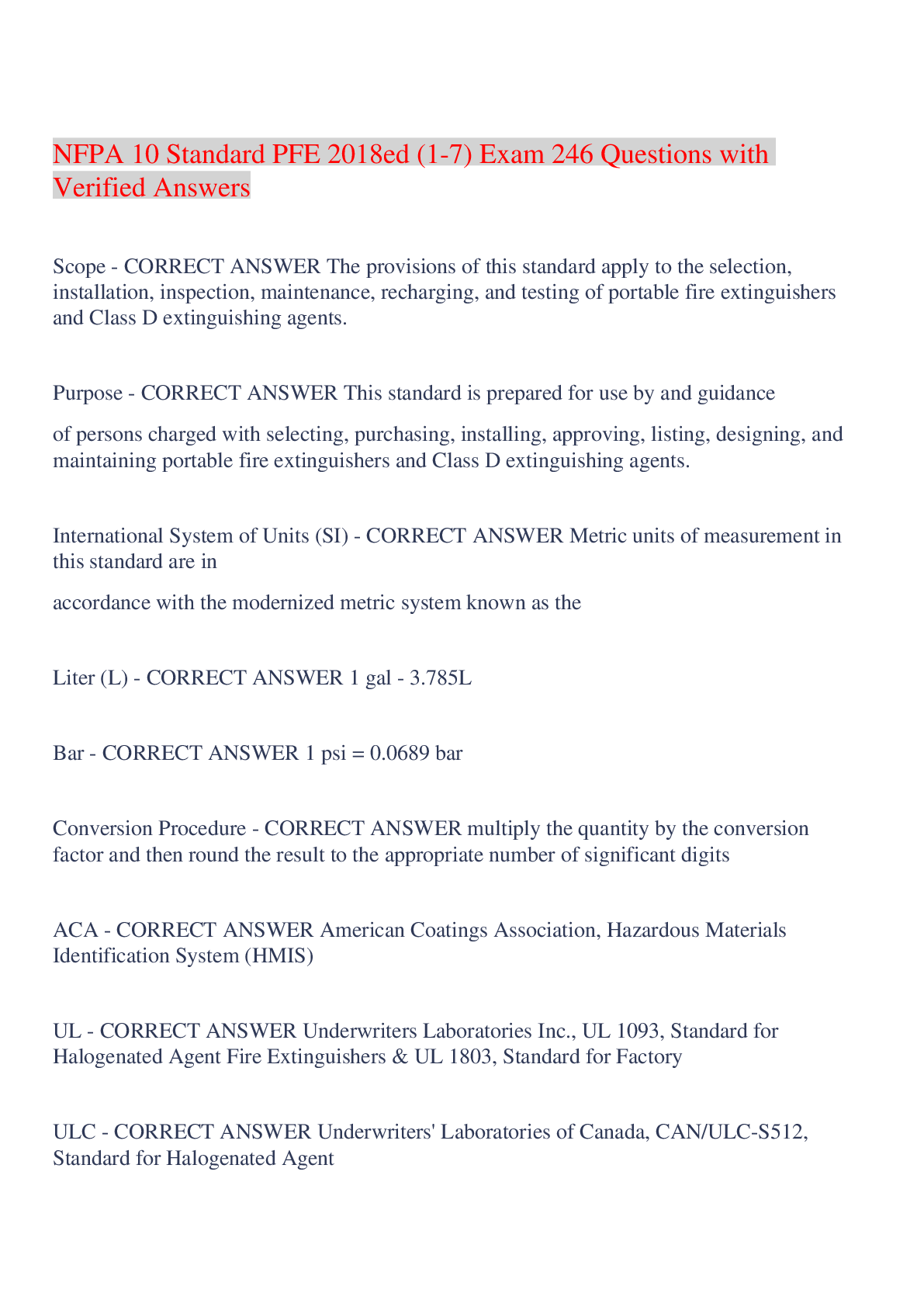
NFPA 10 Standard PFE 2018ed (1-7) Exam 246 Questions with Verified Answers Scope - CORRECT ANSWER The provisions of this standard apply to the selection, installation, inspection, maintenance, rech ... arging, and testing of portable fire extinguishers and Class D extinguishing agents. Purpose - CORRECT ANSWER This standard is prepared for use by and guidance of persons charged with selecting, purchasing, installing, approving, listing, designing, and maintaining portable fire extinguishers and Class D extinguishing agents. International System of Units (SI) - CORRECT ANSWER Metric units of measurement in this standard are in accordance with the modernized metric system known as the Liter (L) - CORRECT ANSWER 1 gal - 3.785L Bar - CORRECT ANSWER 1 psi = 0.0689 bar Conversion Procedure - CORRECT ANSWER multiply the quantity by the conversion factor and then round the result to the appropriate number of significant digits ACA - CORRECT ANSWER American Coatings Association, Hazardous Materials Identification System (HMIS) UL - CORRECT ANSWER Underwriters Laboratories Inc., UL 1093, Standard for Halogenated Agent Fire Extinguishers & UL 1803, Standard for Factory ULC - CORRECT ANSWER Underwriters' Laboratories of Canada, CAN/ULC-S512, Standard for Halogenated Agent ANSI - CORRECT ANSWER American Nation Standards Institute Approved - CORRECT ANSWER Acceptable to the authority having jurisdiction. AHJ - CORRECT ANSWER Authority Having Jurisdiction Authority Having Jurisdication - CORRECT ANSWER An organization, office, or individual responsible for enforcing the requirements of a code or standard, or for approving equipment, materials, an installation, or a procedure. Labeled - CORRECT ANSWER Equipment or materials to which has been attached a label, symbol, or other identifying mark of an organization that is acceptable to the authority having jurisdiction and concerned with product evaluation, that maintains periodic inspection of production of labeled equipment or materials, and by whose labeling the manufacturer indicates compliance with appropriate standards or performance in a specified manner. Listed - CORRECT ANSWER Equipment, materials, or services included in a list published by an organization that is acceptable to the authority having jurisdiction and concerned with evaluation of products or services, that maintains periodic inspection of production of listed equipment or materials or periodic evaluation of services, and whose listing states that either the equipment, material, or service meets appropriate designated standards or has been tested and found suitable for a specified purpose. Shall - CORRECT ANSWER Indicates a mandatory requirement. Should - CORRECT ANSWER Indicates a recommendation or that which is advised but not required. Standard - CORRECT ANSWER Includes NFPA Standard, including Codes, Standards, Recommended Practices and Guides Antifreeze Charge - CORRECT ANSWER Loaded Stream Charge Carbon Dioxide - CORRECT ANSWER A colorless, odorless, electrically nonconductive inert gas that is a suitable medium for extinguishing Class B and Class C fires. 2 Type of Chemicals - CORRECT ANSWER Dry Chemical and Wet Chemical Dry Chemical - CORRECT ANSWER A powder composed of very small particles, usually sodium bicarbonate-, potassium bicarbonate-, or ammonium phosphate-based with added particulate material supplemented by special treatment to provide resistance to packing, resistance to moisture absorption (caking), and the proper flow capabilities. Wet Chemical - CORRECT ANSWER an aqueous solution of organic or inorganic salts or a combination thereof that forms an extinguishing agent. Clean Agent - CORRECT ANSWER Electrically non-conducting, volatile, or gaseous fire extinguishant that does not leave a residue upon evaporation. 2 Closed Recovery System - CORRECT ANSWER Dry Chemical Closed Recovery System and Halogenated Closed Recovery System Dry Chemical Closed Recovery System - CORRECT ANSWER A system that is constructed in a manner that does not introduce foreign material into the agent being recovered and has a means of visually inspecting the recovered agent for contaminants. Halogenated Closed Recovery System - CORRECT ANSWER A system that provides for the transfer of halogenated agents between fire extinguishers, supply containers, and recharge and recovery containers so that none of the halogenated agent escapes to the atmosphere. Closed recovery systems for halogenated agents with an ozone depleting potential (ODP) of 0.2 or greater should be listed for use with that agent. The system's supply or recharge and recovery container is capable of maintaining the agent in a sealed environment until it is reused or returned to the agent manufacturer. 2 Cylinder types - CORRECT ANSWER High-Pressure Cylinder and Low-Pressure Cylinder High-Pressure Cylinder - CORRECT ANSWER Cylinders (and cartridges) containing nitrogen, compressed air, carbon dioxide, or other gases at a pressure higher than 500 psi (3447 kPa) at 70°F (21°C). Low-Pressure Cylinder - CORRECT ANSWER Cylinders containing fireextinguishing agent (medium), nitrogen, compressed air, or other compressed gases at a service pressure of 500 psi (3447 kPa) or lower at 70°F (21°C). DOT - CORRECT ANSWER U.S. Department of Transportation Dry Powder - CORRECT ANSWER Solid materials in powder or granular form designed to extinguish Class D combustible metal fires by crusting, smothering, or heat-transferring means. Electronic Monitoring - CORRECT ANSWER Either a local alarm device to indicate when an extinguisher is removed from its designated location or a method of electronic communication (data transmission) between an in-place fire extinguisher and an electronic monitoring device/system Extinguisher Bracket - CORRECT ANSWER Extinguisher retention device designed to mount and secure a specific extinguisher model onto various surfaces by incorporating releasable straps or bands to secure the fire extinguisher. Extinguisher Cabinet - CORRECT ANSWER An identifiable and readily accessible fire extinguisher housing device designed to store and protect fire equipment Extinguisher hanger - CORRECT ANSWER Extinguisher mounting device designed for mounting a specific extinguisher model onto stationary vertical surfaces Extinguisher Inspection - CORRECT ANSWER A quick check that a fire extinguisher is in it's designated place, that it has not been actuated or tampered with, and that there is no obvious physical damage or condition to prevent its operation. Extinguisher Maintenance - CORRECT ANSWER A thorough examination of the fire extinguisher that is intended to give maximum assurance that a fire extinguisher will operate effectively and safely and to determine if physical damage or condition will prevent its operation if any repair or replacement is necessary and if hydrostatic testing or internal maintenance is required 2 types of Film-Forming Foam - CORRECT ANSWER Aqueous Film Forming Foam and Film-Form Fluroprotein Foam Film-Forming Foam - CORRECT ANSWER A solution that will form an aqueous film on liquid fuels AFFF - CORRECT ANSWER Aqueous Film Forming Foam FFFP - CORRECT ANSWER Film Forming Fluoroprotein Foam Aqueous Film Forming Foam (AFFF) - CORRECT ANSWER A solution based on fluorinated surfactants plus foam stabilizers to produce a fluid aqueous film for suppressing liquid fuel vapors. Film Forming Fluoroprotein Foam (FFFP) - CORRECT ANSWER A protein-foam solution that uses fluorinated surfactants to produce a fluid aqueous film for suppressing liquid fuel vapors. Flammable Liquids of Appreciable Depth - CORRECT ANSWER Flammable liquids of appreciable depth are those with a depth greater than 1∕4 in. (6.3 mm). Halogenated Agents - CORRECT ANSWER Clean Agents 2 Type of Halogenated Agents - CORRECT ANSWER Halocarbons and Halons Halocarbons - CORRECT ANSWER Halocarbon agents include hydrochlorofluorocarbon (HCFC), hydrofluorocarbon (HFC), perfluorocarbon (PFC), fluoroiodocarbon (FIC) types of agents, and other halocarbons that are found acceptable under the Environmental Protection Agency Significant New Alternatives Policy program. Halons - CORRECT ANSWER Halons include bromochlorodifluoromethane (Halon 1211), bromotrifluoromethane (Halon 1301), and mixtures of Halon 1211 and Halon 1301 (Halon 1211/1301). Hydrostatic Testing - CORRECT ANSWER Pressure testing of the extinguisher to verify its strength against unwanted rupture. Loaded Stream Charge - CORRECT ANSWER A water based extinguishing medium that uses an alkali metal salt as a freezing point depressant. Mild Steel Shell - CORRECT ANSWER All steel shells other than stainless steel and steel shells used for high pressure cylinders 2 type of Pressure - CORRECT ANSWER Extinguisher Service Pressure and Factory Test Pressure Extinguisher Service Pressure - CORRECT ANSWER The normal operating pressure as indicated on the nameplate or cylinder of a fire extinguisher factory Test Pressure - CORRECT ANSWER The pressure shown on the nameplate at which a shell was tested at time of manufacture. Pressurized Flammable Liquid Fires - CORRECT ANSWER Fires resulting from liquids that are forced, pumped, or sprayed. Recharging - CORRECT ANSWER The replacement of the extinguishing agent (also includes the expellant for certain types of fire extinguishers) Servicing - CORRECT ANSWER performing maintenance, recharging, or hydrostatic testing on a fire extinguisher TC - CORRECT ANSWER Transport Canada, formerly Canada Transport Commission (CTC), which has jurisdiction over high- and low pressure cylinders and cartridges in Canada Travel Distance - CORRECT ANSWER The actual walking distance from a point to the nearest fire extinguisher fulfilling hazard requirements. Wetting Agent - CORRECT ANSWER A concentrate that, when added to water, reduces the surface tension and increases its ability to penetrate and spread. Cartridge/Cylinder-Operated Fire Extinguisher - CORRECT ANSWER A fire extinguisher in which the expellant gas is in a separate container from the agent storage container. Nonrechargeable (Nonrefillable) Fire Extinguisher - CORRECT ANSWER A fire extinguisher that is intended to be used one time and not capable of or intended to be recharged and returned to service. Portable Fire Extinguisher - CORRECT ANSWER A portable device, carried or on wheels and operated by hand, containing an extinguishing agent that can be expelled under pressure for the purpose of suppressing or extinguishing fire. Rechargeable (Refillable) Fire Extinguisher - CORRECT ANSWER A fire extinguisher capable of undergoing complete maintenance, including internal inspection of the pressure vessel, replacement of all substandard parts and seals, and hydrostatic testing Self-Expelling Fire Extinguisher - CORRECT ANSWER A fire extinguisher in which the agent has sufficient vapor pressure at normal operating temperatures to expel itself. Stored-Pressure Fire Extinguisher - CORRECT ANSWER A fire extinguisher in which both the extinguishing agent and expellant gas are kept in a single container, and that includes a pressure indicator or gauge. Water Mist Fire Extinguisher - CORRECT ANSWER A fire extinguisher containing distilled or de-ionized water and employing a nozzle that discharges the agent in a fine spray. Water-Type Fire Extinguisher - CORRECT ANSWER fire extinguisher containing water-based agents, such as water, film-forming foam agents (AFFF, FFFP), antifreeze, loaded stream, and wet chemical. Wheeled Fire Extinguisher - CORRECT ANSWER portable fire extinguisher equipped with a carriage and wheels intended to be transported to the fire by one person. ANSI/UL 711, CAN/ULC-S508, Standard for Rating and Fire Testing of Fire Extinguishers - CORRECT ANSWER Portable fire extinguishers used to comply with this standard shall be listed and labeled and shall meet or exceed all the requirements ANSI/UL 154, CAN/ULC-S503 - CORRECT ANSWER Standard for Carbon-Dioxide Fire Extinguishers ANSI/UL 299, CAN/ULC-S504 - CORRECT ANSWER Standard for Dry Chemical Fire Extinguishers ANSI/UL 626, CAN/ULC-S507 - CORRECT ANSWER Standard for Water Fire Extinguishers CAN/ULC-S512 - CORRECT ANSWER Standard for Halogenated Agent Hand and Wheeled Fire Extinguishers ANSI/UL 8, CAN/ULC-S554 - CORRECT ANSWER Water Based Agent Fire Extinguishers ANSI/UL 2129, CAN/ULC-S566 - CORRECT ANSWER Standard for Halocarbon Clean Agent Fire Extinguishers Each fire extinguisher shall be marked with #1 - CORRECT ANSWER (1) Identification of the listing and labeling organization Each fire extinguisher shall be marked with #2 - CORRECT ANSWER Product category indicating the type of extinguisher Each fire extinguisher shall be marked with #3 - CORRECT ANSWER Extinguisher classification as indicated in Section 5.3 Each fire extinguisher shall be marked with #4 - CORRECT ANSWER Performance and fire test standards that the extinguisher meets or exceeds Fire extinguishers manufactured prior to _______________, shall not be required to comply with 4.1.2. - CORRECT ANSWER January 1, 1986 UL 1093 - CORRECT ANSWER Standard for Halogenated Agent Fire Extinguishers, shall be permitted to be used to comply with the requirements of this standard when installed, inspected, and maintained in accordance with this standard. UL 1803 - CORRECT ANSWER Standard for Factory Follow-Up on Third Party Certified Portable Fire Extinguishers Fire extinguishers manufactured prior to _______________, shall not be required to comply with 4.1.3. - CORRECT ANSWER January 1, 1989 Certification organizations accredited by the _______________ shall not be required to comply with 4.1.3 - CORRECT ANSWER Standards Council of Canada ANSI/UL 711, CAN/ULC-S508 - CORRECT ANSWER Listed and labeled Class D extinguishing agents intended to be manually applied to combustible metal fires shall comply with the fire test requirements specified Electrical Conductivity - CORRECT ANSWER Extinguishers listed for the Class C rating shall not contain an agent that is a conductor of electricity. In addition to successfully meeting the requirements of ANSI/UL 711, CAN/ULC-S508, water-based agents that are listed for the Class C rating shall be tested in accordance with - CORRECT ANSWER ASTM D5391, Standard Test for Electrical Conductivity and Resistivity of a Flowing High Purity Water Sample Fire extinguishers containing water-based agents that have a conductivity higher than _______________ shall be considered a conductor of electricity and therefore shall not be rated Class C. - CORRECT ANSWER 1.00 μS/cm at 25°C (77°F) Paragraphs 4.1.4.1 and 4.1.4.2 shall apply only to waterbased extinguishers manufactured after _______ - CORRECT ANSWER August 15, 2002 A fire extinguisher shall have a label, tag, or stencil attached to it providing the following information: - CORRECT ANSWER (1) The content's product name as it appears on the manufacturer's Material Safety Data Sheet (MSDS) (2) Listing of the hazardous material identification in accordance with Hazardous Materials Identification System (HMIS), Implementational Manual [in Canada, Globally Harmonized System of Classification and Labeling of Chemicals (GHS)] (3) List of any hazardous materials that are in excess of 1.0 percent of the contents (4) List of each chemical in excess of 5.0 percent of the contents (5) Information as to what is hazardous about the agent in accordance with the MSDS (6) Manufacturer's or service agency's name, mailing address, and phone number The owner or the owner's agent shall be provided with a__________________ that details condensed instructions and cautions necessary to the installation, operation, inspection, and maintenance of the fire extinguisher (s) - CORRECT ANSWER Fire Extinguisher Instruction Manual Obsolete Fire Extinguishers - CORRECT ANSWER (1) Soda acid (2) Chemical foam (excluding film-forming agents) (3) Carbon tetrachloride, methyl bromide, and chlorobromomethane (CBM) (4) Cartridge-operated water (5) Cartridge-operated loaded stream (6) Copper or brass shell (excluding pump tanks) joined by soft solder or rivets (7) Carbon dioxide extinguishers with metal horns (8) Solid charge-type AFFF extinguishers (paper cartridge) (9) Pressurized water fire extinguishers manufactured prior to 1971 (10) Any extinguisher that needs to be inverted to operate (11) Any extinguisher manufactured prior to 1955 (12) Any extinguishers with 4B, 6B, 8B, 12B, and 16B fire ratings (13) Stored-pressure water extinguishers with fiberglass shells (pre-1976) Dry chemical stored-pressure extinguishers with an indicated manufacturing date of 1984 or prior - CORRECT ANSWER shall be removed from service Any fire extinguisher that can no longer be serviced in accordance with the manufacturer's maintenance manual is considered - CORRECT ANSWER obsolete and shall be removed from service The selection of fire extinguishers for a given situation shall be determined by the applicable requirements of Sections 5.2 through 5.6 and the following factors: - CORRECT ANSWER (1) Type of fire most likely to occur (2) Size of fire most likely to occur (3) Hazards in the area where the fire is most likely to occur (4) Energized electrical equipment in the vicinity of the fire (5) Ambient temperature conditions (6) Other factors (See Section H.2.) True - CORRECT ANSWER Portable fire extinguishers shall be installed as a first line of defense to cope with fires of limited size, except as required by 5.5.5. Independent - CORRECT ANSWER The selection of extinguishers shall be _____________ of whether the building is equipped with automatic sprinklers, standpipe and hose, or other fixed protection equipment Classifications of Fires - CORRECT ANSWER Fires shall be classified in accordance with the guidelines specified in 5.2.1 through 5.2.5 Class A Fires - CORRECT ANSWER are fires in ordinary combustible materials, such as wood, cloth, paper, rubber, and many plastics. Class B Fires - CORRECT ANSWER are fires in flammable liquids, combustible liquids, petroleum greases, tars, oils, oil-based paints, solvents, lacquers, alcohols, and flammable gases. Class C Fires - CORRECT ANSWER are fires that involve energized electrical equipment. Class D Fires - CORRECT ANSWER are fires in combustible metals, such as magnesium, titanium, zirconium, sodium, lithium, and potassium. Class K Fires - CORRECT ANSWER are fires in cooking appliances that involve combustible cooking media (vegetable or animal oils and fats) The classification of fire extinguishers shall consist of a _______ that indicates the class of fire on which a fire extinguisher has been found to be effective - CORRECT ANSWER letter Fire extinguishers classified for use on Class A or Class B hazards shall be required to have a __________preceding the classification letter that indicates the relative extinguishing effectiveness. - CORRECT ANSWER rating number Fire extinguishers classified for use on Class C, Class D, or Class K hazards _____________________________ preceding the classification letter - CORRECT ANSWER shall not be required to have a number Fire extinguishers shall be selected for the ____________________ to be protected in accordance with 5.3.2.1 through 5.3.2.5. - CORRECT ANSWER class(es) of hazards Use of ______________ fire extinguishers shall be limited to applications where a clean agent is necessary to extinguish fire efficiently without damaging the equipment or area being protected or where the use of alternative agents has the potential to cause a hazard to personnel in the area. - CORRECT ANSWER Halon Agent Placement of portable fire extinguishers containing halogenated agents shall conform to . - CORRECT ANSWER minimum confined space volume requirement warnings contained on the fire extinguisher nameplates Wheeled fire extinguishers shall be considered for hazard protection in areas in which a fire risk assessment has shown the following: - CORRECT ANSWER (1) High hazard areas are present. (2) Limited available personnel are present, thereby requiring an extinguisher that has the following features: (a) High agent flow rate (b) Increased agent stream range (c) Increased agent capacity Classifying Occupancy Hazard - CORRECT ANSWER Rooms or areas shall be classified as being light hazard, ordinary hazard, or extra hazard. Classification of Hazards - CORRECT ANSWER Light Hazard, Ordinary Hazard and Extra Hazard Light Hazard - CORRECT ANSWER Light hazard occupancies shall be classified as locations where the quantity and combustibility of Class A combustibles and Class B flammables are low and fires with relatively low rates of heat release are expected. These occupancies consist of fire hazards having normally expected quantities of Class A combustible furnishings, and/or the total quantity of Class B flammables typically expected to be present is less than 1 gal (3.8 L) in any room or area Ordinary Hazard - CORRECT ANSWER Ordinary hazard occupancies shall be classified as locations where the quantity and combustibility of Class A combustible materials and Class B flammables are moderate and fires with moderate rates of heat release are expected. These occupancies consist of fire hazards that only occasionally contain Class A combustible materials beyond normal anticipated furnishings, and/or the total quantity of Class B flammables typically expected to be present is from 1 gal to 5 gal (3.8 L to 18.9 L) in any room or area. Extra Hazard - CORRECT ANSWER Extra hazard occupancies shall be classified as locations where the quantity and combustibility of Class A combustible material are high or where high amounts of Class B flammables are present and rapidly developing fires with high rates of heat release are expected. These occupancies consist of fire hazards involved with the storage, packaging, handling, or manufacture of Class A combustibles, and/or the total quantity of Class B flammables expected to be present is more than 5 gal (18.9 L) in any room or area Selection by Occupancy - CORRECT ANSWER Fire extinguishers shall be provided for the protection of both the building structure and the occupancy hazards contained therein regardless of the presence of any fixed fire suppression systems Required building protection shall be provided by fire extinguishers for - CORRECT ANSWER Class A fires Water-Soluble Flammable Liquid Fires (Polar Solvents) - CORRECT ANSWER Aqueous film-forming foam (AFFF) and film-forming fluoroprotein foam (FFFP) types of fire extinguishers shall not be used for the protection of water-soluble flammable liquids, such as alcohols, acetone, esters, ketones, and so forth, unless specifically referenced on the fire extinguisher nameplate Three-Dimensional Fires - CORRECT ANSWER Large-capacity dry chemical extinguishers of 10 lb (4.54 kg) or greater and having a discharge rate of 1 lb/sec (0.45 kg/sec) or more shall be used to protect these hazards. Obstacle Fires. Selection of a fire extinguisher for this type of hazard shall be based on one of the following: - CORRECT ANSWER (1) Extinguisher containing a vapor-suppressing foam agent (2)* Multiple extinguishers containing non-vapor-suppressing Class B agents intended for simultaneous application (3) Larger capacity extinguishers of 10 lb (4.54 kg) or greater and a minimum discharge rate of 1 lb/sec (0.45 kg/sec) Extinguishers for Pressurized Flammable Liquids and Pressurized Gas Fires - CORRECT ANSWER Large-capacity dry chemical extinguishers of 10 lb (4.54 kg) or greater and a discharge rate of 1 lb/sec (0.45 kg/sec) or more shall be used to protect these hazards Class K Cooking Media Fires - CORRECT ANSWER Fire extinguishers provided for the protection of cooking appliances that use combustible cooking media (vegetable or animal oils and fats) shall be listed and labeled for Class K fires Class K fire extinguishers manufactured after January 1, 2002, shall not be equipped with - CORRECT ANSWER extended wand-type discharge devices. Fire extinguishers installed specifically for the protection of cooking appliances that use combustible cooking media (animal or vegetable oils and fats) without a Class K rating - CORRECT ANSWER shall be removed from service. Where a hazard is protected by an automatic fire protection system, - CORRECT ANSWER a placard shall be conspicuously placed near the extinguisher that states that the fire protection system shall be actuated prior to using the fire extinguisher. Electronic Equipment Fires - CORRECT ANSWER Fire extinguishers for the protection of delicate electronic equipment shall be selected from types specifically listed and labeled for Class C hazards ____________________ fire extinguishers shall not be installed for the protection of delicate electronic equipment - CORRECT ANSWER Dry Chemical Areas Containing Oxidizers - CORRECT ANSWER Only water or foam extinguishers shall be installed in areas where pool chemicals containing chlorine or bromine are stored. ________________________fire extinguishers shall not be installed in areas where pool chemicals containing chlorine or bromine are stored. - CORRECT ANSWER Multipurpose dry chemical Fire extinguishers intended for use where oxidizers are stored or used shall be selected and installed based on the specific recommendations contained within the - CORRECT ANSWER material's safety data sheet (SDS) for the oxidizer, surrounding conditions, and NFPA 400. Class D Combustible Metal Fires. - CORRECT ANSWER Class D fire extinguishers and agents shall be compatible with the specific metal for which protection is provided Number of Extinguishers - CORRECT ANSWER The minimum number of fire extinguishers needed to protect a property shall be determined as outlined in this chapter. The installation of extinguishers shall be _________________ of whether the building is equipped with automatic sprinklers,standpipe and hose, or other fixed protection equipment - CORRECT ANSWER independent True - CORRECT ANSWER Additional extinguishers shall be permitted to be installed to provide more protection Extinguisher Readiness - CORRECT ANSWER Portable fire extinguishers shall be maintained in a fully charged and operable condition and shall be kept in their designated places at all times when they are not being used. Placement - CORRECT ANSWER Fire extinguishers shall be conspicuously located where they are readily accessible and immediately available in the event of fire. Fire extinguishers shall be located along normal paths of travel, including exits from areas Visual Obstructions - CORRECT ANSWER Fire extinguishers shall be installed in locations where they are visible except as permitted by 6.1.3.3.2 In rooms and in locations where visual obstructions cannot be avoided, signs or other means shall be provided toindicate the extinguisher location - CORRECT ANSWER Signs or other means used to indicate fire extinguisher location shall be located in close proximity to the extinguisher and visible from the normal path of travel. Portable fire extinguishers other than wheeled extinguishers shall be installed using any of the following means: - CORRECT ANSWER (1) Securely on a hanger intended for the extinguisher (2) In a bracket incorporating releasing straps or bands supplied by the extinguisher manufacturer (3) In a listed bracket incorporating releasing straps or bands approved for such purpose (4) In approved cabinets or wall recesses Hangers and brackets shall ___ be fabricated in the field. - CORRECT ANSWER Not Fire extinguishers having a gross weight not exceeding 40 lb (18.14 kg) shall be installed - CORRECT ANSWER so that the top of the fire extinguisher is not more than 5 ft (1.53 m) above the floor Fire extinguishers having a gross weight greater than 40 lb (18.14 kg) (except wheeled types) - CORRECT ANSWER shall be installed so that the top of the fire extinguisher is not more than 31∕2 ft (1.07 m) above the floor. In no case shall the clearance between the bottom of the hand portable fire extinguisher and the floor be less than - CORRECT ANSWER 4 in. (102 mm) Fire extinguishers shall be installed so that the fire extinguisher's operating instructions - CORRECT ANSWER face outward HMIS - CORRECT ANSWER Hazardous Material Identification System Hazardous materials identification systems (HMIS) labels, 6-year maintenance labels, hydrostatic test labels, or other labels shall not be located or placed on the - CORRECT ANSWER Front of the Extinguisher Cabinets - CORRECT ANSWER housing fire extinguishers shall not be locked, except where fire extinguishers are subject to malicious use and cabinets include a means of emergency access Antifreeze - CORRECT ANSWER a substance that prevents liquid from freezing Calcium Chloride Solution - CORRECT ANSWER shall not be used in stain-less steel fire extinguishers Electronic Monitoring and Alarm System - CORRECT ANSWER Where an electronic monitoring and alarm system is installed, continuously supervised and continuity power Class A Hazard, Fire extinguishers shall be located so that the maximum travel distances - CORRECT ANSWER shall not exceed 75ft 2-A Light Hazard Occupancy Maximum floor area per unit of A - CORRECT ANSWER 3000 ft2 2-A Ordinary Hazard Occupancy Maximum floor area per unit of A - CORRECT ANSWER 1500 ft2 2-A Extra Hazard Occupancy Maximum floor area per unit of A - CORRECT ANSWER 1000 ft2 2-A Light, Ordinary and Extra Hazard Occupancy Maximum floor area per extinguisher of A - CORRECT ANSWER 11,250 ft2 Fire Extinguisher for Class B Hazard travel distance hall not exceed - CORRECT ANSWER 50 ft (15.25 m) 5-B Light Hazard travel distance to extinguisher - CORRECT ANSWER 30 ft 10-B Light Hazard travel distance to extinguisher - CORRECT ANSWER 50 ft 10-B Ordinary Hazard travel distance to extinguisher - CORRECT ANSWER 30 ft 20-B Ordinary Hazard travel distance to extinguisher - CORRECT ANSWER 50 ft 40-B Extra Hazard travel distance to extinguisher - CORRECT ANSWER 30 ft 80-B Extra Hazard travel distance to extinguisher - CORRECT ANSWER 50 ft Where hand portable fire extinguishers are installed or positioned for obstacle, gravity/three-dimensional, or pressure fire hazards, the actual travel distance to hazard shall not - CORRECT ANSWER exceed 30 ft Where wheeled fire extinguishers of 125 lb (56.7 kg) agent capacity or larger are installed or positioned for obstacle,gravity/three-dimensional, or pressure fire hazards, the actual travel distance to hazard shall - CORRECT ANSWER exceed 100 ft Fire extinguishers or extinguishing agents (media) shall be located _______________of travel distance from the Class D hazard. - CORRECT ANSWER not more than 75 ft (22.9 m) Maximum travel distance shall ____________________ from the Class K hazard to the extinguishers. - CORRECT ANSWER not exceed 30 ft (9.1 m) Personnel - CORRECT ANSWER Persons performing maintenance and recharging of extinguishers shall be certified Responsibility - CORRECT ANSWER The owner or designated agent or occupant of a property in which fire extinguishers are located shall be responsible for inspection, maintenance, and recharging. Certification - CORRECT ANSWER requires that a person pass a test administered by an organization acceptable to the AHJ. Replacement While Servicing - CORRECT ANSWER Fire extinguishers removed from service for maintenance or recharging shall be replaced by a fire extinguisher suitable for the type of hazard being protected and shall be of at least equal rating. Tags or labels - CORRECT ANSWER intended for recording inspections, maintenance, or recharging shall be affixed so as not to obstruct the fire extinguisher use, fire extinguisher classification, or manufacturer's labels Labels - CORRECT ANSWER indicating fire extinguisher use or classification, or both, shall be permitted to be placed on the front of the fire extinguisher. Inspection Frequency - CORRECT ANSWER Fire extinguishers shall be manually inspected when initially placed in service Fire extinguishers and Class D extinguishing agents shall be inspected - CORRECT ANSWER either manually or by means of an electronic monitoring device/system at intervals not exceeding 31 days; at least once per calendar month Extinguishers that are electronically monitored for location only, such as those monitored by means of a switch to indicate when the extinguisher is removed from its bracket or cabinet, - CORRECT ANSWER shall be manually inspected in accordance with 7.2.2 Inspection Procedures. Periodic inspection or electronic monitoring of fire extinguishers shall include a check of at least the following items: - CORRECT ANSWER (1) Location in designated place (2) Visibility of the extinguisher or means of indicating the extinguisher location (3) Access to the extinguisher (4) Pressure gauge reading or indicator in the operable range or position (5) Fullness determined by weighing or hefting (6) Condition of tires, wheels, carriage, hose, and nozzle for wheeled extinguishers (7) Indicator for nonrechargeable extinguishers using push-to- test pressure indicators The ____________________ shall determine the method of extinguisher inspection such as manual inspection,electronic monitoring, or any combination of the two - CORRECT ANSWER owner or the owner's agent Any method(s) of inspection other than manual inspection shall require the approval of the - CORRECT ANSWER authority having jurisdiction. Inspection Procedure for Containers of Class D Extinguishing Agent. Periodic inspection of containers of Class D extinguishing agent used to protect Class D hazards shall include verification of at least the following: - CORRECT ANSWER (1) Located in designated place (2) Visibility of the container or means of indicating the container location (3) Access to the container (4) Lid is sealed (5) Fullness by hefting or weighing (6) No obvious physical damage to container Class D Extinguishing Agent - Corrective Action - CORRECT ANSWER When an inspection of any fire extinguisher reveals a deficiency in any of the conditions in 7.2.2 or .2.2.4, immediate corrective action shall be taken Class D Extinguishing Agent - Rechargeable Fire Extinguisher - CORRECT ANSWER When an inspection of any rechargeable fire extinguisher reveals a deficiency in any of the conditions in the extinguisher shall be subjected to applicable maintenance procedures. Class D Extinguishing Agent - Nonrechargeable Dry Chemical Fire Extinguisher - CORRECT ANSWER When an inspection of any nonrechargeable dry chemical fire extinguisher reveals a deficiency in any of the conditions listed in 7.2.2(4), 7.2.2(5), 7.2.2(7), or 7.2.2.4(1) through 7.2.2.4(3), the extinguisher shall be removed from further use, discharged, and destroyed at the direction of the owner or returned to the manufacturer. Class D Extinguishing Agent - Nonrechargeable Halon Agent Fire Extinguisher - CORRECT ANSWER When an inspection of any nonrechargeable fire extinguisher containing a halon agent reveals a deficiency in any of the conditions listed in 7.2.2(4), 7.2.2(5), 7.2.2(7), or 7.2.2.4(1) through 7.2.2.4(3), the extinguisher shall be removed from service, shall not be discharged, and shall be returned to the manufacturer, a fire equipment dealer, or a distributor to permit recovery of the halon Manual Inspection Records - CORRECT ANSWER Where manual inspections are conducted, records for manual inspections shall be kept on a tag or label attached to the fire extinguisher, on an inspection checklist maintained on file, or by an electronic method. Where manual inspections are conducted, need to have the - CORRECT ANSWER month and year the manual inspection was performed and the initials of the person performing the inspection shall be recorded Records for manual and electronic inspection shall be kept to demonstrate that at least the last __________inspections have been performed. - CORRECT ANSWER 12 monthly Electronic Inspection Records - CORRECT ANSWER extinguisher causes a signal at a control unit when a deficiency in any of the conditions listed in 7.2.2 occurs, record keeping shall be provided in the form of an electronic event log at the control panel. Maintenance Procedures - CORRECT ANSWER shall include the procedures detailed in the manufacturer's service manual and a thorough examination of the basic elements of the fire extinguisher, including the following: (1) Mechanical parts of all fire extinguishers (2) Extinguishing agent (3) Expelling means (4) Physical condition Annual External Examination of All Extinguishers - CORRECT ANSWER shall be made to detect obvious physical damage, corrosion, or nozzle blockage to verify that the operating instructions are present, legible, and facing forward, and that the HMIS information is present and legible, and to determine if a 6-year interval examination or hydrostatic test is due. Seals or Tamper Indicators - CORRECT ANSWER At the time of the maintenance, the tamper seal of a rechargeable fire extinguisher shall be removed by operating the pull pin or locking device. After maintenance a new listed tamper seal shall be installed. Seals or tamper indicators on nonrechargeable-type extinguishers - CORRECT ANSWER shall not be removed Boots, Foot Rings, and Attachments - CORRECT ANSWER shall be removed to accommodate thorough annual cylinder examinations When subjected to temperatures at or above their listed rating, stored-pressure fire extinguishers that require a 12-year hydrostatic test shall be emptied and subjected to the applicable maintenance and recharge procedures on an - CORRECT ANSWER annual basis Corrective Action - CORRECT ANSWER When an external examination of any fire extinguisher reveals a deficiency, immediate corrective action shall be taken Stored-pressure types of fire extinguishers containing a loaded stream agent shall be disassembled on - CORRECT ANSWER an annual basis and subjected to complete maintenance. Loaded Stream Charge when the internal maintenance procedures are performed during periodic recharging or hydrostatic testing, the 1-year requirement shall begin from that - CORRECT ANSWER date Cartridge- or Cylinder-Operated Extinguishers - CORRECT ANSWER shall be internally examined annually Internal Examination Interval (years) - Stored-pressure loaded stream and antifreeze - CORRECT ANSWER 1 year Internal Examination Interval (years) Pump tank water and pump tank, calcium chloride based - CORRECT ANSWER 1 year Internal Examination Interval (years) - dry chemical, cartridge and cylinder operated with mild steel shells - CORRECT ANSWER 1 year (annually) Internal Examination Interval (years) dry powder, cartridge and cylinder operated with mild steel shells - CORRECT ANSWER 1 year (annually) Internal Examination Interval (years) Wetting agent stored pressure water - CORRECT ANSWER 1 year Internal Examination Interval (years) AFFF & FFFP - CORRECT ANSWER 3 year (extinguisher is replaced every 3 years and an internal examination (teardown) is normally conducted at that time Internal Examination Interval (years) stored pressure dry chemical with stainless steel shells - CORRECT ANSWER 5 year Internal Examination Interval (years) carbon dioxide - CORRECT ANSWER 5 years Internal Examination Interval (years) wet chemical - CORRECT ANSWER 5 years Internal Examination Interval (years) dry chemical stored pressure with mild steel shells, brazed brass shells and aluminum shells - CORRECT ANSWER 6 years Internal Examination Interval (years) Halogenated agents - CORRECT ANSWER 6 years Internal Examination Interval (years) dry powder, stored pressure, with mild steel shells - CORRECT ANSWER 6 years Pressure Regulators - CORRECT ANSWER Pressure regulators provided with wheeled-type fire extinguishers shall be tested annually for outlet static pressure and flow rate in accordance with the manufacturer's instructions. Corrective Action. When maintenance of any fire extinguisher hose or pressure regulator reveals a deficiency, - CORRECT ANSWER immediate corrective action shall be taken All rechargeable-type fire extinguishers shall be recharged - CORRECT ANSWER after any use or when the need is indicated by an inspection or servicing The amount of recharge agent shall be verified by - CORRECT ANSWER weighing The added label containing the gross weight shall be a - CORRECT ANSWER durable material of a pressure-sensitive, self-destruct type Pump tank water and pump tank calcium chloride based antifreeze types shall not be required to - CORRECT ANSWER have weight marked In no case shall an extinguisher be recharged _______________ if it is beyond its specified hydrostatic test date. - CORRECT ANSWER without hydrostatic testing Pump Tank Recharging - CORRECT ANSWER Every 12 months, pump tank water and pump tank calcium chloride-based antifreeze types of fire extinguishers shall be recharged with new chemicals or water as applicable. Wetting Agent Reharging - CORRECT ANSWER The agent in stored-pressure wetting agent fire extinguishers shall be replaced annually AFFF and FFFP Recharging - CORRECT ANSWER The premixed agent in liquid charge-type AFFF and FFFP fire extinguishers shall be replaced at least once every 3 years. Recharge Agents - CORRECT ANSWER Only those agents specified on the nameplate or agents proven to have equal chemical composition, physical characteristics, and fire-extinguishing capabilities shall be used Mixing of Dry Chemicals - CORRECT ANSWER Multipurpose dry chemicals shall not be mixed with alkaline-based dry chemicals Topping Off - CORRECT ANSWER The remaining dry chemical in a discharged fire extinguisher shall be permitted to be re-used, provided that it is thoroughly checked for the proper type, contamination, and condition. Dry Chemical Agent Re-Use - CORRECT ANSWER The dry chemical agent shall be permitted to be reused, provided a closed recovery system is used and the agent is stored in a sealed container to prevent contamination Dry Chemical Closed Recovery System - CORRECT ANSWER A system that is constructed in a manner that does not introduce foreign material into the agent being recovered and has a means of visually inspecting the recovered agent for contaminants Dry Powder - CORRECT ANSWER Pails or drums containing dry powder agents for scoop or shovel application for use on metal fires shall be kept full and sealed with the lid provided with the container. The dry powder shall be replaced if found damp Removal of Moisture - CORRECT ANSWER For all non-water types of fire extinguishers, any moisture shall be removed before recharging Halogenated Agent. - CORRECT ANSWER Halogenated agent fire extinguishers shall be charged with only the type and weight of agent specified on the nameplate Halogenated Agent Re-Use - CORRECT ANSWER The removal of Halon 1211 from fire extinguishers shall be done using only a listed halon closed recovery system. Carbon Dioxide - CORRECT ANSWER The vapor phase of carbon dioxide shall be not less than 99.5 percent carbon dioxide Water Types - CORRECT ANSWER The amount of liquid agent shall be determined by using one of the following: (1) Exact measurement by weight (2) Exact measurement by volume (3) Anti-overfill tube, if provided (4) Fill mark on fire extinguisher shell, if provided Wet Chemical and Water Mist Agent Re-Use - CORRECT ANSWER Wet chemical and water mist agents shall not be reused.If a wet chemical or water mist extinguisher is partially discharged, all remaining wet chemical or water mist shall be discarded. Wet chemical or water mist agent shall be discarded and replaced at the hydrostatic test interval. Only the agent specified on the extinguisher nameplate shall be used for recharge. Recharging Expellant Gas for Stored-Pressure Fire Extinguishers. - CORRECT ANSWER Only standard industrial-grade nitrogen with a maximum dew point of −60°F (−51°C), in accordance with CGA G-10.1, Commodity Specification for Nitrogen, shall be used to pressurize stored-pressure dry chemical and halogenated-type fire extinguishers that use nitrogen as a propellant A regulated source of pressure, set no higher than - CORRECT ANSWER 25 psi (172 kPa) above the operating (service) pressure, shall be used to pressurize fire extinguishers The gauge used to set the regulated source of pressure - CORRECT ANSWER shall be calibrated at least annually Recharge Record Keeping - CORRECT ANSWER Each fire extinguisher shall have a tag or label attached that indicates the month and year recharging was performed, identifies the person performing the service, and identifies the name of the agency performing the work Each extinguisher that has been recharged - CORRECT ANSWER shall have a verification-of-service collar located around the neck of the container, except as identified in 7.11.4. Fire extinguishers shall not be converted from one type to another, modified, or altered. - CORRECT ANSWER True Fire extinguishers shall not be converted for the use of a different type of extinguishing agent. - CORRECT ANSWER True Maintenance and Recharge Service Collar. Each extinguisher that has undergone maintenance that included internal examination or that has been recharged requiring the removal of the valve assembly shall have - CORRECT ANSWER a verification-of-service collar located around the neck of the container The verification of service collar shall, as a minimum, identify the following: - CORRECT ANSWER (1) Month and year the recharging or internal examination was performed (2) Name of the agency performing the work New extinguishers requiring an initial charge in the field (such as pressurized water, AFFF, FFFP, or wet chemical extinguishers) - CORRECT ANSWER shall not be required to have a verification-of service collar installed Liquefied gas, halogenated agent, and carbon dioxide extinguishers that have been recharged without valve removal - CORRECT ANSWER shall not be required to have a verification-of-service collar installed following recharge Cartridge- and cylinder-operated extinguishers - CORRECT ANSWER shall not be required to have a verification-of-service collar installed. Weight Scales - CORRECT ANSWER used for the maintenance and recharge of fire extinguishers shall have the reading increments and the accuracy necessary to verify the charge weights required in the service manuals and on the nameplates [Show More]
Last updated: 2 years ago
Preview 1 out of 29 pages
Buy this document to get the full access instantly
Instant Download Access after purchase
Buy NowInstant download
We Accept:

Reviews( 0 )
$10.50
Can't find what you want? Try our AI powered Search
Document information
Connected school, study & course
About the document
Uploaded On
Dec 15, 2023
Number of pages
29
Written in
All

Additional information
This document has been written for:
Uploaded
Dec 15, 2023
Downloads
0
Views
73