COM 312 Test 1|69 Questions with Verified Answers
Conflict - CORRECT ANSWER an expressed struggle between at least two interdependent parties who perceive incompatible goals, scarce resources, and interference from ot
...
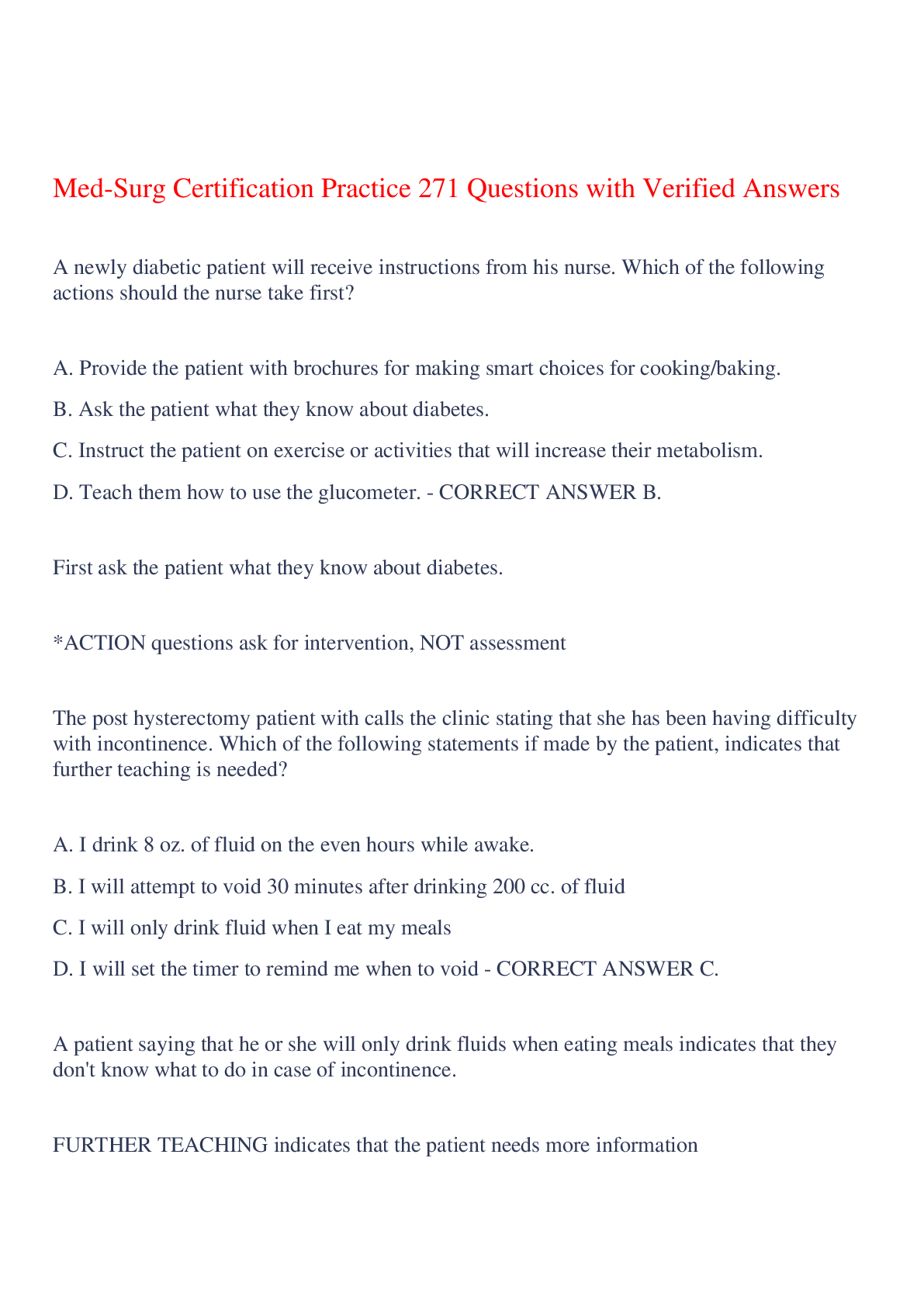
COM 312 Test 1|69 Questions with Verified Answers
Conflict - CORRECT ANSWER an expressed struggle between at least two interdependent parties who perceive incompatible goals, scarce resources, and interference from others in achieving their goals.
Intrapersonal conflict - CORRECT ANSWER internal strain that creates a state of ambivalence, conflicting internal dialogue, or lack of resolution in one's thinking and feeling
interpersonal conflict - CORRECT ANSWER an expressed struggle between interdependent parties
most expressed struggles are activated by? - CORRECT ANSWER a triggering event
perceived incompatible goals - CORRECT ANSWER the parties either want exactly the same thing or opposites
biggest perceived scarce resources - CORRECT ANSWER power and self esteem
destructive conflict - CORRECT ANSWER when all participants are dissatisfied with the outcomes of a conflict and think they have lost as a result
4 horsemen of the apocalypse - CORRECT ANSWER criticism, defensiveness, stonewalling, contempt
defensive climate - CORRECT ANSWER Evaluation, Control, Strategy, Neutrality, Superiority, Certainty
supportive climate - CORRECT ANSWER description, problem solving, spontaneity, empathy, equality, provisionalism
Escalatory spirals - CORRECT ANSWER behaviors - perceptions of the other- perceptions of the relationship- disintegration (with each party viewing oneself as not responsible for any of it)
Avoidance spirals - CORRECT ANSWER Less direct interaction - Active avoidance of the other party - Reduction of dependence - Harboring of resentment or disappointment - Complaining to third persons about the other party
attack/withdrawal pattern - CORRECT ANSWER passive aggressive
Reciprocity of emotions - CORRECT ANSWER you mirror the other person's emotions
avoidant system - CORRECT ANSWER members avoid most conflict (denial of the conflict, changing and avoiding topics, being noncommittal, and joking rather than dealing with the conflict at hand)
collaborative system - CORRECT ANSWER members use cooperation and collaboration
aggressive/coercive system - CORRECT ANSWER members engage in overt yelling, calling of names, blaming, scapegoating, and similar aggressive moves
worldview - CORRECT ANSWER The cognitive, ethical, and perceptual frames of an individual
mood - CORRECT ANSWER Level of consciousness and consistency that we have at any given time
topic goals - CORRECT ANSWER what do we want? (holiday plans, money, buying a house, etc)
relational goals - CORRECT ANSWER Who are we to each other? (The heart of conflict!)
identity / face saving goals - CORRECT ANSWER Who am I? The desire to maintain your identity of yourself, which isn't accurate. Do you save your face or give the person a way out or a chance to save their face?
process goals - CORRECT ANSWER What communication process will be used?
Prospective goals - CORRECT ANSWER Intentions people hold before they engage in conflict
Transactive goals - CORRECT ANSWER Goals discovered during conflict itself
Retrospective goals - CORRECT ANSWER goals that emerge after the conflict is over
Reactive behavior - CORRECT ANSWER making choices based on what we think the other person is thinking and intending
Estimating others goals - CORRECT ANSWER we act based on what we think the other person wants
Collaborative goals - CORRECT ANSWER Short-, medium-, and long-range issues are addressed.
Goals are behaviorally specific.
Statements orient toward the present and future.
Goals recognize interdependence.
Collaborative goals recognize an ongoing process.
Distributive power - CORRECT ANSWER (Either/Or) Power that's cant be shared, it's held over other people. One person has the power, they command you.
Integrative power - CORRECT ANSWER (Sharing Powers usually equal in this situation) Both parties are able to share the power. Doesn't make sense in a lot of situations (school, military, food service).
Designated power - CORRECT ANSWER Power derived from your position (marshal resources, assign grades, give orders, command people)
Power - CORRECT ANSWER Relational/fluid, product of our communicative relationships
Interpersonal power - CORRECT ANSWER Ability to influence a relational partner in any context bc you control, or at least the partner perceives that you control, resources that the partner needs, values, desires, or fears
What's the primary disadvantage to integration? - CORRECT ANSWER The time it takes to work
Because integration addresses needs of all parties, it's considered the best conflict management style. - CORRECT ANSWER FALSE. It's annoying, labor intensive
A professor that consistently double books appointments w/ someone she doesn't want to deal w/ is engaging in? - CORRECT ANSWER (C) passive aggressive style (she's not disengaging, she's actually engaging and creating more conflict)
In a conflict situation, if you try to use your authority to make a decision in your favor, you're using which conflict style? - CORRECT ANSWER (B) dominating style
Which of the following is true of patterns of violence? - CORRECT ANSWER (E) husbands are more likely than wives to minimize and deny their violence
What's a good threat? - CORRECT ANSWER Are you willing to follow through, bullying
A newlywed couple is trying to solve their issues but the wife doesn't take the husband seriously during their meetings. The meetings are times to shut out distractions and find a solution. What's the paramount goal? - CORRECT ANSWER The process goal
If you feel excluded from making an important decision, the element you're most likely concerned with is? - CORRECT ANSWER The process
"Well you don't have to be so nasty about it" attacks what? - CORRECT ANSWER Identity
Which of the following is generally true about research regarding gender differences in conflict? - CORRECT ANSWER (D) women are more likely to avoid a conflict than men
Which of the following isn't true about the nature of overlapping trip goals? - CORRECT ANSWER (C) in serious dispute, content only solutions are most satisfying
Which of the following statements isn't true about relational issues and identity? - CORRECT ANSWER A
denying power - CORRECT ANSWER denying you said something or someone said something to you or denying the situation as a whole
conflict styles - CORRECT ANSWER patterned responses, or clusters of behavior, that people use in conflict
avoid/criticize loop - CORRECT ANSWER avoiding the topic while criticizing another person directly or indirectly
dominating style of conflict - CORRECT ANSWER (my way) aggressive and uncooperative behavior—pursuing your own concerns at the expense of another
compromising style of conflict - CORRECT ANSWER (half way) some gains and some losses for each party. It is moderately assertive and cooperative.
accommodating/obliging style of conflict - CORRECT ANSWER (your way) does not assert individual needs but prefers a cooperative and harmonizing approach. sets aside their concerns in favor of pleasing the other people involved.
integrating/collaborating style of conflict - CORRECT ANSWER (our way) making descriptive and disclosing statements and soliciting reactions from the other party. You make concessions when necessary and accept respon-sibility for your part in the conflict. Integrating does not mean taking total responsibility
macro-level analysis - CORRECT ANSWER wholeness, organization, patterning
microevents - CORRECT ANSWER Repetitive loops of observable interpersonal behaviors with a redundant outcome (he initiates, she reluctantly agrees, no discussion of the relationship occurs, neither address the underlying concerns, the conflict isn't settled)
(the systems theory) a full analysis of conflict is done by? - CORRECT ANSWER (1) describing the workings of the overall system and how those connect to (2) recurring communication patterns inside the system
conflict as a chain reaction - CORRECT ANSWER one member responds to a situation, the other members must consciously or unconsciously respond to the movement in the system
coalition - CORRECT ANSWER when some are closer to each other than they are to others. A private bond emerges. (ppl outside the coalition are the outcasts, outsiders, etc.)
reasons to form coalitions - CORRECT ANSWER (1) share topic information, (2) get support and understanding, (3) have a sense of belonging, and (4) gain power
rice model of power - CORRECT ANSWER reach, impact, confidence and effort
power currencies - CORRECT ANSWER how much your particular resources are valued by the other persons in a relationship context. Power depends on the ability to employ currencies that other people need.
normative power - CORRECT ANSWER The use of common norms (values, beliefs, ideology, pledge of allegiance, dress codes) as a basis of influencing other actors' behavior.
Resource control - CORRECT ANSWER Often comes with one's formal position in an organization or group. An example is the controlling of rewards or punishments such as salary, number of hours worked, or firing. Parents control resources such as money, freedom, cars, and privacy for teenagers.
Interpersonal linkages - CORRECT ANSWER Your position in the larger system, such as being central to the communi-cation exchange. If you are a liaison person between two factions, serve as a bridge between two groups that would otherwise not have information about each other, or have a network of friends who like each other, you have linkage currencies.
Communication skills - CORRECT ANSWER Conversational skills, persuasive ability, listening skills, group leadership skills, the ability to communicate caring and warmth, and the ability to form close bonds with others all contribute to interpersonal power. All people need to be related to others, to matter to others, and to be understood by others. Those who communicate well gain value and thus interpersonal power.
Expertise - CORRECT ANSWER Special knowledge, skills, and talents that are useful for the task at hand. Being an expert in a content area such as budget analysis, computer skills, fixing houses, or local knowl-edge of real estate choices give you power when others need your expertise.
Empowerment - CORRECT ANSWER occurs when third parties are invested with the power to inter-vene on the behalf of less powerful persons. For instance, children who have been abused by their parents or caretakers can be empowered if their plight is reported to the proper agency. The legal system will provide attorneys, caseworkers to monitor the situation, counselors to work with the parents, judges to arbitrate decisions involving the children, and free services to help the children recover from the effects of the abuse
threat - CORRECT ANSWER 1. source must control the outcome and
2. sanction/threat must be seen as negative by the recipient.
("If you don't go to bed in three minutes, I won't read you a story")
warning - CORRECT ANSWER a comment- the source does not control the outcome (a friend says, "If you don't get your paper in on time, it will hurt your grade")
[Show More]











![Preview of eBook [PDF] Irwin and Rippe's Intensive Care Medicine 1st Edition By Richard S Irwin_ Crai](https://browseimages.nyc3.digitaloceanspaces.com/paper-images/2024/Aug/29/LgDadm8w2024-08-29-09-0966d01095d6f9d.png)
![Preview of eBook [PDF] Applied Therapeutics The Clinical Use of Drugs 12th Edition By Caroline S. Zei](https://browseimages.nyc3.digitaloceanspaces.com/paper-images/2024/Aug/29/gJZkPmEd2024-08-29-10-3866d0258f694bb.png)