EDF 6225 Exam 2|84 Questions with Verified Answers
Functional Relationship - CORRECT ANSWER the results of an experiment that describe the occurrence of the phenomena under study as a function of the operation of one
...
EDF 6225 Exam 2|84 Questions with Verified Answers
Functional Relationship - CORRECT ANSWER the results of an experiment that describe the occurrence of the phenomena under study as a function of the operation of one or more specified and controlled variables in the experiment in which specific change in one event (dependent variable) can be produced by manipulating another event (the independent variable) and that the change in the dependent variable was unlikely the result of other factors (confounding variable).
Functional Relationship - CORRECT ANSWER It shows specific manipulations of one event (IV) produce a change in other events (DV) and that change in the DV was unlikely the result of extraneous factors (confounding variables)- this finding is the....
Independent Variable (IV) - CORRECT ANSWER The variable that is systematically manipulated by the researcher in an experiment to see whether changes in the independent variable produce reliable changes in the dependent variable. In applied behavior analysis, it is usually an environment event or condition antecedent or consequent to the dependent variable. (sometimes called the intervention or treatment variable)
Dependent Variable (DV) - CORRECT ANSWER The measured behavior in an experiment to determine if it changes as a result of manipulations of the independent variable; in applied behavior analysis, it represents some measure of a socially significant behavior. (Target behavior)
antecedent - CORRECT ANSWER is the environmental conditions or stimulus changes that exist or occur prior to the behavior of interest.
Behavior - CORRECT ANSWER An organism's interaction with the environment.
Consequence - CORRECT ANSWER is anything immediately following a behavior in which we are interested.
Stimulus Class - CORRECT ANSWER A group of stimuli that are similar along one or more dimensions (for example, they look or sound similar, they have a common effect on behavior, or they occur at similar times relative to the response).
Stimulus Class - CORRECT ANSWER You show a student a banana, kiwi, strawberry and plum. You ask the student, "What are these?" The student says, "Fruit", even though they are all different fruits.
Response Class - CORRECT ANSWER is a group of responses that produce the same effect on the environment. (in other words, several behaviors that have the same function.)
Response Class - CORRECT ANSWER A patient engages in head banging, screaming, and hitting staff which all produce the same effect on the environment; the patient can escape their non-preferred therapies.
The 4 Reinforcer Dimensions - CORRECT ANSWER Rate of reinforcement, Quality of reinforcement, Reinforcer Delay, and Response effort.
Rate of reinforcement - CORRECT ANSWER is the number of reinforcements per time
Quality of reinforcement - CORRECT ANSWER how good is that reinforcer compared to other similar reinforcers
Reinforcer Delay - CORRECT ANSWER refers to whether access to reinforcers earned was immediate or delayed.
Response Effort - CORRECT ANSWER the amount of effort a person must put forth to successfully complete a specific behavior and can have a direct impact on the frequency with which the person will engage in that behavior
Hernstein's Matching Law - CORRECT ANSWER says that we (animals including humans) perform behaviors in a ratio that matches the ratio of available reinforcement for those behaviors.
The matching law - CORRECT ANSWER suggests that when different schedules of reinforcement are available at the same time for different behaviors, individuals will distribute their behavior according to the relative rates of reinforcement available for each option.
Time-out - CORRECT ANSWER The immediate response-contingent withdrawal of opportunity to earn positive reinforcement or the immediate loss of access to positive reinforcers for a specified time; a form of negative punishment.
Non-exclusion - CORRECT ANSWER student remains in the time-in setting.
Terminate Specific reinforcer contact - CORRECT ANSWER variation whereby each occurrence of the target behavior immediately stops an activity or sensory reinforcer.
contingent observation - CORRECT ANSWER the person is repositioned in the existing setting so they can observe what is going on but access to available reinforcers is lost.
Partition or Select Space Time-Out - CORRECT ANSWER student remains in time-in setting, but their view is restricted by a panel/cubicle, or select space is arranged to serve as a time-out area.
Exclusion Time-out - CORRECT ANSWER The physical separation of the participant from the time-in environment when time-out goes into effect.
Fixed Ratio - CORRECT ANSWER involve reinforcement after a certain number of responses have been emitted. This schedule involves using a constant number of responses.
Variable Ratio - CORRECT ANSWER schedules involve reinforcement after an average number of responses have occurred.
Fixed Interval - CORRECT ANSWER schedules involve reinforcing a behavior after a set time has passed.
Variable Interval - CORRECT ANSWER schedule involves reinforcing a behavior after an average of time has passed.
Differential Reinforcement of High Rates (DRH) - CORRECT ANSWER Reinforcement occurs only after several responses at or above a pre-established rate. There are times when a behavior is already in a student's repertoire, but you may want to increase the rate of the behavior.
Differential Reinforcement of Low Rate (DRL) - CORRECT ANSWER you reinforce gradually decreasing rates of behavior. This intervention is ideal for a behavior you want to reduce but not eliminate.
Differential Reinforcement of Diminishing Rates (DRD) - CORRECT ANSWER Providing reinforcement dependent upon the number of responses meeting or being below a predetermined limit during a specified time frame.
Lag Schedule - CORRECT ANSWER Schedule where the number of prior responses that the current response must differ from before receiving reinforcement.
Progressive Schedule of Reinforcement - CORRECT ANSWER Systematically thins each successive reinforcement opportunity within the session independent of the participant's behavior.
Delay to Reinforcement - CORRECT ANSWER Used to develop self-control.
Example: Do you want this now 3 points now? Or 6 points later?
Compound Schedules of Reinforcement - CORRECT ANSWER The combination of two or more schedules of reinforcement. They can occur simultaneously or successively. Can occur with or without Discriminative stimuli.
concurrent schedules of reinforcement - CORRECT ANSWER two or more contingencies of reinforcement (elements) operate independently and simultaneously for two or more behaviors.
Multiple Schedule of Reinforcement - CORRECT ANSWER a compound schedule of reinforcement consisting of two or more basic schedules of reinforcement (elements) that occur in an alternating, usually random, sequence; a discriminative stimulus is correlated with the presence or absence of each element of the schedule, and reinforcement is delivered for meeting the response requirements of the element in effect at any time.
behavioral contrast - CORRECT ANSWER occurs in a multiple schedule of reinforcement or punishment and describes what happens when a change in the schedule of one part of the reinforcement or punishment changes a behavior in an opposite direction in the other component of the schedule.
Chained Schedule of Reinforcement - CORRECT ANSWER the response requirements of two or more basic schedules must be met in a specific sequence before reinforcement is delivered; a discriminative stimulus is correlated with each component of the schedule.
Mixed Schedule of Reinforcement - CORRECT ANSWER two or more basic schedules of reinforcement (elements) that occur in an alternating, usually random, sequence; no discriminative stimuli are correlated with the presence or absence of each element of the schedule, and reinforcement is delivered for meeting the response requirements of the element in effect at any time.
Tandem Schedule of Reinforcement - CORRECT ANSWER a schedule of reinforcement identical to the chained schedule except, this schedule does not use discriminative stimuli with the elements in the chain.
Alternative Schedule of Reinforcement - CORRECT ANSWER provides reinforcement whenever the requirement of either a ratio schedule or an interval schedule - the basic schedules that makeup the alternative schedule - is met, regardless of which of the component schedule's requirements is met first.
Conjunctive Schedules of Reinforcement - CORRECT ANSWER This schedule is in effect whenever reinforcement follows the completion of response requirements for both a ratio schedule and an interval schedule of reinforcement.
Fixed Ratio - CORRECT ANSWER Reinforcing a child after every fifth math sheet is completed?
Variable Ratio - CORRECT ANSWER Reinforcing on average every third time a child exhibits sharing behavior?
Fixed Interval - CORRECT ANSWER Reinforcing a child every 2 min for being in a seat?
Variable Interval - CORRECT ANSWER Reinforcing on average every 3 min for science work?
Concurrent Schedule - CORRECT ANSWER a pigeon in a box might be faced with two pecking keys; pecking responses can be made on either, and food reinforcement might follow a peck on either. The schedules of reinforcement arranged for pecks on the two keys can be different.
Multiple Schedule - CORRECT ANSWER In the presence of a red light, key pecking is reinforced on a fixed-ratio schedule and in the presence of a green light, key pecking is reinforced on a fixed-interval schedule.
Chained Schedule - CORRECT ANSWER Many of our activities of daily living such as hygiene routines, domestic chores and following a recipe fit into a..?
Tandem Schedule - CORRECT ANSWER FI 10 FR 5 a reinforcement occurs when 5 responses have been executed after a 10 minute interval has elapsed.
Alternative Schedule - CORRECT ANSWER FR 10 Fl 60-s, the tenth response or the first response after 1 minute is reinforced, whichever comes first, and both schedule requirements then start over.
Conjunctive Schedule - CORRECT ANSWER a response is reinforced after 10 minutes and after 100 responses have been emitted, both of these since the preceding reinforcement.
Intermittent schedule of reinforcement - CORRECT ANSWER When some but not all occurrences of a behavior result in the delivery of reinforcement.
continuous reinforcement - CORRECT ANSWER provides a reinforcement each and every time a behavior is emitted.
Extinction - CORRECT ANSWER previously reinforced behavior that is no longer reinforced at all.
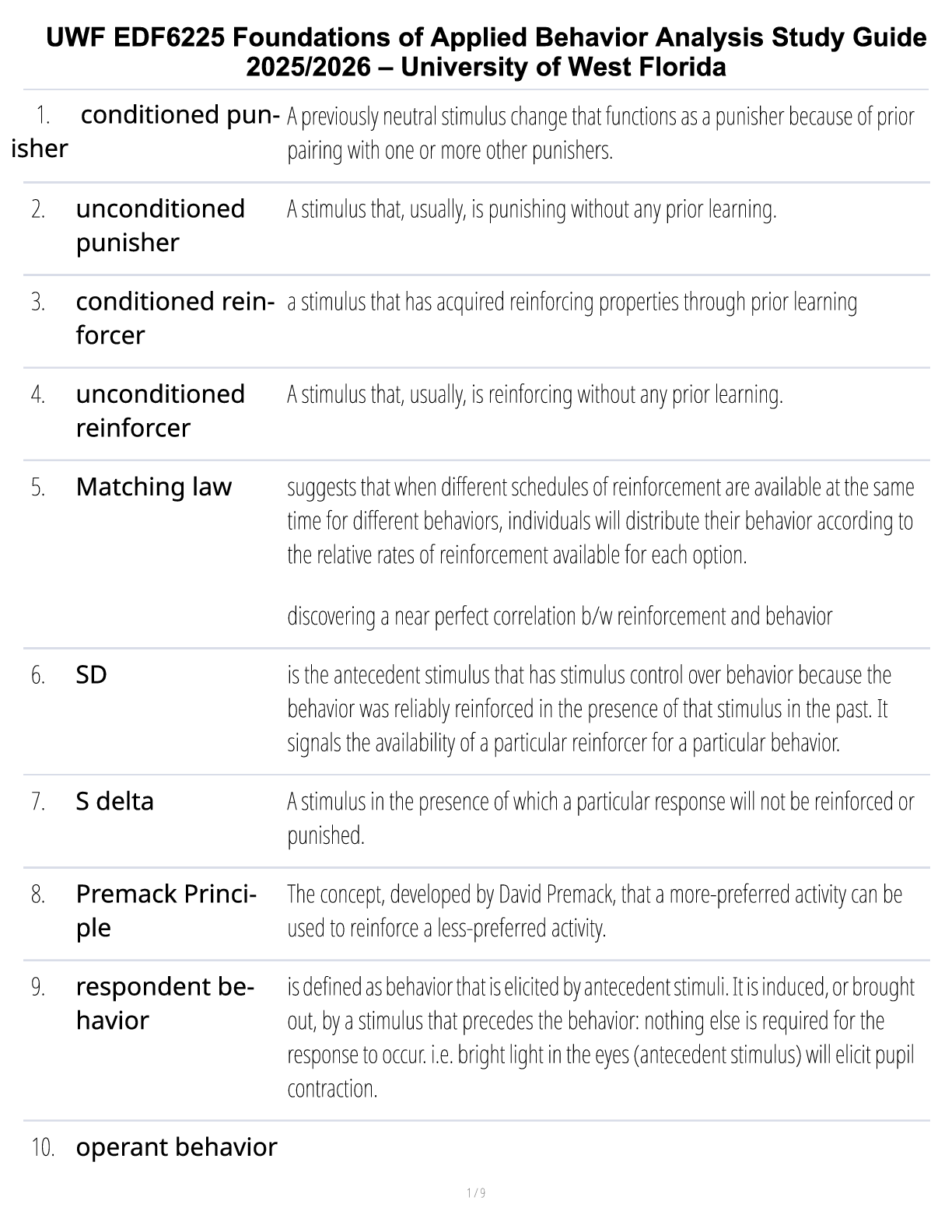
conditioned punisher - CORRECT ANSWER A previously neutral stimulus changes that functions as a punisher due to prior pairing with one or more other punishers.
Unconditioned Punisher - CORRECT ANSWER Punishment that works without prior learning (in other words, living things come into the world with a need to avoid these things "built in" to their biology)
conditioned reinforcer - CORRECT ANSWER is also called a secondary reinforcer. It is something that needs to be learned through pairings with unconditioned reinforcers.
Edible Reinforcers - CORRECT ANSWER Highly preferred food items.
Sensory Reinforcers - CORRECT ANSWER Anything that affects pleasure to the senses of the individual. Again, it has to be something that the person likes, otherwise, it is not going to be a reinforcer. This can include massage, music, or a beautiful painting.
tangible reinforcers - CORRECT ANSWER Any tangible item that the person values. This can be money, stickers or tokens.
activity reinforcers - CORRECT ANSWER The opportunity to have some fun. This is anything the person enjoys doing: going fishing, watching TV, jumping on a trampoline.
social reinforcer - CORRECT ANSWER Any positive or desired attention or interaction with another person can serve to reinforce.
Unconditioned Reinforcer - CORRECT ANSWER is also called a primary reinforcer. These are reinforcers that do not need to be learned, such as food, water, oxygen, warmth and sex. These are all primary drives that we have for basic survival and if they are deprived in any way, gaining access to these reinforcers is very motivating.
restitution - CORRECT ANSWER is based on having the person do what a normal individual might do to correct a situation.
restitutional overcorrection - CORRECT ANSWER is where the person corrects the consequences of their misbehavior by restoring the situation to an improved state from before the event.
positive practice overcorrection - CORRECT ANSWER where the person practices an activity with the appropriate behavior. Repeatedly removing gum from their mouth, wrapping it in paper, and placing it into the trash container.
Side Effects of Punishment - CORRECT ANSWER May lead to an increase in other undesirable behavior.
Can lead to problems such as escape & avoidance, emotional outbursts, and behavioral contrast.
escape - CORRECT ANSWER the occurrence of the behavior terminates the aversive stimulus. May lead to an increase in other undesirable behavior.
Avoidance - CORRECT ANSWER the occurrence of the behavior prevents the presentation of an aversive stimulus.
discriminative stimulus - CORRECT ANSWER discriminative stimulus
discriminative stimulus - CORRECT ANSWER it signals the availability of a particular reinforcer for a particular behavior.
Reinforcer - CORRECT ANSWER When a response is followed immediately by the presentation of a stimulus and, as a result, similar responses occur more frequently in the future.
Punisher - CORRECT ANSWER Any event that follows a response and decreases the rate of that behavior.
Premack Principle - CORRECT ANSWER Some professionals will also refer to this technique as "First/Then", "If/Then", or "High Probability/Low Probability".
Premack Principle - CORRECT ANSWER You need to eat all your vegetables if you want some chocolate cake". The child sees the yummy cake, and gulps down the peas in order to access the cake.
concurrent schedules of reinforcement assessment - CORRECT ANSWER pits two stimuli against each other to see which will produce the larger increase in responding when presented as a consequence for responding. The more effective reinforcer is the one that has more responses.
Multiple Schedules of reinforcement assessment - CORRECT ANSWER reinforcers are delivered for the same behavior, on the same schedule but at different times; an SD is present to signal which schedule is in effect. The more effective reinforcer is the one associated with the session with the highest rate of behavior.
Porgressive schedule of reinforcement assessment - CORRECT ANSWER response requirements for reinforcement are increased systematically independent of responding. The practitioner gradually requires more responses to receive reinforcement until a breaking point is reached and responding declines. A progressive ratio increases the behavior that must be emitted before receiving reinforcement. The reinforcers that produce the most behavior are considered the most reinforcing
Preference Assessments - CORRECT ANSWER Ask, Free Operant, Trial based,
Automatic Reinforcement - CORRECT ANSWER occurs when a person's behavior creates a favorable outcome without the involvement of another person.
Automatic Reinforcement - CORRECT ANSWER if you turn on your television.
the four-term contingency - CORRECT ANSWER antecedent, behavior, consequence, motivation
[Show More]