EDF 6225 Final Exam 82 Questions with Verified Answers
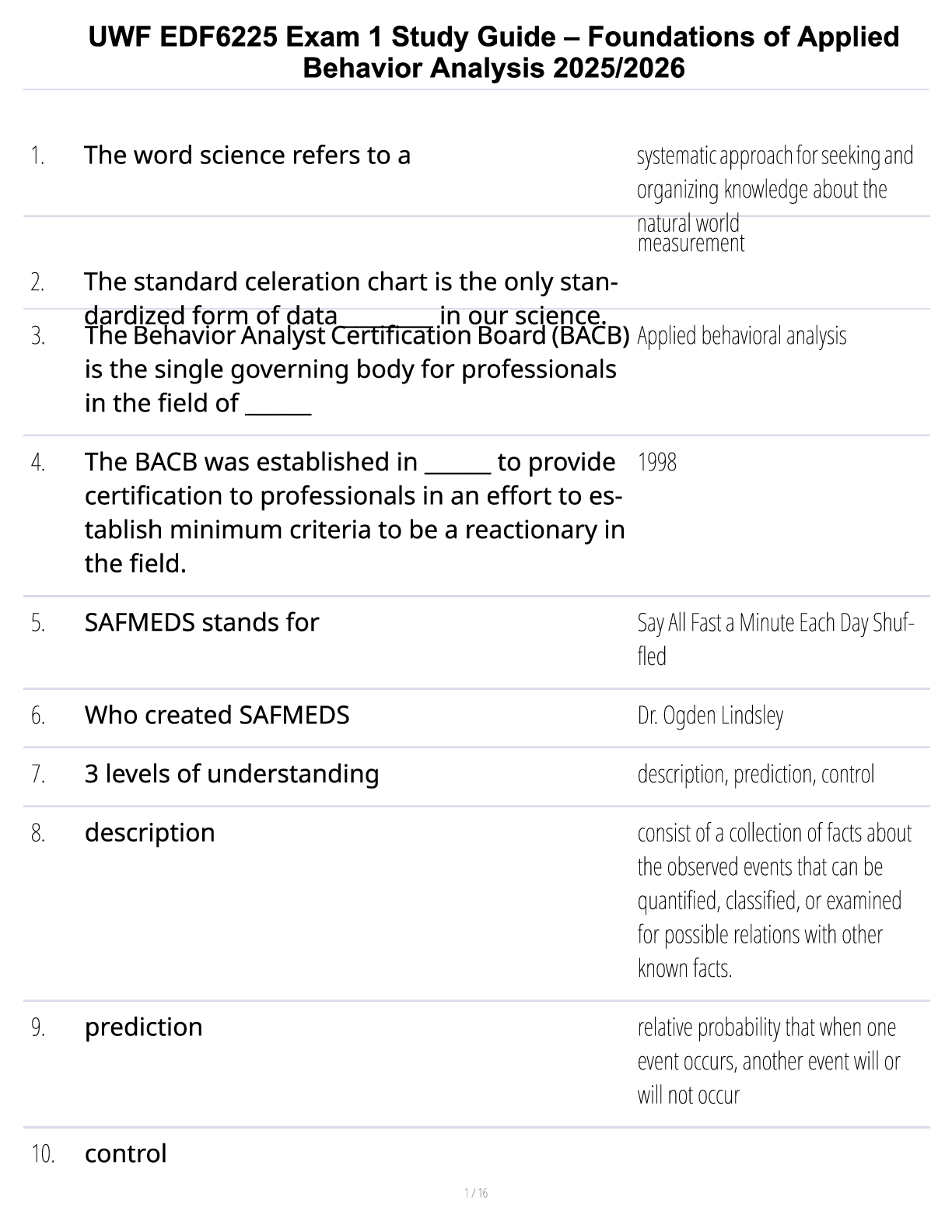
Conditioned punisher - CORRECT ANSWER A previously neutral stimulus change that functions as a punisher because of prior pairing with one or more other punishers.
...
EDF 6225 Final Exam 82 Questions with Verified Answers
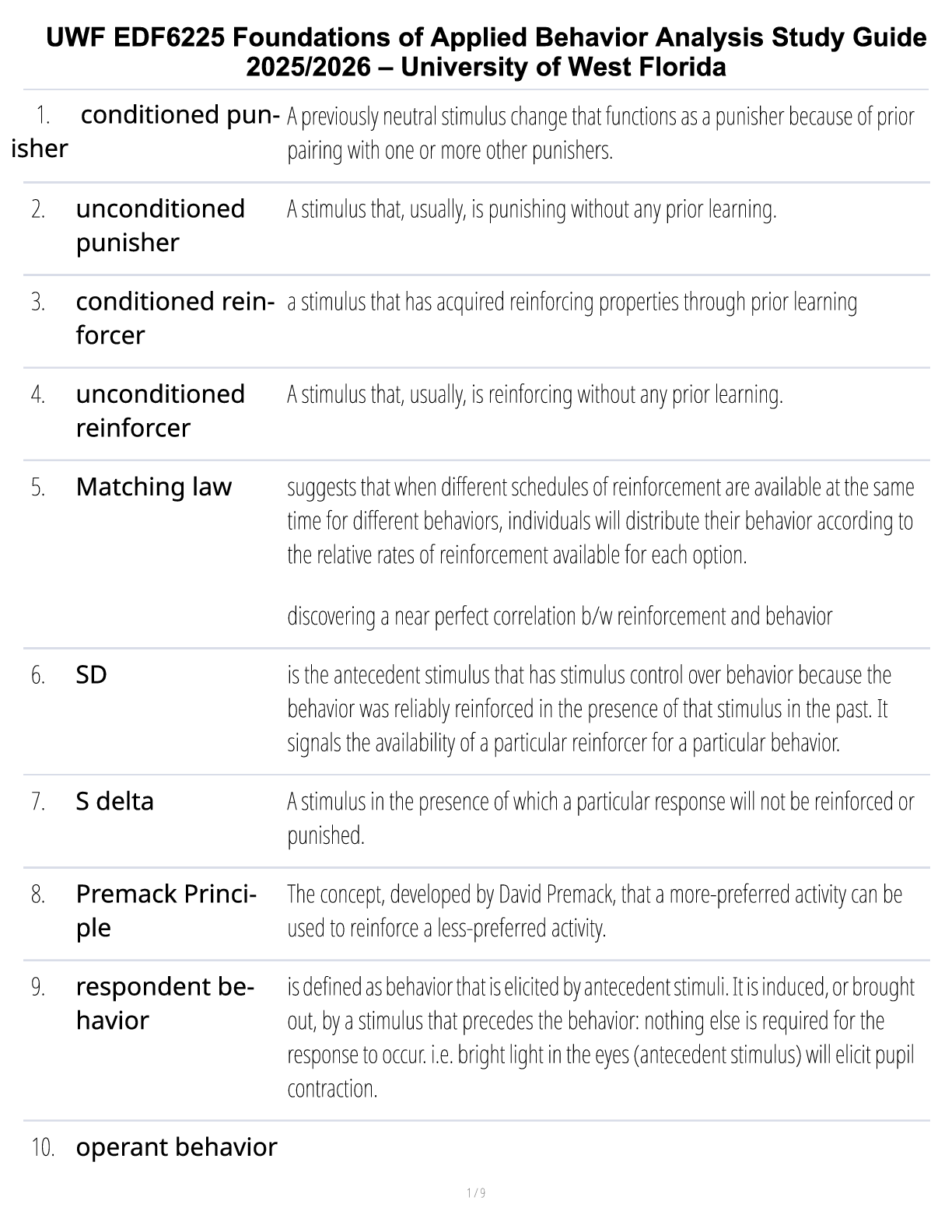
Conditioned punisher - CORRECT ANSWER A previously neutral stimulus change that functions as a punisher because of prior pairing with one or more other punishers.
unconditioned punisher - CORRECT ANSWER A stimulus that, usually, is punishing without any prior learning.
conditioned reinforcer - CORRECT ANSWER a stimulus that has acquired reinforcing properties through prior learning
Unconditioned Reinforcer - CORRECT ANSWER A stimulus that, usually, is reinforcing without any prior learning.
Side effects of punishment - CORRECT ANSWER May lead to an increase in other undesirable behavior.
Can lead to problems such as escape & avoidance, emotional outbursts, and behavioral contrast.
Reinforcer - CORRECT ANSWER any event that strengthens the behavior it follows
Punisher - CORRECT ANSWER A stimulus change that decreases the future frequency of behavior that immediately precedes it.
Hernstein's Matching Law - CORRECT ANSWER suggests that when different schedules of reinforcement are available at the same time for different behaviors, individuals will distribute their behavior according to the relative rates of reinforcement available for each option.
antecedent, behavior, consequence - CORRECT ANSWER The three-term contingency is made of these three terms:
antecedent - CORRECT ANSWER is the environmental conditions or stimulus changes that exist or occur prior to the behavior of interest.
behavior - CORRECT ANSWER An organism's interaction with the environment.
consequence - CORRECT ANSWER is anything immediately following a behavior in which we are interested. Makes the behavior more or less likely to happen in the future.
Discriminative Stimulus (SD) - CORRECT ANSWER is the antecedent stimulus that has stimulus control over behavior because the behavior was reliably reinforced in the presence of that stimulus in the past. It signals the availability of a particular reinforcer for a particular behavior.
Motivating Operation (MO) - CORRECT ANSWER influences the effectiveness of a reinforcer or punisher while also influencing the frequency of the specific behavior.
Premack Principle - CORRECT ANSWER Some professionals will also refer to this technique as "First/Then", "If/Then", or "High Probability/Low Probability."
Automatic Reinforcement - CORRECT ANSWER reinforcement that occurs independent of the social mediation of others.
when a person's behavior creates a favorable outcome without the involvement of another person.
Response - CORRECT ANSWER An action or change in behavior that occurs as a result of a stimulus.
Is a single instance of behavior.
respondent behavior - CORRECT ANSWER is defined as behavior that is elicited by antecedent stimuli.
It is induced, or brought out, by a stimulus that precedes the behavior: nothing else is required for the response to occur.
i.e. bright light in the eyes (antecedent stimulus) will elicit pupil contraction.
operant behavior - CORRECT ANSWER Behavior that is selected, maintained, and brought under stimulus control as a function of its consequences.
each person's repertoire of this type of behavior is a product of his history of interactions with the environment
Radical Behaviorism (Skinner) - CORRECT ANSWER attempts to understand all human behavior, including private events such as thoughts and feelings, in terms of controlling variables in the history of the person and the species.
methodological behaviorism - CORRECT ANSWER a philosophical position that views behavioral events that cannot be publicly observed as outside the realm of science.
It acknowledges the existence of mental events but do not consider them in the analysis of behavior.
Independent Variable (IV) - CORRECT ANSWER The variable that is systematically manipulated by the researcher in an experiment to see whether changes in this variable will produce reliable changes in the dependent variable.
In applied behavior analysis, it is usually an environment event or condition antecedent or consequent to the dependent variable. (sometimes called the intervention or treatment variable)
Dependent Variable (DV) - CORRECT ANSWER The measured behavior in an experiment to determine if it changes as a result of manipulations of the independent variable; in applied behavior analysis, it represents some measure of a socially significant behavior. (Target behavior)
Scientific Attitudes (Skinner..DEERPP) - CORRECT ANSWER Determinism,
Empiricism,
Experimentation,
Replication,
Parsimony,
Philosophic Doubt.
Determinism - CORRECT ANSWER assumes that all behavior is the result of certain events. Once these events are identified, future occurrences of a behavior can be modified.
Empiricism - CORRECT ANSWER is the practice of objective observation of the phenomena of interest. experiment. a type of research activity that involves changing only one component of an individual's environment (IV) to see its effect on some specified behavior (DV) experimental analysis of behavior (EAB)
This is the OBSERVATION and DATA taking part of ABA.
Experimentation - CORRECT ANSWER is the manipulation of variables and taking measurements and collecting data yields answers. It is a controlled comparison of some measure of the phenomenon of interest (DV) under two or more different conditions in which only one factor at a time (IV) differs from one condition to another.
Replication - CORRECT ANSWER is the repeating of experiments (as well as repeating IV conditions within experiments). Replication is the primary method scientists determine the reliability and usefulness of their findings and discover their mistakes.
parsimony - CORRECT ANSWER requires that all simple, logical explanations for the phenomenon under investigation be ruled out, experimentally or conceptually, before more complex or abstract explanations are considered.
In other words, given a choice between two competing and compelling explanations for the same phenomenon, one should shave off extraneous variables and choose the simplest explanation, the one that requires the fewest assumptions.
CHOOSING THE SIMPLEST AND MOST LOGICAL EXPLANATION.
Philosophic Doubt - CORRECT ANSWER requires the scientist to continually question the truthfulness of what is regarded as fact. Good scientists maintain a healthy level of skepticism. It's an attitude that the truthfulness and validity of all scientific theory and knowledge should be continually questioned.
QUESTION EVERYTHING!
3 levels of scientific understanding (DPC) - CORRECT ANSWER description, prediction, control
description - CORRECT ANSWER enhances the understanding of a given phenomenon. Descriptive knowledge consists of a collection of facts about the observed events that can be quantified, classified, and examined for possible relations with other known facts.
prediction - CORRECT ANSWER occurs when repeated observations reveal that two events consistently covary with each other. When in the presence of one event another event occurs with some specified probability.
Control - CORRECT ANSWER the highest level of scientific understanding. When you are able to arrange conditions and manipulate the environment.
Momentary Time Sampling - CORRECT ANSWER the observer marks down whether or not the behavior was occurring at the moment the interval ended.
Whole Interval Recording - CORRECT ANSWER the observer records whether the target behavior occurred throughout the entire interval; tends to underestimate the proportion of the observation period that many behaviors actually occurred.
Partial Interval Recording - CORRECT ANSWER a time sampling method in which the observer records whether the target behavior occurred at any time during the interval.
planned activity check (PLACHECK) - CORRECT ANSWER a variation of momentary time sampling in which the observer records whether each person in a group is engaged in the target behavior at specific points in time; provides a measure of "group behavior"
Interobserver Agreement (IOA) - CORRECT ANSWER The degree to which 2 or more independent observers report the same observed values after measuring the same events
4 Methods for collecting IOA - CORRECT ANSWER total count IOA,
mean count-per-interval IOA,
exact count-per-interval IOA,
trial-by-trial IOA.
total count IOA formula - CORRECT ANSWER Smaller count/Larger count x 100 = %
mean count-per-interval IOA formula - CORRECT ANSWER (Int.1 IOA + Int. 2 IOA + Int.N IOA)/n intervals x 100= %
exact count-per-interval IOA formula - CORRECT ANSWER N Intervals of 100% IOA/N intervals x 100 = %
trial-by-trial IOA formula - CORRECT ANSWER Number of trial (items) agreement/Total number of trials (items) x 100= %
minimum agreement IOA - CORRECT ANSWER 80% agreement is the minimum agreement for research in ABA
observer reactivity - CORRECT ANSWER any measurement error that comes from an observers knowledge that others are evaluating the data that they report
observer bias - CORRECT ANSWER systematic errors in observation that occur because of an observer's expectations.
is the tendency to see what we expect to see, or what we want to see.
observer drift - CORRECT ANSWER Any unintended change in the way an observer uses a measurement system over the course of an investigation that results in measurement error.
Topography - CORRECT ANSWER is the physical form or shape of behavior. It describes behavior—specifically what the behavior looks like. defines instances of the targeted response class by the shape or form of the behavior. Specifically what behavior looks like.
magnitude - CORRECT ANSWER The force or intensity with which a response is emitted.
Frequency - CORRECT ANSWER behavior measurement generally refers to cycles per unit time, or a count (usually of behavior) divided by the time during which it occurred.
Duration - CORRECT ANSWER is a recording used to document the amount of time a student spends engaging in a behavior.
This type of data collection is appropriate for behaviors that have a distinct beginning and ending or for those that occur at very high rates (e.g., tantrumming, being out of seat, not completing a task).
Latency - CORRECT ANSWER is a recording that measures the amount of time that lapses between an antecedent (e.g., teacher's directive) and when the student begins to perform a specified behavior.
measurement by permanent product - CORRECT ANSWER measuring behavior after it has occurred by measuring the effects that the behavior produced on the environment.
direct measurement - CORRECT ANSWER Occurs when the behavior that is measured is the same as the behavior that is the focus of the investigation.
The individual measuring behavior takes data by being physically present and directly observing the behavior.
Examples: Frequency and duration are both examples of direct measurement.
indirect measurement - CORRECT ANSWER Occurs when the behavior that is measured is in some way different from the behavior of interest.
It is when the target behavior is not directly observed, conclusions are drawn from other behaviors or environmental events.
includes: Permanent product recording, self-monitoring, interviews, surveys and rating scales.
arbitrary stimulus class - CORRECT ANSWER contains stimuli that evoke the same response but do not share a common physical feature
stimulus control - CORRECT ANSWER Defined as a change in operant behavior that occurs when either an SD or S^ is presented. When an SD is presented, the probability of response increases; and when an S^ is given, operant behavior has a low probability of occurrence.
Stimulus/Prompt Salience - CORRECT ANSWER refers to how obvious or prominent a stimulus is in a person's environment.
If a person has visual deficits, then visual stimulus will not have as much salience as auditory stimulus, for example.
Masking - CORRECT ANSWER is when the salience of a stimulus is decreased. A competing stimulus blocks the evocative power of the stimulus, decreasing its effectiveness.
Overshadowing - CORRECT ANSWER is when the first stimulus has no more stimulus control.
stimulus equivalence - CORRECT ANSWER the emergence of accurate responding to untrained and nonreinforced stimulus-stimulus relations following the reinforcement of responses to some stimulus-stimulus relations.
In other words, it is when two forms of reinforced teaching lead to a third concept that was not taught or reinforced
Reflexivity - CORRECT ANSWER refers to the matching of a sample to itself, sometimes called identity matching (AA, BB, CC, in these examples, each letter pair represents a sample and its matching comparison stimulus).
symmetry - CORRECT ANSWER refers to the reversibility of a relation (if AB, then BA)
Transivity - CORRECT ANSWER refers to the transfer of the relation to new combinations through shared membership (if AB and BC, then AC).
Concept Formation - CORRECT ANSWER Requires Stimulus control that has attained generalization within a class of stimuli and discrimination between classes of stimuli.
stimulus generalization - CORRECT ANSWER learning that occurs when stimuli that are similar but not identical to the conditioned stimulus produce the conditioned response.
Satiation - CORRECT ANSWER A decrease in the frequency of operant behavior presumed to be the result of continued contact with or consumption of a reinforcer that has followed the behavior.
deprivation - CORRECT ANSWER is the absence or reduction of a reinforcer for a period of time. It is an establishing operation that increases the effectiveness of the reinforcer and the rate of behavior that produced that reinforcer in the past.
3 Types of CMOs - CORRECT ANSWER surrogate (CMO-S)
reflexive (CMO-R)
transitive (CMO-T)
Surrogate CMO (CMO-S) - CORRECT ANSWER A stimulus that acquires its MO effectiveness by being paired with another MO and has the same value-altering and behavior-altering effects as the MO with which it was paired.
CMO-S - CORRECT ANSWER EXAMPLE: Mom usually puts the baby to sleep. One day, dad tried to put the baby to sleep, but the baby didn't fall asleep. Mom usually wears a certain fuzzy house robe that the baby has paired with sleep. Dad wears mom's house robe and the pairing of the robe with dad helps the baby fall asleep.
Reflexive CMO (CMO-R) - CORRECT ANSWER a condition or an object that acquires its effectiveness as an MO by preceding a situation that either is worsening or improving. This signals to us that an aversive event may be occurring soon.
CMO-R - CORRECT ANSWER Example: The punishing coworker. In the presence of this person you "can't seem to do anything right" and are constantly punished. She is always finding fault with you. Because of this, you want to spend less time with this person and you avoid her. Soon the office associated with her takes on these aversive qualities and you avoid going anywhere near where this person might be. Even hearing their voice down the hallway may signal you to take an early lunch and avoid running into them (and therefore avoid possible punishment).
Transitive CMO (CMO-T) - CORRECT ANSWER An environmental variable that establishes (or abolishes) the reinforcing effectiveness of another stimulus and thereby evokes (or abates) the behavior that has been reinforced by that other stimulus.
CMO-T - CORRECT ANSWER Example: Someone puts a lock on the fridge. This establishes the reinforcing value of a key (key becomes the ____________) when access to food is valuable as a source of reinforcement.
unconditioned motivating operation (UMO) - CORRECT ANSWER A motivating operation whose value-altering effect does not depend on a learning history. For example, food deprivation increases the reinforcing effectiveness of food without the necessity of any learning history.
UMO - CORRECT ANSWER include states such as being tired, hungry, thirsty and wanting of activity.
A clear example, if you are stranded on an island without food the need to satisfy hunger would be reinforced. This association would not have to have been previously learned.
Establishing Operation (EO) - CORRECT ANSWER A motivating operation that establishes (increases) the effectiveness of some stimulus, object, or event as a reinforcer. For example, food deprivation establishes food as an effective reinforcer.
Abolishing Operation (AO) - CORRECT ANSWER A motivating operation that decreases the reinforcing effectiveness of a stimulus, object, or event. For example, the reinforcing effectiveness of food is abolished as a result of food ingestion.
evocative effect - CORRECT ANSWER an increase in the current frequency of behavior that has been reinforced by the stimulus that is increased in reinforcing effectiveness by the same motivating operation.
Example, when the organism is deprived of food, there will be an increase in behaviors (e.g., foraging) that have been reinforced with food in the past.
abative effect - CORRECT ANSWER A decrease in the current frequency of behavior that has been reinforced by the stimulus that is increased in reinforcing effectiveness by the same motivating operation.
Example: food ingestion abates (decreases the current frequency of) behavior that has been reinforced by food. abolishing operation (AO)
[Show More]