PSYC 2008 LEARNING COMPLETED EXAM WITH RATIONALES . Which of the following best describes classical conditioning?
a) Learning through active engagement with the environment
b) Learning through the association
...
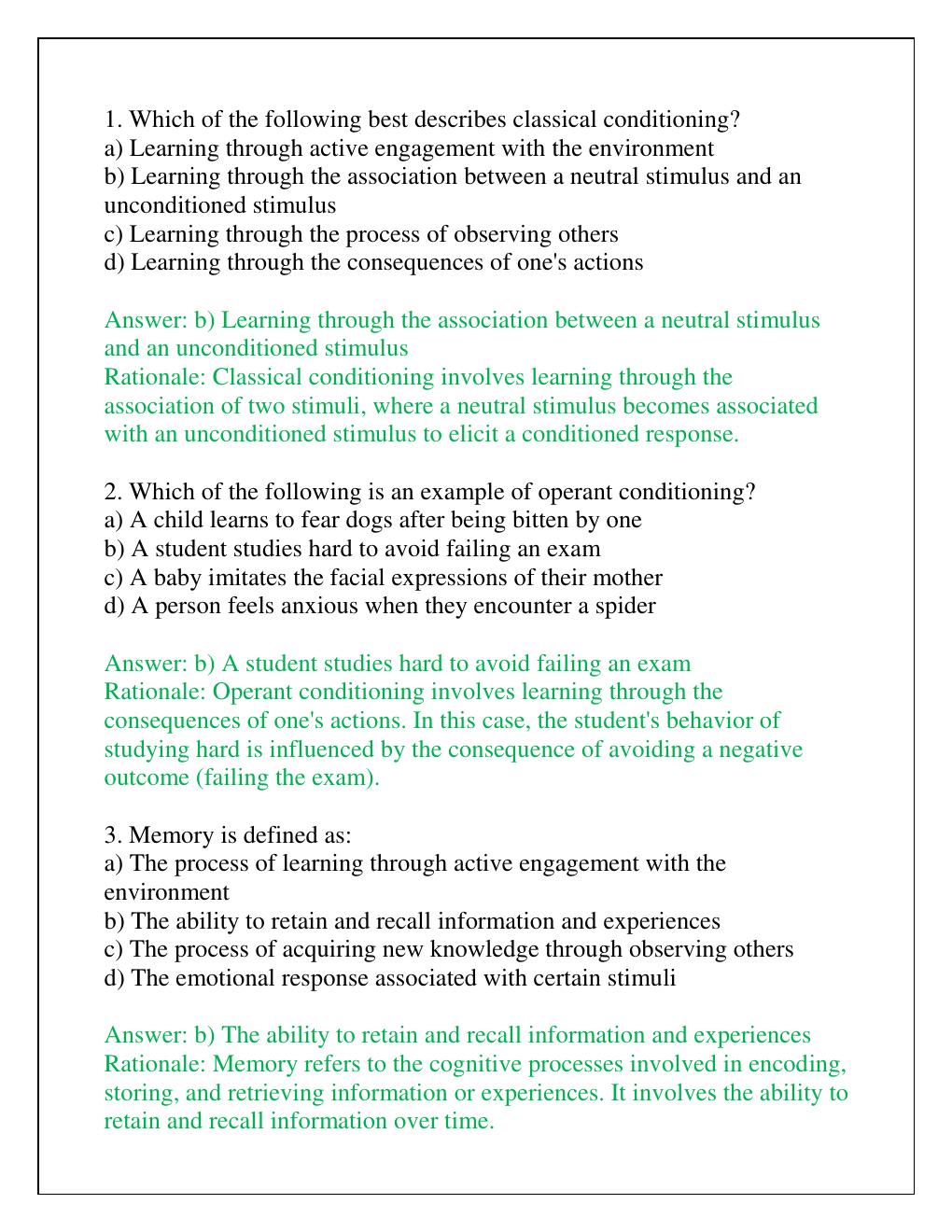
PSYC 2008 LEARNING COMPLETED EXAM WITH RATIONALES . Which of the following best describes classical conditioning?
a) Learning through active engagement with the environment
b) Learning through the association between a neutral stimulus and an unconditioned stimulus
c) Learning through the process of observing others
d) Learning through the consequences of one's actions
Answer: b) Learning through the association between a neutral stimulus and an unconditioned stimulus
Rationale: Classical conditioning involves learning through the association of two stimuli, where a neutral stimulus becomes associated with an unconditioned stimulus to elicit a conditioned response.
2. Which of the following is an example of operant conditioning?
a) A child learns to fear dogs after being bitten by one
b) A student studies hard to avoid failing an exam
c) A baby imitates the facial expressions of their mother
d) A person feels anxious when they encounter a spider
Answer: b) A student studies hard to avoid failing an exam
Rationale: Operant conditioning involves learning through the consequences of one's actions. In this case, the student's behavior of studying hard is influenced by the consequence of avoiding a negative outcome (failing the exam).
3. Memory is defined as:
a) The process of learning through active engagement with the environment
b) The ability to retain and recall information and experiences
c) The process of acquiring new knowledge through observing others
d) The emotional response associated with certain stimuli
Answer: b) The ability to retain and recall information and experiences
Rationale: Memory refers to the cognitive processes involved in encoding, storing, and retrieving information or experiences. It involves the ability to retain and recall information over time.
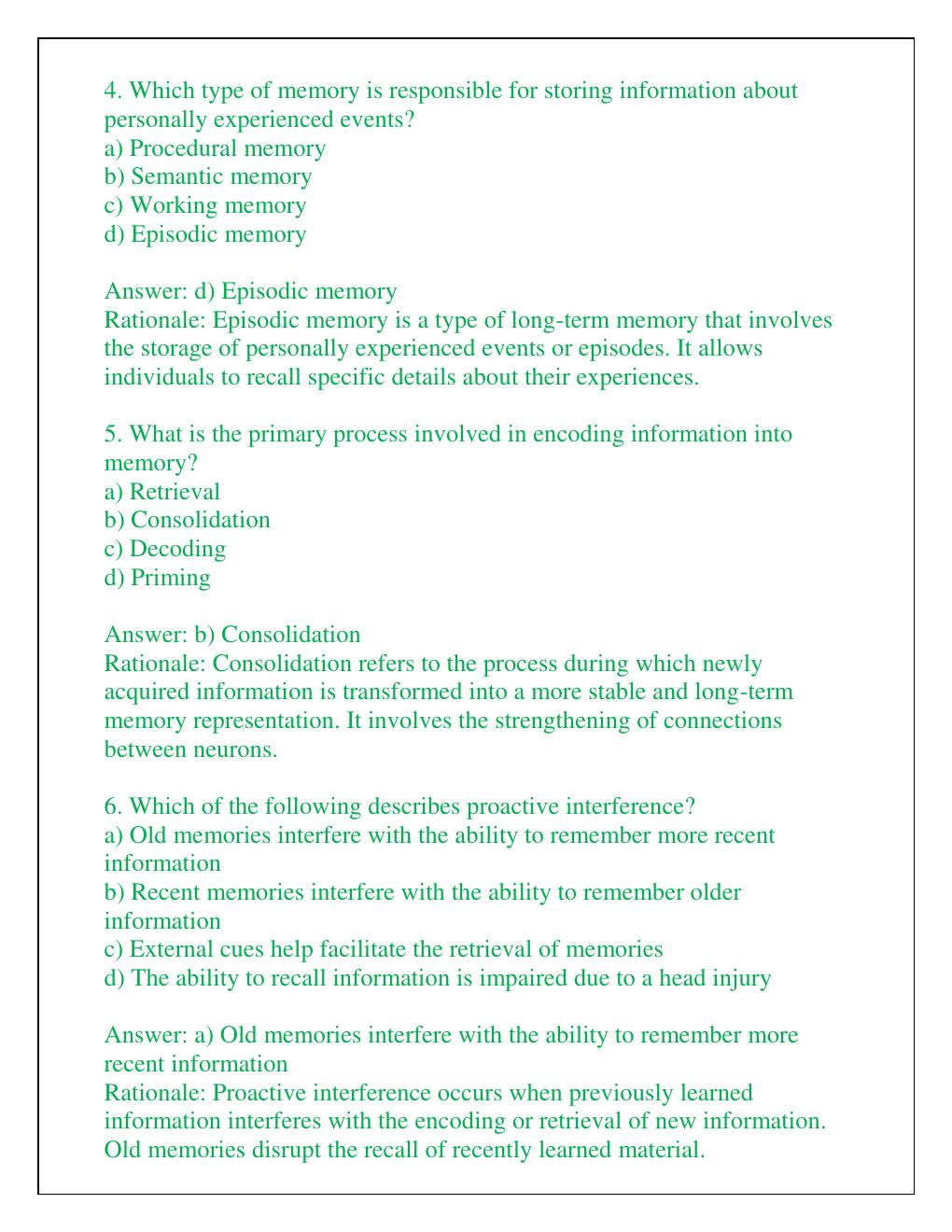
4. Which type of memory is responsible for storing information about personally experienced events?
a) Procedural memory
b) Semantic memory
c) Working memory
d) Episodic memory
Answer: d) Episodic memory
Rationale: Episodic memory is a type of long-term memory that involves the storage of personally experienced events or episodes. It allows individuals to recall specific details about their experiences.
5. What is the primary process involved in encoding information into memory?
a) Retrieval
b) Consolidation
c) Decoding
d) Priming
Answer: b) Consolidation
Rationale: Consolidation refers to the process during which newly acquired information is transformed into a more stable and long-term memory representation. It involves the strengthening of connections between neurons.
6. Which of the following describes proactive interference?
a) Old memories interfere with the ability to remember more recent information
b) Recent memories interfere with the ability to remember older information
c) External cues help facilitate the retrieval of memories
d) The ability to recall information is impaired due to a head injury
Answer: a) Old memories interfere with the ability to remember more recent information
Rationale: Proactive interference occurs when previously learned information interferes with the encoding or retrieval of new information. Old memories disrupt the recall of recently learned material.
7. According to the levels of processing theory, which of the following processing levels would result in the deepest level of encoding?
a) Rehearsing information repeatedly
b) Paying attention to the physical features of information
c) Relating the information to personal experiences
d) Recognizing familiar information
Answer: c) Relating the information to personal experiences
Rationale: The levels of processing theory suggests that the depth of processing affects the strength of the memory trace. Relating information to personal experiences involves a deep level of processing, which leads to better memory retention.
8. What is the role of the hippocampus in memory?
a) It controls the retrieval of memories
b) It stores long-term memories
c) It processes visual information
d) It is involved in the formation of new m