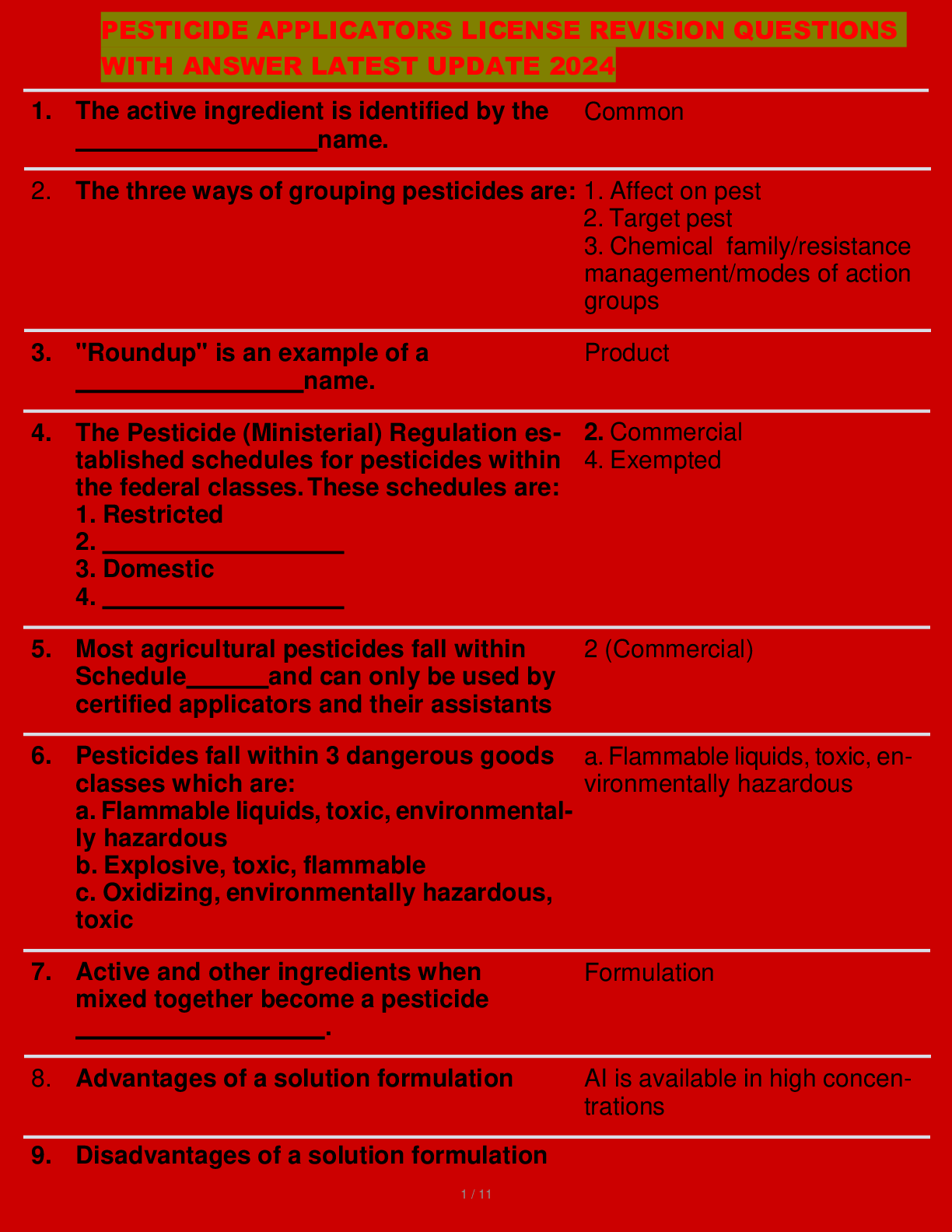
PESTICIDE APPLICATORS LICENSE REVISION QUESTIONS WITH ANSWER LATEST UPDATE 2024
1. The active ingredient is identified by the
name.
Common
2. The three ways of grouping pesticides are: 1. Affect on pest
...
PESTICIDE APPLICATORS LICENSE REVISION QUESTIONS WITH ANSWER LATEST UPDATE 2024
1. The active ingredient is identified by the
name.
Common
2. The three ways of grouping pesticides are: 1. Affect on pest
2. Target pest
3. Chemical family/resistance management/modes of action groups
3. "Roundup" is an example of a
name.
4. The Pesticide (Ministerial) Regulation es- tablished schedules for pesticides within the federal classes. These schedules are:
1. Restricted
2.
3. Domestic
4.
5. Most agricultural pesticides fall within Schedule and can only be used by certified applicators and their assistants
6. Pesticides fall within 3 dangerous goods classes which are:
a. Flammable liquids, toxic, environmental- ly hazardous
b. Explosive, toxic, flammable
c. Oxidizing, environmentally hazardous, toxic
7. Active and other ingredients when mixed together become a pesticide
.
Product
2. Commercial
4. Exempted
2 (Commercial)
a. Flammable liquids, toxic, en- vironmentally hazardous
Formulation
8. Advantages of a solution formulation AI is available in high concen-
trations
9. Disadvantages of a solution formulation
10. Advantages of emulsifiable concentrate formulation
Higher risk of exposure due to higher concentration of AI
Limited agitation required
11. Disadvantages of emulsifiable concentrate Higher phytotoxicity hazard
formulation
12. Advantages of Flowable formulations Rarely clogs nozzels
13. Disadvantages of Flowable formulations Mix needs constant agitation
14. The classes of TDG that apply to pesticides are?
a) 1, 3, 4
b) 2, 3,6.2
C) 3, 6.1, 9
C) 3, 6.1, 9
15. Advantages of Dust formulations Ready to use
16. Pesticides can fall into 3 classes of danger- ous goods, they are:
Flammable and combustible liq- uids, Poisonous (toxic) Liquids, and
Miscellaneous, including envi- ronmentally hazardous
17. Disadvantages of dust formulations Drift
18. Advantages and Disadvantages of Granule formulations
19. Advantages and disadvantages of Solu- able granules
20. Advantages and disadvantages of Solu- able powder
Advantages: Ready to use Disadvantages: Possible to in- hale dust
Advantages: Safe handling Disadvantages: Mixing re- quired
Advantages: Agitation needed only while mixing
21. Advantages and disadvantages of Wettable powder
22. Active ingredients are mixed with
for safer handling, easier application, and better storage
23. A formulation with AI's and edible carriers are known as .
24. Finely ground particles suspended in liq- uid carrier are known as
25. Wettable powders are typically applied as
.
26. Mixtures of pesticides that cause problems are termed
27. Adjuvants that assist in even distribution of product are called
28. Adjuvants that reduce the alkalinity of wa- ter are called .
Disadvantages: Inhalation hazard
Advantages: No heated stor- age needed
Disadvantages: High risk of exposure
Formulants
Baits
Flowable formulations Sprays
Incompatible Spreaders Buffers
29. The 6 elements of IPM are: 1. Prevention
2. Identification
3. Monitoring
4. Thresholds
5. Treatment
6. Evaluation
30. What are 6 things to check when monitor- ing for pests?
1. Pest damage
2. Pest presence and species abundance
[Show More]