Hyperbilirubinemia
UNFOLDING Reasoning
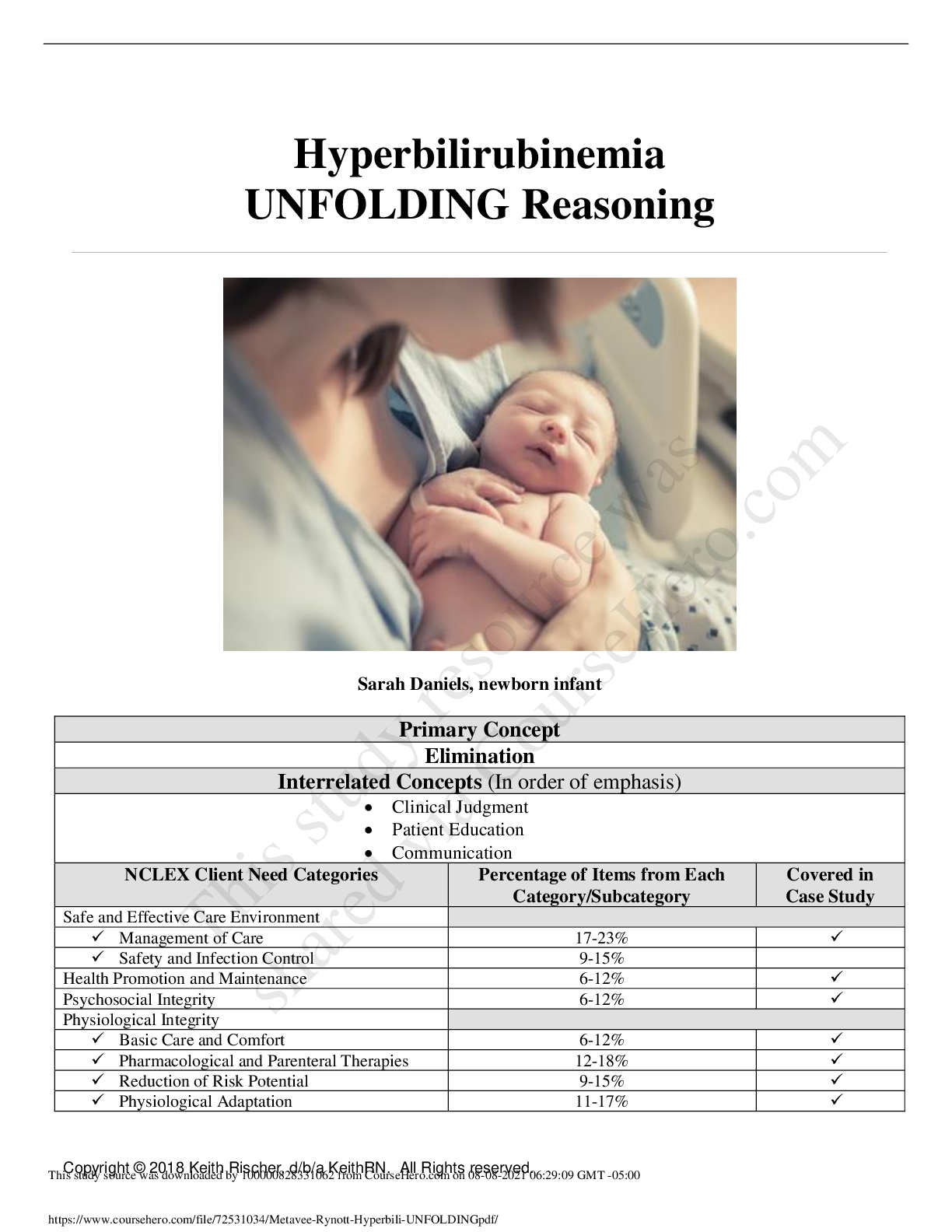
Sarah Daniels, newborn infant
Primary Concept
Elimination
Interrelated Concepts (In order of emphasis)
• Clinical Judgment
• Patient Education
• Communication
NCLEX Client
...
Hyperbilirubinemia
UNFOLDING Reasoning
Sarah Daniels, newborn infant
Primary Concept
Elimination
Interrelated Concepts (In order of emphasis)
• Clinical Judgment
• Patient Education
• Communication
NCLEX Client Need Categories Percentage of Items from Each
Category/Subcategory
Covered in
Case Study
Safe and Effective Care Environment
✓ Management of Care 17-23% ✓
✓ Safety and Infection Control 9-15%
Health Promotion and Maintenance 6-12% ✓
Psychosocial Integrity 6-12% ✓
Physiological Integrity
✓ Basic Care and Comfort 6-12% ✓
✓ Pharmacological and Parenteral Therapies 12-18% ✓
✓ Reduction of Risk Potential 9-15% ✓
✓ Physiological Adaptation 11-17% ✓
https://www.coursehero.com/file/72531034/Metavee-Rynott-Hyperbili-UNFOLDINGpdf/
This study resource was
shared via CourseHero.comCopyright © 2018 Keith Rischer, d/b/a KeithRN. All Rights reserved.
History of Present Problem:
Sarah Daniels was born six hours ago by vaginal delivery after 22 hours of labor at 36 weeks gestation because of
premature rupture of membranes. She weighed 9 lbs 0 ounces. (4090 g). Her Apgar was 8 at one minute and 9 at 5
minutes. Her newborn assessment revealed a cephalohematoma on the right-posterior aspect of her head. All other
assessment data is within normal limits. Sarah has breastfed once since birth for seven minutes. She is noted to be sleepy
when at the breast and not an aggressive feeder, consistent with her gestational age. She has voided once since birth, but
has not yet stooled.
Sarah’s mom Morgan was a diet-controlled gestational diabetic. Morgan’s prenatal labs are as follows: Blood type is
O +, GBS is negative, Hepatitis B is negative. Her prenatal course was unremarkable other than the premature rupture of
membranes.
Sarah’s blood type is A+. Blood sugars were obtained per protocol starting at two hours after birth and have been
consistently > 50 mg/dL. Her hematocrit was tested per protocol of a baby of a diabetic mother born before 37 weeks and
was 48% four hours after birth. Twelve hours after birth, her transcutaneous bilirubin level is 6.1 mg/dL.
Personal/Social History:
Morgan Daniels is a 22-year-old single mom who attends a local community college. The father of the baby is not
involved. Morgan lives with her parents, who are supportive and available.
What data from the histories are RELEVANT and must be interpreted as clinically significant by the nurse?
(Reduction of Risk Potential)
RELEVANT Data from Present Problem: Clinical Significance:
RELEVANT Data from Social History: Clinical Significance:
Patient Care Begins:
What VS data are RELEVANT and must be interpreted as clinically significant by the nurse?
(Reduction of Risk Potential/Health Promotion and Maintenance)
RELEVANT VS Data: Clinical Significance:
Current VS: NIPS Pain Assessment:
T: 98.3 F/36.8 C (axillary) Facial Expression: Relaxed
P: 138 (regular) Cry: No cry
R: 54 (regular) Breathing Pattern: Relaxed
Legs: Relaxed
State of Arousal: Sleeping
NIPS Score: 0
https://www.coursehero.com/file/72531034/Metavee-Rynott-Hyperbili-UNFOLDINGpdf/
This study resource was
shared via CourseHero.comCopyright © 2018 Keith Rischer, d/b/a KeithRN. All Rights reserved.
What assessment data is RELEVANT and must be interpreted as clinically significant by the nurse?
(Reduction of Risk Potential/Health Promotion & Maintenance)
RELEVANT Assessment Data: Clinical Significance:
Lab Results:
What lab results are RELEVANT and must be interpreted as clinically significant by the nurse?
RELEVANT Lab(s): Clinical Significance: TREND:
Improve/Worsening/Stable:
Current Assessment:
GENERAL
APPEARANCE:
Calm, body flexed, no grimacing, appears to be resting comfortably
RESP: Breath sounds clear, nonlabored respiratory effort. No grunting, retracting or nasal flaring noted
CARDIAC: Heart sounds regular with no abnormal beats, S1S2, brisk cap refill, no edema. Moderate
systolic murmur present over apex.
NEURO: Sleepy; difficult to wake for feedings, does not stay awake at breast. All reflexes intact
INTEG: Facial jaundice noted, skin color pink with acrocyanosis. Cephalohematoma to right-posterior
aspect of head. Swelling does not cross sutures lines.
Current: High/Low/WNL?
Bilirubin (<5 mg/dL) 6.4
Hgb (15-24 g/dL) 18
Hct (45-65%) 60
Glucose (40-60 mg/dL) 55
You contact the provider regarding the current serum bilirubin level. He comes in and talks
to the mother about the results and orders double phototherapy.
https://www.coursehero.com/file/72531034/Metavee-Rynott-Hyperbili-UNFOLDINGpdf/
This study resource was
shared via CourseHero.comCopyright © 2018 Keith Rischer, d/b/a KeithRN. All Rights reserved.
Clinical Reasoning Begins…
1. What is the primary problem that your patient is most likely presenting? (Management of Care/Physiologic Adaptation)
2. What is the underlying cause/pathophysiology of this primary problem? (Management of Care/Physiologic Adaptation)
Collaborative Care: Medical Management (Pharmacologic and Parenteral Therapies)
Care Provider Orders: Rationale: Expected Outcome:
Obtain parental consent.
Check body temp hourly.
Place eye mask over Sarah’s
eyes.
Remove all clothing except
for her diaper.
Place Sarah on the Bilibed
and under the bili lights.
Accurate and strict I and O
Repeat serum bilirubin level
in 6 hours after phototherapy
is initiated-
-
-
-
-
--
-
-Continued
[Show More]












 - Georgia Institute of tech.png)

