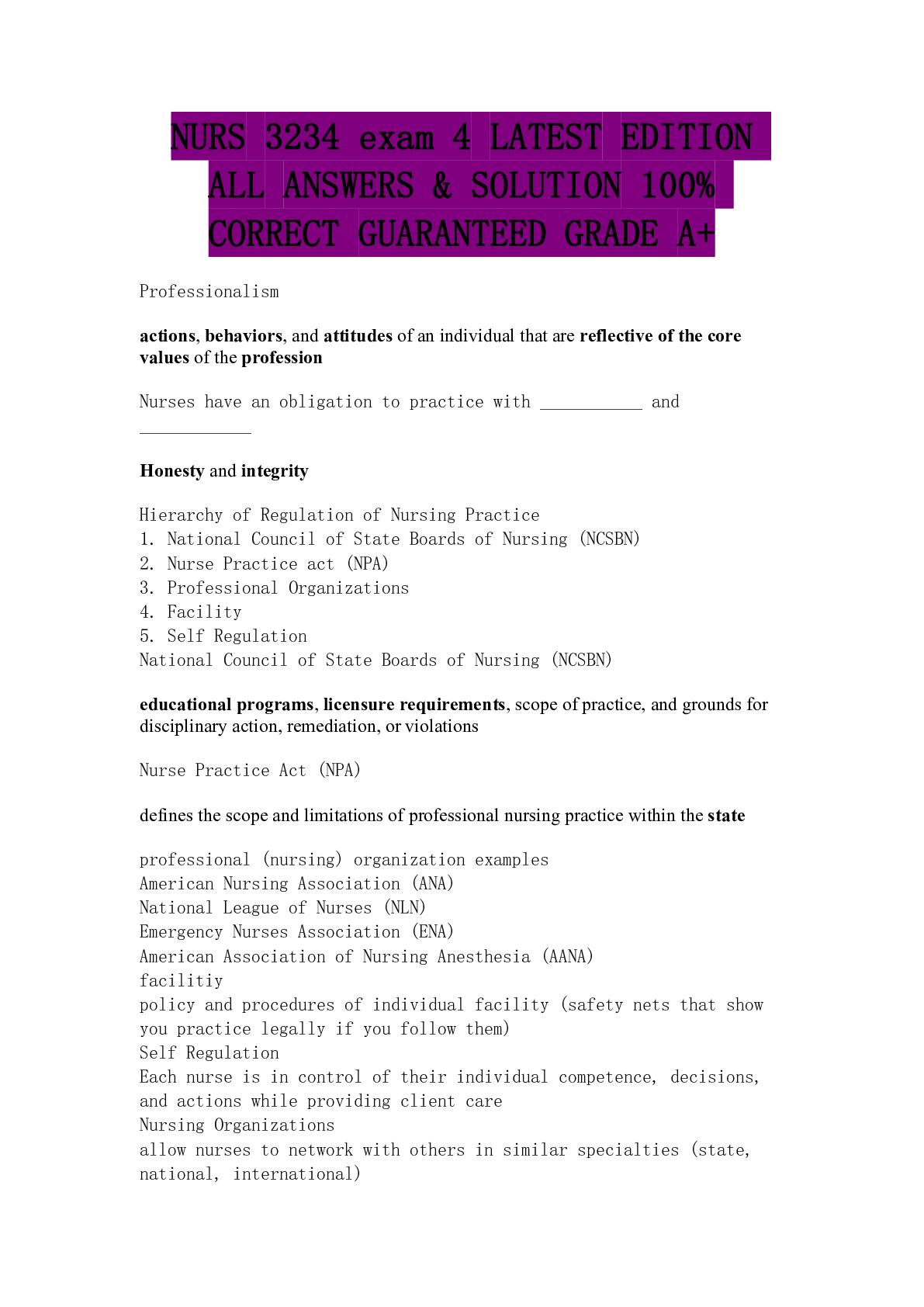
Professionalism
actions, behaviors, and attitudes of an individual that are reflective of the core values of the profession
Nurses have an obligation to practice with ___________ and ____________
Honesty and integrity
...
Professionalism
actions, behaviors, and attitudes of an individual that are reflective of the core values of the profession
Nurses have an obligation to practice with ___________ and ____________
Honesty and integrity
Hierarchy of Regulation of Nursing Practice
1. National Council of State Boards of Nursing (NCSBN)
2. Nurse Practice act (NPA)
3. Professional Organizations
4. Facility
5. Self Regulation
National Council of State Boards of Nursing (NCSBN)
educational programs, licensure requirements, scope of practice, and grounds for disciplinary action, remediation, or violations
Nurse Practice Act (NPA)
defines the scope and limitations of professional nursing practice within the state
professional (nursing) organization examples
American Nursing Association (ANA)
National League of Nurses (NLN)
Emergency Nurses Association (ENA)
American Association of Nursing Anesthesia (AANA)
facilitiy
policy and procedures of individual facility (safety nets that show you practice legally if you follow them)
Self Regulation
Each nurse is in control of their individual competence, decisions, and actions while providing client care
Nursing Organizations
allow nurses to network with others in similar specialties (state, national, international)
Certification
demonstrates a mastery of knowledge, education, and skills, as well as the motivation and passion for delivering quality client care
Certification examples
Advanced Diabetes Management
Advanced Oncology Certified Nurse
Tele-ICU Acute/Critical Care Nursing
Unprofessional Behavior
conduct that does not adhere to the standards of practice or the Code of Ethics
misconduct
"conduct unbecoming"
- incompetence
- impairment
- unethical behavior
Incompetence
lack reasonable skills, knowledge, or concern for the client’s welfare, which places the client in jeopardy or harm’s way
Impairment
unable or unfit to practice because of physical illness, behavioral health issues, or being under the influence of a chemical substance like drugs or alcohol that causes mental or physical impairment
Unethical nursing behaviors
Addiction, breaking the law, cheating, disruptive behavior, financial improprieties, HIPAA violation, inappropriate conduct, falsification, practicing with expired license, practicing outside scope, sexual violations
Novice nurse
student nurses, transitioning to new area of practice
- learns right from wrong, accepts their limitations, sets boundaries for practice, and gets comfortable asking questions
- novice begins to show acceptable “nurse” behavior, recognizes signs and symptoms
- Learn to catch errors and prioritize care
Advanced Beginner Nurse
lack confidence to make independent decisions and struggle to implement individualized client care, often exerting an extended amount of time and energy on one thing at a time
- Become hyper focused on task that they overlook holistic care
Competent Nurse
plan, make decisions, and perform their job responsibly and efficiently
- Nurse completes tasks with little or no error and begins to help others
Proficient Nurse
advanced decision-making, knowledge, resourcefulness, flexibility, and the ability to address problems or challenges
Expert Nurse
master with a deep understanding and will multitask effortlessly and fluently without a second thought
Professional Identity
nurse's sense of self as influenced by the values, beliefs, and attributes associated with the nursing discipline
What is professional commitment shown by
involvement in scholarly activities, councils, committees, professional organizations, continuing education, and specialty certification
Nursing Code of Ethics
a set of principles that reflect the primary goals, values, and obligations of the profession
Advocacy
defending the interests, rights, and safety of those who cannot do it for themselves
Steps of Advocating
Phase 1: Assessment → determine the client’s level of understanding, interests, personal values, mental function, and awareness of rights
Phase 2: Identification → goals of the client, which are based on their distinctive needs and personal beliefs, are identified
Phase 3: Implementation → advocacy plan to communicate the client’s preferences to the rest of the interprofessional team is implemented
Phase 4: Evaluation → see if what was expected or something else resulted
Accountability
legal obligation with a moral and ethical commitment to do the right thing every time and in every situation
responsibility
obligation to perform work, duties, or tasks using sound professional judgment
- ex. documenting in a complete and factual manner
Transactional Leader
establish standards, highlight obligations, concentrate on monitoring behaviors, and use rewards or punishments based on how tasks are completed
- Ex. set measurable goals and reward with pizza party
Transformational Leader
establish a common mission and vision and, in turn, encourage employees to heighten their level of performance
- Charismatic, Confident, Honest, Effective communicator, Engaging
- Ex. Dr. Martin Luther King Jr.
Laissez-faire Leader
hands-off leaders that oversee and encourage their team to work independently, providing little direct control over decision making
- Relinquish power and responsibility to others
Bureaucratic Leader
abide by the specific policy and procedures or rules established within a top-down decision-making organization (by the book)
- Strict compliance Inflexible to creativity, suggestions, or ideas
Situational Leader
A situational leader assesses the situation and decides what strategy to use by aligning their style to the group, the situation, and the needs of the organization
- Flexible to the needs of the group
Shared governance
a shared-decision structure that gives nurses control over their own practice
Nursing Role: Caregiver
helping someone get better through direct client care
Nursing Role: Critical Thinker
logical process of interpretation and examination of a problem; reasoning and application of a solution; and evaluation of the outcomes
Nursing Role: Advocate
advocating for treatment alternatives, supporting autonomy, communicating client preferences, and confronting inappropriate policies or rules
Nursing Role: Change Agent
involves and guides the client to recognize the need for change, engage in the plan, and take a proactive role in their health status.
Nursing Role: Educator
teach and support clients to better comprehend, address, and assume responsibility for their own health status
Nursing Role: Counselor
Establishing an effective nurse-client relationship
Nursing Role: leader
influence the attitudes, behaviors, feelings, and beliefs of those around them
Nursing Role: mentor
shares their knowledge and time to support, guide, encourage, and motivate another nurse to take control of their own learning, develop their skills, and maximize their potential
Nursing role: researcher
use of past and present evidence-based research to improve nursing practice
Nursing role: care coordinator
organizing client care, including the involvement of the client, family, interprofessional team members, and resources required to provide all client care activities
The Joint Commission
National Patient Safety Goals (NPSG)
- goals → client safety, safe and effective delivery of health care, and recommendations to avoid adverse outcomes
Identify Clients Correctly (NPSG)
- Two patient identifiers → client's name, date of birth, hospital ID number, telephone number, or alternate client-specific documentation
- Clients assigned room should NEVER be used
Improve staff communication (NPSG)
Report critical results (potentially dangerous lab values) promptly
Common guidelines for reporting
- The facility’s definition of a critical result
- A defined time frame from when the results are available to when they are reported to the provider
- Written documentation of the notification of results to the provider (who received the results and who communicated them)
Use Medications Safely (NPSG)
- Label all medications
- Decrease errors with anticoagulant medications
- Reconcile client medications
Label All medications
All medications and solutions used in surgery or procedures should have a label on them (if not labeled → throw out)
Decrease errors with anticoagulant medications
Important to review routine monitoring of the client's weight, renal and hepatic lab values, frequency of dosage, the amount prescribed, as well as drug interaction potential
Reconcile Client Medications
home + hospital meds and identify discrepancies or interactions → work to resolve
- Typically nurse but can also be pharmacist or provider
- Done on admission, discharge, transfer
Use Alarms Safely (NPSG)
use clinical alarm systems for equipment (beds, chairs, heart monitors, vents, IV and infusion pumps)
alarm fatigue
Sensory overload from noise pollution created in part by the numerous distress alerts
Prevent Hospital Acquired Infections (NPSG)
CLABSI, CAUTI, SSI, VAP → MDROs are a big concern (MRSA, VRE, C diff)
- Associated with → high mortality rates, increased length of stay in hospitals, and increased costs of care
Identify Client Safety Risk - Risk of Suicide (NPSG)
ensure that suicide prevention methods are implemented and maintained while a client with any risk for suicide is in the health care facility
- All 12+ year old children admitted for behavioral health must be screened for SI
- If identified as risk placed on around the clock supervision
Prevent adverse events during surgery (NPSG)
Time out: pause taken by all personnel → identifying the correct patient, site, the procedure
- Use two client identifiers to establish the client’s identity.
Mark the surgical site if possible.
- Perform a time-out in the operating/procedure room
Three key elements to creating a culture of safety
1. Commitment to consistently follow safe operations
2. A just culture without punishment (for coming forward)
3. A commitment by the organization
Robert Wood Johnson (Transforming Patient Care)
- nurses spend 70% of their time at the bedside performing direct client care
- Strengthen management through leadership development programs
- Implement a rapid response team for the facility’s medical–surgical units
- Created framework of standardized communication
Spending more time at the bedside...
- More time at the bedside → less falls, HAIs, and medical errors
- Increased through → hourly rounding, bedside handoffs, charting at bed
Rapid Response Team
Consists of ICU nurse, critical care provider, respiratory
Called for…
- A sudden change in vital signs
- Low oxygen saturation despite efforts to oxygenate
- Chest pain despite the administration of nitroglycerine
- Seizure
- Medical professional has a deep concern about the client’s condition
- Sudden variation in the client’s mental status
Framework of Standardized communication (ISBARR)
Identity: Introduce yourself and where you are calling from.
Situation: Client name and age, admitting diagnosis, and chief complaint or urgent need for the rapid response to be called.
Background: Medical history including current medications and advanced directives (if any).
Assessment: General client impression and significant findings through assessment, diagnostic tests, lab work, and vital signs.
Recommendations: Treatment provided and the client’s response to the treatment.
Read back: Read back the message or prescription from the provider, which allows for clarification of any miscommunication
Near miss
potential error or event or circumstance that could have caused harm, but that was caught and avoided.
Client safety event
unexpected event or circumstance that occurred with or without injury to the client, but that had the potential to cause harm to the client.
Adverse event
situation or circumstance that caused unexpected harm to the client.
Sentinel event (never event)
critical, unexpected adverse event that caused severe physical or psychological harm to a client, including death, dismemberment, permanent injury, and severe or temporary injury.
occurence (incident) report
A tool used to report an adverse event, sentinel event, client safety event, or near miss
- Not meant to punish individuals
- track the near miss or events → prevent future events
- Not mentioned in clients chart → internal facility document
Events requiring incident reports
- Accident or injury of a client, staff member, or a visitor (fall)
- Unexpected vaccine reaction
- Unexpected drug reaction
- Administration of the wrong vaccine or drug to a client
- Incorrect administration of a drug or vaccine to a client
- etc
10 evidence based recommendations to improve patient safety
1. Prevent infections.
2. Simplify discharge instructions.
3. Establish a protocol to prevent hospital-acquired venous thromboembolism (VTE).
4. Improve education provided to clients regarding medications.
5. Limit the amount of continuous time for which a health care provider can provide direct client care. (fatigue increases risk of errors)
6. Work with a patient safety organization (PSO) to identify potential risks to client safety.
7. Improve design aspects of the facility that support client safety.
8. Survey facility personnel to assess the culture of safety.
9. Create better teams to facilitate communication and improve response times.
10. Use an evidence-based protocol when performing invasive client procedures.
Chemical safety (ways chemicals can enter the body)
- Inhalation: Breathing in the fumes or air that has been contaminated by the chemical
- Skin or eyes: Contact with skin or eyes
- Ingestion: Direct (swallowing of the chemical) or indirect (contamination of the hands, which then contact a food or liquid that is consumed)
- Injection: Due to needlestick injury
Radiation Safety
Exposure → diagnostic imaging procedures (x-rays, computed tomography [CT] scans) as well as in certain treatments (e.g., for some types of cancer)
- Always ask female clients if pregnant
- Reduce time
- Shielding → lead aprons, concrete walls
- Increase distance
Safety Consideration: Infants and preschoolers (0-4 yo)
- prone to burn injuries related to hot liquids or steam
- Accidental poisonings, choking, drownings
- Improper use of seat chairs and belts
Safety Considerations: school aged (5-12 yo)
- vehicles safety
- Proper protective equipment when playing sports
- Accidental shootings and drowning
Safety Considerations: adolescents (13-19 yo)
- water, fire, sports, firearms, and vehicles
- Alcohol consumption may begin
- Peer bullying and violence
Safety Considerations: adults (19+)
Poorly developed coping strategies → drinking and smoking
- Older adults → chronic illness, less physical activity, falls
- Stopping Elderly Accidents, Deaths, and Injuries (STEADI) CDC
- Frailty evaluation should be performed
Joint comission "zero harm to client"
intended to create safer culture for patients
Hospital acquired injury
harm directly affects a client while in the hospital, with the injury not having been present on the client's admission to the hospital
- ex. DVT, pressure injury, burns or electrical work
Medical conditions that put at risk for injury
stroke, neurodegenerative disorders such as multiple sclerosis or Parkinson's disease, and fragility in an older client
Behavioral disorders that put client at risk for injury
schizophrenia, personality disorders, and substance use disorders
Communication disabilities that put client at risk for injury
hearing impairment, autism, or aphasia secondary to a stroke or other neurologic conditions
Congntive impairments that put client at risk for injury
Dementia or Parkinsons
Home hazard assessment
May be done for clients who are impaired due to recent surgery, parkinson's, dementia
RACE
Rescue: Assist in removing clients, visitors, and employees who are in immediate danger of the fire.
Alarm: Activate the emergency fire alarm per the facility policy.
Contain: Contain the fire by closing doors and windows, which decreases the source of oxygen for the fire.
Extinguish: Attempt to extinguish small fires if the proper extinguisher is available and it is safe to do so.
Class A fire extinguishers
A water-based fire extinguisher for general combustible materials such as paper, wood, plastics, rubber, and cloth.
Class B fire extinguishers
A carbon dioxide (CO2)–based fire extinguisher for oils, gasoline, paints, grease, and other caustic materials.
Class C Fire Extinguisher
A dry chemical-based fire extinguisher specific for electrical fires, including those involving wiring, fuse boxes, computers, and other electrical devices.
Class D fire extinguisher
A fire extinguisher for fires involving metals or flammable metal shavings from elements such as titanium, magnesium, potassium, and sodium.
Class K Fire Extinguisher
A fire extinguisher specific for kitchen fires involving flammable oils and fats.
What to do with evacuations
- Close all doors.
- Wrap all clients in a blanket, with a face covering over their face. This step is appropriate for both clients and staff members.
- When moving through the hallways, stay low to the ground, because smoke rises. If necessary, crawl on the floor to reach safety.
- Do not run or panic, and do not allow others to do so.
Violence in the workplace
any act or threat of physical violence, harassment, intimidation, or other disruptive behavior that occurs at the worksite
Active shooter
Run: Run away from the assailant, if possible.
Hide: If people cannot run from the assailant, then they should hide in a secure environment.
Fight: If neither running away nor hiding is an option, then fight for your life against the active shooter.
Alpha radiation exposure
The least amount of risk. Alpha radiation does not penetrate clothing, and it travels only a few centimeters. The possibility of health hazards from exposure to alpha radiation is minor.
Beta radiation exposure
middle level of risk. Beta radiation travels a small distance. Specialized clothing is needed to prevent exposure. The possibility of health hazards from exposure to beta radiation is minimal.
Gamma radiation exposure
most serious of the three types. Gamma radiation can travel in a greater distance, penetrating through clothing and body tissue. Protection from exposure requires lead shielding. The possibility of health hazards from exposure to gamma radiation is high, including skin burns and internal tissue or organ injury
chemical exposure
- Immediate treatment is first priority (and then find out what the chemical is)
- Shower, scrub skin, irrigate eyes, cut off clothing (do not pull of shirt)
Biological exposure
- Proper PPE should be worn
- Clothing removed and double bagged
- Early detection and treatment are vital
Universal fall precautions
- Use of non-skid footwear
- Keeping the bed in the low position
- Locking the wheels of beds
- Placing the brakes on wheelchairs
- Maintaining a clutter-free environment
- Adequate lighting
- Placing the call light and belongings within clients' reach
- Fall prevention education for clients, along with basic orientation to the room and call light system
Restraints
Restraints increase risk of injury (human nature to try to get out → end up injury)
- May only be used to protect patients, staff, and others
- Not for punishment and only a last resort
- Never part of fall prevention program
Hazards with restraints
- Increased possibility of serious injury due to fall
- Skin breakdown
- Contractures
- Incontinence
- Depression
- Delirium
- Anxiety
- Aspiration and respiratory difficulties (can choke themselves on vest and belt) - Need slip not to get off quickly
- Death
Physical restraint
manual holding or immobilizing the client using physical strength.
- Ex. Swaddle
- Can cause injury
Mechanical restraint
materials, straps, fabric, and leather devices that can be fastened around the wrists (most common) or ankles of a client
- Least restrictive → hand mitten
- Most restrictive → four point restraints (aggressive and dangerous)
- Always use quick release and NEVER tie to side rail
Chemical restraints
administration of medications (including benzodiazepines, antipsychotics, and neuromuscular blocking agents) to reduce the client's movement or control behavior
Barrier restraints
use of barriers to limit movement, such as concave mattresses and lapboards that are attached to chairs. Bed enclosures and having all four side rails up are also barrier restraints.
Seclusion
placing the client alone in a securely locked room without their consent
Poly glide sheet
A smaller version of the turnsheet or glide sheet. They are meant for movement of body parts as in an obese client's extremities
Nursing interventions for restraints
frequent circulatory, respiratory, and skin checks (restraint must be removed during these assessments)
- client should be offered fluids and an opportunity to void or have a bowel movement, and encouraged to do range-of-motion exercises
- Restraints should be removed as soon as possible
Pre-seizure Nursing Care
Ensure that suction equipment is set up at the bedside
Ensure that oxygen is set up at the bedside.
Check baseline vital signs, including oxygen saturation.
Establish two IV sites.
Ensure that the siderails are padded to prevent injury during a seizure.
Remove potentially constrictive clothing and jewelry in case of a seizure.
Ask if the client feels an aura
Nursing Care During Seizure
Call rapid response
Put patient into side lying position
Protect head
Remove dangerous objects
Loosen any tight clothing
[Show More]



 JN21.png)