Sarah Michelle Eyes Crash course Questions And Answers
1. A parent brings their 5-year-old son into the clinic with complaints that he is not able to
distinguish between various colors on his school assignments. He al
...
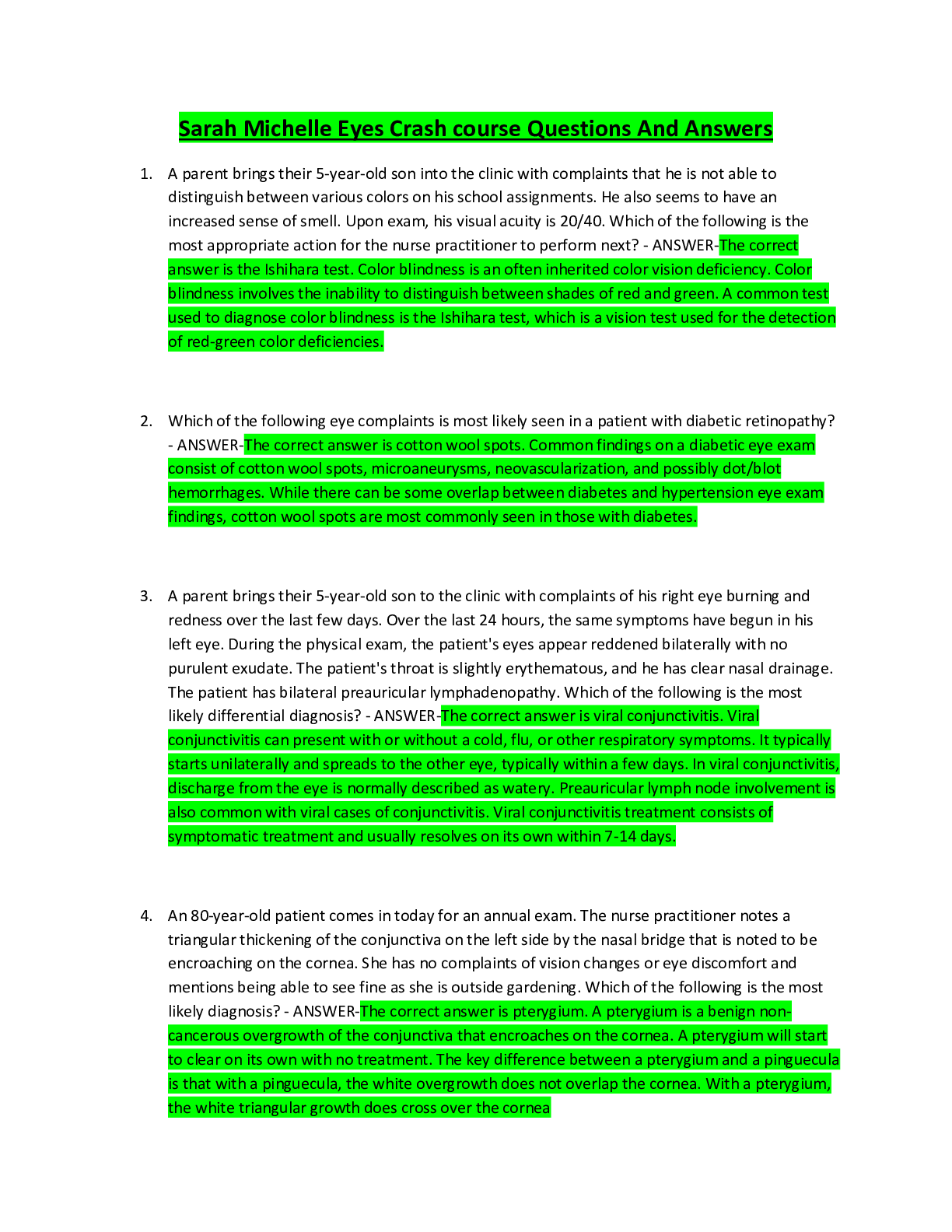
Sarah Michelle Eyes Crash course Questions And Answers
1. A parent brings their 5-year-old son into the clinic with complaints that he is not able to
distinguish between various colors on his school assignments. He also seems to have an
increased sense of smell. Upon exam, his visual acuity is 20/40. Which of the following is the
most appropriate action for the nurse practitioner to perform next? - ANSWER-The correct
answer is the Ishihara test. Color blindness is an often inherited color vision deficiency. Color
blindness involves the inability to distinguish between shades of red and green. A common test
used to diagnose color blindness is the Ishihara test, which is a vision test used for the detection
of red-green color deficiencies.
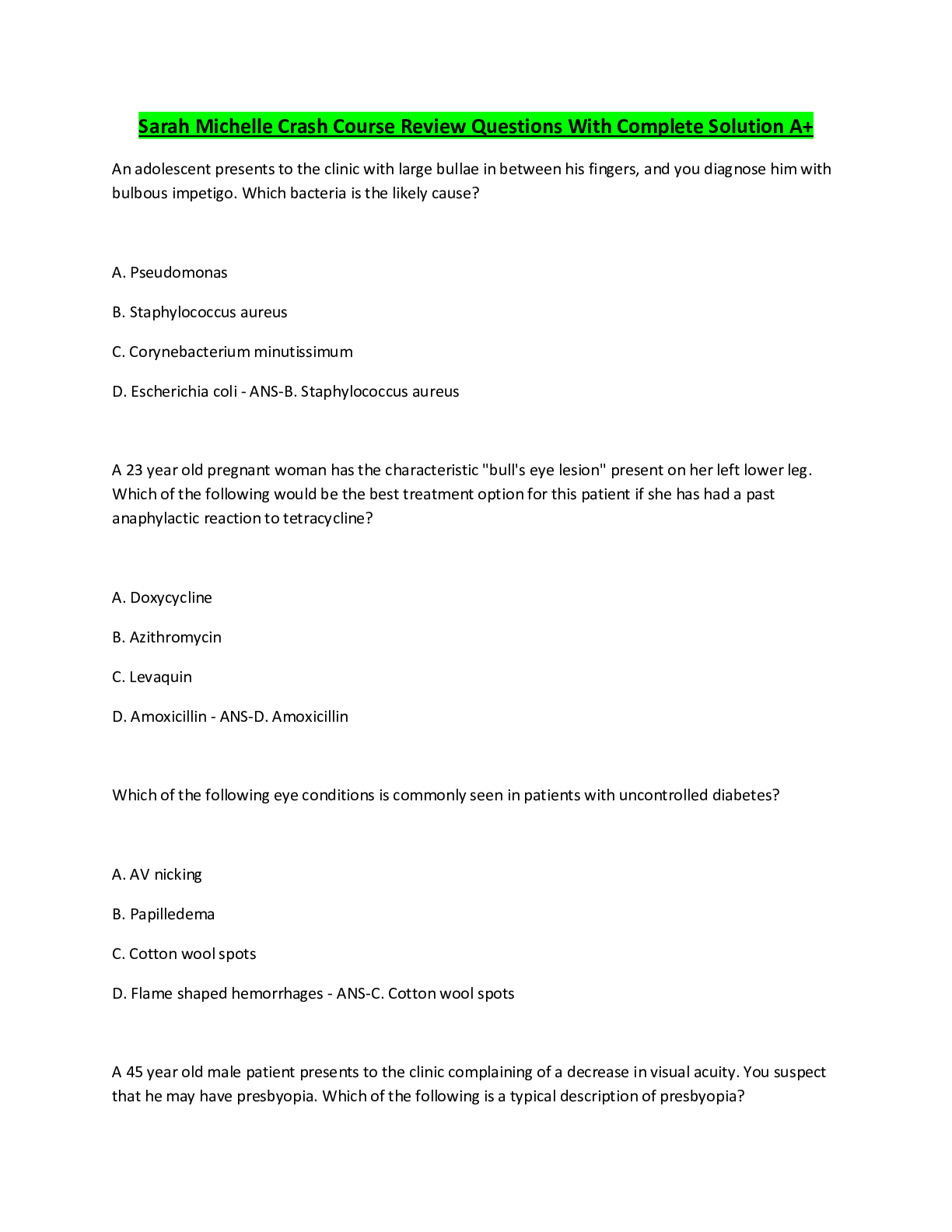
2. Which of the following eye complaints is most likely seen in a patient with diabetic retinopathy?
- ANSWER-The correct answer is cotton wool spots. Common findings on a diabetic eye exam
consist of cotton wool spots, microaneurysms, neovascularization, and possibly dot/blot
hemorrhages. While there can be some overlap between diabetes and hypertension eye exam
findings, cotton wool spots are most commonly seen in those with diabetes.
3. A parent brings their 5-year-old son to the clinic with complaints of his right eye burning and
redness over the last few days. Over the last 24 hours, the same symptoms have begun in his
left eye. During the physical exam, the patient's eyes appear reddened bilaterally with no
purulent exudate. The patient's throat is slightly erythematous, and he has clear nasal drainage.
The patient has bilateral preauricular lymphadenopathy. Which of the following is the most
likely differential diagnosis? - ANSWER-The correct answer is viral conjunctivitis. Viral
conjunctivitis can present with or without a cold, flu, or other respiratory symptoms. It typically
starts unilaterally and spreads to the other eye, typically within a few days. In viral conjunctivitis,
discharge from the eye is normally described as watery. Preauricular lymph node involvement is
also common with viral cases of conjunctivitis. Viral conjunctivitis treatment consists of
symptomatic treatment and usually resolves on its own within 7-14 days.
4. An 80-year-old patient comes in today for an annual exam. The nurse practitioner notes a
triangular thickening of the conjunctiva on the left side by the nasal bridge that is noted to be
encroaching on the cornea. She has no complaints of vision changes or eye discomfort and
mentions being able to see fine as she is outside gardening. Which of the following is the most
likely diagnosis? - ANSWER-The correct answer is pterygium. A pterygium is a benign non�cancerous overgrowth of the conjunctiva that encroaches on the cornea. A pterygium will start
to clear on its own with no treatment. The key difference between a pterygium and a pinguecula
is that with a pinguecula, the white overgrowth does not overlap the cornea. With a pterygium,
the white triangular growth does cross over the cornea
5. A 50-year-old patient presents to the nurse practitioner with a new onset of a severe headache
and "flickering" vision. The nurse practitioner notes bilateral erythematous and swollen optic
discs. Which of the following vital signs are most consistent with the likely diagnosis?
CONTINUES...
[Show More]