MAAC 506 EXAM 1 _ 2020 – Liberty University
QUESTION 1
According to the lecture, the term “spirituality” denotes primarily
The process of reaching into a sense of solitude, hospitality and prayer.
A vague u
...
MAAC 506 EXAM 1 _ 2020 – Liberty University
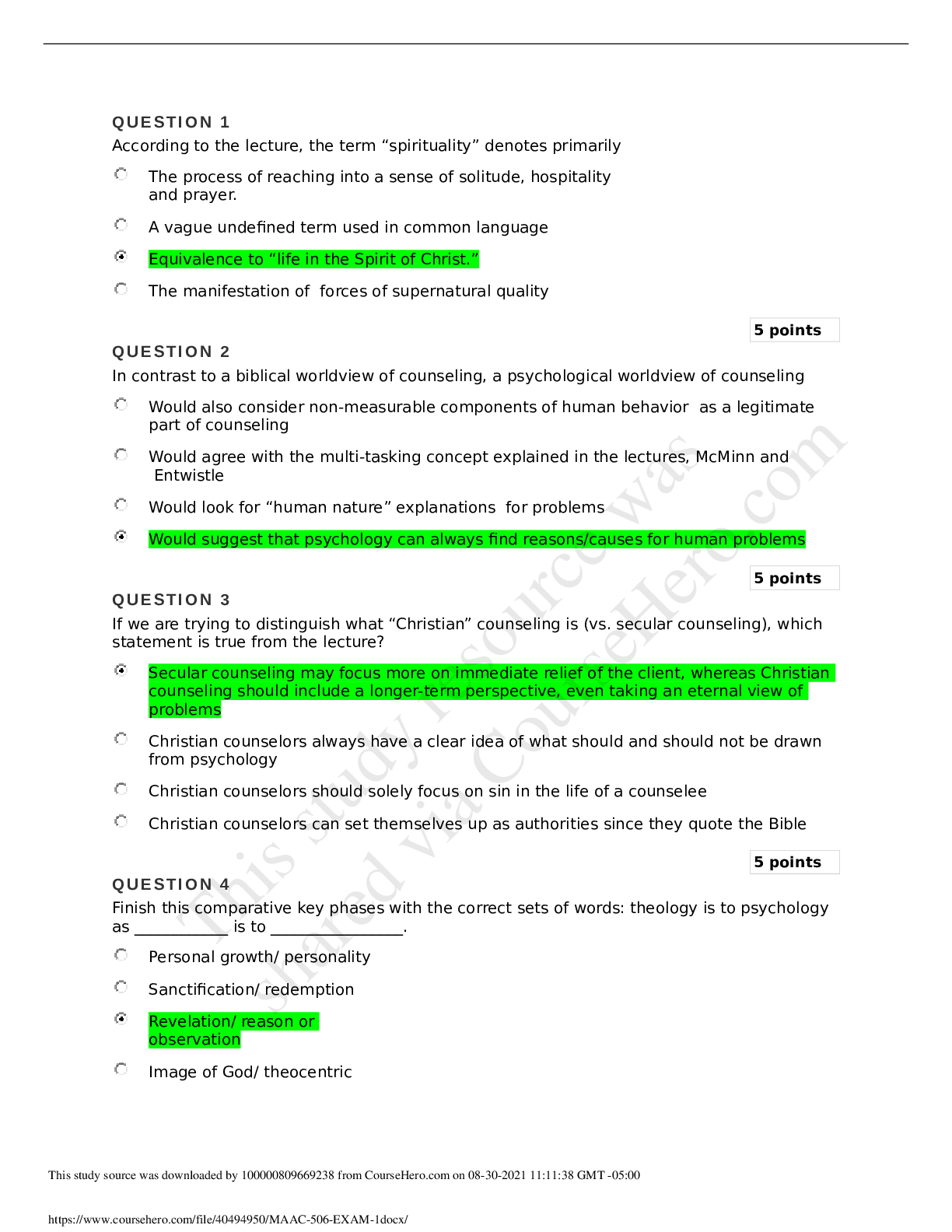
QUESTION 1
According to the lecture, the term “spirituality” denotes primarily
The process of reaching into a sense of solitude, hospitality and prayer.
A vague undefined term used in common language
Equivalence to “life in the Spirit of Christ.”
The manifestation of forces of supernatural quality
5 points
QUESTION 2
In contrast to a biblical worldview of counseling, a psychological worldview of counseling
Would also consider non-measurable components of human behavior as a legitimate part of counseling
Would agree with the multi-tasking concept explained in the lectures, McMinn and Entwistle
Would look for “human nature” explanations for problems
Would suggest that psychology can always find reasons/causes for human problems
5 points
QUESTION 3
If we are trying to distinguish what “Christian” counseling is (vs. secular counseling), which statement is true from the lecture?
Secular counseling may focus more on immediate relief of the client, whereas Christian counseling should include a longer-term perspective, even taking an eternal view of problems
Christian counselors always have a clear idea of what should and should not be drawn from psychology
Christian counselors should solely focus on sin in the life of a counselee
Christian counselors can set themselves up as authorities since they quote the Bible
5 points
QUESTION 4
Finish this comparative key phases with the correct sets of words: theology is to psychology as ____________ is to _________________.
Personal growth/ personality
Sanctification/ redemption
Revelation/ reason or observation
Image of God/ theocentric
5 points
QUESTION 5
From the lecture discussion on ways of knowing truth, what can we say?
Logic is the best method to know something
There is a link between our worldview and what ways of knowing (epistemological methods) that we accept and reject
A Christian counselor who accepts revelation as a way of knowing, would nonetheless typically reject claims that God spoke to a client
Empirical studies, as a way of knowing is generally only accepted by counselors with a secular worldview
5 points
QUESTION 6
The lectures in week one referred to Jay Adams (the founder of Nouthetic counseling) when discussing the biblical foundation/worldview of Christian counseling. What did the lecture emphasize in that discussion?
We may gain insights from psychology and psychological theories but God’s word is still our primary authority and our “lens” to view other sources
We should emphasize the fallen nature of human beings
True change comes primarily as one person helps another
A counselee is most successful in counseling by keeping personal issues between him/her and the counselor
5 points
QUESTION 7
The lectures explain that ways of knowing (epistemologies) can be limited. What is a true statement based on that discussion?
As we search for truth, we need to realize that our thinking can be flawed and be willing to allow others to challenge our thinking and conclusions
We can never claim to know any truth for sure
Even though we are under a lot of emotional pressure, we still generally think clearly
Most of the time, people take into account their biases, presuppositions, and worldview when determining what is really true
5 points
QUESTION 8
Both Entwistle and the lectures talked about worldview. A worldview is
A set of presuppositions which we hold about the basic makeup of the world.
The integration of facts into a focused position
The acceptance of a fictionalized myth theology
A subconscious phenomenon
5 points
QUESTION 9
The lecture talked about levels of integration. What is an INCORRECT statement from that discussion?
As part of interdisciplinary integration, we would study biblical interpretation but also become an expert in the process of empirical science
We need to know our basic assumptions about life—or worldview
We realize that truth fits together no matter the source
We focus solely on the cognitive process of how we are discovering truth, rather than how we are living as a counselor
5 points
QUESTION 10
In the discussion on worldview, the lecture contrasted the “modern” and the “post-modern” worldview. If one held the post-modern worldview, which would be true?
One should search for truth as a guide to my behavior
One should take personal responsibility for actions
One should use personal experiences as a guide to what is right/wrong
One should focus on thoughts rather than feelings
5 points
QUESTION 11
The lecture emphasized that the way we interpret behavior has a lot to do with our worldview, and a lot to do with our expectations of our clients. What is true based on the lecture discussion?
The worldview of most secular psychologists would suggest that a primary reason for personal problems is a lack of coping skills
Psychology would emphasize a transcendent purpose for humans
Counselors operating with a Christian worldview would point to a dysfunctional environment as the source of problems
Counselors operating with a Christian worldview would look for a solution to problems by freeing our “true selves”
5 points
QUESTION 12
If I am following the “earmarks” of integration laid out in the lectures, which of the following would I demonstrate?
I would strongly assert that my interpretation of scripture is always accurate
I would actively seek to find truth in theology, in principles of spiritual formation, and in the theories and empirical discoveries of psychology
I would primarily focus on the relief of human suffering
I would largely focus on the cognitive aspects of integration, and only secondarily focus on my personal spiritual growth
-
-
-
-
-
-
-
Continued
[Show More]






 – Chamberlain College of Nursing.png)
 – Chamberlain College of Nursing.png)