BSN HESI 266 - Questions with Verified Answers While caring for a client with a full thickness burn covering 40% of the body, the nurse observes purulent drainage at the wound. Before reporting this finding to the heal
...
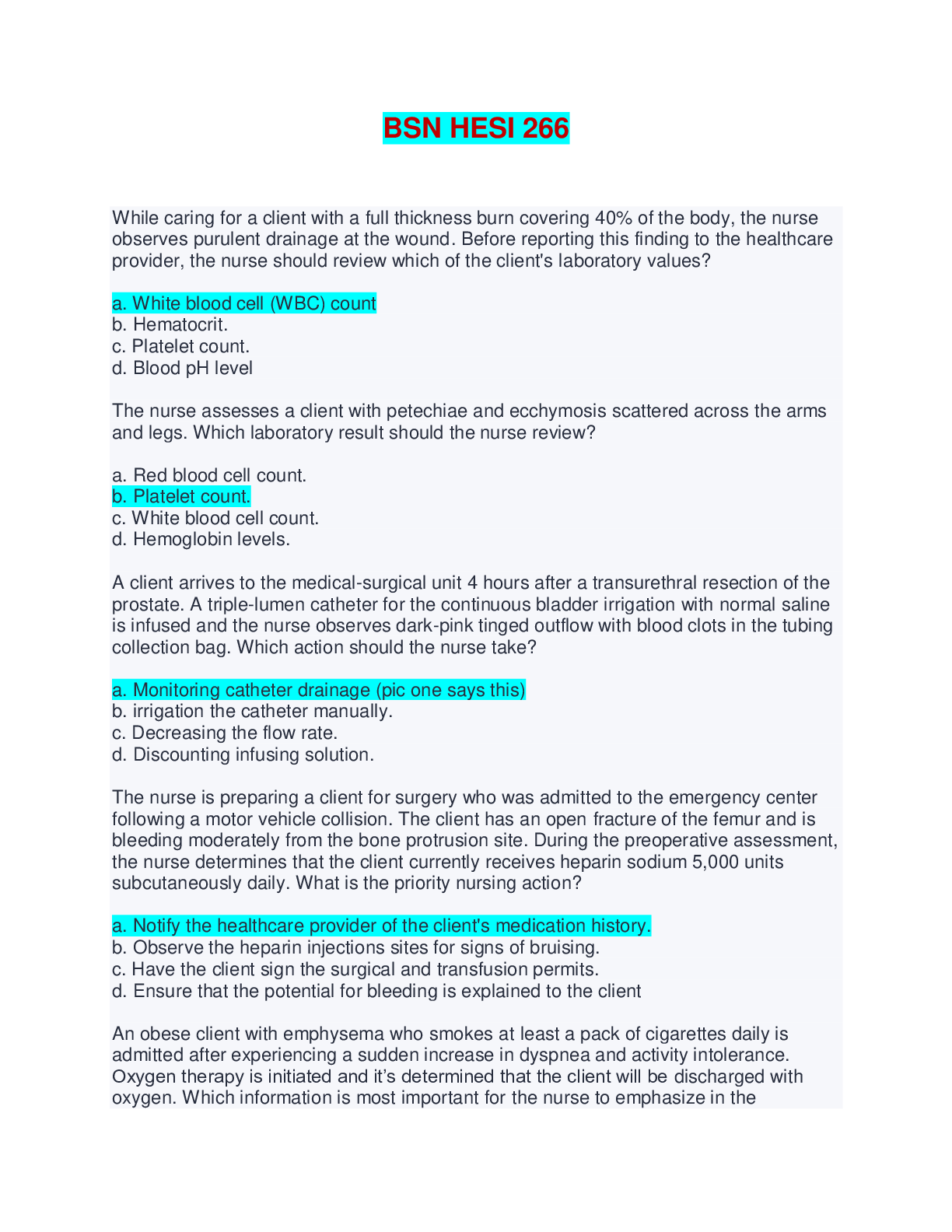
BSN HESI 266 - Questions with Verified Answers While caring for a client with a full thickness burn covering 40% of the body, the nurse observes purulent drainage at the wound. Before reporting this finding to the healthcare provider, the nurse should review which of the client's laboratory values? a. White blood cell (WBC) count b. Hematocrit. c. Platelet count. d. Blood pH level The nurse assesses a client with petechiae and ecchymosis scattered across the arms and legs. Which laboratory result should the nurse review? a. Red blood cell count. b. Platelet count. c. White blood cell count. d. Hemoglobin levels. A client arrives to the medical-surgical unit 4 hours after a transurethral resection of the prostate. A triple-lumen catheter for the continuous bladder irrigation with normal saline is infused and the nurse observes dark-pink tinged outflow with blood clots in the tubing collection bag. Which action should the nurse take? a. Monitoring catheter drainage (pic one says this) b. irrigation the catheter manually. c. Decreasing the flow rate. d. Discounting infusing solution. The nurse is preparing a client for surgery who was admitted to the emergency center following a motor vehicle collision. The client has an open fracture of the femur and is bleeding moderately from the bone protrusion site. During the preoperative assessment, the nurse determines that the client currently receives heparin sodium 5,000 units subcutaneously daily. What is the priority nursing action? a. Notify the healthcare provider of the client's medication history. b. Observe the heparin injections sites for signs of bruising. c. Have the client sign the surgical and transfusion permits. d. Ensure that the potential for bleeding is explained to the client An obese client with emphysema who smokes at least a pack of cigarettes daily is admitted after experiencing a sudden increase in dyspnea and activity intolerance. Oxygen therapy is initiated and it’s determined that the client will be discharged with oxygen. Which information is most important for the nurse to emphasize in the discharge teaching plan? a. Approaches to conserve energy. b. Guidelines for oxygen use. c. Methods for weight loss. d. Strategies for smoking cessation The healthcare provider prescribes penicillin 200,000 units intramuscularly for a client with pneumonia. The available vial is labeled, "Penicillin 500,000 units/mL". How many mL should the nurse administer to this client? (Enter numerical value only. If rounding is required, round the nearest tenth.) 0.4 The nurse is caring for a client in the post anesthesia care unit (PACU) who underwent a thoracotomy two hours ago. The nurse observes the following vital signs; heart rate 140 beats/minute, respirations 26 breaths/minute, and blood pressure 140/90 mmHg. Which intervention is most important for the nurse to implement? a. Apply oxygen at 10 L via non-rebreather mask and monitor pulse oximeter. b. Medicate for pain and monitor vital signs according to protocol. c. Administer intravenous fluid bolus as prescribed by the healthcare provider. d. Encourage the client to splint the incision with a pillow to cough and deep breathe While assessing a client with degenerative joint disease, the nurse observes Heberden's nodes, large prominences on the client's fingers that are reddened. The client reports that the nodes are painful. Which action should the nurse take? a. Assesses the client's radical pulses and capillary refill time. b. Discuss approaches to chronic pain control with the client. c. Notify the healthcare provider of the finding immediately. d. Review the client's dietary intake of high-protein foods A client with draining skin lesions of the lover extremity is admitted with possible Methicillin-Resistant Staphylococcus Aureus (MRSA). Which nursing interventions should the nurse include in the plan of care? (Select all that apply.) a. Explain the purpose of a low bacteria diet. b. Monitor the client's white blood cell count. c. Send wound drainage for culture and sensitivity d. Use standard precautions and wear a mask e. Institute contact precautions for staff and visitors The nurse is preparing to obtain a rapid coronavirus (COVID-19) test for a client who was exposed to the virus eight days ago. The client is experiencing fever, cough and shortness of breath. Which action is most important for the nurse to take?
[Show More]