HPEX 445 Exam 1 - Questions and Answers What are Maslow's Hierarchy of Needs: 1. Physiological needs: food, water, sex 2. Safety Needs: shelter, jobs, pay 3. Belonging Needs: social interactions 4. Esteem needs: status
...
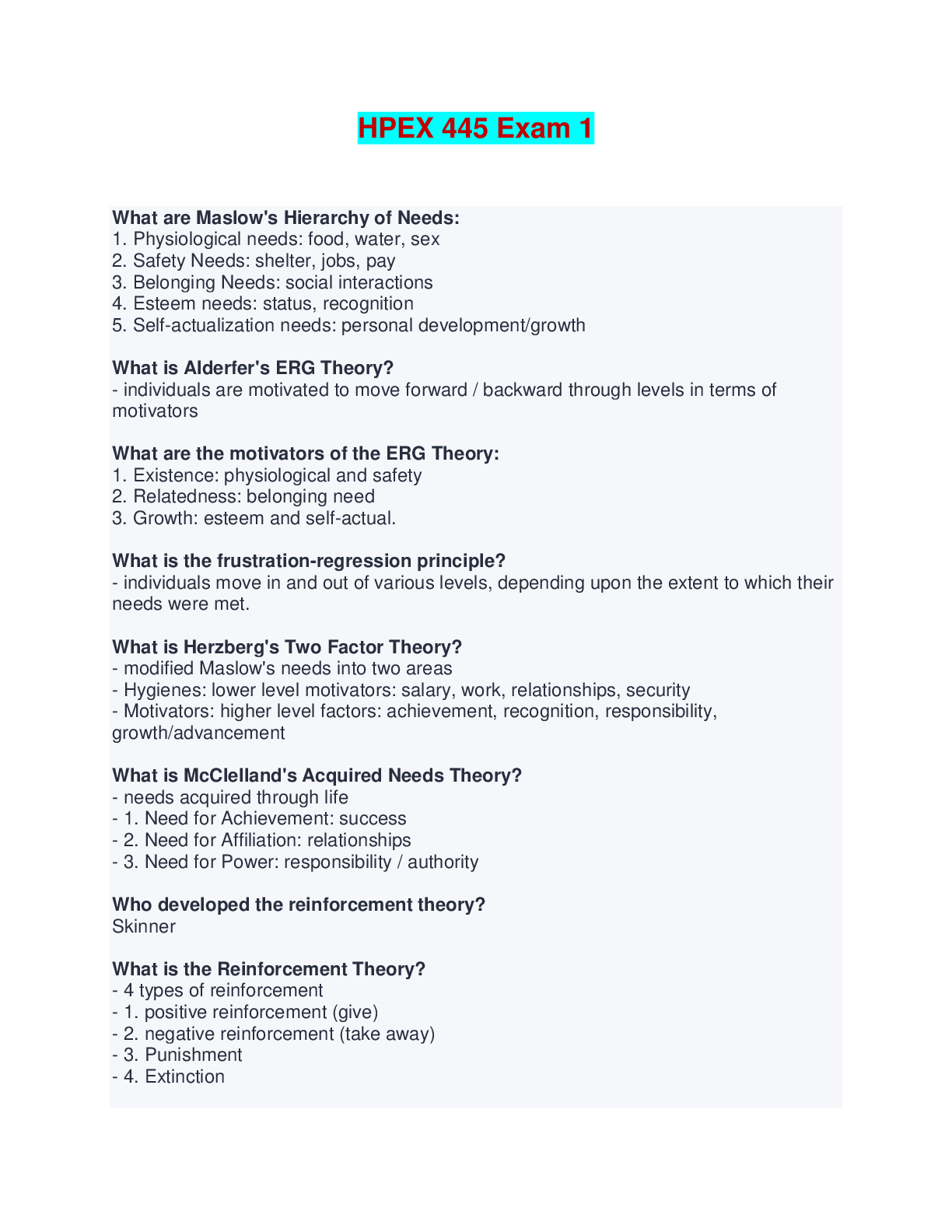
HPEX 445 Exam 1 - Questions and Answers What are Maslow's Hierarchy of Needs: 1. Physiological needs: food, water, sex 2. Safety Needs: shelter, jobs, pay 3. Belonging Needs: social interactions 4. Esteem needs: status, recognition 5. Self-actualization needs: personal development/growth What is Alderfer's ERG Theory? - individuals are motivated to move forward / backward through levels in terms of motivators What are the motivators of the ERG Theory: 1. Existence: physiological and safety 2. Relatedness: belonging need 3. Growth: esteem and self-actual. What is the frustration-regression principle? - individuals move in and out of various levels, depending upon the extent to which their needs were met. What is Herzberg's Two Factor Theory? - modified Maslow's needs into two areas - Hygienes: lower level motivators: salary, work, relationships, security - Motivators: higher level factors: achievement, recognition, responsibility, growth/advancement What is McClelland's Acquired Needs Theory? - needs acquired through life - 1. Need for Achievement: success - 2. Need for Affiliation: relationships - 3. Need for Power: responsibility / authority Who developed the reinforcement theory? Skinner What is the Reinforcement Theory? - 4 types of reinforcement - 1. positive reinforcement (give) - 2. negative reinforcement (take away) - 3. Punishment - 4. Extinction What are the intrinsic factor theories of motivation? 1. Adam's Equity Theory 2. Vroom's Expectancy Theory 3. Locke's Goal Setting Theory What are the management theories of motivation? 1. Taylor's Scientific Management 2. McGregor's Theory X and Theory Y 3. Ouchi's Theory Z 4. Integrative Model of Motivation T/F: Extrinsic Rewards are intangibles. False: they are Tangibles - money, benefits, praise, good boss, promotions, etc. List some intrinsic rewards: Intangibles - healthy relationships, meaningful work, competence, etc. Name generations of motivation: - Traditionalist (b. before 1945) - Baby Boomer (b. between 1946-1964) - Generation X (b. between 1965-1978) - Millennials (b. between 1979-present) What is the purpose of strategic planning? - identify controllable and non-controllable forces that can influence the outcome of organization - determine appropriate direction to take to counteract forces List the events (in order) of the strategic planning process: 1. SWOT analysis 2. Strategy Identification & Selection 3. Strategy Tactical Plans 4. Rollout and Implementation 5. Monitoring and Control 6. Feedback List two activities of strategic plan: 1. development 2. execution What does SWOT stand for? Strengths Weaknesses
[Show More]