Population Health Exam 2 Questions & Answers-Several small communities have applied for grant funding from the state department of health to help decrease their teenage pregnancy rate. Which of the following communities
...
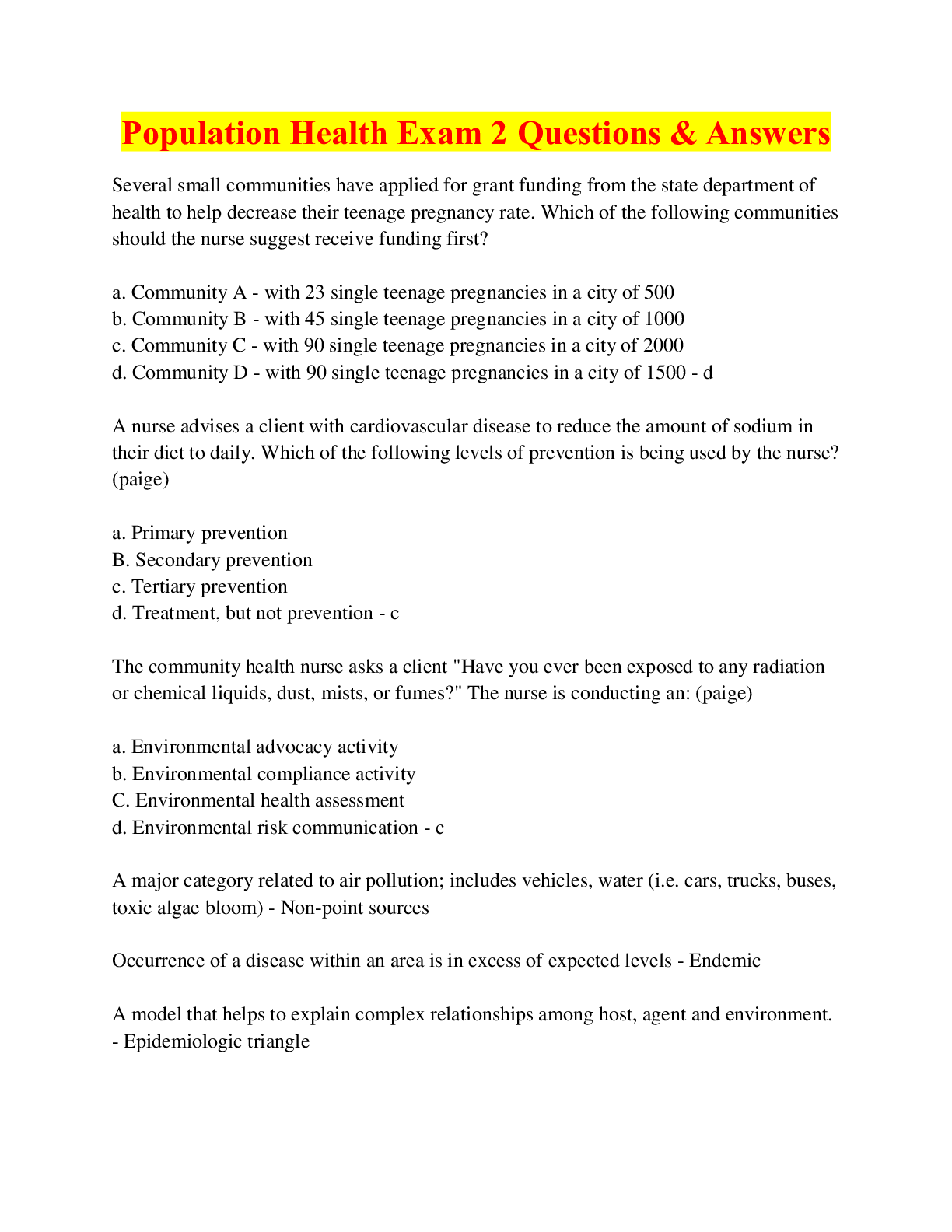
Population Health Exam 2 Questions & Answers-Several small communities have applied for grant funding from the state department of health to help decrease their teenage pregnancy rate. Which of the following communities should the nurse suggest receive funding first?
a. Community A - with 23 single teenage pregnancies in a city of 500
b. Community B - with 45 single teenage pregnancies in a city of 1000
c. Community C - with 90 single teenage pregnancies in a city of 2000
d. Community D - with 90 single teenage pregnancies in a city of 1500 - d
A nurse advises a client with cardiovascular disease to reduce the amount of sodium in their diet to daily. Which of the following levels of prevention is being used by the nurse? (paige)
a. Primary prevention
B. Secondary prevention
c. Tertiary prevention
d. Treatment, but not prevention - c
The community health nurse asks a client "Have you ever been exposed to any radiation or chemical liquids, dust, mists, or fumes?" The nurse is conducting an: (paige)
a. Environmental advocacy activity
b. Environmental compliance activity
C. Environmental health assessment
d. Environmental risk communication - c
A major category related to air pollution; includes vehicles, water (i.e. cars, trucks, buses, toxic algae bloom) - Non-point sources
Occurrence of a disease within an area is in excess of expected levels - Endemic
A model that helps to explain complex relationships among host, agent and environment. - Epidemiologic triangle
How often a disease (that is generally fatal) occurs in a specific area or period of time; Can include attack rate (proportion of persons exposed who develop disease. - Morbidity
Measure of an existing disease in a population at a particular time. - Prevalence
Also known as Right to Know reports; report that discloses results of drinking water testing to consumers. - Consumer Confidence Report
Epidemic spread of the problem over several countries or continents - Pandemic
National comprehensive government organization responsible for disaster management - FEMA
Number of new cases or events in a population at risk during a specified time. - epidemic
signs and symptoms a person is exhibiting are consistent with a particular disease - Suspected case
Death rate of a disease in a population during a specific time - Mortality
Persistent (usual) presence of a disease with low to moderate numbers of cases - incidence
Laboratory confirmed clinical specimen that meets the diagnostic criteria of a specific disease / disorder - Confirmed case
Aids in disaster response on a local or national level. Volunteers from all areas of licensed and unlicensed personnel can be involved. - ARC / MRC
What are the 6 themes of focus for Environmental Health? - i. Outdoor air quality
ii. Surface and ground water quality
iii. Toxic substances and hazardous wastes
iv. Homes and communities
v. Infrastructure and surveillance
vi. Global environmental health
What is the WHO (World Health Organization) definition of environment? - The WHO defines environment, as "all the physical, chemical, and biological factors external to a person, and all the related behaviors." Environmental health consists of preventing or controlling disease, injury, and disability related to the interactions between people and their environment.
A newly hired public health nurse is familiarizing himself with the levels of disaster management. Which of the following actions is a component of disaster prevention?
a. Outlining specific roles of community agencies
b. Prioritizing care of individuals
c. Providing stress counseling
d. Identifying community vulnerabilities - d
A community is experiencing the Honeymoon phase following a disaster. Which of the following is most likely to occur in the community? - b
True or False: The timing of a disaster does not influence the types of injuries that will occur. - f
A nurse wants to find information about environmental threats that are present in the community. Which of the following would be the best source of data for the nurse?
a. CINAHL
b. National Library of Medicine
c. State health department
d. Closest local library - b. National Library of Medicine
List and describe the steps in the EBP process - 1. Pick a topic and develop a question to study (PICO)
2. Search literature for evidence
3. Evaluate the evidence found
4. Implement research to practice
5. Evaluate the effect of the research
Identify EBP nursing interventions related to the core public health functions - a. Assessment
Evidence-based research done by the system management in public health will focus on monitoring health, diagnosing health, and investigating health. These three parts are focused inside of the assessment phase of the core public health literacy.
b. Policy Development
Next, the system management focuses on policy development and inside this phase is informing, educating, and empowering the public health. Also inside of this phase is mobilizing the community partnerships and developing policies. This part of the core public health function is critical and detailed.
c. Assurance
Lastly, the system management bases their research on the assurance of the core public health functions. Inside of this phase, researchers are focussing on the linking to and actually providing care to the people in public health. They are also assuring competent workforce and evaluating each phase.
Each part of this core fu
Considering the nature of learning, describe the domains and give an example of each - Cognitive
Learning that is concerned with acquisition of problem-solving abilities. It is the learning that is active, constructive, and long-lasting. It helps engage the learning process and teaching people to use their brain more effectively when making connections with new things. This is the knowledge based of mental skills. For example learning notes for an instrument, use memory of where the finger placement is and then it all will connect the dots, making connection boxes or circles of items that connect but are different in other ways.
b. Affective
Part of a system that understands and addressing how people learn. The growth in feelings or emotional areas within their self or attitude. For example with sitting through a lecture or attending a lecture is affective learning because they want to learn and willingness to learn.
c. Psychomotor
Is the manual or physical skills of learning. For example this is t
[Show More]