SOPHIA _US HISTORY UNIT 1 CHALLENGE 3
(2020) – 100% CORRECT
Plato: An academic approach to concepts
Select the option that accurately completes the statement below.
Being a genius is a _____ condition for being a col
...
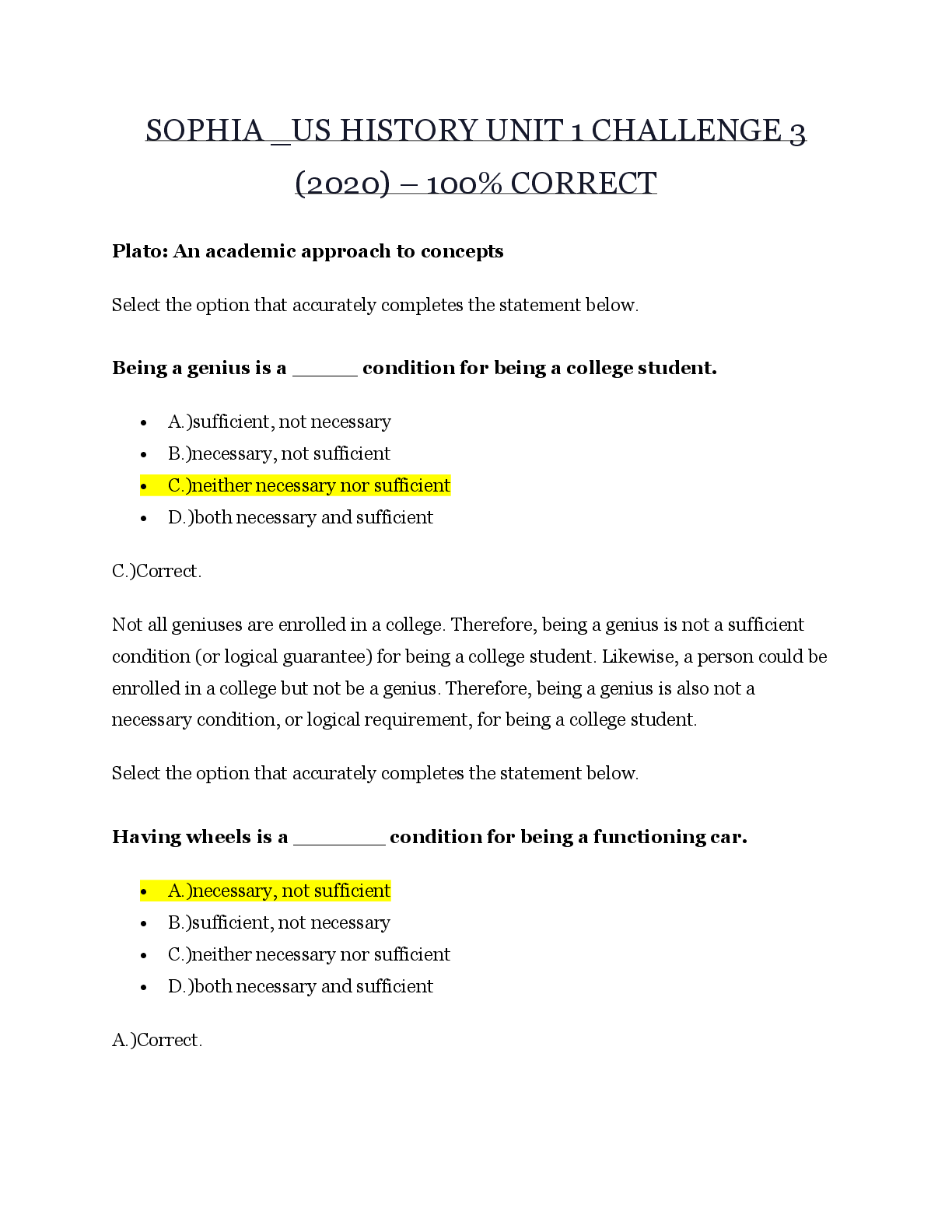
SOPHIA _US HISTORY UNIT 1 CHALLENGE 3
(2020) – 100% CORRECT
Plato: An academic approach to concepts
Select the option that accurately completes the statement below.
Being a genius is a _____ condition for being a college student.
• A.)sufficient, not necessary
• B.)necessary, not sufficient
• C.)neither necessary nor sufficient
• D.)both necessary and sufficient
C.)Correct.
Not all geniuses are enrolled in a college. Therefore, being a genius is not a sufficient
condition (or logical guarantee) for being a college student. Likewise, a person could be
enrolled in a college but not be a genius. Therefore, being a genius is also not a
necessary condition, or logical requirement, for being a college student.
Select the option that accurately completes the statement below.
Having wheels is a _______ condition for being a functioning car.
• A.)necessary, not sufficient
• B.)sufficient, not necessary
• C.)neither necessary nor sufficient
• D.)both necessary and sufficient
A.)Correct.All functioning cars have wheels, therefore, wheels are a necessary condition (or a
logical requirement) for being a functioning car. Since not all things that have wheels
are cars, having wheels is not a sufficient condition (or logical guarantee) for being a car.
Select the option that accurately completes the statement below. Being a
bodybuilder is a _____ condition for being strong.
• A.)sufficient, not necessary
• B.)neither necessary nor sufficient
• C.)necessary, not sufficient
• D.)both necessary and sufficient
A.)Correct.
It is correct that all bodybuilders are strong, which makes being a bodybuilder a
sufficient condition (or logical guarantee) for being strong. But not all strong people are
bodybuilders, so being a bodybuilder is not a necessary condition (or logical
requirement) for being strong.
Plato's Forms: The Objects of Knowledge
Select the statement that does NOT represent a central epistemological
tenet of Plato's doctrine of the Forms.
• A.)Forms are the abstract universals in which all particulars participate.
• B.)The true nature of reality can only be uncovered by understanding the Forms.
• C.)Knowledge is a justified true belief in which justification is grounded in
understanding the world as it really is.
• D.)An essence is a physical entity that is the building block of every object in the
universe.
D.)Correct.It's true that Plato's doctrine of the Forms defines essences as universal entities in which
worldly objects participate, but essences are abstract entities that exist in the intellectual
realm. They are NOT physical entities.
Select the statement that represents a central epistemological tenet of
Plato's doctrine of the Forms.
• A.)If humans cease to exist, so does the Form of knowledge.
• B.)Knowledge differs from opinion because knowledge requires one to be able to
justify his or her beliefs.
• C.)Forms are entities that exist only in the natural world.
• D.)In philosophy, Forms play no role in determining what is morally right and
wrong.
B.)Correct.
Plato believed that knowledge consists of three components: belief, truth, and
justification. Justification means being able to support beliefs with good reasons. Beliefs
that are not justified are only opinions.
Select the statement that does NOT represent a central epistemological
tenet of Plato's doctrine of the Forms.
• A.)Understanding the essence of a thing is the only way to justify having true
knowledge of that thing.
• B.)Knowledge of the Forms enables one to understand the true nature of reality.
• C.)Having an opinion about something assumes that you also have knowledge
about that thing.
• D.)A belief becomes justified when it can be accurately connected to the world.
C.)Correct.Plato believed the opposite of this statement to be true. Having an opinion is one
component of knowledge, but that opinion must be true and justified to qualify as
knowledge.
Plato Forms: The Foundations of Being
Select the statement that represents a central metaphysical tenet of Plato's
doctrine of the Forms.
• A.)Individual objects participate in the Form of those objects.
• B.)The essence of an object exists only when a human invents its Form.
• C.)Only a cause-and-effect aspect exists between an object and its Form.
• D.)The Form of an object is an imitation of the more genuine worldly object.
A.)Correct.
According to Plato, all objects participate in their Forms. This participation grounds
worldly objects in truth.
Select the statement that represents a central metaphysical tenet of Plato's
doctrine of the Forms.
• A.)A perfect circle exists in the world because the Form of a circle exists in the
world.
• B.)When the Form of a tree changes, the tree that exists in the world will change
along with it.
• C.)The Form of Humanity exists independently, regardless of the existence of
human beings.
• D.)Metaphysically speaking, a horse is more genuine than the Form of a horse.
C.)Correct.
According to Plato, Forms are real entities that exist in Platonic Heaven. They would
exist even in the absence of humans
-
-
-
-
-
-
-
-
-
-
Continued
[Show More]
 – 100% CORRECT.png)






 – Chamberlain College of Nursing.png)
 – Chamberlain College of Nursing.png)