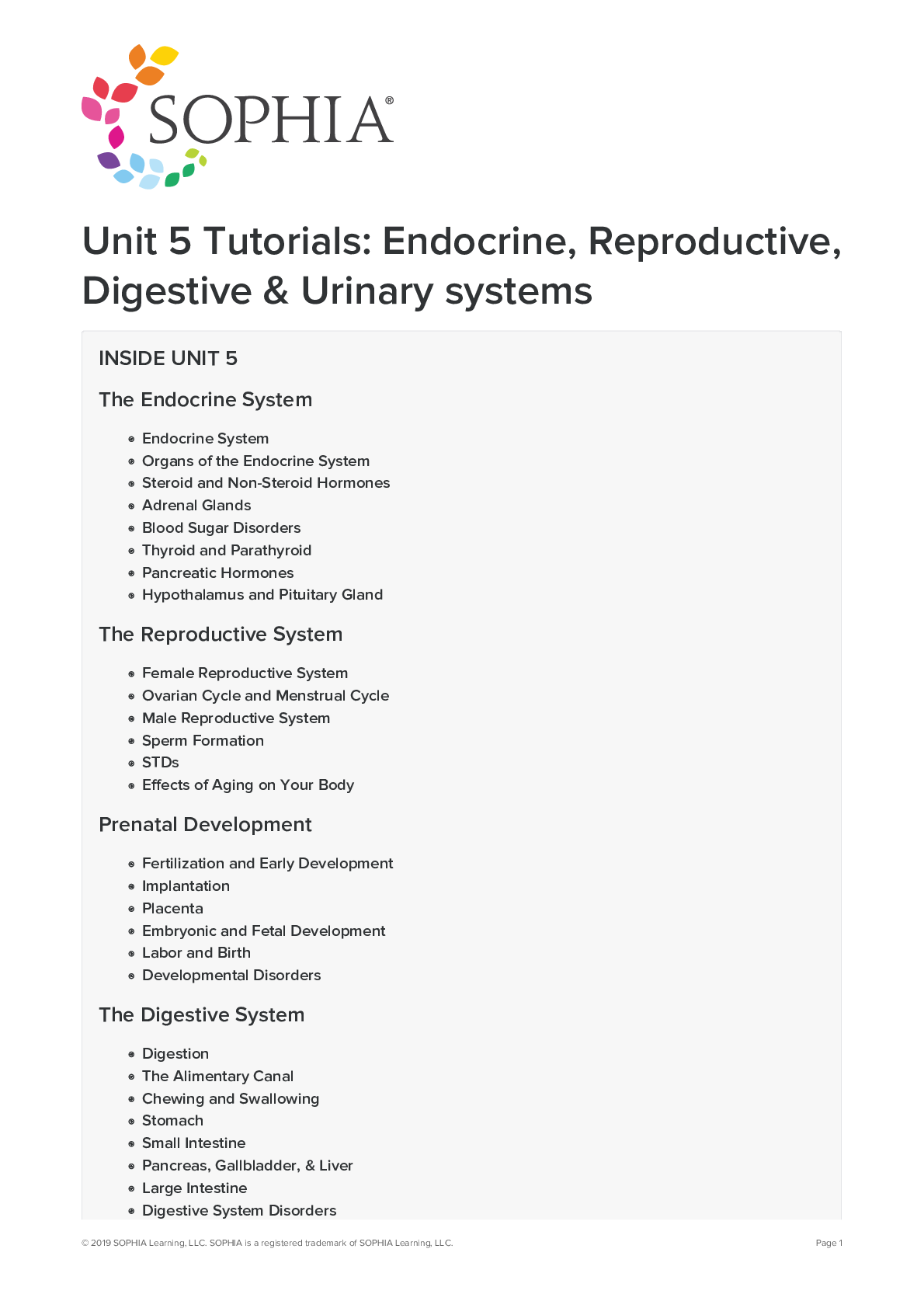
Unit 5 Tutorials: Endocrine, Reproductive,
Digestive & Urinary systems
INSIDE UNIT 5
The Endocrine System
Endocrine System
Organs of the Endocrine System
Steroid and Non-Steroid Hormones
Adrenal Glands
Blood Suga
...
Unit 5 Tutorials: Endocrine, Reproductive,
Digestive & Urinary systems
INSIDE UNIT 5
The Endocrine System
Endocrine System
Organs of the Endocrine System
Steroid and Non-Steroid Hormones
Adrenal Glands
Blood Sugar Disorders
Thyroid and Parathyroid
Pancreatic Hormones
Hypothalamus and Pituitary Gland
The Reproductive System
Female Reproductive System
Ovarian Cycle and Menstrual Cycle
Male Reproductive System
Sperm Formation
STDs
Effects of Aging on Your Body
Prenatal Development
Fertilization and Early Development
Implantation
Placenta
Embryonic and Fetal Development
Labor and Birth
Developmental Disorders
The Digestive System
Digestion
The Alimentary Canal
Chewing and Swallowing
Stomach
Small Intestine
Pancreas, Gallbladder, & Liver
Large Intestine
Digestive System Disorders
© 2019 SOPHIA Learning, LLC. SOPHIA is a registered trademark of SOPHIA Learning, LLC. Page 1Nutrition and Health
The Urinary System
Urinary System
Kidneys
Urine Formation
Fluid Balance and Blood Pressure
Blood pH
Kidney Health
Endocrine System
by Sophia Tutorial
WHAT'S COVERED
Welcome to this lesson on the endocrine system and hormones. Today you will be learning about
what the endocrine system is, and how hormones can interact within the endocrine system.
Specifically, you will look at:
1. Endocrine System Overview
2. Opposing Hormone Interaction
3. Synergistic Hormone Interaction
4. Permissive Hormone Interaction
1. Endocrine System Overview
The endocrine system is a body system that consists ofglands. Glands are clusters of cells that produce and
secrete specific molecules such as hormones. Hormones are small signaling molecules (derived from either
amino acids or lipids) that interact with target cells to change those cells' behavior in a way that promotes
homeostasis.
Many hormones play specific roles in specific parts of the body. Certain cells have a specific receptor for a
particular type of hormone, ensuring that hormone can only affect those target cells. Because of this, not all
cells are affected by all hormones.
TERMS TO KNOW
Endocrine System
A system of glands that produces and secretes hormones into the bloodstream; the endocrine system is used
to communicate on a broad scale to the cells in the body
Glands
Glands are clusters of cells that produce and secrete specific molecules; endocrine glands secrete hormones
directly into the bloodstream, where they can quickly reach their target cells anywhere in the body
Hormones
The major chemical messenger of the endocrine system, hormones, are produced, stored and secreted by
glands; hormones either increase or decrease activity of the cells with which they interact
Target Cell
The cell or group of cells with which a hormone is designed to interact
© 2019 SOPHIA Learning, LLC. SOPHIA is a registered trademark of SOPHIA Learning, LLC. Page 22. Opposing Hormone Interaction
Hormones can actually interact with each other in order to produce different effects. One type of hormone
interaction is an opposing interaction; where the effect of one hormone opposes the effect of another.
EXAMPLE Examples of opposing hormone interactions are insulin and glucagon. Insulin is a type of
hormone that helps to lower sugar levels, while glucagon is a type of hormone that helps to increase blood
sugar levels. There are certain situations when these hormones need to be released, such as after a meal
(insulin) or when starved (glucagon), but not at the same time.
TERM TO KNOW
Opposing Interaction
A term used to describe hormones that create opposite effects of one another; an example would be that
insulin lowers blood glucose while glucagon elevates blood glucose
3. Synergistic Hormone Interaction
Sometimes hormones can create synergistic interactions, which means the two hormones cooperate with
each other to affect a target cell.
TERM TO KNOW
Synergistic Interaction
A term used to describe hormones that create similar effects through slightly different mechanisms; an
example would be that ADH stimulating kidneys retain water while aldosterone stimulates kidneys to retain
sodium, which in turn retains water
4. Permissive Hormone Interaction
A permissive interaction is when one hormone will prepare a cell for another hormone. For the second
hormone to be able to affect the target cell, the target cell first has to be exposed to the first hormone. Think
of it as one hormone will prep the cell for the other hormone to be able to take effect. The second hormone
does not take effect until the cell has been exposed to the first hormone.
TERM TO KNOW
Permissive Interaction
When one hormone allows another hormone to have its full effect; an example would be thyroid hormones
allowing growth hormone to have its full metabolic effects
SUMMARY
This lesson has been a brief overview of the endocrine system and hormone interactions. Specifically,
you looked at opposing, synergistic, and permissive hormone interactions. Keep up the learning and
have a great day!
Source: THIS WORK IS ADAPTED FROM SOPHIA AUTHOR AMANDA SODERLIND
TERMS TO KNOW
© 2019 SOPHIA Learning, LLC. SOPHIA is a registered trademark of SOPHIA Learning, LLC. Page 3Endocrine System
A system of glands that produces and secretes hormones into the bloodstream; the endocrine system
is used to communicate on a broad scale to the cells in the body.
Gland
Glands are clusters of cells that produce and secrete specific molecules. Endocrine glands secrete
hormones directly into the bloodstream, where they can quickly reach their target cells anywhere in
the body.
Hormones
The major chemical messenger (derived from either amino acids or lipids) of the endocrine system.
Hormones are produced, stored and secreted by glands; hormones either increase or decrease
activity of the cells with which they interact.
Opposing Interaction
A term used to describe hormones that create opposite effects of one another. An example would be:
insulin lowers blood glucose while glucagon elevates blood glucose.
Permissive Interaction
When one hormone allows another hormone to have its full effect. An example would be: thyroid
hormones allowing growth hormone to have its full metabolic effects.
Synergistic Interaction
A term used to describe hormones that create similar effects through slightly different mechanisms.
An example would be: ADH stimulating kidneys to retain water while aldosterone stimulates kidneys
to retain sodium, which in turn retains water.
Target Cell
The cell or group of cells with which a hormone is designed to interact.
© 2019 SOPHIA Learning, LLC. SOPHIA is a registered trademark of SOPHIA Learning, LLC. Page 4Organs of the Endocrine System
by Sophia Tutorial
WHAT'S COVERED
Welcome to this lesson on organs of the endocrine system. Today you are going to be looking at a
brief overview of the various organs and the hormones they secrete that are all associated with the
endocrine system. Specifically, you will learn about:
1. Overview
2. Hypothalamus
3. Pituitary Gland
4. Pineal Gland
5. Thyroid & Parathyroid Glands
6. Thymus Gland
7. Pancreas
8. Adrenal Glands
9. Ovaries & Testes
1. Overview
Below is a diagram of the various organs of the endocrine system and the hormones that they secrete.
2. Hypothalamus
The hypothalamus produces hormones such as ADH and oxytocin. ADH is also known as the antidiuretic
hormone and helps to regulate urination. Oxytocin is a hormone that plays a role in childbirth, among other
things.
TERM TO KNOW
Hypothalamus
© 2019 SOPHIA Learning, LLC. SOPHIA is a registered trademark of SOPHIA Learning, LLC. Page 5The hypothalamus is at the "basement" of the forebrain, between the cerebrum and the midbrain/brainstem;
the hypothalamus controls the activity of the pituitary gland.
3. Pituitary Gland
The pituitary gland is a gland that works very closely with the hypothalamus. The pituitary gland stores and
releases hormones that were produced in the hypothalamus. In addition, the pituitary gland also makes and
secretes some of its own hormones, like growth hormone.
TERM TO KNOW
Pituitary Gland
Called the “master gland” because of its effects on other glands; the endocrine hormones increase
activity/secretion of many major glands of the endocrine system.
4. Pineal Gland
Another part of the endocrine system that we'll discuss is thepineal gland. The pineal gland is a gland that
secretes melatonin, which is a hormone that plays a role in our sleep and wake cycles.
TERM TO KNOW
Pineal Gland
A gland located in the cerebrum that secretes melatonin, an important hormone for regulating sleep/wake
cycles.
5. Thyroid & Parathyroid Glands
The thyroid gland is located in front of the trachea (in men, it is just below the Adam's apple), and has a couple
of different roles. The thyroid gland releases two main hormones: Thyroid hormone, abbreviated TH, which
plays a role in metabolism and calcitonin, which is a hormone that plays a role in bone remodeling and blood
calcium levels. Parathyroid glands are four tiny glands found on the thyroid gland and also play a role in bone
remodeling.
TERMS TO KNOW
Thyroid Gland
The largest endocrine gland located on the anterior trachea, the thyroid gland secretes hormones that
regulate metabolism; the thyroid gland also secretes a hormone called calcitonin that lowers blood calcium
levels by increasing the kidneys' excretion of calcium and inhibiting osteoclasts.
Parathyroid Glands
A group of glands on the posterior thyroid that secrete parathyroid hormones to increase blood calcium levels
by decreasing the kidneys' excretion of calcium and increasing osteoclast activity.
6. Thymus Gland
The thymus gland releases thymosins; it is also where T cells mature, which are a part of our immune system.
TERM TO KNOW
Thymus Gland
A gland located above the heart; it secretes thymosins, which mature the immune system's T cells.
© 2019 SOPHIA Learning, LLC. SOPHIA is a registered trademark of SOPHIA Learning, LLC. Page 67. Pancreas
The role of the pancreas is to make and secrete insulin and glucagon. Insulin is a hormone that lowers blood
sugar levels, and glucagon is a hormone that raises blood sugar levels. Somebody who has diabetes doesn't
create or secrete the hormone insulin. Because of this, they have to take insulin injections to help lower blood
sugar levels in their body.
TERM TO KNOW
Pancreas
The endocrine functions of the pancreas are to secrete insulin and glucagon to regulate blood glucose levels.
8. Adrenal Glands
The two adrenal glands, found on top of the kidneys, are the next glands of the endocrine system we're going
to talk about. Adrenal glands basically secrete the hormones epinephrine and norepinephrine, which create
the fight or flight response that prepares the body for different types of stress.
IN CONTEXT
If you're in a dangerous situation, you get a rush of adrenaline. That feeling is coming from hormones
the adrenal gland is releasing. It also sends out cortisol and aldosterone in response to stress.
TERM TO KNOW
Adrenal Glands
Located on top of the kidneys, the adrenal glands have two anatomic divisions: The adrenal cortex and the
adrenal medulla. The adrenal cortex secretes hormones that regulate body mineral levels and metabolism and
also aids in the production of sex hormones. The adrenal medulla releases hormones called catecholamines
(adrenaline) that elevate our metabolism in response to stress.
9. Ovaries & Testes
The female-specific organs of the endocrine system are theovaries. The ovaries release progesterone and
estrogen, which are involved in the menstrual cycle and pregnancy, among other things. The male-specific
organs of the endocrine system are the testes. The testes make and secrete testosterone, which is involved in
the production of sperm, among other things.
TERMS TO KNOW
Ovaries
The primary sex organs of females and the primary source of estrogen and progesterone; the ovaries are also
where the eggs are matured and released.
Testes
The primary sex organs of males and are the primary source of testosterone; the testes are also where sperm
is produced and matured.
SUMMARY
This lesson has been an overview of the various glands of the endocrine system, as well as the
different hormones that those organs create and secrete. Specifically, you learned about the
© 2019 SOPHIA Learning, LLC. SOPHIA is a registered trademark of SOPHIA Learning, LLC. Page 7hypothalamus, pituitary gland, pineal gland, the thyroid and parathyroid glands, thymus gland,
pancreas, adrenal glands, and the ovaries and testes. Keep up the learning and have a great day!
Source: THIS WORK IS ADAPTED FROM SOPHIA AUTHOR AMANDA SODERLIND
ATTRIBUTIONS
Endocrine System | Author: Wikipeda | License: Public Domain
TERMS TO KNOW
Adrenal Glands
Located on top of the kidneys, the adrenal glands have two anatomic divisions: The adrenal cortex
and the adrenal medulla. The adrenal cortex secretes hormones that regulate body mineral levels and
metabolism and also aids in the production of sex hormones. The adrenal medulla releases hormones
called catecholamines (adrenaline) that elevate our metabolism in response to stress.
Hypothalamus
The hypothalamus is at the "basement" of the forebrain, between the cerebrum and the
midbrain/brainstem. The hypothalamus controls that activity of the pituitary gland.
Ovaries
Ovaries are the primary sex organs of females; they are females' primary source of the hormones
estrogen and progesterone. The ovaries are also where the eggs are matured and released.
Pancreas
The endocrine functions of the pancreas are to secrete insulin and glucagon to regulate blood
glucose levels.
Parathyroid Glands
A group of glands on the posterior thyroid that secrete parathyroid hormone to increase blood
calcium levels by decreasing renal excretion of calcium and increasing osteoclast activity.
Pineal Gland
A gland located in the cerebrum that secretes melatonin, an important hormone for regulating
sleep/wake cycles.
Pituitary Gland
Called the “master gland” because of its effects on other glands; endocrine hormones increase
activity/secretion of many major glands of the endocrine system.
Testes
Testes are the primary sex organs of males, and are their primary source of testosterone. The testes
are also where the sperm is produced and matured.
© 2019 SOPHIA Learning, LLC. SOPHIA is a registered trademark of SOPHIA Learning, LLC. Page 8Thymus Gland
A gland located above the heart. It secretes thymosins, which mature the immune system's T-cells.
Thyroid Gland
Located on the anterior trachea, the thyroid gland secretes hormones that regulate metabolism. The
thyroid gland also secretes a hormone called calcitonin that lowers blood calcium levels by increasing
the kidneys' excretion of calcium into the urine and inhibiting osteoclasts.
© 2019 SOPHIA Learning, LLC. SOPHIA is a registered trademark of SOPHIA Learning, LLC. Page 9Steroid and Non-Steroid Hormones
by Sophia Tutorial
WHAT'S COVERED
Welcome to this lesson on steroid and non-steroid hormones. In this lesson you will look at:
1. Hormone Overview
2. Steroid Hormones
3. Non-Steroid Hormones
4. Secondary Messenger
1. Hormone Overview
Hormones are chemical messengers (derived from either amino acids or lipids) of the endocrine system. They
are made and secreted by glands. Once secreted, hormones interact with specific types of cells, signaling the
cell's activity to change in some way. Cell receptors are specific to the hormones they interact with, and
certain types of hormones can only affect certain types of cells. This means that not every hormone affects
every type of cell because not all cells will possess their receptors.
2. Steroid Hormones
Steroid hormones are lipids that are made from cholesterol. They're produced in the adrenal glands and
reproductive glands. Because steroid hormones are lipids made from cholesterol, they are non-polar,
hydrophobic (water-repelling) molecules. This means they can't move through blood (which is very watery)
without help, but they can move through the plasma membrane easily. They get to make a direct path through
the cell to receptors on the nucleus.
Steroid hormones will bind to receptors on the nucleus, and this will allow them to affect the behavior of the
DNA. They can turn genes and DNA on or off; this controls protein-making mechanisms and can directly affect
the target cell's function.
EXAMPLE Examples of steroid hormones are estrogen (which is involved in female reproduction) and
testosterone (which is involved in male reproduction).
TERM TO KNOW
Steroid Hormones
Hormones that have a cholesterol backbone and are not soluble in water due to their lipid structure; steroid
hormones are transported through the blood attached to carrier proteins; steroid hormones penetrate the cell
membrane and interact with nuclear receptors that affect DNA transcription.
3. Non-Steroid Hormones
Non-steroid hormones are derived from amino acids; as a result, they tend to be more polar/hydrophilic
(water-attracting). This means that they can pass easily through the blood (which is very watery), but cannot
pass through the target cells' plasma membranes. Instead, non-steroid hormones bind to receptors on the
target cell's plasma membrane.
TERM TO KNOW
© 2019 SOPHIA Learning, LLC. SOPHIA is a registered trademark of SOPHIA Learning, LLC. Page 10Non-steroid Hormones
A class of hormones that are primarily derived from amino acids and are water soluble due to their polar
nature; non-steroid hormones are transported freely through the blood; non-steroid hormones interact with
receptors on the cell membrane and activate secondary messenger systems that carry out their effects within
the cell.
4. Secondary Messenger
Remember, steroid hormones bind to receptors on the nucleus, and non-steroid hormones are going to bind
to receptors on the target cell's plasma membrane. Because non-steroid hormones aren't able to pass through
the plasma membrane, they will activate what are called secondary messengers.
Secondary messengers relay information to the interior of the cell. When non-steroid hormones bind with their
receptors on the plasma membrane, the secondary messenger will be activated. The secondary messenger
will then relay the signal ultimately to the DNA, where changes in the target cell's behavior are controlled.
TERM TO KNOW
Secondary Messenger
A group of signaling molecules located near a hormone receptor on the inside of the cell; when a non-steroid
hormone binds to its receptor, it activates secondary messenger systems that carry out specific effects inside
of the cell. Non-steroid hormones rely on secondary messenger signaling molecules because they are unable
to penetrate the cell membrane and get into the cell.
SUMMARY
This lesson has been an overview of hormones, including steroid and non-steroid hormones and
secondary messengers. Keep up the learning and have a great day!
Source: THIS WORK IS ADAPTED FROM SOPHIA AUTHOR AMANDA SODERLIND
TERMS TO KNOW
Non-steroid Hormones
A class of hormones that are primarily derived from proteins and are water soluble due to their polar
nature; non-steroid hormones are transported freely through the blood. Non-steroid hormones
interact with receptors on the cell membrane and activate secondary messenger systems that carry
out their effects within the cell.
Secondary Messenger
A group of signaling molecules located near a hormone receptor on the inside of the cell; when a
non-steroid hormone binds to its receptor on the extracellular side of the plasma membrane, it
activates secondary messenger systems that carry out specific effects inside of the cell. Non-steroid
hormones rely on secondary messenger signaling molecules because they are unable to penetrate
the cell membrane and get into the cell.
Steroid Hormones
Hormones that have a cholesterol backbone and are not soluble in water due to their lipid structure;
steroid hormones are transported through the blood attached to carrier proteins. Steroid hormones
© 2019 SOPHIA Learning, LLC. SOPHIA is a registered trademark of SOPHIA Learning, LLC. Page 11penetrate the cell membrane and interact with nuclear receptors that affect the DNA.-
-
-
-
-
-
-
-
-
-
-
-
-
-
-
-
-
-
-
-
-
-
-
--
-
-
--
Blood pH
by Sophia Tutorial
WHAT'S COVERED
Welcome to this lesson on maintaining blood pH. Today you will be discussing the kidney's role in
maintaining the blood pH. Specifically, you will be learning about:
1. pH Balance Overview
2. pH Management
1. pH Balance Overview
Kidneys are organs of the body that help maintain the body'sacid-base balance. Acid-base balance is the
amount of acids and bases found in extracellular fluids of the body.
Acids are substances that increase the amount of hydrogen ions (H+) in a liquid and lower thepH. For
example, distilled vinegar is an acid of around pH 2 or 3. That means it's at least 10,000 times more acidic
than water, which has a neutral (neither acidic nor basic) pH of 7. When added to warm milk, it changes the
shape of milk proteins into curds that can be made into cheese. Stomach acid also has a pH of about 2 or 3;
you can imagine how effective stomach acid is at curdling the proteins in potentially infectious bacteria!
Bases are substances that decrease the amount of hydrogen ions (H+) in a liquid and raise the pH. Baking
soda is a mild base (pH 9); it's about 100 times less acidic than water. This can be a problem for the Electron
Transport Chain. Remember, you need to have a certain amount of hydrogen ions in the intermembrane
space of your mitochondria to create an electrical chemical gradient needed to make ATP. If your blood is too
basic, it means hydrogen ions are in short supply, and making enough ATP to function well will be more
difficult.
Normal body pH is between 7.37 to 7.43. If you're familiar with the pH scale, you know that a pH of seven is
neutral, a pH of less than seven is acidic, and a pH of more than seven is basic. If our pH is 7.37 to 7.43, that's
slightly more than seven, which means the normal pH of the body is slightly basic.
For our body to function properly, for our cells and enzymes to function optimally, pH needs to stay within this
range. If blood pH drops to 7.36, for example, it is still technically more basic than water, but it is too acidic for
our proteins to function well (think of milk proteins curdling in vinegar). Likewise, if blood pH rises to 7.44, it's
too basic for proteins to function properly.
TERMS TO KNOW
Acid-Base Balance
The amount of acids and bases in the extracellular fluids of the body; amounts of acids vs. bases affects the
overall pH of extracellular fluids.
Acids
Substances that increase the amount of hydrogen ions (H+) in a liquid and lower the pH.
Bases
Substances that decrease the amount of hydrogen ions (H+) in a liquid and raise the pH.
pH
A measure of whether a liquid has a lot of hydrogen ions (H+) or relatively few hydrogen ions; the lower the
pH, the more hydrogen ions it has, and the more acidic it is, the higher the pH, the fewer hydrogen ions it has,
the more basic it is
© 2019 SOPHIA Learning, LLC. SOPHIA is a registered trademark of SOPHIA Learning, LLC. Page 1212. pH Management
pH is largely managed by the amount of carbon dioxide dissolved in your blood. When carbon dioxide (CO )
dissolves in your blood plasma, it interacts with a water molecule (H O) to become carbonic acid (HOCOOH or
H CO ). However, above a pH of ~6, carbonic acid would rather split into bicarbonate and a hydrogen ion
(HOCOO- and H+). This means that in your blood (pH ~7.4, well above pH 6), dissolved carbon dioxide will
generate hydrogen ions, making your blood more acidic and lowering the pH.
What happens when there's not enough carbon dioxide dissolved in your blood? It means that there are not
enough hydrogen ions being generated, so your blood becomes more basic, and your blood pH rises. This is
what happens if you hyperventilate: You're breathing so hard that more carbon dioxide is leaving your blood
through your lungs than your metabolism (converting acetyl-CoA into carbon dioxide through the Krebs Cycle,
for example) can quickly replace. Your blood pH rises, and you may even faint.
SUMMARY
This lesson has been an overview of how the kidneys help to maintain the body's acid-base balance.
Specifically, you learned about pH management. Keep up the learning and have a great day!
Source: THIS WORK IS ADAPTED FROM SOPHIA AUTHOR AMANDA SODERLIND
TERMS TO KNOW
Acid-Base Balance
The amounts of acids and bases in the extracellular fluids of the body; amounts of acids vs. bases
affects the overall pH of extracellular fluids.
Acids
Substances that increase the amount of hydrogen ions (H+) in a liquid and lower the pH.
Bases
Substances that decrease the amount of hydrogen ions (H+) in a liquid and raise the pH.
pH
A measure of whether a liquid has a lot of hydrogen ions (H+) or relatively few hydrogen ions. The
lower the pH, the more hydrogen ions it has, and the more acidic it is. the higher the pH, the fewer
hydrogen ions it has, and the more basic it is.
2
2
2 3
© 2019 SOPHIA Learning, LLC. SOPHIA is a registered trademark of SOPHIA Learning, LLC. Page 122Kidney Health
by Sophia Tutorial
WHAT'S COVERED
Welcome to this lesson on kidney disorders and health. Today, you’re going to be learning about
various disorders that can affect kidneys. Specifically, you will learn about:
1. Kidney Stones
2. Urinary Tract Infections
3. Nephritis
4. Kidney Cancer
5. Dialysis
6. Alcohol Consumption
1. Kidney Stones
Kidney stones can develop from minerals or other substances that are found in urine. These can be things like
uric acid or calcium salts that settle out of urine to form these kidney stones. Kidney stones can range in size
from being pretty small to fairly large.
If a kidney stone is small enough, it'll end up just passing out of the body with the urine. If they're large
enough, they can become very painful as they move through the urinary system and can clog up different
parts of the urinary system. They may get clogged in a ureter, which connects a kidney to the urinary bladder.
At that point, the person would have to go to the doctor and get some sort of treatment to break this kidney
stone down into a size small enough to pass. This can be a very painful process and may also cause damage
to the lining of ureters.
TERM TO KNOW
Kidney Stones
Deposits of acids and salts that accumulate in the kidneys and can obstruct the flow of urine; kidney stones
are very painful to void.
2. Urinary Tract Infections
Urinary tract infections are caused when bacteria from outside the body make their way into the bladder and
cause inflammation. They are actually more common in women because they have a much shorter urethra
than men, so it's much easier for bacteria to travel up a short urethra and into the bladder than up a very long
urethra and into the bladder.
TERM TO KNOW
Urinary Tract Infection (UTI)
Infections that enter the urethra and can climb as high as the kidneys, UTIs cause inflammation of the urinary
bladder or kidneys.
3. Nephritis
Nephritis is the inflammation of the kidneys, which can be caused by bacterial infections, among other factors,
© 2019 SOPHIA Learning, LLC. SOPHIA is a registered trademark of SOPHIA Learning, LLC. Page 123and result in pressure build up around capillaries. Filtration of blood then becomes ineffective. Because of its
hard outer covering, the kidney has a hard time swelling if fluid accumulates within it.
Remember that the renal arterioles are very narrow, so blood pressure is relatively high when it enters the
glomerulus (just like when you put your thumb over the water stream of a hose, making the spray shoot
harder and further). It's this pressure that forces the water and solutes of the blood plasma into the Bowman's
capsule for filtration. If there's back-pressure (if there's inflammation of the kidneys pushing back on the
pressure from the renal arterioles), the total pressure of the blood plasma on the capillaries of the glomerulus
is less. The result is less fluid being forced from the blood into the Bowman's capsule, so filtration is far less
effective.
TERM TO KNOW
Nephritis
Inflammation of the kidneys caused by infections or autoimmune disorders.
4. Kidney Cancer
Kidney cancer is a cancer of the kidney, as the name implies. This type of cancer can actually spread very
easily through the bloodstream because kidneys filter the blood. If the kidneys have cancer, it can be fairly
easy for some of those cancerous cells to basically flow with the blood and implant themselves in another part
of the body. Kidney cancer can spread easily throughout the body due to its access to the bloodstream.
Bladder cancer is another cancer that is closely related to the kidneys. Both bladder cancer and kidney
cancer are more common in men than they are in women.
TERM TO KNOW
Kidney Cancer
Cancer that occurs in the kidneys; it is more prevalent in males than in females.
5. Dialysis
Dialysis is a process in which a machine will clean the blood if the kidneys are unable to. If a person has some
sort of kidney disorder, where kidneys are not properly functioning, they can't properly filter the blood.
Dialysis is the process in which a machine will filter blood for them. A dialysis machine cleans the blood and
helps maintain the volume and composition of extracellular fluids.
TERM TO KNOW
Dialysis
The process of artificially filtering a person’s blood by pumping it out of their body and into a machine; dialysis
is a necessary procedure for a person whose kidneys are failing or completely gone (failed).
6. Alcohol Consumption
Consumption of alcohol is another factor that can have an effect on kidney health. Consumption of alcohol will
inhibit ADH, which stands for anti-diuretic hormone. This causes the body to lose more water, and as the body
loses more water, the concentration of ions will be upset, and balance will be altered. Alcohol causes the
kidneys to increase urinary output, which will then lead to dehydration. If a person heavily drinks over a long
period of time throughout their life, it can actually lead to much more serious kidney disorders in the future.
SUMMARY
This lesson has been an overview on kidney disorders and health. Specifically, you learned about
© 2019 SOPHIA Learning, LLC. SOPHIA is a registered trademark of SOPHIA Learning, LLC. Page 124kidney stones, urinary tract infections, nephritis, both kidney cancer and bladder cancer, the benefits
of dialysis and the dangers of alcohol consumption. Keep up the learning and have a great day!
Source: THIS WORK IS ADAPTED FROM SOPHIA AUTHOR AMANDA SODERLIND
TERMS TO KNOW
Dialysis
The process of artificially filtering a person’s blood by pumping it out of their body and into a machine;
dialysis is a necessary procedure for a person whose kidneys are failing or completely gone (failed).
Kidney Cancer
Cancer that occurs in the kidneys; it is more prevalent in males than in females.
Kidney Stones
Deposits of acids and salts that accumulate in the kidneys and can obstruct the flow of urine; kidney
stones are very painful to void.
Nephritis
Inflammation of the kidneys caused by infections or autoimmune disorders.
Urinary Tract Infection (UTI)
Infections that enter the urethra and can climb as high as the kidneys, UTIs cause inflammation of the
urinary bladder or kidneys.
[Show More]