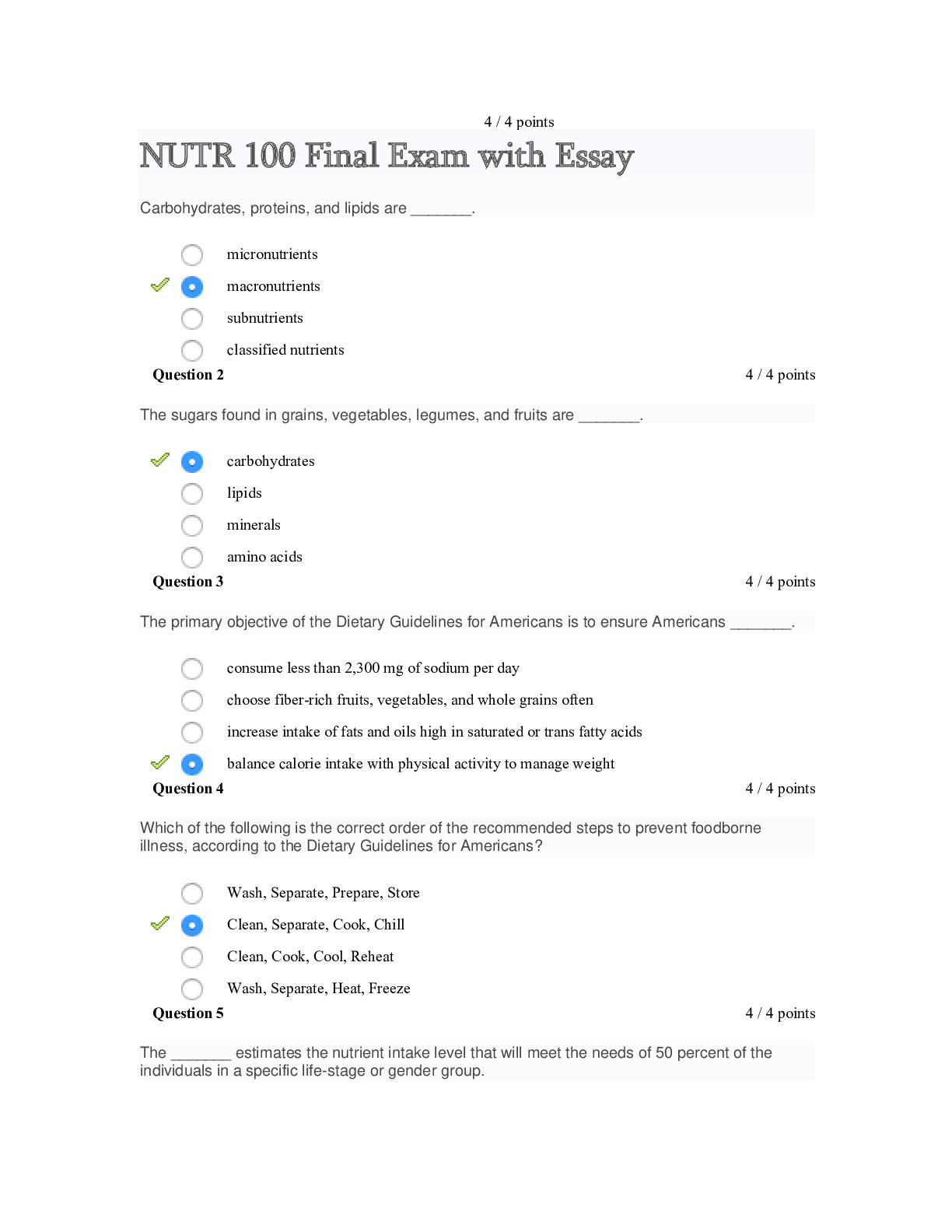
Question 1 4 / 4 points
NUTR 100 Final Exam with Essay
Carbohydrates, proteins, and lipids are _______.
micronutrients
macronutrients
subnutrients
classified nutrients
Question 2 4 / 4 point
...
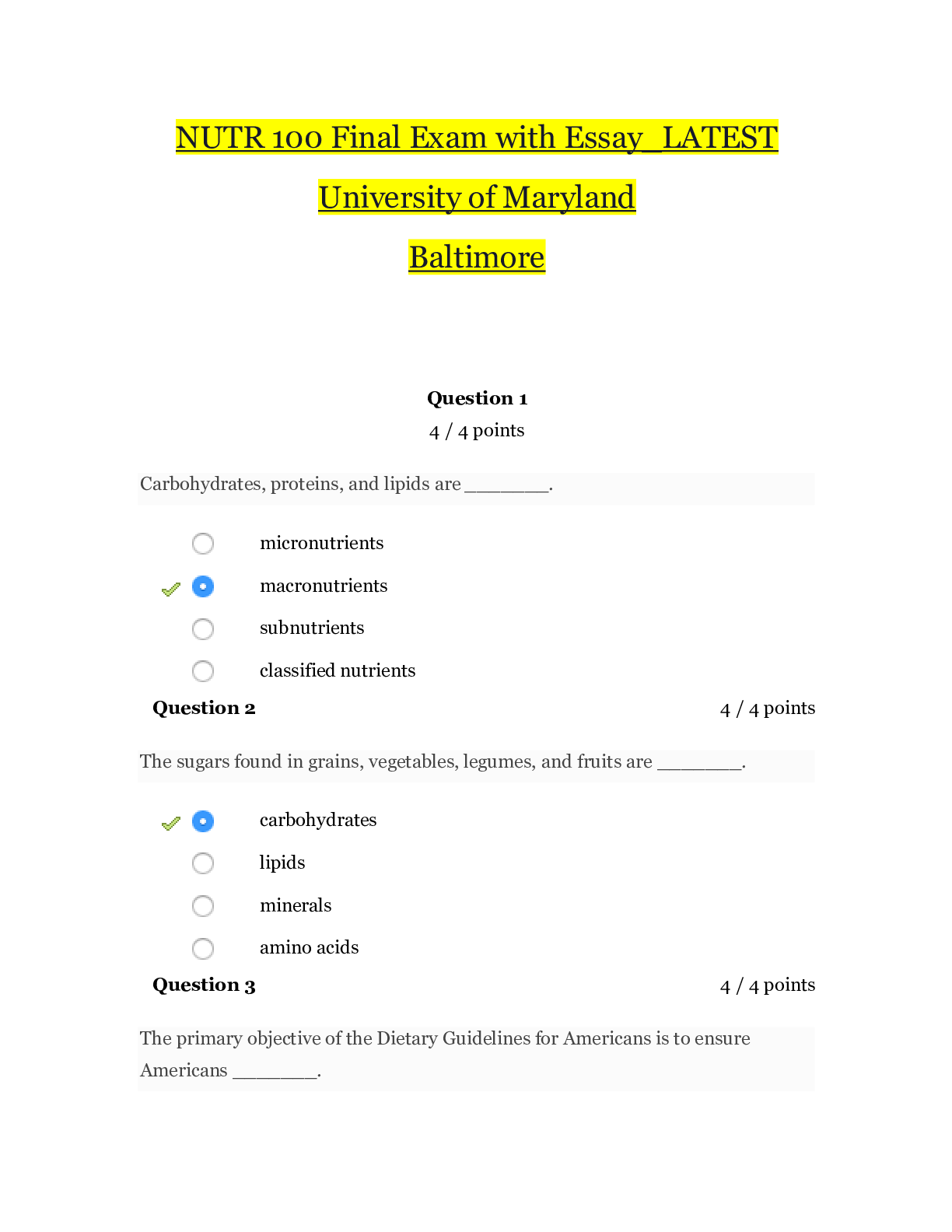
Question 1 4 / 4 points
NUTR 100 Final Exam with Essay
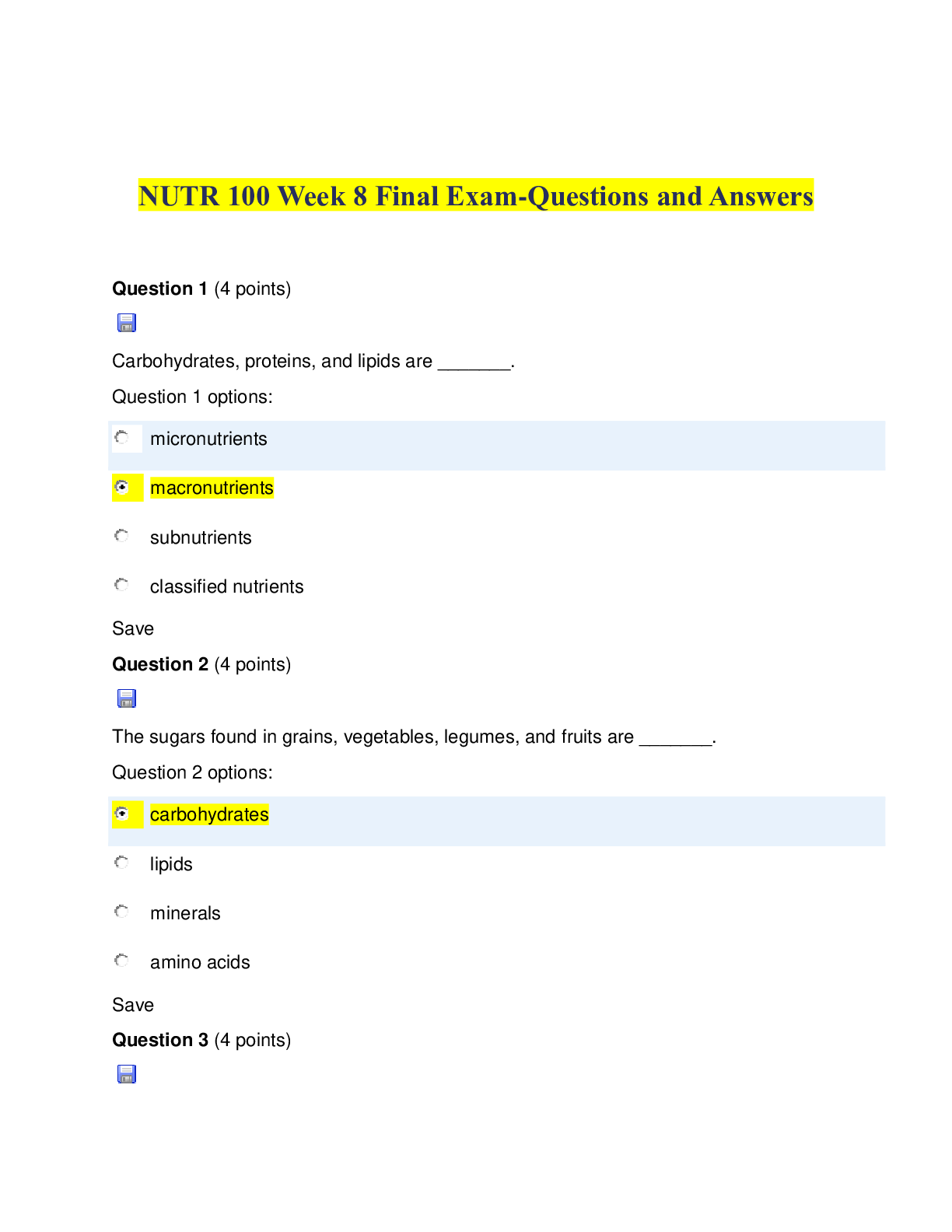
Carbohydrates, proteins, and lipids are _______.
micronutrients
macronutrients
subnutrients
classified nutrients
Question 2 4 / 4 points
The sugars found in grains, vegetables, legumes, and fruits are _______.
carbohydrates
lipids
minerals
amino acids
Question 3 4 / 4 points
The primary objective of the Dietary Guidelines for Americans is to ensure Americans _______.
consume less than 2,300 mg of sodium per day
choose fiber-rich fruits, vegetables, and whole grains often
increase intake of fats and oils high in saturated or trans fatty acids
balance calorie intake with physical activity to manage weight
Question 4 4 / 4 points
Which of the following is the correct order of the recommended steps to prevent foodborne illness, according to the Dietary Guidelines for Americans?
Wash, Separate, Prepare, Store
Clean, Separate, Cook, Chill
Clean, Cook, Cool, Reheat
Wash, Separate, Heat, Freeze
Question 5 4 / 4 points
The _______ estimates the nutrient intake level that will meet the needs of 50 percent of the individuals in a specific life-stage or gender group.
Estimated Average Requirement
Recommended Dietary Allowance
Tolerable Upper Limit
Average Needs Level
Question 6 4 / 4 points
Essential nutrients are nutrients that _______.
can be synthesized in the body
must be obtained from dietary intake
are essential to good health
can only be obtained through taking supplements
Question 7 4 / 4 points
The current icon to represent the food groups is known as _______.
The Food Guide Pyramid
MyPlate
MyPyramid
Idaho Plate Method
Question 8 4 / 4 points
Replacing lost nutrients in foods is called _______.
fortification
pasteurization
enrichment
modification
Question 9 4 / 4 points
The majority of digestion takes place in the _______.
duodenum
colon
jejunum
ileum
Question 10 4 / 4 points
Celiac disease is treated by removing gluten from the diet. Gluten is found in all of the following EXCEPT _______.
wheat
rye
barley
rice
Question 11 4 / 4 points
Lipase is an enzyme that breaks down _______.
carbohydrate
fat
protein
all of these choices
Question 12 4 / 4 points
In order to move food from the mouth, down the esophagus, and into the stomach, the food must be made into _____.
chyme
a bolus
a blob
an epiglottis
Question 13 4 / 4 points
A __________ fat has two or more carbon double bonds.
saturated
bisaturated
monounsaturated
polyunsaturated
Question 14 4 / 4 points
Which of the following is not a digestion accessory organ?
liver
gallbladder
colon
pancreas
Question 15 4 / 4 points
The AMDR for protein is______ percent of total daily calories.
5 to 10
10 to 35
20 to 35
45 to 65
Question 16 4 / 4 points
How many kilocalories are in 24 grams of fat?
216
168
96
240
Question 17 4 / 4 points
___________ atoms are added to unsaturated fats in order to make liquid fats more solid at room temperature.
carbon
hydrogen
sodium
lipid
Question 18 4 / 4 points
How many amino acids can’t be synthesized in the body?
9
11
21
19
Question 19 4 / 4 points
The AMDR for fat is _____________ percent of daily kilocalorie intake.
45 to 65
5 to 10
20 to 35
10 to 35
Question 20 4 / 4 points
An enzyme ___________ a chemical reaction.
slows down
speeds up
stops
provides stability for
Question 21 4 / 4 points
Which of the following combines with carbon, hydrogen, and oxygen to make up the structure of protein?
nitrogen
sulfur
pepsin
chloride
Question 22 4 / 4 points
A triglyceride is formed through a ____________reaction between a glycerol and _______fatty acid(s).
partial hydrogenation; one
rehydration; three
lipogenesis; one
dehydration; three
Question 23 4 / 4 points
_______ is the deficiency associated with thiamin.
scurvy
beriberi
rickets
anemia
Question 24 4 / 4 points
Which of the following choices include all of the fat-soluble vitamins?
vitamin B12, vitamin B6, vitamin C, vitamin D
vitamin A, vitamin D, vitamin E, vitamin K
vitamin D, vitamin K, thiamin, vitamin B6
vitamin E, vitamin A, vitamin B6, niacin
Question 25 4 / 4 points
B-complex vitamins often serve as _______.
cofactors/coenzymes
blood thinners
a source of calories
none of these choices
Question 26 4 / 4 points
Flushing is a common side effect from which nutrient?
thiamin
vitamin C
niacin
sodium
Question 27 4 / 4 points
The majority of sodium intake for the standard American diet comes from _______.
iodized table salt
sauces and soups
processed foods
cheese
Question 28 4 / 4 points
Metabolism is described as the balance between __________ and _________ reactions in the body.
steroidal; carboxylic
anabolic; synthetic
catabolic; anabolic
catabolic; amine
Question 29 4 / 4 points
You are able to maintain your body weight when energy expended _______ calories consumed.
exceed
equals
are less than
double
Question 30 4 / 4 points
Which of the following daily protein intakes is recommended for endurance and strength training athletes?
0.8-1.2 grams/kg body weight
0.5-0.8 grams/kg body weight
1.2-1.7 grams/kg body weight
2.0-2.5 grams/kg body weight
Question 31 4 / 4 points
All of the following are guidelines for reducing cancer risk EXCEPT:
Limit intake of charred foods.
Reduce intake of red meat.
Increase consumption of fruits.
All of these choice are guidelines to reduce cancer risk.
Question 32 4 / 4 points
Research studies are often used to provide evidence for CAM therapies.
True
False
Question 33 4 / 4 points
Sodium, calcium, iron, vitamin C, and vitamin A are all required by law to be included on the food label.
True
False
Question 34 4 / 4 points
Peanut butter is one example of a high-quality protein.
True
False
Question 35 4 / 4 points
Supplements are approved by the FDA before reaching the market.
True
False
Question 36 4 / 4 points
Vitamin D is a nonessential nutrient.
True
False
Question 37 4 / 4 points
Weight loss occurs when energy balance is in equilibrium.
True
False
Question 38 4 / 4 points
A high-fiber, low-fat diet may reduce the risk of cancer
True
False
Question 39 4 / 4 points
Body Mass Index (BMI) provides an accurate measurement of the amount of fat tissue on the body.
True
False
Question 40 4 / 4 points
Before exercising, athletes are encouraged to drink plenty of fluids and consume a high-fat meal for energy.
True
False
Question 41 0 / 20 points
Describe two common dietary misconceptions in our society today. Write a 200 word essay (with at least 2 references) refuting the misconceptions and using information that you have learned in this class.
Common Dietary Misconceptions
Sufficient nutrition is a critical component of the wellbeing of individuals in different parts of the world. It encompasses a careful balance of nutrients where each nutrient plays a fundamental role in the dietary composition (Hesketh et al., 2005). Despite the importance of such a balance, there exist a series of misinformation surrounding mainstream nutrition and hence hinder the attainment of adequate dietary. Besides, diet has become an essential issue to many individuals who strive to achieve healthy eating habits. This essay looks into the two most common dietary misconceptions as well as the truth behind such misconceptions.
The first misconception is about late night eating where most individuals are forced to believe that it makes people fat. In a society where many people struggle with issues of obesity and being overweight, they tend to believe every source of information hoping it will solve their problems (Hesketh et al., 2005). The misconception does not stand since it is based on the argument that the energy from late-night dinner gets stored as fat when one sleeps. This isn't the case because an individual's body does not care when he or she consumes calories but rather the amount of calories consumed and how much is burned. If a person consumes more calories than what he or she burns, such an individual will gain weight, and therefore, it is not an issue of late-night eating.
The second misconception relates to the belief that eggs are bad for health. While it is a fact that eggs contain high amounts of cholesterol, they are not necessarily bad for an individual's health when eaten in moderation (Gray & Griffin, 2009). Notably, eggs are an adequate source of protein as well as vitamin A, D and E. The research by a nutritionist, Gray Juliet as well as Bruce Griffin from the University of Surrey recommends re-evaluating the limit on the level of healthy egg consumption (Gray & Griffin, 2009).
In conclusion, effective nutrition is a significant component in staying healthy for individuals throughout the world.
References:
Gray, J., & Griffin, B. (2009). Eggs and dietary cholesterol–dispelling the myth. Nutrition Bulletin, 34(1), 66-70.
Hesketh, K., Waters, E., Green, J., Salmon, L., & Williams, J. (2005). Healthy eating, activity and obesity prevention: a qualitative study of parent and child perceptions in Australia. Health promotion international, 20(1), 19-26.
This question has not been graded.
The correct answer is not displayed for Long Answer type questions.
Question 42 0 / 20 points
Your friend insists that it is impossible to survive long-term on a vegetarian diet (vegan). Describe to your friend how a vegan diet can also be a "healthy diet" . Create a one day eating plan (3 meals, 2 snacks), for a 30 year old woman of an average BMI that is an athlete (wrestler).
Breakfast
1 serving of Oatmeal- 1/2 cup rolled oats mixed with 1 cup of unsweetened non-dairy milk and water, with 1/2 sliced banana, ½ cup of strawberries, 2 tbsp. chia seeds and 1 tbsp. ground flax seeds.
8oz Non Fat Soy Milk
Snack
1/3 cup of trail mix- raw almonds, coconut flakes, mulberries, brazil nuts and walnuts.
Lunch
1 cup of kale
1 cup of arugula
½ cup of cucumbers
¼ cup of avocado
¼ cup of sliced red bell peppers
¼ cup of shredded carrots
3 tbsp sunflower seeds
3 tbsp dried raisins
3 tbsp dried strawberries
2 tbsp vinaigrette dressing
32oz water
Snack
6 oz non fat Greek yogurt, unsweetened
1 oz almonds
Dinner
Teriyaki tofu roll with avocado, cucumber, potato, and black rice
1 package tofu
2 potatoes
3 garlic cloves, chopped
3 tablespoons tamari
2 tablespoons maple syrup
2 tablespoons olive oil
2 teaspoons liquid smoke
1/2 cucumber
1 avocado
1 cup black rice
Nori sheets
24 oz water
[Show More]









.png)
.png)



.png)


