3.) A nurse is discussing routine follow-up needs with a client who has a new
prescription for valproate. The nurse should inform the client of the need for
routine monitoring of which of the following?
a. AST/ALT a
...
3.) A nurse is discussing routine follow-up needs with a client who has a new
prescription for valproate. The nurse should inform the client of the need for
routine monitoring of which of the following?
a. AST/ALT and LDH.
b. Creatinine and BUN.
c. WBC and granulocyte counts.
d. Serum sodium and potassium.
4.) A nurse is caring for a client who is experiencing extreme mania due to
bipolar disorder. Prior to administration of lithium carbonate, the client’s
lithium blood level is 1.2 mEq/L. Which of the following actions should the
nurse take?
a. Administer the next dose of lithium carbonate as scheduled.
b. Prepare for administration of aminophylline.
c. Notify the provider for a possible increase in the dosage of lithium
carbonate.
d. Request a stat repeat of the client’s lithium blood level.
5.) A nurse is admitting a client who has a new diagnosis of bipolar disorder
and is scheduled to begin lithium therapy. When collecting a medical history
from the client’s adult daughter, which of the following statements is the
priority to report to the provider?
a. “My mother has diabetes that is controlled by her diet.”
b. “My mother recently completed a course of prednisone for acute
bronchitis.”
c. “My mother received her flu vaccine last month.”
d. “My mother is currently on furosemide for her congestive heart
failure.”
1.) A nurse is providing teaching for a client who is scheduled to receive ECT
for the treatment of major depressive disorder. Which of the following client
statements indicates understanding of the teaching?
a. “It is common to treat depression with ECT before trying
medications.”
b. “I can have my depression cured if I receive a series of ECT
treatments.”
c. “I should receive ECT once a week for 6 weeks.”
d. “I will receive a muscle relaxant to protect me from injury during
ECT.”
2.) A charge nurse is discussing TMS with a newly licensed nurse. Which of the
following statements by the newly licensed nurse indicates an understanding
of the teaching?
a. “TMS is indicated for clients who have schizophrenia spectrum
disorders.”
b. “I will provide postanesthesia care following TMS.”
c. “TMS treatments usually last 5 to 10 minutes.”
d. “I will schedule the client for daily TMS treatments for the first
several weeks.”
3.) A nurse is assessing a client immediately following an ECT procedure.
Which of the following findings should the nurse expect? (Select all that
apply.)
a. Hypotension.
b. Paralytic ileus.
c. Memory loss.
d. Nausea.
e. Confusion.
4.) A nurse is leading a peer group discussion about the indications for ECT.
Which of the following indications should the nurse include in the
discussion?
a. Borderline personality disorder.
b. Acute withdrawal related to a substance use disorder.
c. Bipolar disorder with rapid cycling.
d. Dysphoric disorder.
5.) A nurse is planning care for a client following surgical implantation of a
VNS device. The nurse should plan to monitor for which of the following
adverse effects? (Select all that apply.)
a. Voice changes.
b. Seizure activity.
c. Disorientation.
d. Dysphagia.
e. Neck pain.
Chapter 16 Personality Disorders
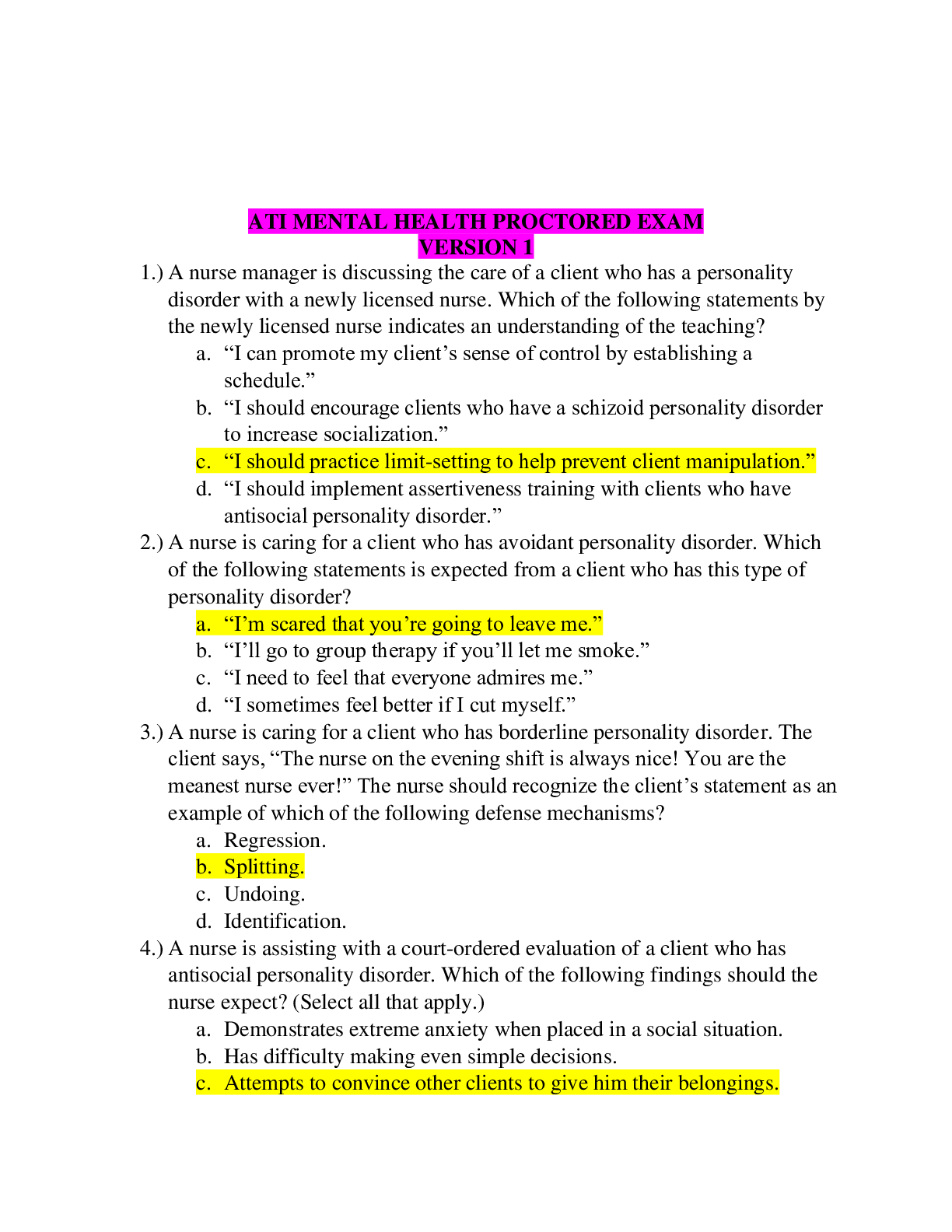
6.) A nurse manager is discussing the care of a client who has a personality
disorder with a newly licensed nurse. Which of the following statements by
the newly licensed nurse indicates an understanding of the teaching?
a. “I can promote my client’s sense of control by establishing a
schedule.”
b. “I should encourage clients who have a schizoid personality disorder
to increase socialization.”
c. “I should practice limit-setting to help prevent client manipulation.”
d. “I should implement assertiveness training with clients who have
antisocial personality disorder.”
7.) A nurse is caring for a client who has avoidant personality disorder. Which
of the following statements is e
[Show More]