Statistics > TEST BANKS > Instructor Manual for Statistics A Tool for Social Research and Data Analysis 11th Edition Joseph F. (All)
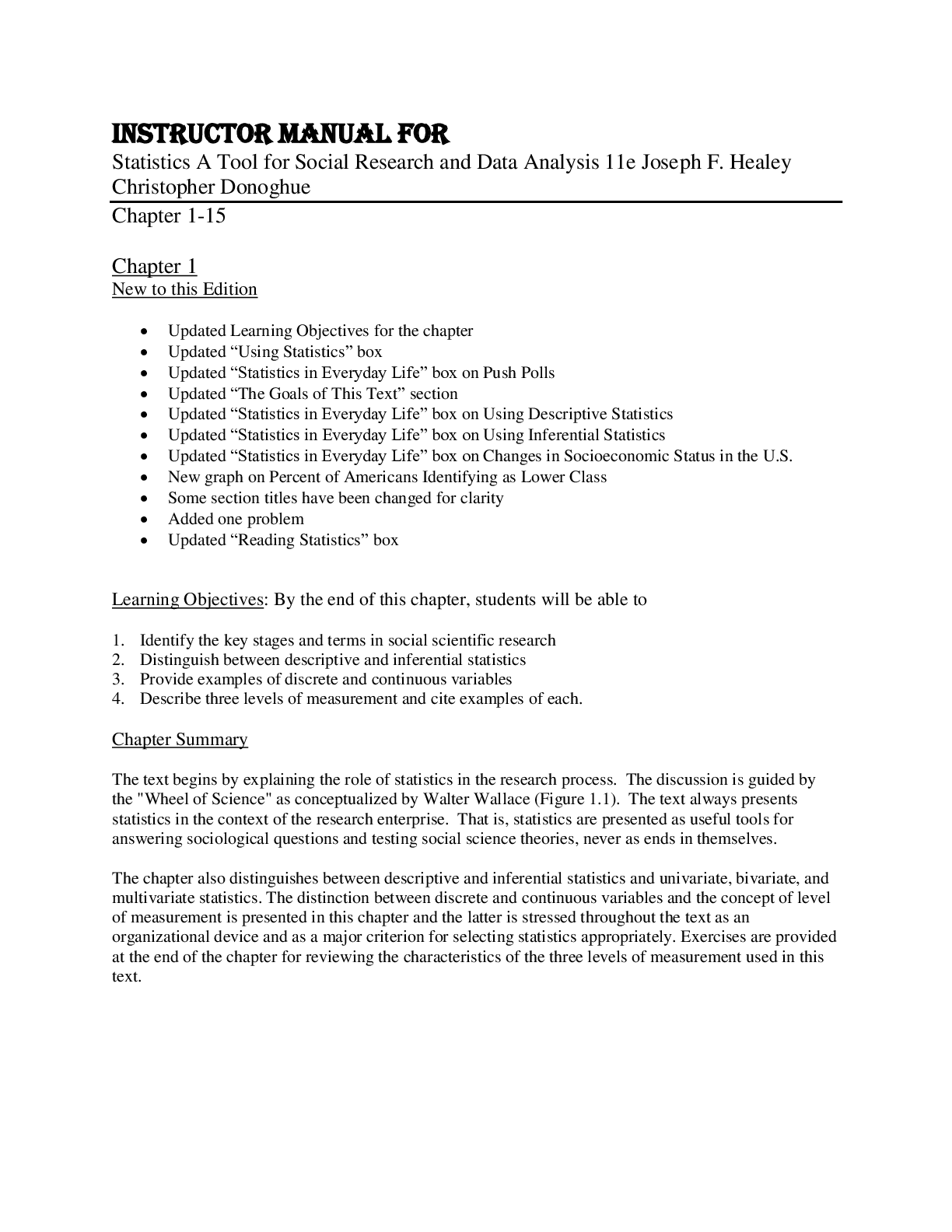
Instructor Manual for Statistics A Tool for Social Research and Data Analysis 11th Edition Joseph F. HealeyChristopher Donoghue
Document Content and Description Below
Instructor Manual For Statistics A Tool for Social Research and Data Analysis 11e Joseph F. Healey Christopher Donoghue Chapter 1-15 Chapter 1 New to this Edition Updated Learning Objective ... s for the chapter Updated “Using Statistics” box Updated “Statistics in Everyday Life” box on Push Polls Updated “The Goals of This Text” section Updated “Statistics in Everyday Life” box on Using Descriptive Statistics Updated “Statistics in Everyday Life” box on Using Inferential Statistics Updated “Statistics in Everyday Life” box on Changes in Socioeconomic Status in the U.S. New graph on Percent of Americans Identifying as Lower Class Some section titles have been changed for clarity Added one problem Updated “Reading Statistics” box Learning Objectives: By the end of this chapter, students will be able to 1. Identify the key stages and terms in social scientific research 2. Distinguish between descriptive and inferential statistics 3. Provide examples of discrete and continuous variables 4. Describe three levels of measurement and cite examples of each. Chapter Summary The text begins by explaining the role of statistics in the research process. The discussion is guided by the "Wheel of Science" as conceptualized by Walter Wallace (Figure 1.1). The text always presents statistics in the context of the research enterprise. That is, statistics are presented as useful tools for answering sociological questions and testing social science theories, never as ends in themselves. The chapter also distinguishes between descriptive and inferential statistics and univariate, bivariate, and multivariate statistics. The distinction between discrete and continuous variables and the concept of level of measurement is presented in this chapter and the latter is stressed throughout the text as an organizational device and as a major criterion for selecting statistics appropriately. Exercises are provided at the end of the chapter for reviewing the characteristics of the three levels of measurement used in this text. [Show More]
Last updated: 1 year ago
Preview 1 out of 16 pages
Buy this document to get the full access instantly
Instant Download Access after purchase
Buy NowInstant download
We Accept:

Reviews( 0 )
$18.50
Can't find what you want? Try our AI powered Search
Document information
Connected school, study & course
About the document
Uploaded On
Mar 25, 2024
Number of pages
16
Written in
All

Additional information
This document has been written for:
Uploaded
Mar 25, 2024
Downloads
0
Views
94
.png)