HIGH RISKS DURING PREGNANGY
What is preterm birth? - Birth before 37 weeks is "preterm".
Infants weighing less than 1500 grams are at great risk of what? - dying or living with neurological impairments
Preterm
...
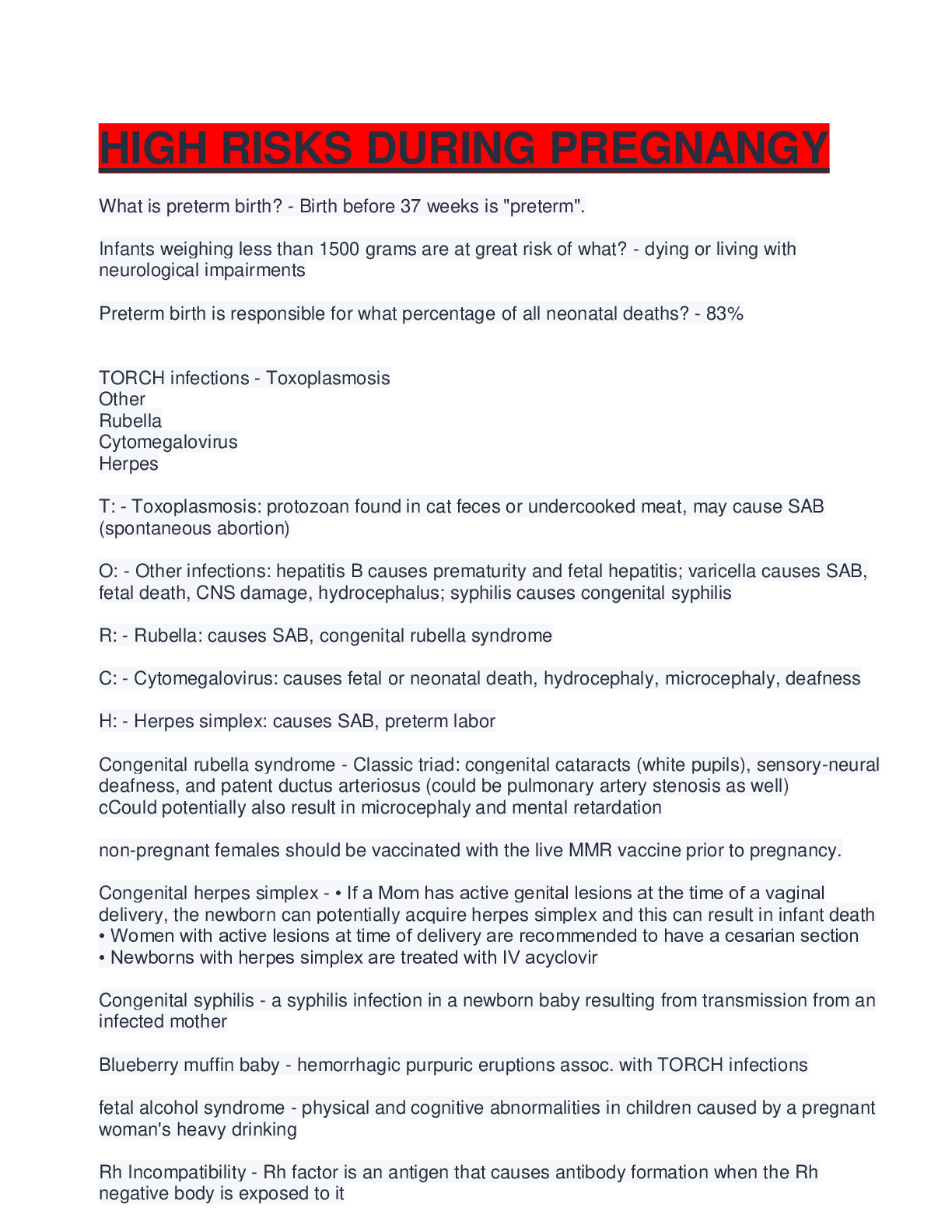
HIGH RISKS DURING PREGNANGY
What is preterm birth? - Birth before 37 weeks is "preterm".
Infants weighing less than 1500 grams are at great risk of what? - dying or living with neurological impairments
Preterm birth is responsible for what percentage of all neonatal deaths? - 83%
TORCH infections - Toxoplasmosis
Other
Rubella
Cytomegalovirus
Herpes
T: - Toxoplasmosis: protozoan found in cat feces or undercooked meat, may cause SAB (spontaneous abortion)
O: - Other infections: hepatitis B causes prematurity and fetal hepatitis; varicella causes SAB, fetal death, CNS damage, hydrocephalus; syphilis causes congenital syphilis
R: - Rubella: causes SAB, congenital rubella syndrome
C: - Cytomegalovirus: causes fetal or neonatal death, hydrocephaly, microcephaly, deafness
H: - Herpes simplex: causes SAB, preterm labor
Congenital rubella syndrome - Classic triad: congenital cataracts (white pupils), sensory-neural deafness, and patent ductus arteriosus (could be pulmonary artery stenosis as well)
cCould potentially also result in microcephaly and mental retardation
non-pregnant females should be vaccinated with the live MMR vaccine prior to pregnancy.
Congenital herpes simplex - • If a Mom has active genital lesions at the time of a vaginal delivery, the newborn can potentially acquire herpes simplex and this can result in infant death
• Women with active lesions at time of delivery are recommended to have a cesarian section
• Newborns with herpes simplex are treated with IV acyclovir
Congenital syphilis - a syphilis infection in a newborn baby resulting from transmission from an infected mother
Blueberry muffin baby - hemorrhagic purpuric eruptions assoc. with TORCH infections
fetal alcohol syndrome - physical and cognitive abnormalities in children caused by a pregnant woman's heavy drinking
Rh Incompatibility - Rh factor is an antigen that causes antibody formation when the Rh negative body is exposed to it
When a woman who is Rh-negative carries a fetus that is Rh-positive: - a blood incompatibility may occur
Mixing of fetal blood with maternal occurs occasionally when: - villi rupture allowing a few drops of fetal blood into maternal blood stream
At time of placental separation there is exchange of - maternal & fetal blood
What does Rh incompatibility cause? - Causes erythroblastosis fetalis which is manifested by destruction of fetal RBCs when attacked by the Rh antibodies from mother
When is RhoGam given? - Rho-immunoglobulin (RhoGam) given to Rh-negative woman at 28 weeks gestation if she does not have an elevated anti-D antibody titer and again within 72 hours after delivery of Rh-positive infant (Coomb's negative)
If already sensitized - RhoGam won't help (Coomb's positive)
How is rhogam given - RhoGam is an IM injection of passive antibodies to Rh factor
What does rhogam do? - These antibodies do not cross placenta so do not attack fetal RBCs
This prevents maternal production of natural Rh antibodies that will cross placenta
Who gets Rhogam? - Mothers who are Rh- and if the RH+ blood cells leak into blood stream the mothers antibodies kill red blood cells in baby or future baby.
RH pos mom - rh pos baby= NO
RH pos mom - rh neg baby = NO
RH neg mom - RH neg baby = NO
RN neg mom - RH pos baby = YES
Risk factors for Hypertensive disorders in pregnancy: - Primigravida
Age under 19 and over 40
Multiple gestation pregnancy
Molar pregnancy
Familial tendency
Chronic renal disease
Chronic HTN
Diabetes
Severe malnutrition
primigravida - a woman who is pregnant for the first time
molar pregnancy - also known as gestational trophoblastic disease; abnormal proliferation of trophoblastic cells in the first trimester
[Show More]