VATI MENTAL HEALTH EXAM WITH RATIONALE QUARANTEED PASS
A nurse is assessing a group of clients in a community health clinic. In which of the follwoing situations should the nurse identify a requirement to report ch
...
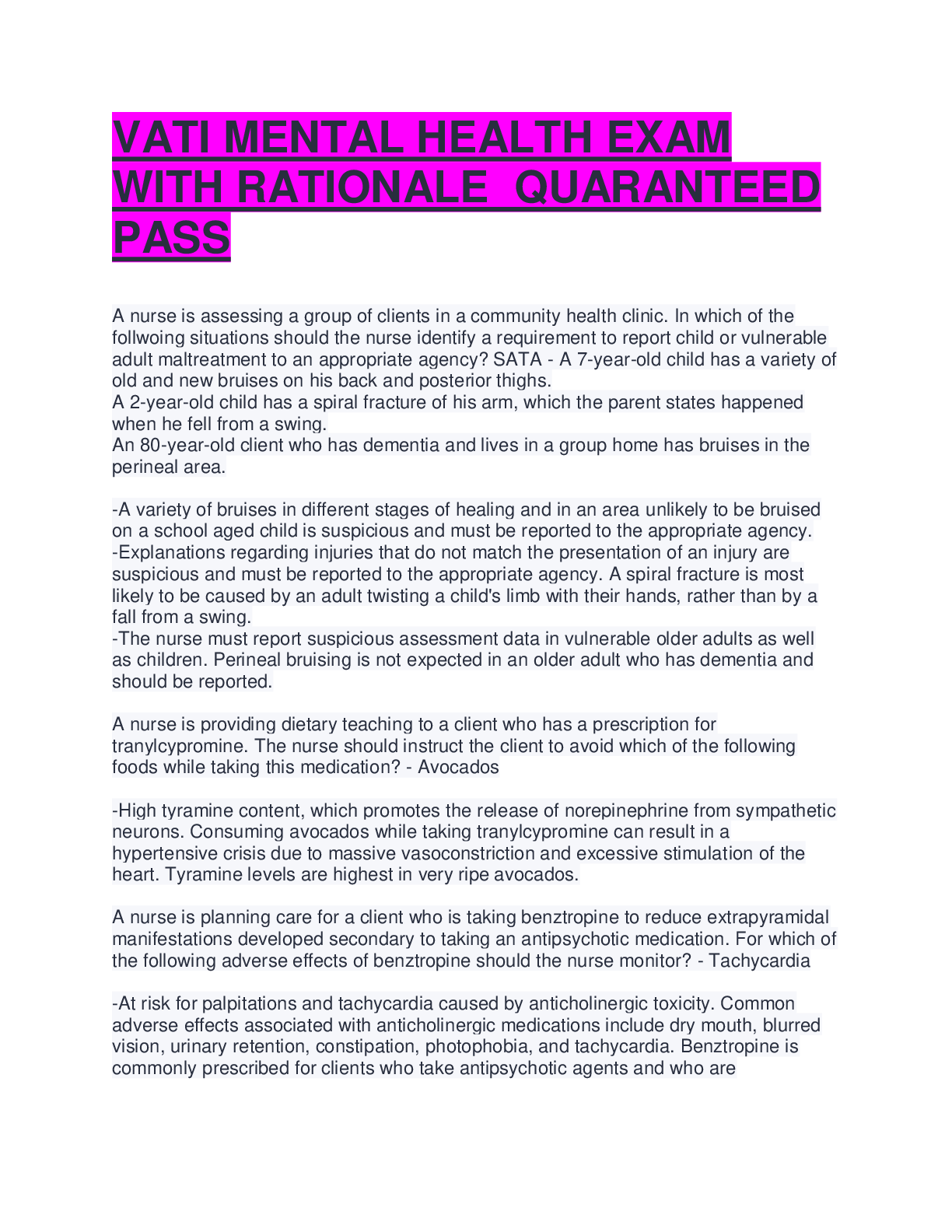
VATI MENTAL HEALTH EXAM WITH RATIONALE QUARANTEED PASS
A nurse is assessing a group of clients in a community health clinic. In which of the follwoing situations should the nurse identify a requirement to report child or vulnerable adult maltreatment to an appropriate agency? SATA - A 7-year-old child has a variety of old and new bruises on his back and posterior thighs.
A 2-year-old child has a spiral fracture of his arm, which the parent states happened when he fell from a swing.
An 80-year-old client who has dementia and lives in a group home has bruises in the perineal area.
-A variety of bruises in different stages of healing and in an area unlikely to be bruised on a school aged child is suspicious and must be reported to the appropriate agency.
-Explanations regarding injuries that do not match the presentation of an injury are suspicious and must be reported to the appropriate agency. A spiral fracture is most likely to be caused by an adult twisting a child's limb with their hands, rather than by a fall from a swing.
-The nurse must report suspicious assessment data in vulnerable older adults as well as children. Perineal bruising is not expected in an older adult who has dementia and should be reported.
A nurse is providing dietary teaching to a client who has a prescription for tranylcypromine. The nurse should instruct the client to avoid which of the following foods while taking this medication? - Avocados
-High tyramine content, which promotes the release of norepinephrine from sympathetic neurons. Consuming avocados while taking tranylcypromine can result in a hypertensive crisis due to massive vasoconstriction and excessive stimulation of the heart. Tyramine levels are highest in very ripe avocados.
A nurse is planning care for a client who is taking benztropine to reduce extrapyramidal manifestations developed secondary to taking an antipsychotic medication. For which of the following adverse effects of benztropine should the nurse monitor? - Tachycardia
-At risk for palpitations and tachycardia caused by anticholinergic toxicity. Common adverse effects associated with anticholinergic medications include dry mouth, blurred vision, urinary retention, constipation, photophobia, and tachycardia. Benztropine is commonly prescribed for clients who take antipsychotic agents and who are experiencing extrapyramidal effects, such as Pseudoparkinsonism with tremors, shuffling gait, and drooling or dystonia with painful contractions of the jaw or neck.
A nurse is assessing a client who is experiencing mild anxiety. Which of the following findings should the nurse expect? - Sharpened perceptions.
-Mild anxiety occurs daily during normal experiences and allows and individual to grasp more information and problem-solve more effectively. As stress increases, the client's perceptual field narrows and they are able to focus only on the source of the anxiety.
A nurse is performing a mental status examination of a client. Which of the following questions should the nurse ask the client to assess their cognition? - What did you have for dinner last night?
-The nurse can assess the client's cognitive status by asking questions that test the client's recent and immediate memory, such as what they had for dinner.
A nurse is creating a plan of care for a newly admitted client who has anorexia nervosa. Which of the following interventions should the nurse include? - Weigh the client daily after first voiding.
-Weigh the client each morning after waking and following their first voiding. The client should have nothing by mouth, including water, before obtaining the clients weight. The nurse should also assess the clients skin turgor and oral mucus membranes to ensure the client is hydrated.
A nurse is assessing a client for a substance use disorder. The client exhibits yawning, pupillary dilation, rhinorrhea, and reports muscle cramps. The nurse should suspect that the client is withdrawing from which of the following substances? - Heroin
-Manifestations of opioid withdrawal can include severe muscle cramps, yawning, rhinorrhea, and pupillary dilation. A client who is withdrawing from heroin can start to experience manifestations within 6-8hrs after the last dose following a period of at least 1 week of use.
[Show More]