Canadian Fundamentals of Nursing > EXAM > 6TH EDITION CANADIAN FUNDAMENTALS OF NURSING CARE QUESTION WITH ANSWERS (All)
6TH EDITION CANADIAN FUNDAMENTALS OF NURSING CARE QUESTION WITH ANSWERS
Document Content and Description Below
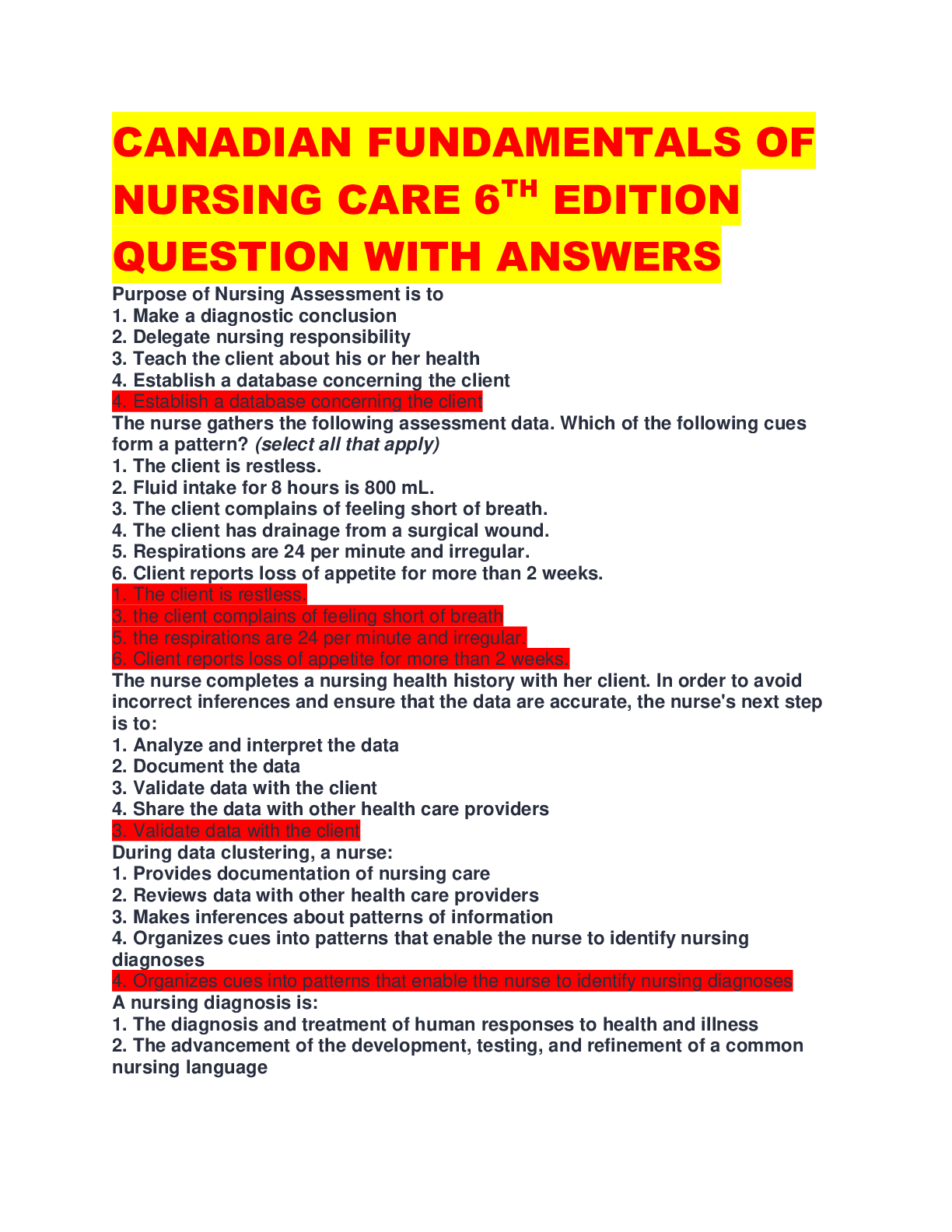
CANADIAN FUNDAMENTALS OF NURSING CARE 6TH EDITION QUESTION WITH ANSWERS Purpose of Nursing Assessment is to 1. Make a diagnostic conclusion 2. Delegate nursing responsibility 3. Teach the client a ... bout his or her health 4. Establish a database concerning the client 4. Establish a database concerning the client The nurse gathers the following assessment data. Which of the following cues form a pattern? (select all that apply) 1. The client is restless. 2. Fluid intake for 8 hours is 800 mL. 3. The client complains of feeling short of breath. 4. The client has drainage from a surgical wound. 5. Respirations are 24 per minute and irregular. 6. Client reports loss of appetite for more than 2 weeks. 1. The client is restless. 3. the client complains of feeling short of breath 5. the respirations are 24 per minute and irregular. 6. Client reports loss of appetite for more than 2 weeks. The nurse completes a nursing health history with her client. In order to avoid incorrect inferences and ensure that the data are accurate, the nurse's next step is to: 1. Analyze and interpret the data 2. Document the data 3. Validate data with the client 4. Share the data with other health care providers 3. Validate data with the client During data clustering, a nurse: 1. Provides documentation of nursing care 2. Reviews data with other health care providers 3. Makes inferences about patterns of information 4. Organizes cues into patterns that enable the nurse to identify nursing diagnoses 4. Organizes cues into patterns that enable the nurse to identify nursing diagnoses A nursing diagnosis is: 1. The diagnosis and treatment of human responses to health and illness 2. The advancement of the development, testing, and refinement of a common nursing language 3. A clinical judgement about individual, family, or community responses to actual and potential health problems or life processes 4. The identification of a disease condition on the basis of a specific evaluation of physical signs, symptoms, the client's medical history, and the results of diagnostic tests 3. A clinical judgement about individual, family, or community responses to actual and potential health problems or life processes One of the purposes of the use of standard formal nursing diagnostic statements is to: 1. Evaluate nursing care 2. Gather information on client data 3. Help nurses to focus on the role of nursing in client care 4. Facilitate understanding of client problems among health care providers 4. Facilitate understanding of client problems among health care providers The nursing diagnosis readiness for enhanced communication is an example of: 1. A risk nursing diagnosis 2. An actual nursing diagnosis 3. A potential nursing diagnosis 4. A wellness nursing diagnosis 4. A wellness nursing diagnosis The nursing diagnosis hypothermia is an example of: 1. A risk nursing diagnosis 2. An actual nursing diagnosis 3. A potential nursing diagnosis 4. A wellness nursing diagnosis 2. An actual nursing diagnosis The word impaired in the diagnosis impaired physical mobility is an example of: 1. A descriptor 2. A risk factor 3. A related factor 4. A nursing diagnosis 1. A descriptor Nurses use a variety of assessment techniques for data collection. The nurse knows that the first appropriate assessment technique for data collection is to: 1. Review client's medical record 2. Interview client 3. Consult health care team 4. Review literature 2. Interview client Which of the following are defining characteristics for the nursing diagnosis impaired urinary elimination? (Select all that apply.) 1. Nocturia 2. Frequency 3. Urine retention 4. Inadequate urinary output 5. Treatment with intravenous fluids 6. Sensation of bladder fullness 1. Nocturia 2. Frequency You are scheduled to begin a clinical placement in an immunization clinic and are aware that some parents in the community are extremely concerned about the safety of childhood immunizations. Prior to your first day in the clinic, you conduct a comprehensive Internet search to learn more about the potential sources of their anxiety and the validity of the information available to them on the Internet. This is an example of: 1. Reflection 2. Truth-seeking 3. Problem solving 4. Evidence-informed decision making 2. Truth-seeking A nurse uses an institution's procedure manual to confirm how to change a patient's nasogastric tubing. The level of critical thinking the nurse is using is 1. Commitment 2. Scientific method 3. Basic critical thinking 4. Complex critical thinking 3. Basic critical thinking A patient had hip surgery 24 hours ago. The nurse refers to the written plan of care, noting that the patient has a device collecting wound drainage. The physician is to be notified when the accumulation in the device exceeds 100 mL for the day. When the nurse enters the room, the nurse looks at the device and carefully notes the amount of drainage currently in the device. This is an example of 1. Planning 2. Assessment 3. Intervention 4. Nursing diagnosis 2. Assessment The nurse asks a patient how she feels about her impending surgery for breast cancer. Before the discussion, the nurse reviewed the description in his textbook of loss and grief in addition to therapeutic communication principles. The critical thinking component involved in the nurse's review of the literature is: 1. Experience 2. Problem solving 3. Knowledge application 4. Clinical decision making 3. Knowledge application As the nurse enters a patient's room, she observes that the intravenous line is not infusing at the ordered rate. The nurse checks the flow regulator on the tubing, looks to see whether the patient is lying on the tubing, checks the connection between the tubing and the intravenous catheter, and then checks the condition of the site where the intravenous catheter enters the patient's skin. She readjusts the flow rate, and the infusion begins at the correct rate. This is an example of 1. Inference 2. Reflection 3. Problem solving 4. Evidence-informed decision making 3. Problem solving In observing a new mother breastfeeding her baby, the public health nurse observes that the baby is fussy and is not sucking effectively. The nurse reviews the baby's record and finds that he has lost a considerable amount of weight since birth. The nurse conducts an assessment and notes that the baby has poor skin turgor. The mother reports that he urinates infrequently and sleeps only for very short periods of time between feedings. The nurse concludes that the baby is dehydrated and is at risk of becoming malnourished. This is an example of 1. Inference 2. Problem solving 3. Diagnostic reasoning 4. Applying nursing practice standards 3. Diagnostic reasoning Paul participates in a standardized patient simulation exercise designed to enhance therapeutic communication skills when working with clients experiencing mental health challenges. Later he asks, “What did I learn about myself that could hinder my therapeutic engagement with mental health clients? And, how can I rephrase my responses so that they do not have an unintended, detrimental effect on my nurse–patient relationships?” This is an example of 1. Reflection 2. Problem solving 3. Knowing the patient 4. Evidence-informed practice 1. Reflection Your community is engaged in a contested debate about whether or not it should open a needle-exchange program and a safe injection site for intravenous drug users. Some citizens believe that doing so condones drug abuse; others believe that such actions will reduce harm and save lives. You can appreciate both arguments but have not yet formulated your own position. Which of the following should you do in thinking critically about this complex question? (Select all that apply) 1. Listen carefully to both points of view. 2. Challenge your own beliefs about drug addiction. 3. Examine the scientific arguments both for and against such initiatives. 4. Support the communities that are reluctant to have the clinic in their neighbourhood. 5. Assume that the people in authority who are speaking about the issue are well informed. 1. Listen carefully to both points of view. [Show More]
Last updated: 1 year ago
Preview 1 out of 36 pages
Buy this document to get the full access instantly
Instant Download Access after purchase
Buy NowInstant download
We Accept:

Reviews( 0 )
$16.00
Can't find what you want? Try our AI powered Search
Document information
Connected school, study & course
About the document
Uploaded On
Mar 29, 2024
Number of pages
36
Written in
All

Additional information
This document has been written for:
Uploaded
Mar 29, 2024
Downloads
0
Views
51