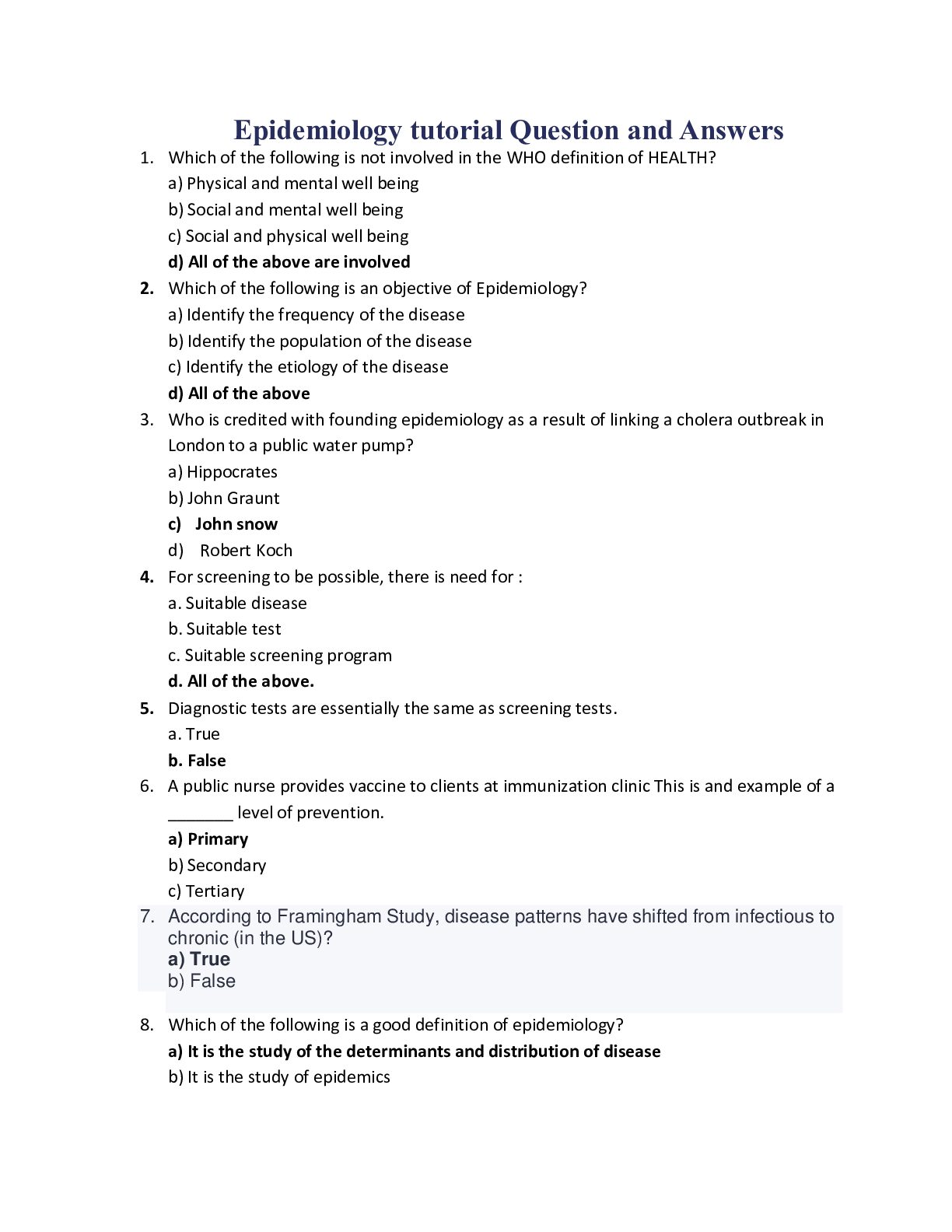
1. Which of the following is not involved in the WHO definition of HEALTH?
a) Physical and mental well being
b) Social and mental well being
c) Social and physical well being
d) All of the above are involved
2. Whic
...
1. Which of the following is not involved in the WHO definition of HEALTH?
a) Physical and mental well being
b) Social and mental well being
c) Social and physical well being
d) All of the above are involved
2. Which of the following is an objective of Epidemiology?
a) Identify the frequency of the disease
b) Identify the population of the disease
c) Identify the etiology of the disease
d) All of the above
3. Who is credited with founding epidemiology as a result of linking a cholera outbreak in London to a public water pump?
a) Hippocrates
b) John Graunt
c) John snow
d) Robert Koch
4. For screening to be possible, there is need for :
a. Suitable disease
b. Suitable test
c. Suitable screening program
d. All of the above.
5. Diagnostic tests are essentially the same as screening tests.
a. True
b. False
6. A public nurse provides vaccine to clients at immunization clinic This is and example of a _______ level of prevention.
a) Primary
b) Secondary
c) Tertiary
7. According to Framingham Study, disease patterns have shifted from infectious to chronic (in the US)?
a) True
b) False
8. Which of the following is a good definition of epidemiology?
a) It is the study of the determinants and distribution of disease
b) It is the study of epidemics
c) It is the study of medicine and its effect on disease
d) It is the study of biological agents that cause disease
9. In epidemiology, analysis of disease pattern is done by all except
a) Person
b) Place
c) Time
d) Situation
10. A disease that crosses international borders is an example of a/an
a) Endemic
b) Epidemic
c) Pandemic
11. Mr. Arnold goes to local clinic for his annual prostate screening, this is an example of a _________ level of prevention
a) Primary
b) Secondary
c) Tertiary
[Show More]