*NURSING  >  EXAM  >  NSG 6020 Midterm Study Guide | NSG6020 COMPLETE Midterm Study Guide (All)

NSG 6020 Midterm Study Guide | NSG6020 COMPLETE Midterm Study Guide

Document Content and Description Below

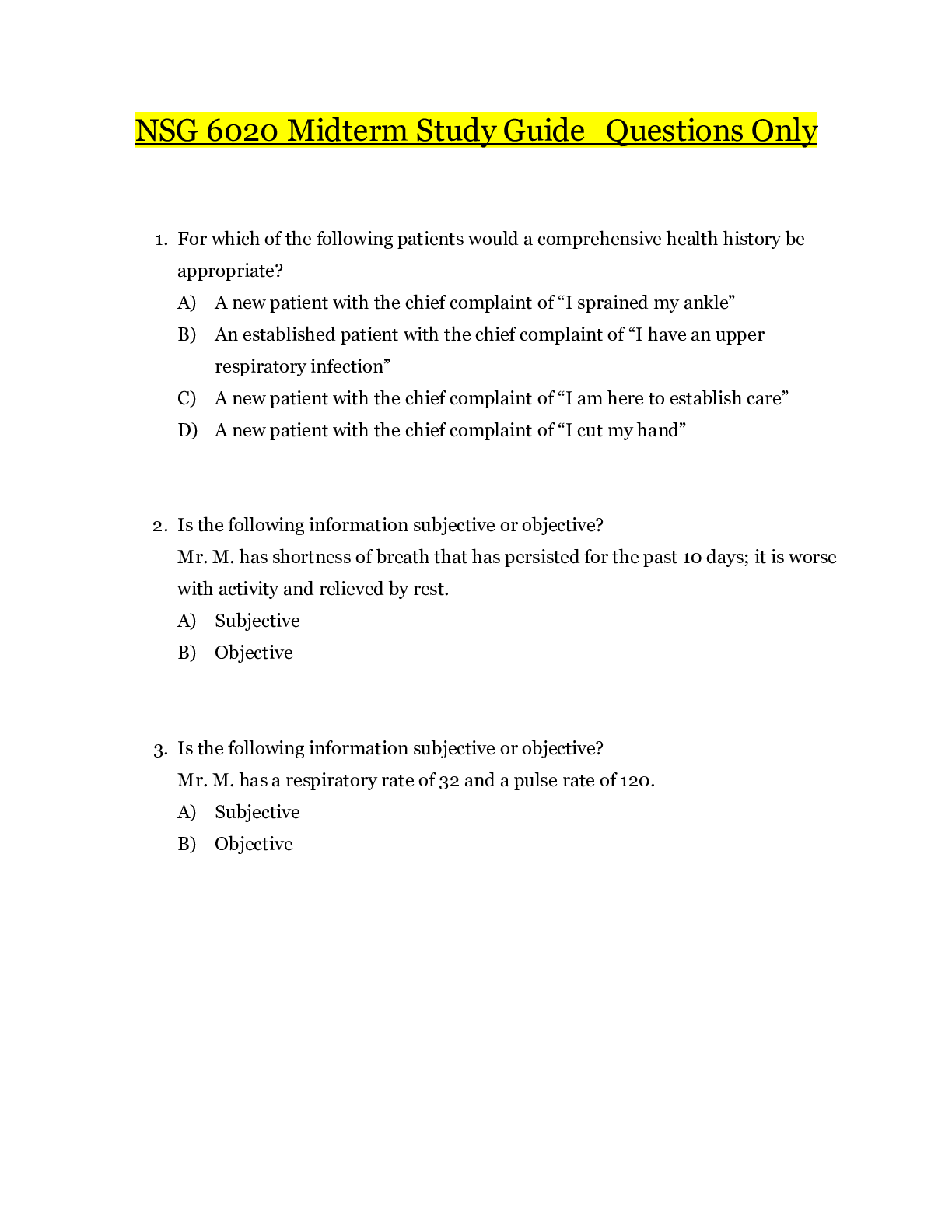
NSG 6020 Midterm Study Guide_Questions Only 1. For which of the following patients would a comprehensive health history be appropriate? A) A new patient with the chief complaint of “I sprained m ... y ankle” B) An established patient with the chief complaint of “I have an upper respiratory infection” C) A new patient with the chief complaint of “I am here to establish care” D) A new patient with the chief complaint of “I cut my hand” 2. Is the following information subjective or objective? Mr. M. has shortness of breath that has persisted for the past 10 days; it is worse with activity and relieved by rest. A) Subjective B) Objective 3. Is the following information subjective or objective? Mr. M. has a respiratory rate of 32 and a pulse rate of 120. A) Subjective B) Objective 4. The following information is recorded in the health history: “Patient denies chest pain, palpitations, orthopnea, and paroxysmal nocturnal dyspnea.” Which category does it belong to? A) Chief complaint B) Present illness C) Personal and social history D) Review of systems 5. A patient presents for evaluation of a sharp, aching chest pain which increases with breathing. Which anatomic area would you localize the symptom to? A) Musculoskeletal B) Reproductive C) Urinary D) Endocrine 6. A 22-year-old advertising copywriter presents for evaluation of joint pain. The pain is new, located in the wrists and fingers bilaterally, with some subjective fever. The patient denies a rash; she also denies recent travel or camping activities. She has a family history significant for rheumatoid arthritis. Based on this information, which of the following pathologic processes would be the most correct? A) Infectious B) Inflammatory C) Hematologic D) Traumatic 7. A 15-year-old high school sophomore comes to the clinic for evaluation of a 3-week history of sneezing; itchy, watery eyes; clear nasal discharge; ear pain; and nonproductive cough. Which is the most likely pathologic process? A) Infection B) Inflammation C) Allergic D) Vascular 8. You are seeing an elderly man with multiple complaints. He has chronic arthritis, pain from an old war injury, and headaches. Today he complains of these pains, as well as dull chest pain under his sternum. What would the order of priority be for your problem list? A) Arthritis, war injury pain, headaches, chest pain B) War injury pain, arthritis, headaches, chest pain C) Headaches, arthritis, war injury pain, chest pain D) Chest pain, headaches, arthritis, war injury pain 9. Suzanne, a 25 year old, comes to your clinic to establish care. You are the student preparing to go into the examination room to interview her. Which of the following is the most logical sequence for the patient–provider interview? A) Establish the agenda, negotiate a plan, establish rapport, and invite the patient's story. B) Invite the patient's story, negotiate a plan, establish the agenda, and establish rapport. C) Greet the patient, establish rapport, invite the patient's story, establish the agenda, expand and clarify the patient's story, and negotiate a plan. D) Negotiate a plan, establish an agenda, invite the patient's story, and establish rapport. 10. Alexandra is a 28-year-old editor who presents to the clinic with abdominal pain. The pain is a dull ache, located in the right upper quadrant, that she rates as a 3 at the least and an 8 at the worst. The pain started a few weeks ago, it lasts for 2 to 3 hours at a time, it comes and goes, and it seems to be worse a couple of hours after eating. She has noticed that it starts after eating greasy foods, so she has cut down on these as much as she can. Initially it occurred once a week, but now it is occurring every other day. Nothing makes it better. From this description, which of the seven attributes of a symptom has been omitted? A) Setting in which the symptom occurs B) Associated manifestations C) Quality D) Timing 11. A 23-year-old graduate student comes to your clinic for evaluation of a urethral discharge. As the provider, you need to get a sexual history. Which one of the following questions is inappropriate for eliciting the information? A) Are you sexually active? B) When was the last time you had intimate physical contact with someone, and did that contact include sexual intercourse? C) Do you have sex with men, women, or both? D) How many sexual partners have you had in the last 6 months? 12. On a very busy day in the office, Mrs. Donelan, who is 81 years old, comes for her usual visit for her blood pressure. She is on a low-dose diuretic chronically and denies any side effects. Her blood pressure is 118/78 today, which is well-controlled. As you are writing her script, she mentions that it is hard not having her husband Bill around anymore. What would you do next? A) Hand her the script and make sure she has a 3-month follow-up appointment. B) Make sure she understands the script. C) Ask why Bill is not there. D) Explain that you will have more time at the next visit to discuss this. 13. When you enter your patient's examination room, his wife is waiting there with him. Which of the following is most appropriate? A) Ask if it's okay to carry out the visit with both people in the room. B) Carry on as you would ordinarily. The permission is implied because his wife is in the room with him. C) Ask his wife to leave the room for reasons of confidentiality. D) First ask his wife what she thinks is going on. 14. You are performing a young woman's first pelvic examination. You make sure to tell her verbally what is coming next and what to expect. Then you carry out each maneuver of the examination. You let her know at the outset that if she needs a break or wants to stop, this is possible. You ask several times during the examination, “How are you doing, Brittney?” What are you accomplishing with these techniques? A) Increasing the patient's sense of control B) Increasing the patient's trust in you as a caregiver C) Decreasing her sense of vulnerability D) All of the above 15. A 15-year-old high school sophomore and her mother come to your clinic because the mother is concerned about her daughter's weight. You measure her daughter's height and weight and obtain a BMI of 19.5 kg/m2. Based on this information, which of the following is appropriate? A) Refer the patient to a nutritionist and a psychologist because the patient is anorexic. B) Reassure the mother that this is a normal body weight. C) Give the patient information about exercise because the patient is obese. D) Give the patient information concerning reduction of fat and cholesterol in her diet because she is obese. 16. A 25-year-old radio announcer comes to the clinic for an annual examination. His BMI is 26.0 kg/m2. He is concerned about his weight. Based on this information, what is appropriate counsel for the patient during the visit? A) Refer the patient to a nutritionist because he is anorexic. B) Reassure the patient that he has a normal body weight. C) Give the patient information about reduction of fat, cholesterol, and calories because he is overweight. D) Give the patient information about reduction of fat and cholesterol because he is obese. 17. Common or concerning symptoms to inquire about in the General Survey and vital signs include all of the following except: A) Changes in weight B) Fatigue and weakness C) Cough D) Fever and chills 18. You are beginning the examination of a patient. All of the following areas are important to observe as part of the General Survey except: A) Level of consciousness B) Signs of distress C) Dress, grooming, and personal hygiene D) Blood pressure 19. Mrs. Lenzo weighs herself every day with a very accurate balance-type scale. She has noticed that over the past 2 days she has gained 4 pounds. How would you best explain this? A) Attribute this to some overeating at the holidays. B) Attribute this to wearing different clothing. C) Attribute this to body fluid. D) Attribute this to instrument inaccuracy. 20. You are seeing an older patient who has not had medical care for many years. Her vital signs taken by your office staff are: T 37.2, HR 78, BP 118/92, and RR 14, and she denies pain. You notice that she has some hypertensive changes in her retinas and you find mild proteinuria on a urine test in your office. You expected the BP to be higher. She is not on any medications. What do you think is causing this BP reading, which doesn't correlate with the other findings? A) It is caused by an “auscultatory gap.” B) It is caused by a cuff size error. C) It is caused by the patient's emotional state. D) It is caused by resolution of the process which caused her retinopathy and kidney problems. 21. Mr. Garcia comes to your office for a rash on his chest associated with a burning pain. Even a light touch causes this burning sensation to worsen. On examination, you note a rash with small blisters (vesicles) on a background of reddened skin. The rash overlies an entire rib on his right side. What type of pain is this? A) Idiopathic pain B) Neuropathic pain C) Nociceptive or somatic pain D) Psychogenic pain 22. A 50-year-old body builder is upset by a letter of denial from his life insurance company. He is very lean but has gained 2 pounds over the past 6 months. You personally performed his health assessment and found no problems whatsoever. He says he is classified as “high risk” because of obesity. What should you do next? A) Explain that even small amounts of weight gain can classify you as obese. B) Place him on a high-protein, low-fat diet. C) Advise him to increase his aerobic exercise for calorie burning. D) Measure his waist. 23. A 32-year-old white female comes to your clinic, complaining of overwhelming sadness. She says for the past 2 months she has had crying episodes, difficulty sleeping, and problems with overeating. She says she used to go out with her friends from work but now she just wants to go home and be by herself. She also thinks that her work productivity has been dropping because she just is too tired to care or concentrate. She denies any feelings of guilt or any suicidal ideation. She states that she has never felt this way in the past. She denies any recent illness or injuries. Her past medical history consists of an appendectomy when she was a teenager; otherwise, she has been healthy. She is single and works as a clerk in a medical office. She denies tobacco, alcohol, or illegal drug use. Her mother has high blood pressure and her father has had a history of mental illness. On examination you see a woman appearing her stated age who seems quite sad. Her facial expression does not change while you talk to her and she makes little eye contact. She speaks so softly you cannot always understand her. Her thought processes and content seem unremarkable. What type of mood disorder do you think she has? A) Dysthymic disorder B) Manic (bipolar) disorder C) Major depressive episode 24. A 23-year-old ticket agent is brought in by her husband because he is concerned about her recent behavior. He states that for the last 2 weeks she has been completely out of control. He says that she hasn't showered in days, stays awake most of the night cleaning their apartment, and has run up over $1,000 on their credit cards. While he is talking, the patient interrupts him frequently and declares this is all untrue and she has never been so happy and fulfilled in her whole life. She speaks very quickly, changing the subject often. After a longer than normal interview you find out she has had no recent illnesses or injuries. Her past medical history is unremarkable. Both her parents are healthy but the husband has heard rumors about an aunt with similar symptoms. She and her husband have no children. She smokes one pack of cigarettes a day (although she has been chain-smoking in the last 2 weeks), drinks four to six drinks a week, and smokes marijuana occasionally. On examination she is very loud and outspoken. Her physical examination is unremarkable. Which mood disorder does she most likely have? A) Major depressive episode B) Manic episode C) Dysthymic disorder 25. Adam is a very successful 15-year-old student and athlete. His mother brings him in today because he no longer studies, works out, or sees his friends. This has gone on for a month and a half. When you speak with him alone in the room, he states it “would be better if he were not here.” What would you do next? A) Tell him that he has a very promising career in anything he chooses and soon he will feel better. B) Tell him that he needs an antidepressant and it will take about 4 weeks to work. C) Speak with his mother about getting him together more with his friends. D) Assess his suicide risk. [Show More]

Last updated: 3 years ago

Preview 1 out of 53 pages

Buy Now

Instant download

We Accept:

Payment methods accepted on Scholarfriends (We Accept)
Preview image of NSG 6020 Midterm Study Guide | NSG6020 COMPLETE Midterm Study Guide document

Buy this document to get the full access instantly

Instant Download Access after purchase

Buy Now

Instant download

We Accept:

Payment methods accepted on Scholarfriends (We Accept)

Reviews( 0 )

$13.50

Buy Now

We Accept:

Payment methods accepted on Scholarfriends (We Accept)

Instant download

Can't find what you want? Try our AI powered Search

55
0

Document information


Connected school, study & course


About the document


Uploaded On

Mar 08, 2021

Number of pages

53

Written in

All

Seller


Profile illustration for Martin Freeman
Martin Freeman

Member since 5 years

486 Documents Sold

Reviews Received
85
28
9
9
23
Additional information

This document has been written for:

Uploaded

Mar 08, 2021

Downloads

 0

Views

 55

Document Keyword Tags

More From Martin Freeman

View all Martin Freeman's documents »

Recommended For You

Get more on EXAM »

$13.50
What is Scholarfriends

Scholarfriends.com Online Platform by Browsegrades Inc. 651N South Broad St, Middletown DE. United States.

We are here to help

We're available through e-mail, Twitter, and live chat.
 FAQ
 Questions? Leave a message!


Copyright © Scholarfriends · High quality services·