ATI Respiratory Test bank Questions & Answers-1. A perioperative nurse is caring for a postoperative client. The client has a shallow respiratory pattern and is reluctant to cough or to begin mobilizing. The nurse should
...
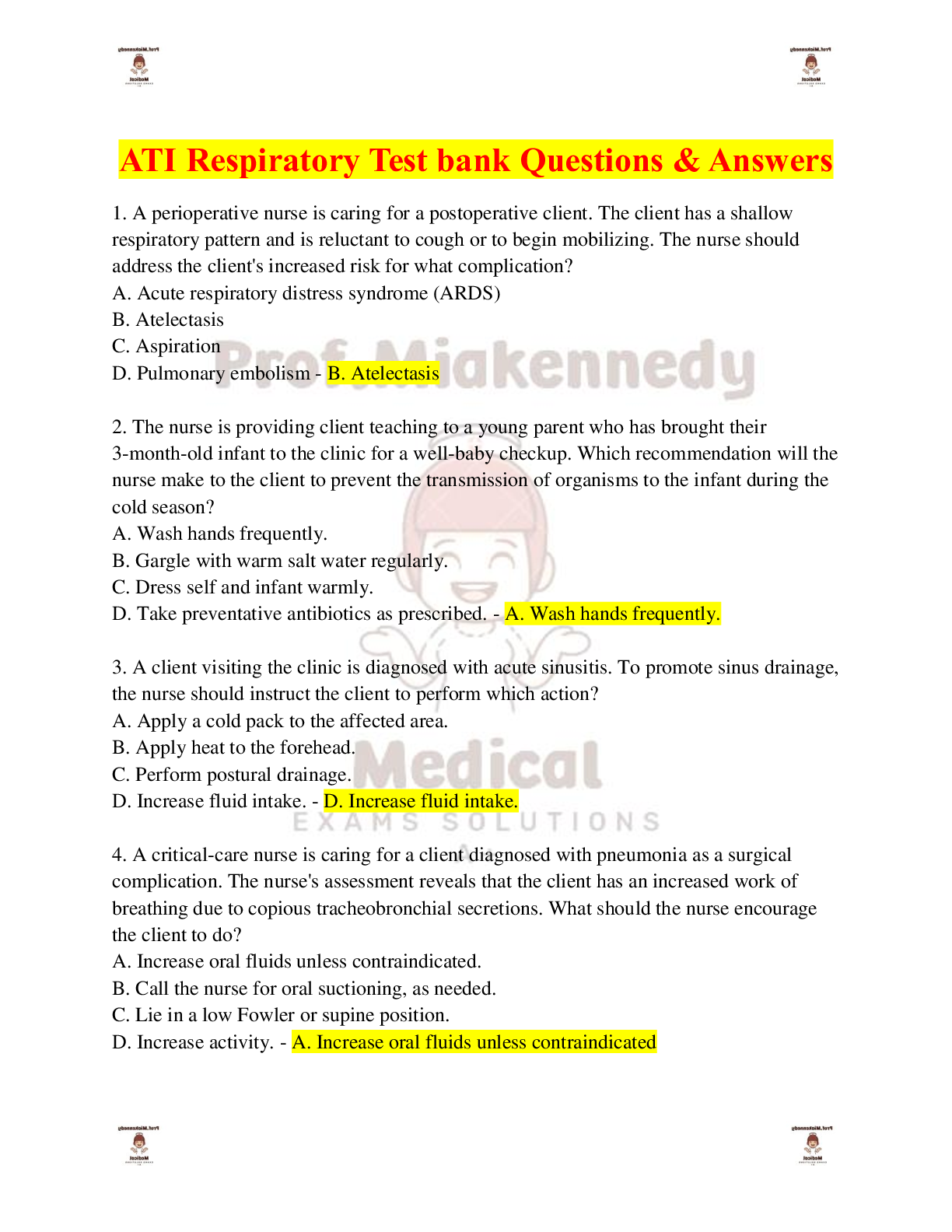
ATI Respiratory Test bank Questions & Answers-1. A perioperative nurse is caring for a postoperative client. The client has a shallow respiratory pattern and is reluctant to cough or to begin mobilizing. The nurse should address the client's increased risk for what complication?
A. Acute respiratory distress syndrome (ARDS)
B. Atelectasis
C. Aspiration
D. Pulmonary embolism - B. Atelectasis
2. The nurse is providing client teaching to a young parent who has brought their
3-month-old infant to the clinic for a well-baby checkup. Which recommendation will the nurse make to the client to prevent the transmission of organisms to the infant during the cold season?
A. Wash hands frequently.
B. Gargle with warm salt water regularly.
C. Dress self and infant warmly.
D. Take preventative antibiotics as prescribed. - A. Wash hands frequently.
3. A client visiting the clinic is diagnosed with acute sinusitis. To promote sinus drainage, the nurse should instruct the client to perform which action?
A. Apply a cold pack to the affected area.
B. Apply heat to the forehead.
C. Perform postural drainage.
D. Increase fluid intake. - D. Increase fluid intake.
4. A critical-care nurse is caring for a client diagnosed with pneumonia as a surgical complication. The nurse's assessment reveals that the client has an increased work of breathing due to copious tracheobronchial secretions. What should the nurse encourage the client to do?
A. Increase oral fluids unless contraindicated.
B. Call the nurse for oral suctioning, as needed.
C. Lie in a low Fowler or supine position.
D. Increase activity. - A. Increase oral fluids unless contraindicated
5. The nurse is assessing a client whose respiratory disease is characterized by chronic hyperinflation of the lungs. Which physical characteristic would the nurse most likely observe in this client?
A. Signs of oxygen toxicity
B. A moon face
C. A barrel chest
D. Long, thin fingers - C. A barrel chest
6. The nurse is providing care for a client who has recently been diagnosed with chronic obstructive pulmonary disease. When educating the client about exacerbations, the nurse should prioritize which topic?
A. Identifying specific causes of exacerbations
B. Prompt administration of corticosteroids during exacerbations
C. The importance of prone positioning during exacerbations
D. The relationship between activity level and exacerbations - A. Identifying specific causes of exacerbations
7. A school nurse is caring for a 10-year-old client who is having an asthma attack. What is the preferred intervention to alleviate this client's airflow obstruction?
A. Administer corticosteroids by metered dose inhaler.
B. Administer inhaled anticholinergics.
C. Administer an inhaled beta-adrenergic agonist.
D. Use a peak flow monitoring device. - C. Administer an inhaled beta-adrenergic agonist.
8. The ED nurse is assessing a client who is reporting dyspnea. The nurse auscultates the client's chest and hears wheezing throughout the lung fields. What might this indicate about the client?
A. Bronchoconstriction
B. Pneumonia
C. Hemoptysis
D. Hemothorax - A. Bronchoconstriction
9. The nurse caring for a client recently diagnosed with lung disease encourages the client not to smoke. What is the primary rationale behind this nursing action?
A. Smoking decreases the amount of mucus production.
B. Smoke particles compete for binding sites on hemoglobin.
C. Smoking causes atrophy of the alveoli.
D. Smoking damages the ciliary cleansing mechanism. - D. Smoking damages the ciliary cleansing mechanism.
10. A nurse is developing a teaching plan for an adult client with asthma. Which teaching point should have the highest priority in the plan of care that the nurse is developing?
A. Gradually increase levels of physical exertion.
B. Change filters on heaters and air conditioners frequently.
C. Take prescribed medications as scheduled.
D. Avoid goose-down pillows. - C. Take prescribed medications as scheduled.
11. The nurse is caring for a client admitted with an acute exacerbation of chronic obstructive pulmonary disease. During assessment, the nurse finds that the client is experiencing increased dyspnea. What is the most accurate measurement of the concentration of oxygen in the client's blood?
A. A capillary blood sample
B. Pulse oximetry
C. An arterial blood gas (ABG) study
D. A complete blood count (CBC) - C. An arterial blood gas (ABG) study
12. A client with chronic lung disease is undergoing lung function testing. What test result denotes the volume of air inspired and expired with a normal breath?
A. Total lung capacity
B. Forced vital capacity
C. Tidal volume
D. Residual volume - C. Tidal volume
[Show More]