NURS 6560 Midterm Exam with Answers
Question 1
S. is a 59-year-old female who has been followed for several years for aortic regurgitation. Serial echocardiography has demonstrated normal ventricular function, but th
...
NURS 6560 Midterm Exam with Answers
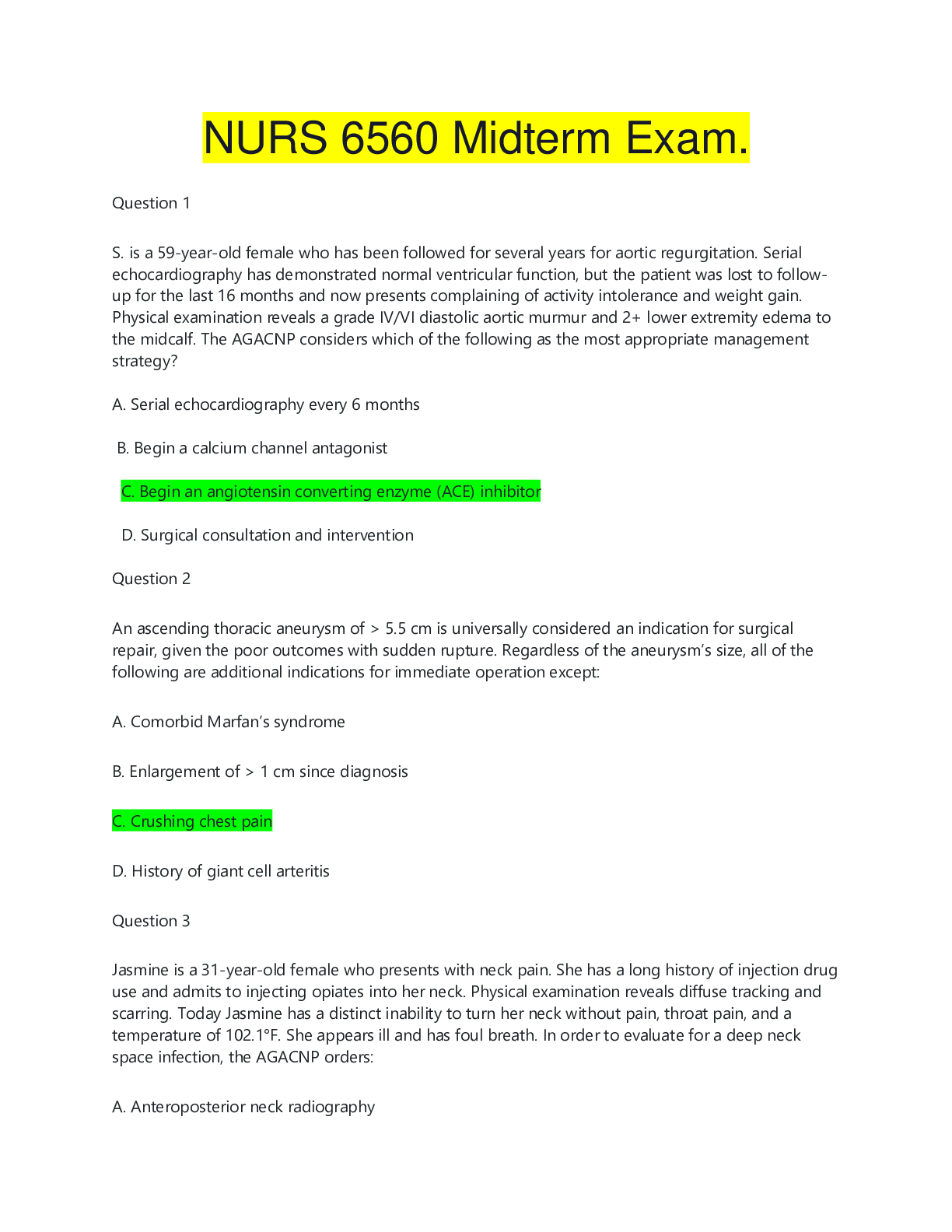
Question 1
S. is a 59-year-old female who has been followed for several years for aortic regurgitation. Serial echocardiography has demonstrated normal ventricular function, but the patient was lost to follow-up for the last 16 months and now presents complaining of activity intolerance and weight gain. Physical examination reveals a grade IV/VI diastolic aortic murmur and 2+ lower extremity edema to the midcalf. The AGACNP considers which of the following as the most appropriate management strategy?
A. Serial echocardiography every 6 months B. Begin a calcium channel antagonist C. Begin an angiotensin converting enzyme (ACE) inhibitor D. Surgical consultation and intervention
C. Begin an angiotensin converting enzyme (ACE) inhibitor
The patient is having grade 6 diastolic aortic murmur. The murmur is not accompanied by any serious complications because there is a 2+ lower extremity edema to the midcalf. Angiotensin converting enzyme (ACE) inhibitor lowers the blood pressure. High blood pressure often worsens the underlying conditions that cause heart murmurs. Beginning an angiotensin converting enzyme (ACE) inhibitor will help in the management of diastolic aortic murmur by dealing with the conditions that cause heart murmurs. A surgery would be used only when the valves are damaged or leaky
Reference
https://www.mayoclinic.org/diseases-conditions/heart-murmurs/diagnosis-treatment/drc-20373175
Question 2
An ascending thoracic aneurysm of > 5.5 cm is universally considered an indication for surgical repair, given the poor outcomes with sudden rupture. Regardless of the aneurysm’s size, all of the following are additional indications for immediate operation except:
A. Comorbid Marfan’s syndrome B. Enlargement of > 1 cm since diagnosis C. Crushing chest pain D. History of giant cell arteritis
C. crushing chest pain
Prophylactic surgery is recommended when the aorta reaches a diameter of 5.5 cm, when the patient falls under the Marfan syndrome bicuspid aortic valve category, when the enlargement is greater than 0.5 cm, and when the patient has a history of fast-growing cell arteritis. Marfan syndrome is a connective tissue condition that involves the respiratory, skeletal, cardiovascular and ocular systems. It is one of the most serious complication of aortic valve regurgitations and needs an immediate surgery. For this reason, a crushing chest pain is the odd one out
Reference
https://www.sciencedirect.com/science/article/pii/S235290671500010X
Question 3
Jasmine is a 31-year-old female who presents with neck pain. She has a long history of injection drug use and admits to injecting opiates into her neck. Physical examination reveals diffuse tracking and scarring. Today Jasmine has a distinct inability to turn her neck without pain, throat pain, and a temperature of 102.1°F. She appears ill and has foul breath. In order to evaluate for a deep neck space infection, the AGACNP orders:
A. Anteroposterior neck radiography B. CT scan of the neck C. White blood cell (WBC) differential D. Aspiration and culture of fluid
B. CT Scan of the neck
Deep neck space infection may lead to severe and potentially life-threatening complications, such as airway obstruction, mediastinitis, septic embolization, dural sinus thrombosis, and intracranial abscess.
In the evaluation of these infections, ultrasonography is the gold standard:
1. to differentiate abscesses from cellulitis
2. for the diagnosis of lymphadenitis
However, field-of-view limitation and poor anatomical information confine the use of ultrasonography to the evaluation of superficial lesions and to image-guided aspiration or drainage.
Computed tomography (CT) combines fast image acquisition and precise anatomical information without field-of-view limitations. For these reasons, it is the most reliable technique for the evaluation of deep and multi-compartment lesions
REFERENCE
https://www.ncbi.nlm.nih.gov/pubmed/22964409
Question 4
Mr. Draper is a 39-year-old male recovering from an extended abdominal procedure. As a result of a serious motor vehicle accident, he has had repair of a small bowel perforation, splenectomy, and repair of a hepatic laceration. He will be on total parenteral nutrition postoperatively. The AGACNP recognizes that the most common complications of parenteral nutrition are a consequence of:
A. Poorly calculated solution B. Resultant diarrhea and volume contraction C. The central venous line used for infusion D. Bowel disuse and hypomotility
C. The central venous line used for infusion
Total parenteral nutrition is the administration of nutritional components via the venous system rather than the enteral route/gastrointestinal tract. It can be total or partial where just a selected number of nutrients are given
[Show More]


.png)