*NURSING  >  EXAMs  >  NUR 205 EXAM WITH CERTIFIED ANSWERS (All)

NUR 205 EXAM WITH CERTIFIED ANSWERS

Document Content and Description Below

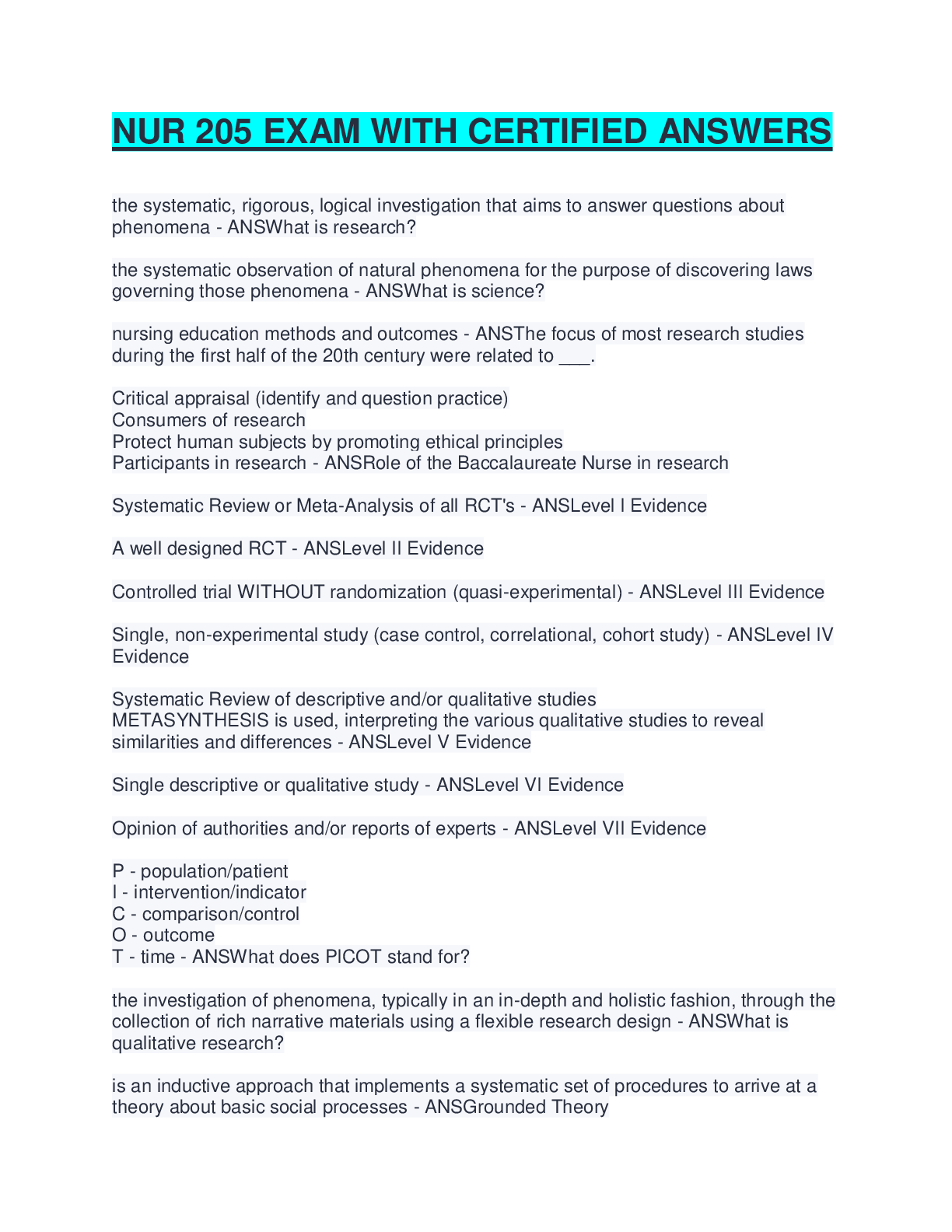
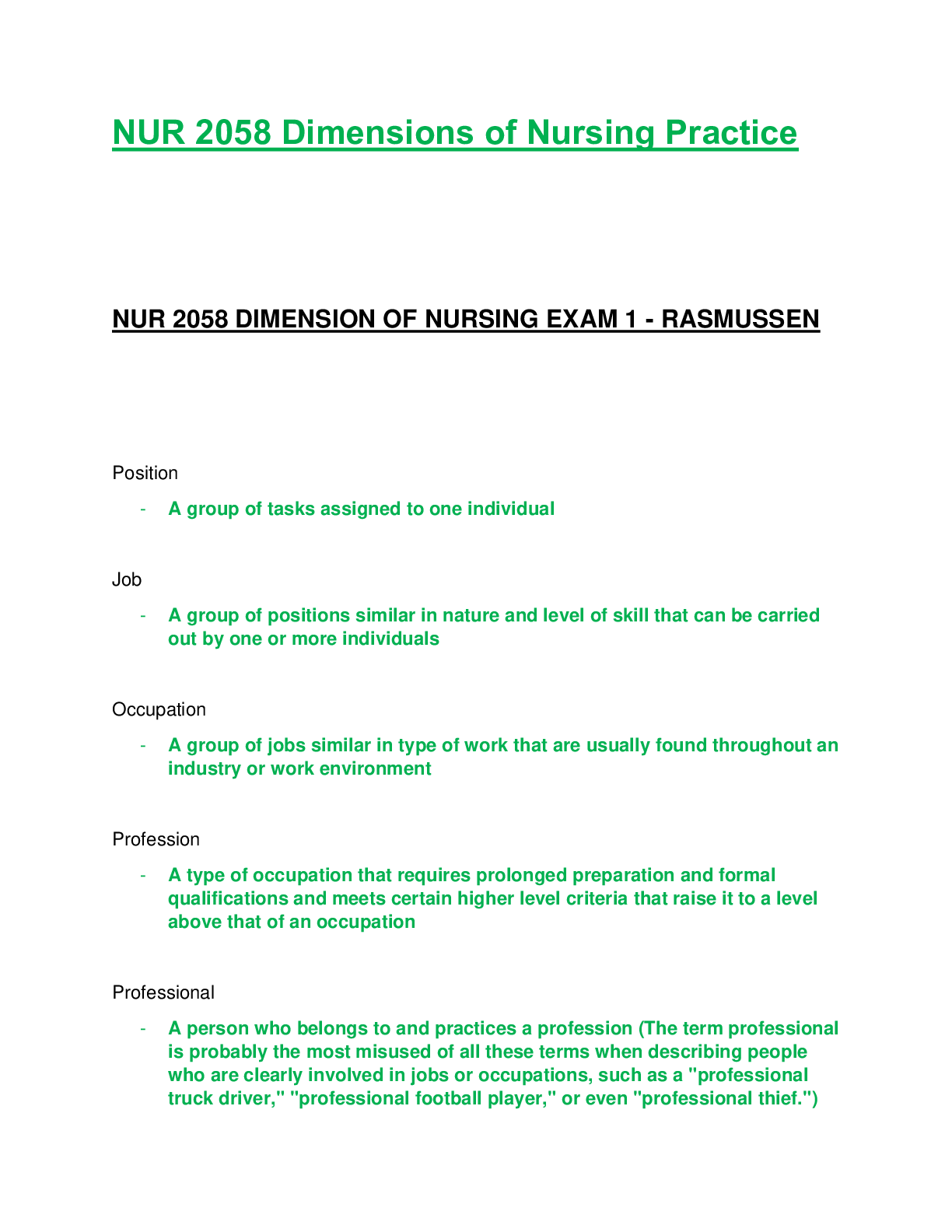
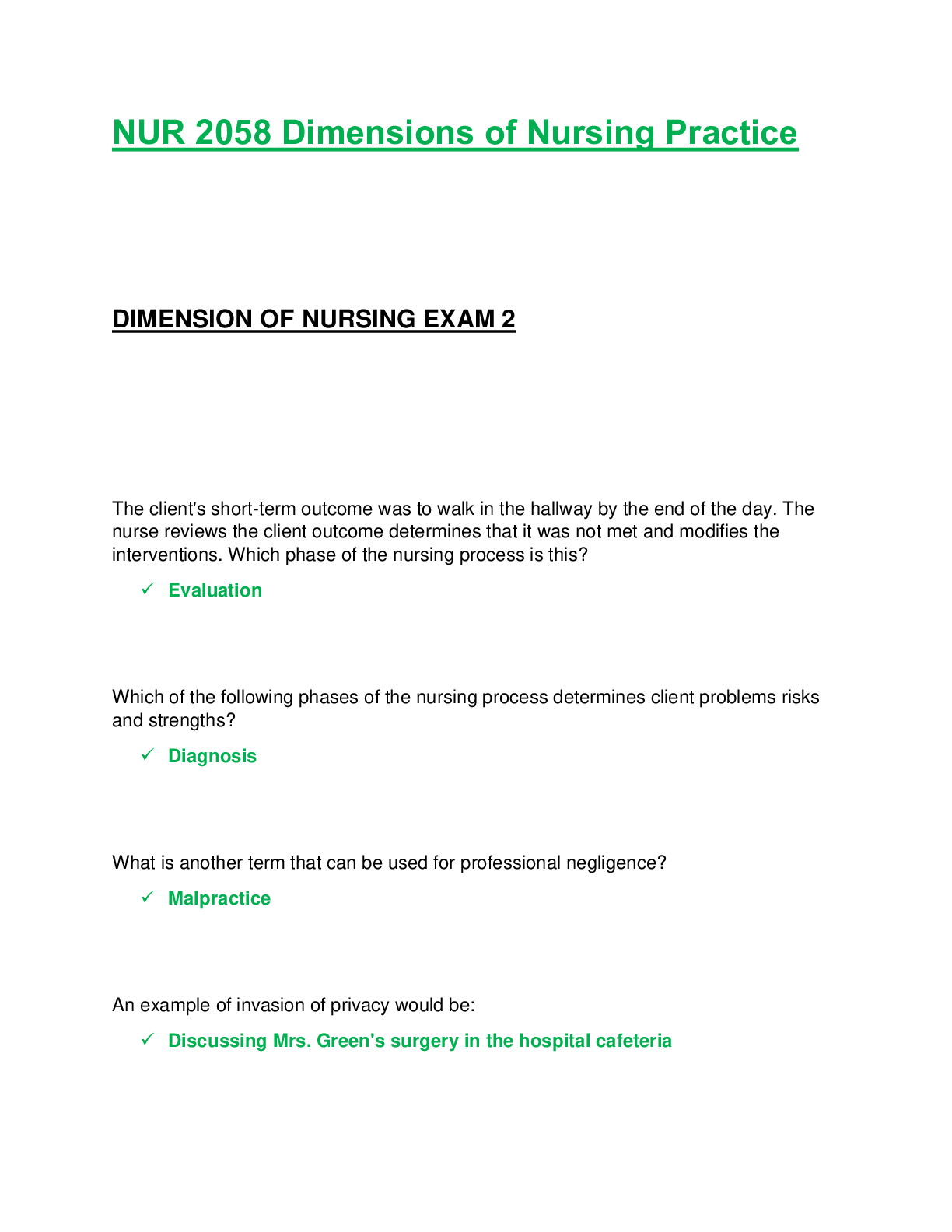
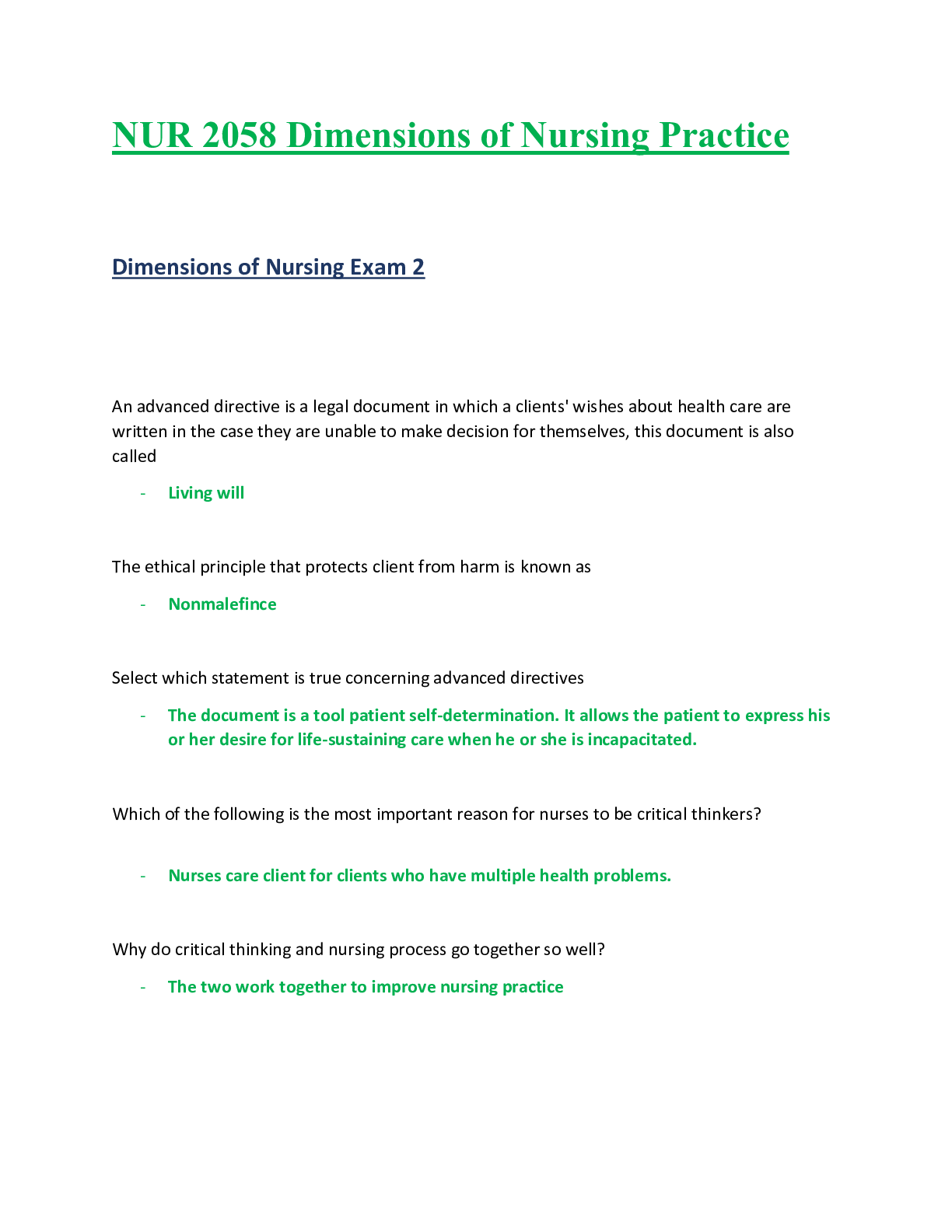
NUR 205 EXAM WITH CERTIFIED ANSWERS the systematic, rigorous, logical investigation that aims to answer questions about phenomena - ANSWhat is research? the systematic observation of natural p ... henomena for the purpose of discovering laws governing those phenomena - ANSWhat is science? nursing education methods and outcomes - ANSThe focus of most research studies during the first half of the 20th century were related to ___. Critical appraisal (identify and question practice) Consumers of research Protect human subjects by promoting ethical principles Participants in research - ANSRole of the Baccalaureate Nurse in research Systematic Review or Meta-Analysis of all RCT's - ANSLevel I Evidence A well designed RCT - ANSLevel II Evidence Controlled trial WITHOUT randomization (quasi-experimental) - ANSLevel III Evidence Single, non-experimental study (case control, correlational, cohort study) - ANSLevel IV Evidence Systematic Review of descriptive and/or qualitative studies METASYNTHESIS is used, interpreting the various qualitative studies to reveal similarities and differences - ANSLevel V Evidence Single descriptive or qualitative study - ANSLevel VI Evidence Opinion of authorities and/or reports of experts - ANSLevel VII Evidence P - population/patient I - intervention/indicator C - comparison/control O - outcome T - time - ANSWhat does PICOT stand for? the investigation of phenomena, typically in an in-depth and holistic fashion, through the collection of rich narrative materials using a flexible research design - ANSWhat is qualitative research? is an inductive approach that implements a systematic set of procedures to arrive at a theory about basic social processes - ANSGrounded Theory focuses on scientific descriptions of cultural groups - ANSEthnographic Research process of learning and constructing the meaning of human experience through intensive dialogue with persons who are living the experience - ANSPhenomenological Research A particular setting is studied to identify areas in which improvements in practice are needed, and then action is taken to implement those changes in partnership with stakeholders Involves participation and action - ANSParticipatory Action Research the systematic compilation of data and the critical presentation, appraisal, and interpretation of facts regarding people, events, and occurrences of the past - ANSHistorical Research studies the similarities and peculiarities of a specific case over time to provide an in-depth description of the phenomenon - ANSCase Study Method data includes stories from patients and these stories are analyzed - ANSNarrative Research a debate about knowledge - ANSWhat is post-positivism? social science and symbolic interaction - ANSThe foundations of grounded theory came from ___. a sociological perspective that places emphasis on micro-scale social interaction, which is particularly important in subfields such as urban sociology and social psychology - ANSWhat is symbolic interaction? social processes related to human interactions - ANSGrounded theory focuses on ___. A qualitative inquiry into human health and illness experiences for the purpose of developing nursing knowledge It is rigorous, logical and is inclusive of philosophical rational Can be directly applied to practice Places importance on understanding what findings mean as a whole - ANSWhat is interpretive description? partners in research - ANSIn participatory action research, community members are ___ rather than subjects of the research All good nursing care begins with - Ansan assessment The Nursing Process - Ans- *systematic problem solving approach* of thinking when delivering care - applying knowledge, skills, and caring to the art and science of nursing 6 Phases of the Nursing Process - AnsADPIE 1. Assessment 2. Diagnosis 3. Planning 4. Interventions 5. Evaluation (1) Assessment (3 gathering ways, 3 times to assess) - Ans1. gather info using a) interview b) observation c) physical exam 2. Validate conflicting data 3. Organize and report data When to do assessment: - Initial Assessment - Ongoing Assessment (compare initial to improvement) - Special Purpose Assessment (i.e post op area) Subjective vs Objective Data - Anssubjective: qualitative: pt states she's in pain objective: quantitative: low blood glucose levels How to validate conflicting data - AnsDiscrepancy between pt report vs your observations - *compare data with 'normal' pt values* - ask pt more questions/ to elaborate - my mistake? did I make an assumption? - pt lying? - recheck assessment - ask for help (2) Diagnosis - Ans- nursing diagnosis is of HUMAN RESPONSE, not the illness itself 1. sort info 2. write statements 3. prioritize diagnoses 4. decide which is independent and dependent Write a Nursing Diagnosis PES Statement - AnsPES: Problem, Etiology, Signs "(risk of) Problem (RT) Cause (AEB) Signs & Symptoms" (3) Planning - Ans1. Planning Outcomes - short term - long term - both are SMART GOALS 2. Planning Interventions - independent - dependent - be specific: who, what, when, how? 3. Give Rationale for choosing each intervention (w references) i.e "nurse on duty will reposition the pt from bed to chain every hour using support cane" Outcomes - AnsOutcomes: results of care Planned outcomes: desired goals SMART goals - AnsSpecific, Measurable, Attainable, Realistic, Timely Independent vs Dependent Interventions - AnsIndependent: interventions we can do alone with our nursing authority Dependent: interventions we can only do with delegation from a physician or referral to other authority 3 things to consider when planning interventions - Ans- pt preference - rationale: research evidence of it's success - feasibility: can I perform thi intervention with my current skills, resources, and pt cooperation? Evidence-Based Informed Interventions - Ans- the amalgamation of research evidence, your own clinical expertise, resource access, and patient preferences to choose an intervention (5) Implementation - Ans1. doing - give interventions! 2. delegating - collab with HTC 3. documenting - record how client responds (6) Evaluation - Ans- make plan to reevaluate success of the GOALS/OUTCOMES by a certain time - pt response to interventions - success of short and long term goals - revise care plan if needed - evaluation data becomes new assessment data: new cycle begins Why the Nursing Process is important - Ans- helps public understand what we do as nurses - promotes INDIVIDUALIZED care (personal cultures, needs, dears) - promotes continuity and coordination between HCT - involves client Purpose of a Theory - Ansoffers a way of looking at a discipline that can be communicated to others Nursing Theory - Ans- art & science - has it's own scientific body of knowledge - CARE - psychosocial - *diagnosis and treatment of HUMAN RESPONSES* to illness - self-management teaching 4 Types of Human Responses - Ans1. Biological Response (physical condition) 2. Psychosocial (mental health, body image) 3. Social (family, connections) 4. Spiritual (mortality, religion) Nursing in ILLNESS vs WELLNESS - AnsILLNESS: - solve/reduce health issues - optimize quality of life for pts who can't be cured WELLNESS - optimize health - prevent illness NANDA Nursing Diagnosis List - Ans- list of human responses or potential health problems (at risk) Evidence is found from these 2 resources - Ans- systematic reviews (JBI) - best practice guidelines (RNAO) The phases of the nursing process _______ - AnsOVERLAP Narrative Charting (by inclusion) - Anscharting everything, chronologically running throughout the day SOAP, DARP charting acronyms Focused Charting (by exception) - Ansjust doing checklist down chart UNLESS there's something wrong/out of the norm to make notes on i.e - pt mentions concern - condition changes - big event like surgery The nursing process helps facilitate ____________ - Ansclinical reasoning (organized guidance through each step) Clinical Reasoning - Ans- collecting/catching cues - recognizing patterns - analyzing and prioritizing evidence - using intuition - prevents assumptions + stereotypes (don't only focus on "at risk" pts) Data vs Cue - Ansdata is the current available pt info CUES: - subtle/incremental physiologic or psycho-social CHANGES - read in context of situation - compared to pt norms - little red flag to investigate further to catch a cue, you must know _________ - Ansthe pts NORMS lack of picking up on cues can result in - Ansfailure to rescue (negligence) why are nurses responsible for catching cues using Clinical Reasoning ? - Ansnurses are the first link to interacting with pt, and spend more time with them than any other HCP DOs and DON'Ts of Clinical Reasoning - AnsDO - identifying a problem based on a cue - read within context - collect as much data as possible - predict future issues DONT - search for cues after finding problem - ignore context, follow straight path - collect only minimum of info - focus on tech>pt If youre stuck in clinical reasoning.... - Ans- reassess - ask for help from senior nurses - call the RACE team - call the doctor SBAR Communication - Ans- to communicate concerns - Situation: what's going on rn? - Background: pt history? - Assessment: what did I find? what do I think is wrong? - Reccomendation: what I suggest to fix it age/gender/body mass effect on body water content - Ansyoung, lean, male = wetter old, obese, woman = drier (adipose tissue is dry) ICF makes up ________ of TBW - Ans2/3 (inside cells) ECF makes up ______ of TBW (+ 3 types) - Ans1/3 - Interstitial Fluid (between cells) - Transcellular (pleural, synovial, peritoneal spaces) - Plasma (blood) Main extracellular cation and anion? Main intracellular cation and anion? - Ansoutisde cell: Na+ and Cl- inside cell: K+ and PO4- (phosphate) a pt who lost 1L of body water would lose... - Ans1kg of body weight (proportionate) electrolyte - Anssubstance whose molecules dissolve into charged ions when put in water 3 Types of Fluid Pressures - Ans1. Hydrostatic Pressure 2. Colloidal Oncotic Pressure 3. Osmotic Pressure Hydrostatic Pressure - Anspressure exerted outwards on vessel walls by the fluid/blood within Colloidal Oncotic Pressure - Anspressure of proteins inside the blood (i.e albumin) pulling fluid INTO The vessel Osmotic Pressure - AnsPressure of hyperosmolar solute pulling fluid towards it normal plasma osmolality - Ans285-295 mmol/kg [Show More]

Last updated: 1 year ago

Preview 1 out of 95 pages

Buy Now

Instant download

We Accept:

Payment methods accepted on Scholarfriends (We Accept)
Preview image of NUR 205 EXAM WITH CERTIFIED ANSWERS document

Buy this document to get the full access instantly

Instant Download Access after purchase

Buy Now

Instant download

We Accept:

Payment methods accepted on Scholarfriends (We Accept)

Reviews( 0 )

$20.00

Buy Now

We Accept:

Payment methods accepted on Scholarfriends (We Accept)

Instant download

Can't find what you want? Try our AI powered Search

55
0

Document information


Connected school, study & course


About the document


Uploaded On

May 29, 2024

Number of pages

95

Written in

All

Seller


Profile illustration for tutorcwakuthii
tutorcwakuthii

Member since 2 years

6 Documents Sold

Reviews Received
2
0
0
0
0
Additional information

This document has been written for:

Uploaded

May 29, 2024

Downloads

 0

Views

 55

More From tutorcwakuthii

View all tutorcwakuthii's documents »

Recommended For You

Get more on EXAMs »

$20.00
What is Scholarfriends

Scholarfriends.com Online Platform by Browsegrades Inc. 651N South Broad St, Middletown DE. United States.

We are here to help

We're available through e-mail, Twitter, and live chat.
 FAQ
 Questions? Leave a message!


Copyright © Scholarfriends · High quality services·