NR 340 HESI Final Exam 2019/2020
Graded A
1. While assessing a client with diabetes mellitus, the nurse observes an absence of hair growth on the client's legs. What additional assessment provides further data to su
...
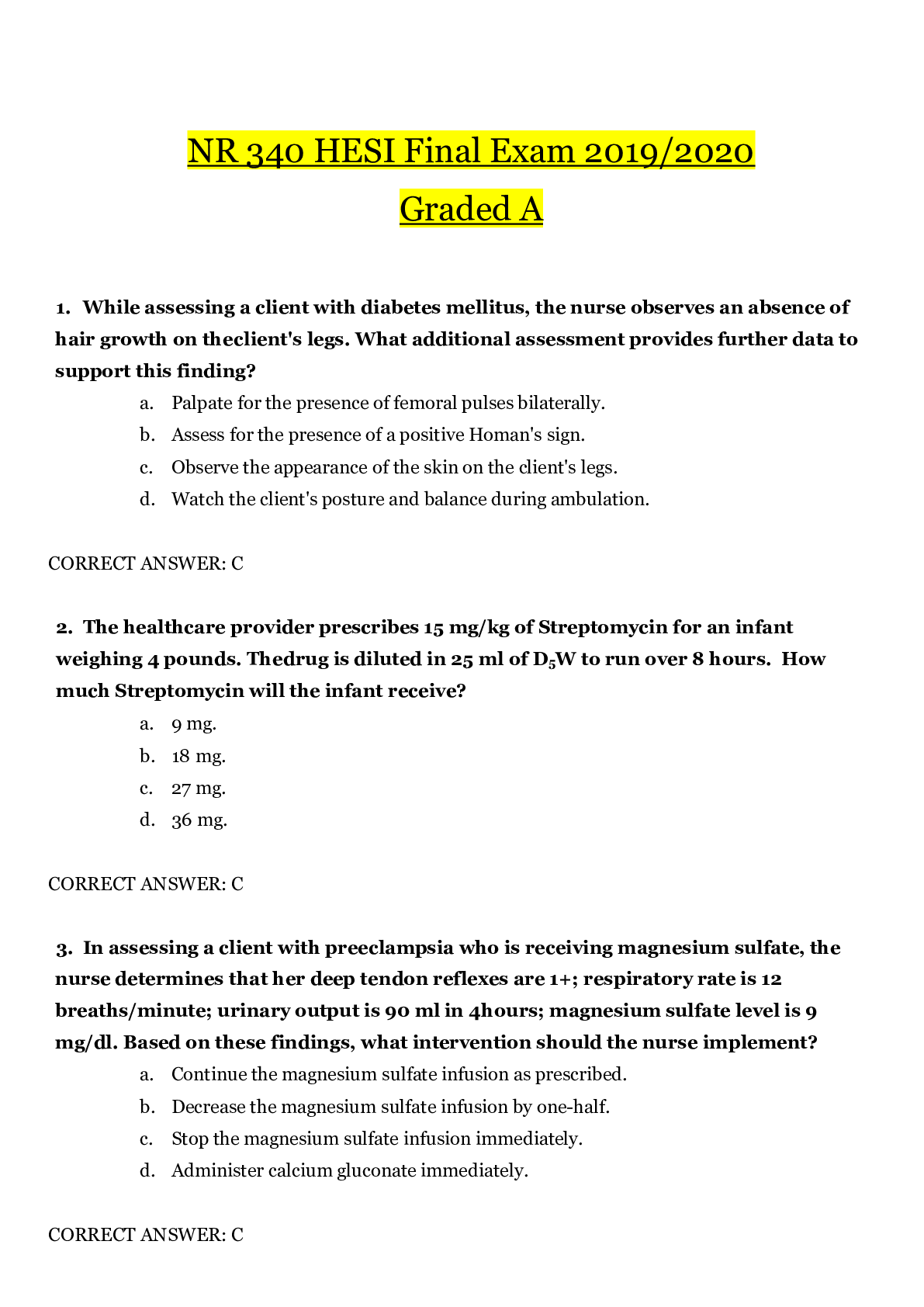
NR 340 HESI Final Exam 2019/2020
Graded A
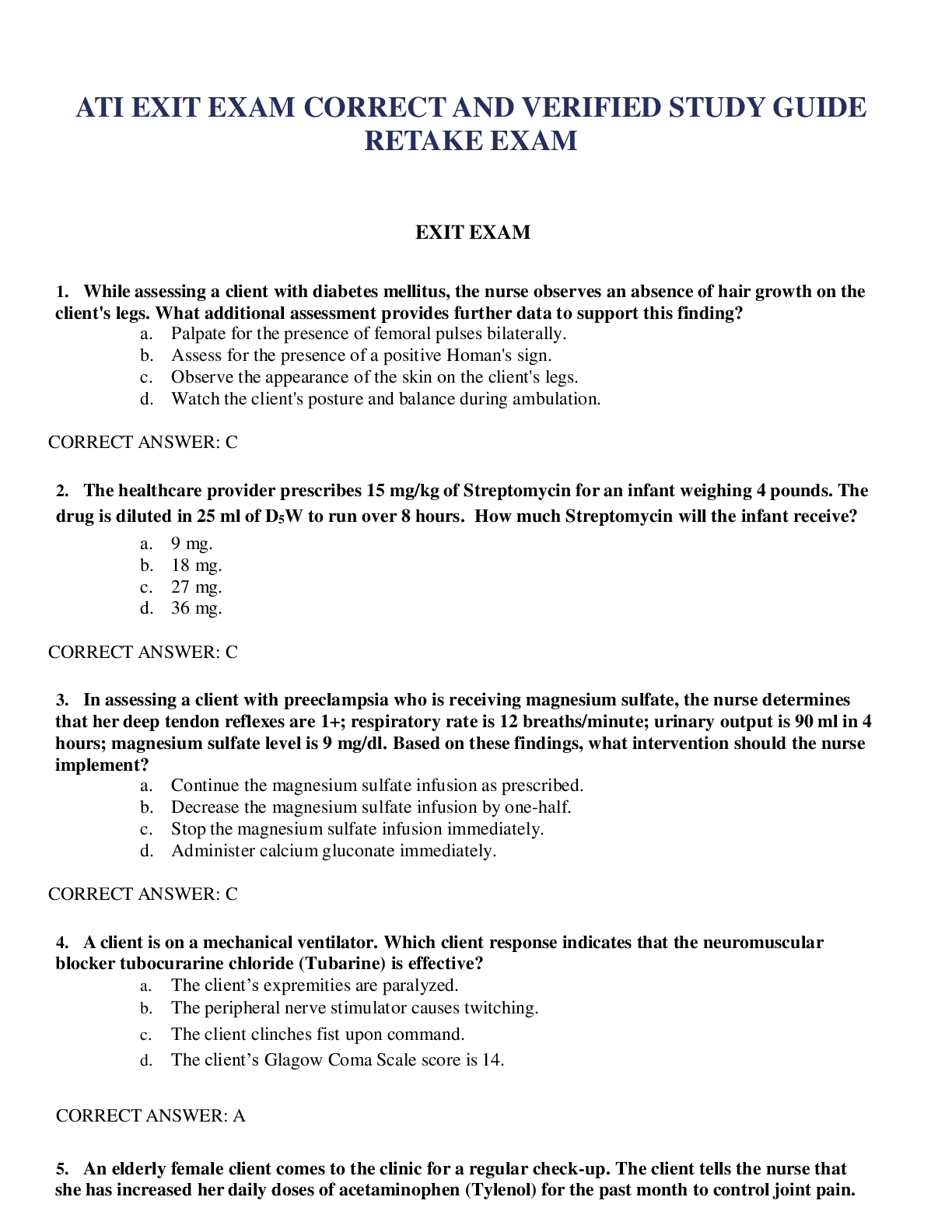
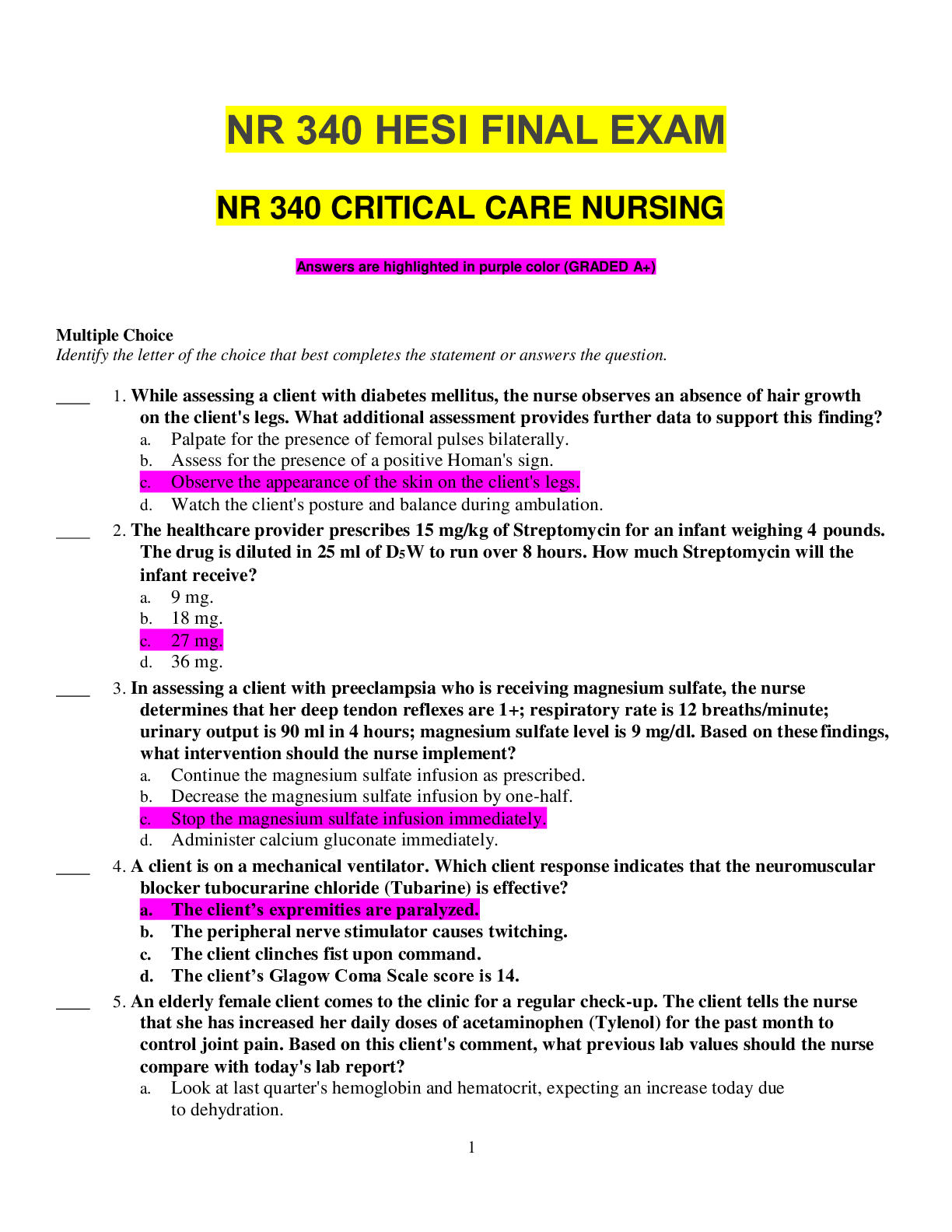
1. While assessing a client with diabetes mellitus, the nurse observes an absence of hair growth on the client's legs. What additional assessment provides further data to support this finding?
a. Palpate for the presence of femoral pulses bilaterally.
b. Assess for the presence of a positive Homan's sign.
c. Observe the appearance of the skin on the client's legs.
d. Watch the client's posture and balance during ambulation.
CORRECT ANSWER: C
2. The healthcare provider prescribes 15 mg/kg of Streptomycin for an infant weighing 4 pounds. The drug is diluted in 25 ml of D5W to run over 8 hours. How much Streptomycin will the infant receive?
a. 9 mg.
b. 18 mg.
c. 27 mg.
d. 36 mg.
CORRECT ANSWER: C
3. In assessing a client with preeclampsia who is receiving magnesium sulfate, the nurse determines that her deep tendon reflexes are 1+; respiratory rate is 12 breaths/minute; urinary output is 90 ml in 4 hours; magnesium sulfate level is 9 mg/dl. Based on these findings, what intervention should the nurse implement?
a. Continue the magnesium sulfate infusion as prescribed.
b. Decrease the magnesium sulfate infusion by one-half.
c. Stop the magnesium sulfate infusion immediately.
d. Administer calcium gluconate immediately.
CORRECT ANSWER: C
4. A client is on a mechanical ventilator. Which client response indicates that the neuromuscular blocker tubocurarine chloride (Tubarine) is effective?
a. The client’s expremities are paralyzed.
b. The peripheral nerve stimulator causes twitching.
c. The client clinches fist upon command.
d. The client’s Glagow Coma Scale score is 14.
CORRECT ANSWER: A
5. An elderly female client comes to the clinic for a regular check-up. The client tells the nurse that she has increased her daily doses of acetaminophen (Tylenol) for the past month to control joint pain. Based on this client's comment, what previous lab values should the nurse compare with today's lab report?
a. Look at last quarter's hemoglobin and hematocrit, expecting an increase today due to dehydration.
b. Look for an increase in today's LDH compared to the previous one to assess for possible liver damage.
c. Expect to find an increase in today's APTT as compared to last quarter's due to bleeding.
d. Determine if there is a decrease in serum potassium due to renal compromise.
CORRECT ANSWER: B
6. Aspirin is prescribed for a 9-year-old child with rheumatic fever to control the inflammatory process, promote comfort, and reduce fever. What intervention is most important for the nurse to implement?
a. Instruct the parents to hold the aspirin until the child has first had a tepid sponge bath.
b. Administer the aspirin with at least two ounces of water or juice.
c. Notify the healthcare provider if the child complains of ringing in the ears.
d. Advise the parents to question the child about seeing yellow halos around objects.
CORRECT ANSWER: C
7. Which signs or symptoms are characteristic of an adult client diagnosed with Cushing's syndrome?
a. Husky voice and complaints of hoarseness.
b. Warm, soft, moist, salmon-colored skin.
c. Visible swelling of the neck, with no pain.
d. Central-type obesity, with thin extremities.
CORRECT ANSWER: D
8. A charge nurse agrees to cover another nurse’s assignment during a lunch break. Based on the status report provided by the nurse who is leaving for lunch, which client should be checked first by the charge nurse? The client
a. admitted yesterday with diabetec ketoacidosis whose blood glucose level is now 195 mg/dl.
b. with an ileal conduit created two days ago with a scant amount of blood in the drainage pouch.
c. post-triple coronary bypass four days ago who has serosanguinous drainage in the chest tube.
d. with a pneumothorax secondary to a gunshot wound with a current pulse oximeter reading of 90%.
CORRECT ANSWER: D
9. An outcome for treatment of peripheral vascular disease is, "The client will have decreased venous congestion." What client behavior would indicate to the nurse that this outcome has been met?
a. Avoids prolonged sitting or standing.
b. Avoids trauma and irritation to skin.
c. Wears protective shoes.
d. Quits smoking.
CORRECT ANSWER: A
10. The healthcare provider performs a paracentesis on a client with ascites and 3 liters of fluid are removed. Which assessment parameter is most critical for the nurse to monitor following the procedure?
a. Pedal pulses.
b. Breath sounds.
c. Gag reflex.
d. Vital signs.
CORRECT ANSWER: D
11. The nurse is administering sevelamer (RenaGel) during lunch to a client with end stage renal disease (ESRD). The client asks the nurse to bring the medication later. The nurse should describe which action of RenaGel as an explanation for taking it with meals?
a. Prevents indigestion associated with ingestion of spicy foods.
b. Binds with phosphorus in foods and prevents absorption.
c. Promotes stomach emptying and prevents gastric reflux.
d. Buffers hydrochloric acid and prevents gastric erosion.
CORRECT ANSWER: B
12. The nurse formulates a nursing diagnosis of, "High risk for ineffective airway clearance" for a client with myasthenia gravis. What is the most likely etiology for this nursing diagnosis?
a. Pain when coughing.
b. Diminished cough effort.
c. Thick dry secretions.
d. Excessive inflammation.
CORRECT ANSWER: B
13. Following a CVA, the nurse assess that a client developed dysphagia, hypoactive bowel sounds and firm, distended abdomen. Which prescription for the client should the nurse question?
a. Continous tube feeding at 65 ml/hr via gastrostomy.
b. Total parenteral nutrition to be infused at 125 ml/hour.
c. Nasogastric tube connected to low intermittent suction.
d. Metoclopramide (Reglan) intermittent piggyback.
CORRECT ANSWER: A
14. A client's telemetry monitor indicates the sudden onset of ventricular fibrillation. Which assessment finding should the nurse anticipate?
a. Bounding erratic pulse.
b. Regularly irregular pulse.
c. Thready irregular pulse.
d. No palpable pulse.
CORRECT ANSWER: D
15. In assessing a 70-year-old female client with Alzheimer's disease, the nurse notes that she has deep inflamed cracks at the corners of her mouth. What intervention should the nurse include in this client's plan of care?
a. Scrub the lesions with warm soapy water.
b. Encourage the client to drink orange juice for added vitamin C.
c. Notify the healthcare provider of the need for oral antibiotics.
d. Ensure that the client gets adequate B vitamins in foods or supplements.
CORRECT ANSWER: D
16. A young adult female client is seen in the emergency department for a minor injury following a motor vehicle collision. She states she is very angry at the person who hit her car. What is the best nursing response?
a. "You are lucky to be alive. Be grateful no one was killed."
b. "I understand your car was not seriously damaged."
c. "You are upset that this incident has brought you here."
d. "Have you ever been in the emergency department before?" CORRECT ANSWER: C
17. An 85-year-old male resident of an extended care facility reaches for the hand of the unlicensed assistive personnel (UAP) and tries to kiss her hand several times during his morning care. The UAP reports the incident to the charge nurse. What is the best assessment of the situation?
a. This is sexual harassment and needs to be reported to the administration immediately.
b. The UAP needs to be reassigned to another group of residents, preferably females only.
c. The client may be suffering from touch deprivation and needs to know appropriate ways to express his need.
d. The resident needs to know the rules concerning unwanted touching of the staff and the consequences.
CORRECT ANSWER: C
18. The parents of a newborn infant with hypospadias are concerned about when the surgical correction should occur. What information should the nurse provide?
a. Repair should be done by one month to prevent bladder infections.
b. Repairs typically should be done before the child is potty-trained.
c. Delaying the repair until school age reduces castration fears.
d. To form a proper urethra repair, it should be done after sexual maturity.
CORRECT ANSWER: B
19. In evaluating teaching of a client about wearing a Holter monitor, which statement made by the client would indicate to the nurse that the client understands the procedure?
a. “I must record any symptoms occurring with my activity.”
b. “I am not looking forward to staying in bed for 24 hours.”
c. “I really am dreading the frequent blood drawing.”
d. “I know that I shouldn’t get close to my microwave oven.” CORRECT ANSWER: A
20. A 9-year-old female client was recently diagnosed with diabetes mellitus. Which symptom will her parents most likely report?
a. Refuses to eat her favorite meals at home.
b. Drinks more soft drinks than previously.
c. Voids only one or two times per day.
d. Gained 10 pounds within one month.
CORRECT ANSWER: B
21. The nurse is caring for four clients: Client A, who has emphysema and whose oxygen saturation is 94%; Client B, with a postoperative hemoglobin of 8.7 mg/dl; Client C, newly admitted with a potassium level of 3.8 mEq/L; and Client D, scheduled for an appendectomy who has a white blood cell count of 15,000 mm3. What intervention should the nurse implement?
a. Increase Client A's oxygen to 4 liters per minute via nasal cannula.
b. Determine if Client B has two units of packed cells available in the blood bank.
c. Ask the dietician to add a banana to Client C's breakfast tray.
d. Inform Client D that surgery is likely to be delayed until the infection is treated.
CORRECT ANSWER: B
22. A recently widowed middle-aged female client presents to the psychiatric clinic for evaluation and tells the nurse that she has "little reason to live." She describes one previous suicidal gesture and admits to having a gun in her home. To maintain the client's confidentiality and to help ensure her safety, which action is best for the nurse to implement?
a. Encourage the client to remove the gun from her possession.
b. Notify the client's healthcare provider of the availability of the weapon.
c. Contact a person of the client's choosing to remove the weapon from the home.
d. Call the local police department and have the weapon removed from the home.
CORRECT ANSWER: C
23. It is most important for the registered nurse (RN) who is working on a medical unit to provide direct supervision in which situation?
a. A graduate nurse needs to access a client's implanted port to start an infusion of Ringer's Lactate.
b. A postpartum nurse pulled to the unit needs to start a transfusion of packed red blood cells.
c. A practical nurse is preparing to assist the healthcare provider with a lumbar puncture at the bedside.
d. An unlicensed assistive personnel is preparing to weigh an obese bedfast client using a bed scale.
CORRECT ANSWER: A
24. A nurse is completing the health history for a 25-year-old male client who reports that he is allergic to penicillin. Which question should the nurse ask after receiving this information?
a. "Are you allergic to any other medications?"
b. "How often have you taken penicillin in the past?"
c. "Is anyone else in your family allergic to penicillin?"
d. "What happens to you when you take penicillin?" CORRECT ANSWER: D
25. A 10-year-old child with meningitis is suspected of having diabetes insipidus. In evaluating the child's laboratory values, which finding is indicative of diabetes insipidus?
a. Decreased urine specific gravity.
b. Elevated urine glucose.
c. Decreased serum potassium.
d. Increased serum sodium.
CORRECT ANSWER: A
26. A client with myelogenous leukemia is receiving an autologous bone marrow transplantation (BMT). What is the priority intervention that the nurse should implement when the bone marrow is repopulating?
a. Administer sargramostim (Leukine, Prokine).
b. Infuse PRBC and platelet transfusions.
c. Give parental prophylactic antibiotics.
d. Maintain a protective isolation environment.
CORRECT ANSWER: D
27. A 38-year-old male client collapsed at his outside construction job in Texas in July. His admitting vital signs to ICU are, BP 82/70, heart rate 140 beats/minute, urine output 10 ml/hr, skin cool to the touch. Pulmonary artery (PA) pressures are, PAWP 1, PAP 8/2, RAP -1, SVR 1600. What nursing action has the highest priority?
a. Apply a hypothermia unit to stabilize core temperature.
b. Increase the client's IV fluid rate to 200 ml/hr.
c. Call the hospital chaplain to counsel the family.
d. Draw blood cultures x 3 to detect infection.
CORRECT ANSWER: B
28. A client who has Type 1 diabetes and is at 10-weeks gestation comes to the prenatal clinic complaining of a headache, nausea, sweating, feeling shaky, and being tired all the time. What action should the nurse take first?
a. Check the blood glucose level.
b. Draw blood for a Hemoglobin A1C.
c. Assess urine for ketone levels.
d. Provide the client with a protein snack.
CORRECT ANSWER: A
29. A client in labor states, "I think my water just broke!" The nurse notes that the umbilical cord is on the perineum. What action should the nurse perform first?
a. Administer oxygen via face mask.
c. Notify the operating room team.
b. Place the client in Trendelenburg.
c. Administer a fluid bolus of 500 ml.
CORRECT ANSWER: B
30. The nurse is planning care for a non-potty-trained child with nephrotic syndrome. Which intervention provides the best means of determining fluid retention?
a. Weigh the child daily.
b. Observe the lower extremities for pitting edema.
c. Measure the child's abdominal girth weekly.
d. Weigh the child's wet diapers.
CORRECT ANSWER: A
31. The mother of a 9-month-old who was diagnosed with respiratory syncytial virus (RSV) yesterday calls the clinic to inquire if it will be all right to take her infant to the first birthday party of a friend's child the following day. What response should the nurse provide this mother?
a. The child can be around other children but should wear a mask at all times.
b. The child will no longer be contagious, no need to take any further precautions.
c. Make sure there are no children under the age of 6 months around the infected child.
d. Do not expose other children. RSV is very contagious even without
-
-
-
-
-
-
-
-
-
-
-
-
Contnued
[Show More]