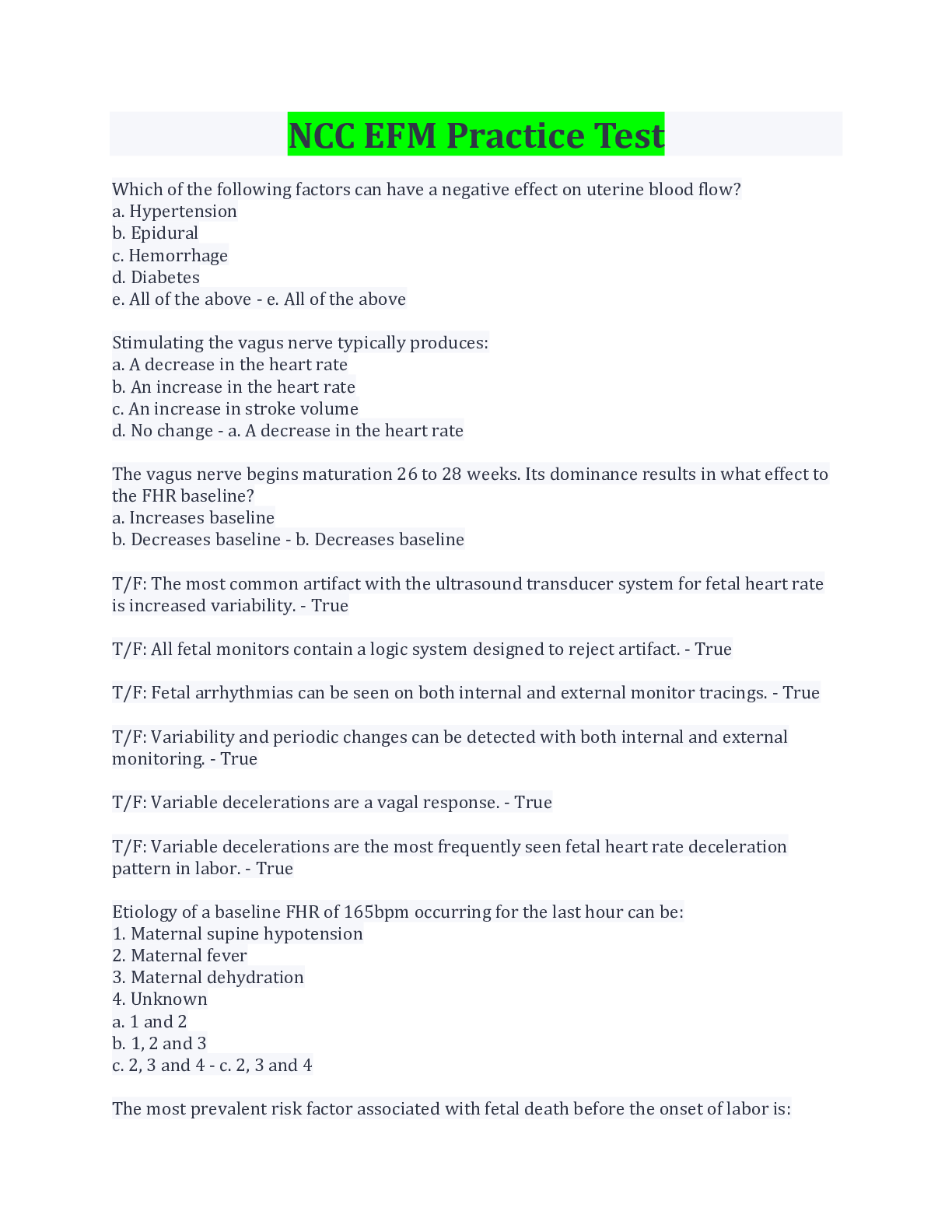
Which of the following factors can have a negative effect on uterine blood flow?
a. Hypertension
b. Epidural
c. Hemorrhage
d. Diabetes
e. All of the above Correct Answer-e. All of the above
Stimulating the vagus ne
...
Which of the following factors can have a negative effect on uterine blood flow?
a. Hypertension
b. Epidural
c. Hemorrhage
d. Diabetes
e. All of the above Correct Answer-e. All of the above
Stimulating the vagus nerve typically produces:
a. A decrease in the heart rate
b. An increase in the heart rate
c. An increase in stroke volume
d. No change Correct Answer-a. A decrease in the heart rate
The vagus nerve begins maturation 26 to 28 weeks. Its dominance results in what effect to the FHR
baseline?
a. Increases baseline
b. Decreases baseline Correct Answer-b. Decreases baseline
T/F: The most common artifact with the ultrasound transducer system for fetal heart rate is increased
variability. Correct Answer-True
T/F: All fetal monitors contain a logic system designed to reject artifact. Correct Answer-True
T/F: Fetal arrhythmias can be seen on both internal and external monitor tracings. Correct Answer-True
T/F: Variability and periodic changes can be detected with both internal and external monitoring.
Correct Answer-True
T/F: Variable decelerations are a vagal response. Correct Answer-True
T/F: Variable decelerations are the most frequently seen fetal heart rate deceleration pattern in labor.
Correct Answer-True
Etiology of a baseline FHR of 165bpm occurring for the last hour can be:
1. Maternal supine hypotension
2. Maternal fever
3. Maternal dehydration
4. Unknown
a. 1 and 2
b. 1, 2 and 3
c. 2, 3 and 4 Correct Answer-c. 2, 3 and 4
The most prevalent risk factor associated with fetal death before the onset of labor is:
a. Low socioeconomic status
b. Fetal malpresentation
c. Uteroplacental insufficiency
d. Uterine anomalies Correct Answer-c. Uteroplacental insufficiency
Which of the following conditions is not an indication for antepartum fetal surveillance?
a. Gestational hypertension
b. Diabetes in pregnancy
c. Fetus in breech presentation
d. Decreased fetal movement Correct Answer-c. Fetus in breech presentation
Which of the following does not affect the degree of fetal activity?
a. Vibroacoustic stimulation
b. Smoking
c. Fetal position
d. Gestational age Correct Answer-a. Vibroacoustic stimulation
T/F: Umbilical cord influences that can alter blood flow include true knots, hematomas, and number of
umbilical vessels. Correct Answer-True
T/F: Low amplitude contractions are not an early sign of preterm labor. Correct Answer-False
T/F: Corticosteroid administration may cause an increase in FHR accelerations. Correct Answer-False
T/F: Corticosteroid administration may cause an increase in FHR. Correct Answer-True
T/F: Contractions cause an increase in uterine venous pressure and a decrease in uterine artery
perfusion. Correct Answer-True
As a result of the intrinsic fetal response to oxygen deprivation, increased catecholamine levels cause
the peripheral blood flow to decrease while the blood flow to vital organs increases. These flow changes
along with increased catecholamine secretions have what effect on fetal blood pressure and fetal heart
rate?
A. Increase BP and increase HR
B. Increase BP and decrease HR
C. Decrease BP and increase HR
D. Decrease BP and decrease HR Correct Answer-B. Increase BP and decrease HR
During a term antepartum NST (non-stress test), you notice several variable decelerations that decrease
at least 15 bpm and last at least 15 sec long. Which of the following is the least likely explanation?
A. True knot
B. Gestational diabetes
C. Umbilical cord entanglement
D. Oligohydramnios Correct Answer-B. Gestational diabetes
All of the following are likely causes of prolonged decelerations except:
A. Uterine tachysystole
B. Prolapsed cord
C. Maternal hypotension
D. Maternal fever Correct Answer-D. Maternal fever
All of the following could likely cause minimal variability in FHR except
A. Magnesium sulfate administration
B. Fetal sleep cycle
[Show More]


.png)

.png)