SCIENCE 101 > QUESTIONS & ANSWERS > Feel the Heat Gizmo student Sheet. (All)
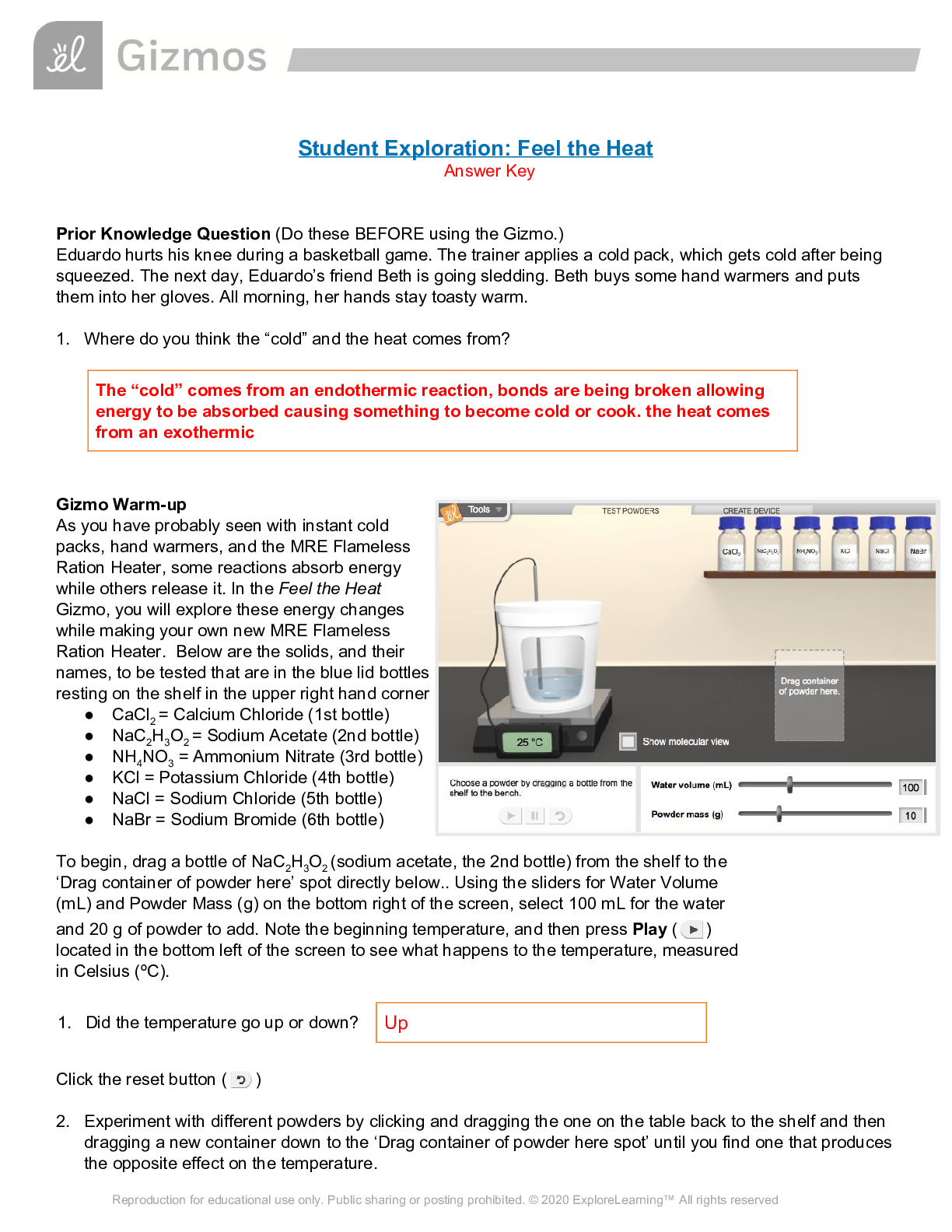
Prior Knowledge Question (Do these BEFORE using the Gizmo.) Eduardo hurts his knee during a basketball game. The trainer applies a cold pack, which gets cold after being squeezed. The next day, Edua ... rdo’s friend Beth is going sledding. Beth buys some hand warmers and puts them into her gloves. All morning, her hands stay toasty warm. 1. Where do you think the “cold” and the heat comes from? Gizmo Warm-up As you have probably seen with instant cold packs, hand warmers, and the MRE Flameless Ration Heater, some reactions absorb energy while others release it. In the Feel the Heat Gizmo, you will explore these energy changes while making your own new MRE Flameless Ration Heater. Below are the solids, and their names, to be tested that are in the blue lid bottles resting on the shelf in the upper right hand corner ● CaCl2 = Calcium Chloride (1st bottle) ● NaC2H3O2 = Sodium Acetate (2nd bottle) ● NH4NO3 = Ammonium Nitrate (3rd bottle) ● KCl = Potassium Chloride (4th bottle) ● NaCl = Sodium Chloride (5th bottle) ● NaBr = Sodium Bromide (6th bottle) To begin, drag a bottle of NaC2H3O2 (sodium acetate, the 2nd bottle) from the shelf to the ‘Drag container of powder here’ spot directly below.. Using the sliders for Water Volume (mL) and Powder Mass (g) on the bottom right of the screen, select 100 mL for the water and 20 g of powder to add. Note the beginning temperature, and then press Play ( ) located in the bottom left of the screen to see what happens to the temperature, measured in Celsius (ºC). Click the reset button ( ) 2. Experiment with different powders by clicking and dragging the one on the table back to the shelf and then dragging a new container down to the ‘Drag container of powder here spot’ until you find one that produces the opposite effect on the temperature. Reproduction for educational use only. Public sharing or posting prohibited. © 2020 ExploreLearning™ All rights reserved The “cold” comes from an endothermic reaction, bonds are being broken allowing energy to be absorbed causing something to become cold or cook. the heat comes from an exothermic 1. Did the temperature go up or down? Up When a powder dissolves in water a solution is formed. The powder is the solute and the water is the solvent. Oftentimes energy changes accompany the formation of a solution. When added to water, some powders cause the resulting solution to get hot, while others make it cold. Some powders don’t produce a temperature change at all. When energy changes do occur, they can be put to good use. Introduction: The reactions in this activity are performed within a calorimeter, an insulated device that keeps heat from escaping, enabling you to accurately record temperature changes. Question: Why does the temperature change when a powder is dissolved in water? 1. Get the Gizmo ready: Drag a bottle of NaC2H3O2 (the 2nd bottle) from the shelf. Set the Water volume to 100mL and the Powder mass to 20 g. 2. Observe: In between the hot plate where you read the temperature and the ‘Drag container of powder here’ spot click to check and turn on “Show molecular view”, and notice the water molecules. a. What color line represents the bonds between the water molec [Show More]
Last updated: 3 years ago
Preview 1 out of 9 pages
Buy this document to get the full access instantly
Instant Download Access after purchase
Buy NowInstant download
We Accept:
Can't find what you want? Try our AI powered Search
Connected school, study & course
About the document
Uploaded On
Mar 10, 2021
Number of pages
9
Written in
All
This document has been written for:
Uploaded
Mar 10, 2021
Downloads
0
Views
180
Scholarfriends.com Online Platform by Browsegrades Inc. 651N South Broad St, Middletown DE. United States.
We're available through e-mail, Twitter, and live chat.
FAQ
Questions? Leave a message!
Copyright © Scholarfriends · High quality services·