SCIENCE 101 > QUESTIONS & ANSWERS > gizmo_melting_points.docx (All)
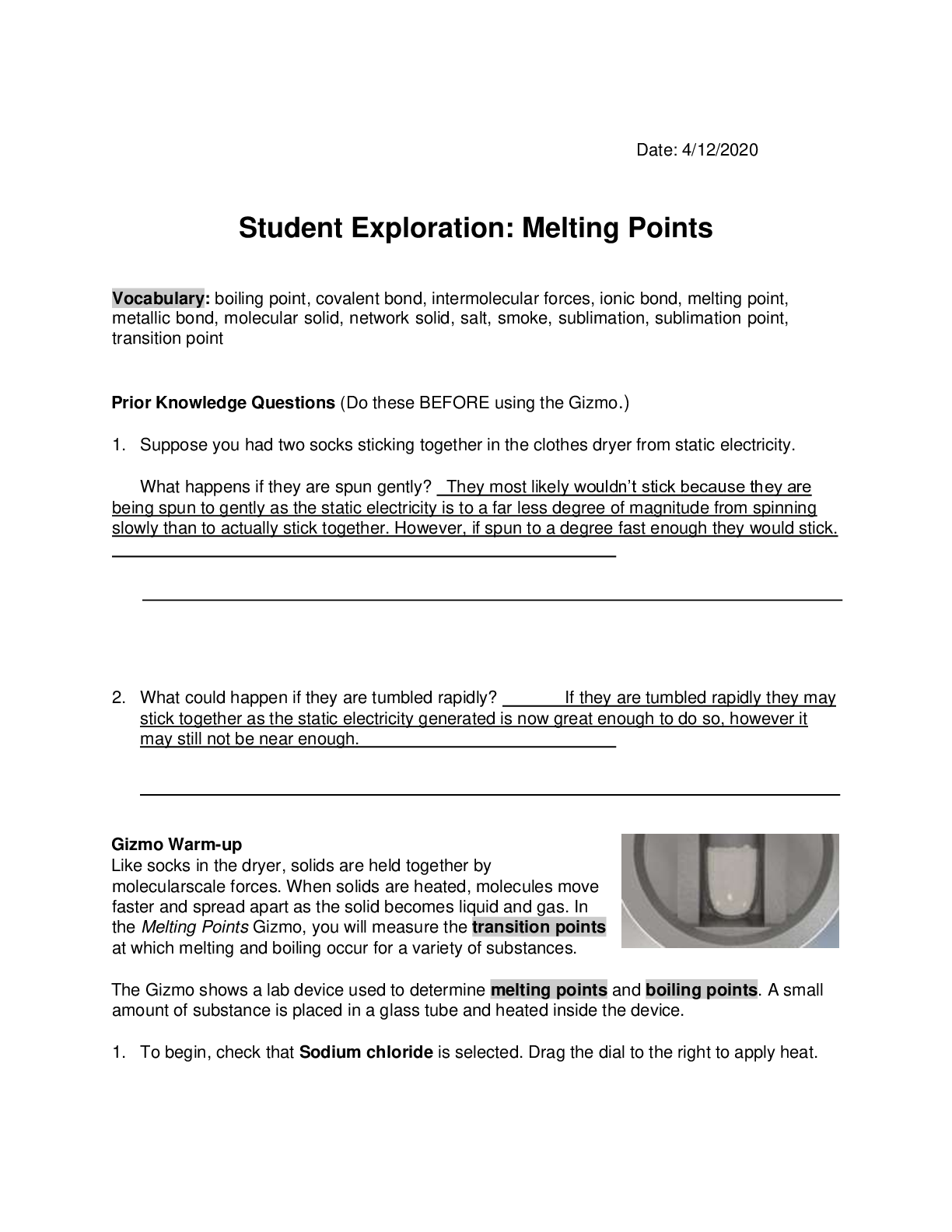
Student Exploration: Melting Points Vocabulary: boiling point, covalent bond, intermolecular forces, ionic bond, melting point, metallic bond, molecular solid, network solid, salt, smoke, subl ... imation, sublimation point, transition point Prior Knowledge Questions (Do these BEFORE using the Gizmo.) 1. Suppose you had two socks sticking together in the clothes dryer from static electricity. What happens if they are spun gently? They most likely wouldn’t stick because they are being spun to gently as the static electricity is to a far less degree of magnitude from spinning slowly than to actually stick together. However, if spun to a degree fast enough they would stick. 2. What could happen if they are tumbled rapidly? If they are tumbled rapidly they may stick together as the static electricity generated is now great enough to do so, however it may still not be near enough. Gizmo Warm-up Like socks in the dryer, solids are held together by molecularscale forces. When solids are heated, molecules move faster and spread apart as the solid becomes liquid and gas. In the Melting Points Gizmo, you will measure the transition points at which melting and boiling occur for a variety of substances. The Gizmo shows a lab device used to determine melting points and boiling points. A small amount of substance is placed in a glass tube and heated inside the device. 1. To begin, check that Sodium chloride is selected. Drag the dial to the right to apply heat. A. When the temperature is around 600 °C, drag the dial back to 0. Notice that the sodium chloride is red-hot, but it is still a solid. B. Drag the dial to the right. When the sodium chloride melts, move the dial back to 0. About what temperature does sodium chloride melt? The temperature that it melts is around 800 Celsius here the range most likely is 800-805 2. Click Reset. This time, decrease the setting on the dial as you get close to the melting point. Notice that melting occurs over a range of temperatures. Can you determine the exact range of temperatures over which melting occurs? (This may take several tries, be patient.) The exact range at which the melting occurs of Sodium chloride is 797 degrees Celsius (the very beginning of signs being shown) to 803 degrees Celsius [Show More]
Last updated: 3 years ago
Preview 1 out of 7 pages
Buy this document to get the full access instantly
Instant Download Access after purchase
Buy NowInstant download
We Accept:
Can't find what you want? Try our AI powered Search
Connected school, study & course
About the document
Uploaded On
Mar 10, 2021
Number of pages
7
Written in
All
This document has been written for:
Uploaded
Mar 10, 2021
Downloads
1
Views
1308
Scholarfriends.com Online Platform by Browsegrades Inc. 651N South Broad St, Middletown DE. United States.
We're available through e-mail, Twitter, Facebook, and live chat.
FAQ
Questions? Leave a message!
Copyright © Scholarfriends · High quality services·