NR566 Week 5 Study Outline
Many questions are written to assess your clinical application of the material from the
textbook, in real-world scenarios.
Chapter 18: Drugs Affecting the Hematopoietic System
Anticoagulant
...
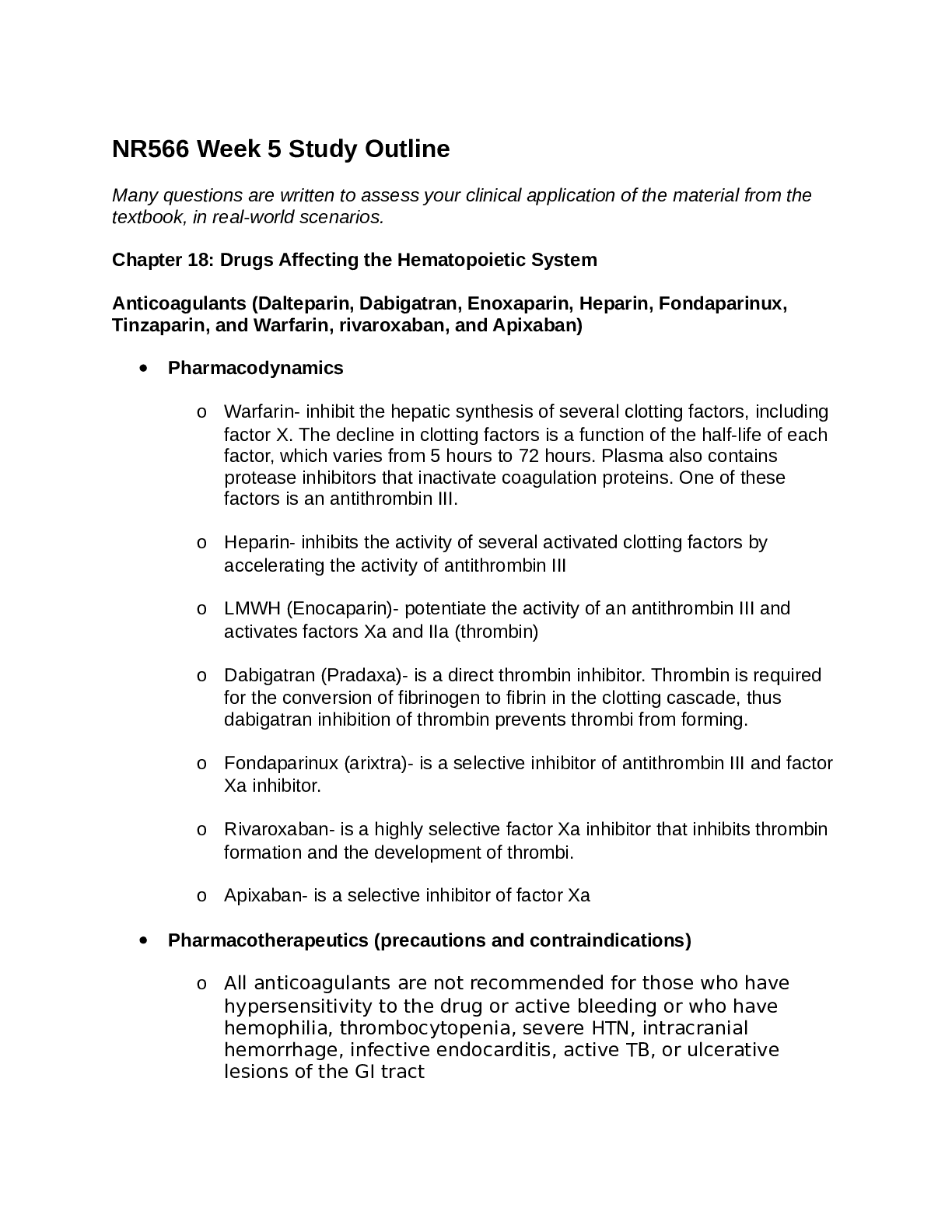
NR566 Week 5 Study Outline
Many questions are written to assess your clinical application of the material from the
textbook, in real-world scenarios.
Chapter 18: Drugs Affecting the Hematopoietic System
Anticoagulants (Dalteparin, Dabigatran, Enoxaparin, Heparin, Fondaparinux,
Tinzaparin, and Warfarin, rivaroxaban, and Apixaban)
Pharmacodynamics
o Warfarin- inhibit the hepatic synthesis of several clotting factors, including
factor X. The decline in clotting factors is a function of the half-life of each
factor, which varies from 5 hours to 72 hours. Plasma also contains
protease inhibitors that inactivate coagulation proteins. One of these
factors is an antithrombin III.
o Heparin- inhibits the activity of several activated clotting factors by
accelerating the activity of antithrombin III
o LMWH (Enocaparin)- potentiate the activity of an antithrombin III and
activates factors Xa and IIa (thrombin)
o Dabigatran (Pradaxa)- is a direct thrombin inhibitor. Thrombin is required
for the conversion of fibrinogen to fibrin in the clotting cascade, thus
dabigatran inhibition of thrombin prevents thrombi from forming.
o Fondaparinux (arixtra)- is a selective inhibitor of antithrombin III and factor
Xa inhibitor.
o Rivaroxaban- is a highly selective factor Xa inhibitor that inhibits thrombin
formation and the development of thrombi.
o Apixaban- is a selective inhibitor of factor Xa
Pharmacotherapeutics (precautions and contraindications)
o All anticoagulants are not recommended for those who have
hypersensitivity to the drug or active bleeding or who have
hemophilia, thrombocytopenia, severe HTN, intracranial
hemorrhage, infective endocarditis, active TB, or ulcerative
lesions of the GI tract
[Show More]