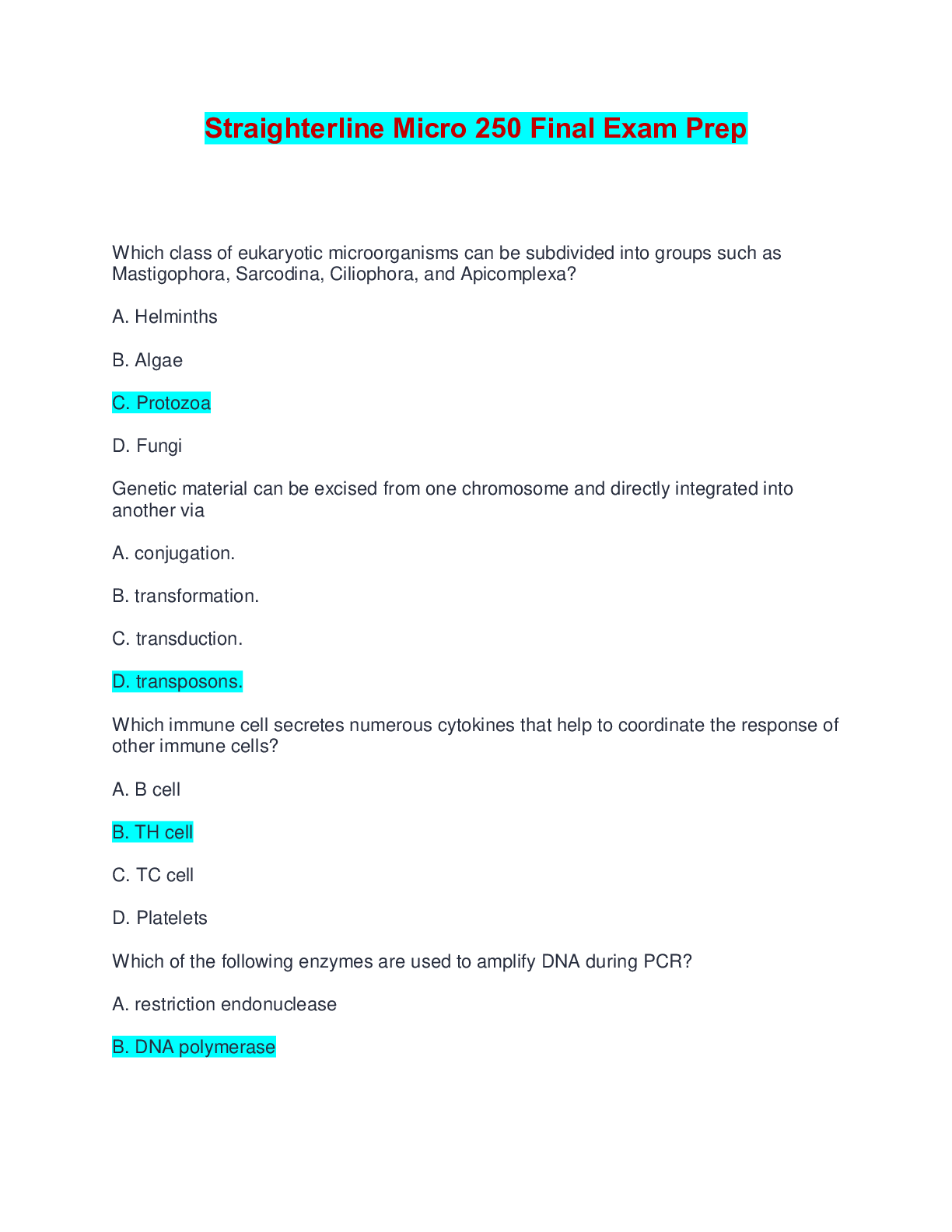
Which class of eukaryotic microorganisms can be subdivided into groups such as Mastigophora, Sarcodina, Ciliophora, and Apicomplexa?
A. Helminths
B. Algae
C. Protozoa
D. Fungi
(Ans- Protozoa
Genetic mat
...
Which class of eukaryotic microorganisms can be subdivided into groups such as Mastigophora, Sarcodina, Ciliophora, and Apicomplexa?
A. Helminths
B. Algae
C. Protozoa
D. Fungi
(Ans- Protozoa
Genetic material can be excised from one chromosome and directly integrated into another via
A. conjugation.
B. transformation.
C. transduction.
D. transposons.
(Ans- transposons.
Which immune cell secretes numerous cytokines that help to coordinate the response of other immune cells?
A. B cell
B. TH cell
C. TC cell
D. Platelets
(Ans- TH cell
Which of the following enzymes are used to amplify DNA during PCR?
A. restriction endonuclease
B. DNA polymerase
C. reverse transcriptase
D. DNA ligase
(Ans- DNA polymerase
In the nitrogen cycle, which of the following steps involves removal of nitrogen from the atmosphere by bacteria?
(Ans- nitrogen fixation, In nitrogen fixation, nitrogen is removed from the atmosphere by nitrogen-fixing bacteria and converted to ammonia.
If enough h+ ions are added to pure water to raise the H+ concentration of the solution to ten times higher than the original concentration, what is the resulting OH- concentration of the solution?
(Ans- 10 -8M
Fungi are able to reproduce asexually by creating conidiospores and sporangiospores. Which of the following is an accurate explanation for why it is advantageous that they are also capable of sexual reproduction?
Select one:
a. Asexually produced offspring are more likely to compete for resources and will kill off the parental fungi.
b. Fungi normally produce sexually but produce asexually in harsh conditions such as severe drought.
c. Offspring from two parents may have variations in form and function that contribute to survival of the species.
d. Sexual reproduction produces more offspring at a faster rate than spore formation.
(Ans- Offspring from two parents may have variations in form and function that contribute to survival of the species.
In a laboratory bacterial cell culture that has been infected by a virus, plaques are areas in which
Select one:
a. bacterial cells are resistant to the virus and have not been infected.
b. there is no nutrient available for the bacteria to grow.
c. the virus has spread and left behind the remains of dead cells.
d. the virus has not yet spread to that area of cells.
(Ans- the virus has spread and left behind the remains of dead cells.
The sun's energy is delivered as discrete packets that travel as waves and are called
Select one:
a. ATP.
b. carotenoids.
c. NADP.
d. photons.
(Ans- photons.
Which of the following is a characteristic of aerobic respiration?
Select one:
a. Oxygen-containing ions act as the final electron acceptors in electron transport.
b. The process includes glycolysis, the Krebs cycle, and the electron transport chain.
c. Aerobic respiration produces a total of 2 ATP molecules.
d. Aerobic respiration produces lactic acid.
(Ans- The three stages of aerobic
[Show More]