Chamberlain College of Nursing - NURSING NR 324Chapter 34
Document Content and Description Below
Chapter 34: Nursing Management:
Coronary Artery Disease and Acute
Coronary Syndrome
Chapter 34: Nursing Management: Coronary Artery Disease and Acute
Coronary Syndrome
Test Bank
MULTIPLE CHOICE
1. When developing
...
[Show More]
Last updated: 3 years ago
Preview 1 out of 21 pages
Instant download
.png)
Buy this Document to get the Full Access Instantly
Provided by Students Who Aced it
We Verify Document Content to Gurantee Accuracy
Reviews( 0 )
Document information
Connected school, study & course
About the document
Uploaded On
Mar 12, 2021
Number of pages
21
Written in
All

Additional information
This document has been written for:
Uploaded
Mar 12, 2021
Downloads
0
Views
94
Topic Tags
Recommended For You
Get more on EXAM »
$10
54 Pages
Gloria Leugers, a 37-year-old female, comes to see Dr. Lewis w...
$15
19 Pages
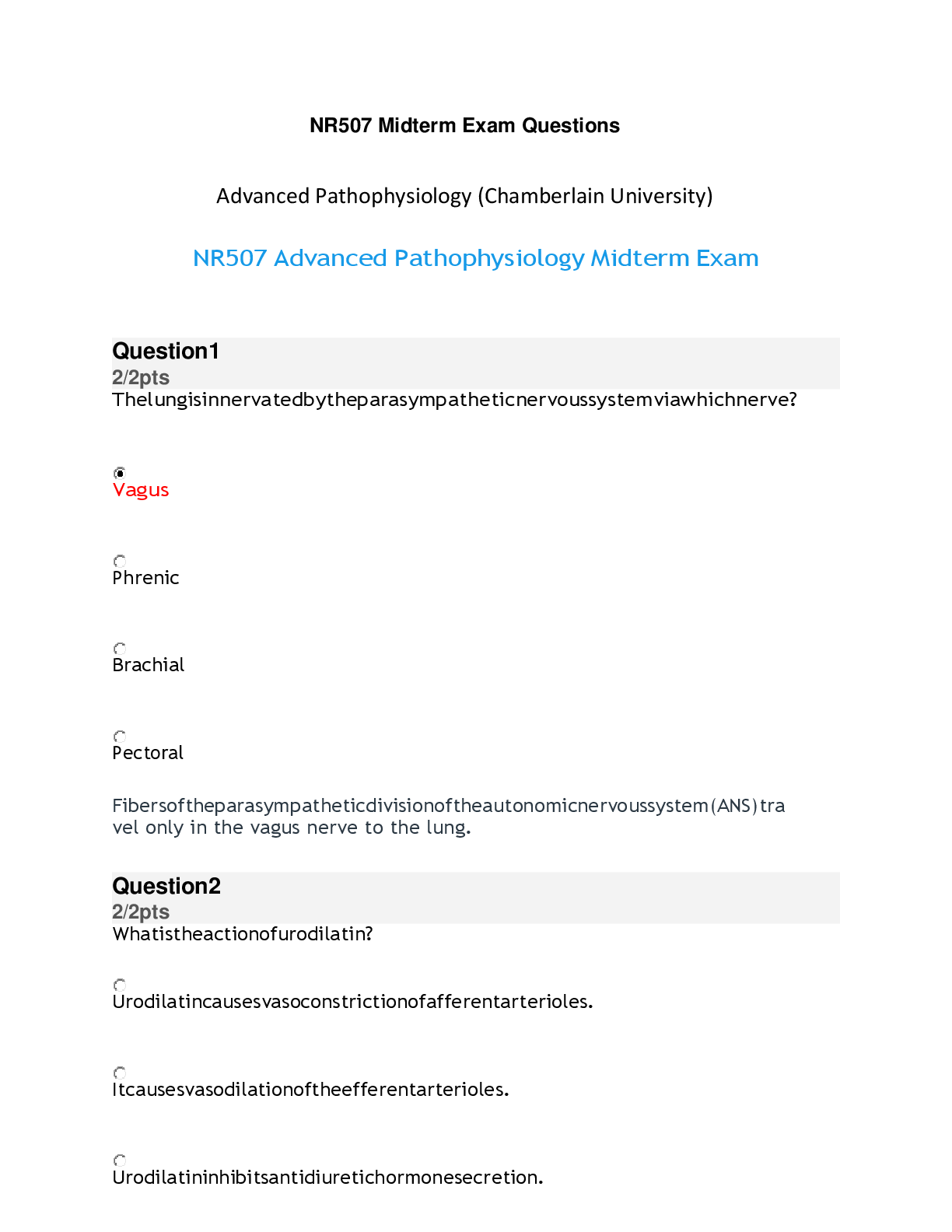
NR 507 Advanced Pathophysiology (NR-507) Week 4 Midterm Exam P...
$15
257 Pages
HESI A2 REVIEW Anatomy and Physiology, HESI A2 Science, HESI A...
$25
68 Pages
Test Bank for Role Development in Professional Nursing Practic...
$23
473 Pages
TEST BANK for Essentials for Nursing Practice, 9th Edition by...

$25
416 Pages
Basic Geriatric Nursing, 8th Edition By Patricia Williams [PDF...
$25
342 Pages
Test Bank For Community Public Health Nursing Promoting the He...


$10
14 Pages
NURS 4325 Maternal-Child Nursing | Healthy Newborn, Infant Car...

$25
137 Pages
Instructor Manual(Lecture Notes Only) for Principles of Pediat...

$5
3 Pages
Brian Foster: Final Diagnosis Conditions of the cardiovascular...
More related documents below

.png)

.png)
.png)