NUR 353 Exam 1 | Complete Solutions (Verified) The process by which human beings produce a new individual. The total process by which organisms produce offspring. Reproduction These cells carry the genetic materials ne
...
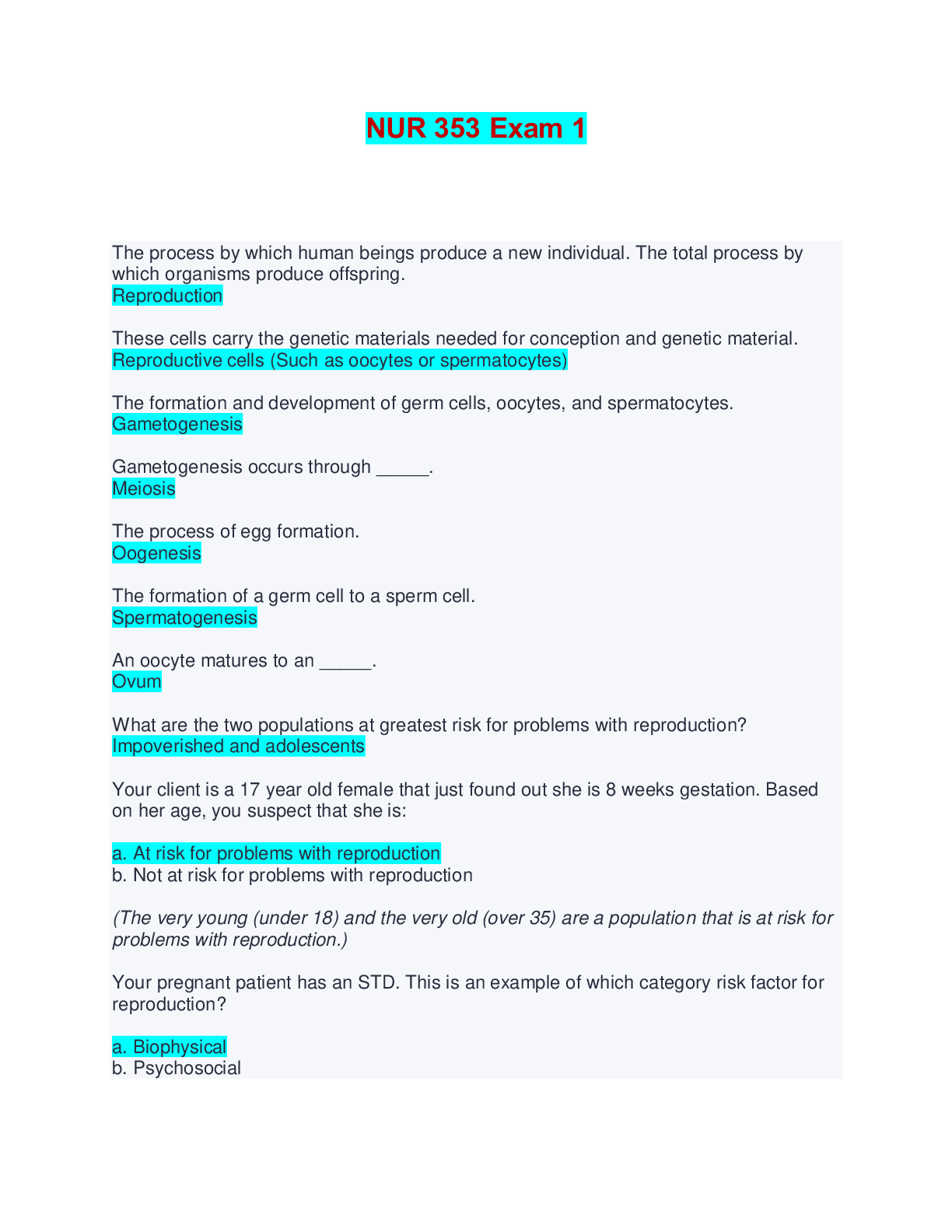
NUR 353 Exam 1 | Complete Solutions (Verified) The process by which human beings produce a new individual. The total process by which organisms produce offspring. Reproduction These cells carry the genetic materials needed for conception and genetic material. Reproductive cells (Such as oocytes or spermatocytes) The formation and development of germ cells, oocytes, and spermatocytes. Gametogenesis Gametogenesis occurs through _____. Meiosis The process of egg formation. Oogenesis The formation of a germ cell to a sperm cell. Spermatogenesis An oocyte matures to an _____. Ovum What are the two populations at greatest risk for problems with reproduction? Impoverished and adolescents Your client is a 17 year old female that just found out she is 8 weeks gestation. Based on her age, you suspect that she is: a. At risk for problems with reproduction b. Not at risk for problems with reproduction (The very young (under 18) and the very old (over 35) are a population that is at risk for problems with reproduction.) Your pregnant patient has an STD. This is an example of which category risk factor for reproduction? a. Biophysical b. Psychosocial c. Sociodemographic d. Environmental (Biophysical risk factors include PID, HIV/AIDS, any STD, chromosomal abnormalities, hypertension, heart failure, type I diabetes, and obesity. Basically, any medical condition.) You know that which of the following would be an example of a psychosocial risk factor related to reproduction? a. Pelvic Inflammatory Disease (PID) b. Secondhand smoking c. Drug addiction d. Lack of insurance (Psychosocial risk factors include: Isolation, anxiety, depression, spousal abuse or inter partner violence, drug and alcohol use and addiction.) Formation of a viable zygote. Conception A process that interferes with the normal process of ovulation, fertilization, and implantation. Contraception The union of a spermatozoal nucleus with an egg nucleus to form the primary nucleus of an embryo Fertilization Carrying of an embryo or fetus inside the uterus from conception until birth. Gestation Refers to the embryonic or fetal age plus two weeks (approximately the duration since the woman's last menstrual period (LMP) began. Gestational age List 5 causes of male infertility. 1. Low testosterone levels 2. Undescended testes 3. Varicocele 4. Low sperm count/no sperm count 5. Infections List 3 causes of female infertility. 1. Uterine abnormalities 2. Hormonal problems 3. Infections Describe of process of reproduction/fertilization. An oocyte is created through the process of oogenesis. During ovulation, the ovum (mature oocyte) drops into the distal third of the fallopian tube. During intercourse, the sperm travels through the vagina, past the cervix, then into the uterus. The sperm swims around to find the ovum in the distal third of the fallopian tube. When the sperm finds the ovum, it fertilizes the egg. When the nucleus of the fertilized cell splits, it forms a zygote (day 1). For a few days, the zygote keeps splitting until it gets to 16 cells, then it is called a morula. It becomes at blastocyst at day 5 then implants into the endometrium. This entire time the cell is traveling from the distal third of the fallopian tube to the fundus of the uterus. The main hormone involved with labor and delivery. It causes labor contractions, and prevents hemorrhaging right after delivery. Oxytocin From 6-8 days until 8 weeks gestation, a baby is called what? Embryo From 9 weeks gestation on, a baby is called what? A fetus How long is an egg viable for? 24 hours These two hormones peak right before ovulation, to cause the ovum to be released into the fallopian tube. FSH and LH How long does it take for the fertilized egg to travel from the ampulla of the fallopian tube to the uterus to implant? Up to 7 days, it varies. A fertilized egg Zygote The process of the blastocyst implanting in the uterus releases which hormone, commonly used for pregnancy tests? HCG The period from fertilization (Day 0) to 2 weeks is called what? Pre-embryonic period Which period is most critical in the development of the organ systems and main features of a fetus? Embryonic period (Week 2-8) What are the three layers of the blastocyst? 1. Ectoderm 2. Mesoderm 3. Endoderm In the fetal period, the fetus grows how much per day? 1.5% The term for the uterine lining during pregnancy (endometrium), which forms the maternal part of the placenta. Decidua # of times a woman has been pregnant (including current pregnancy) Gravida # of times a woman has given birth, longer than 20 weeks gestation Parity A woman who has had 2 or more pregnancies Multigravida A woman who has had no pregnancies Nulligravida A woman who is pregnant for the first time Primigravida A woman who has completed two or more pregnancies to 20 weeks of gestation or more Multipara A woman who has not completed a pregnancy with a fetus or fetuses beyond 20 weeks of gestation Nullipara A pregnancy that has reached 20 weeks of gestation but ends before completion of 37 weeks of gestation Preterm A woman who has completed one pregnancy with a fetus or fetuses who have reached 20 weeks of gestation Primipara A pregnancy from the beginning of week 38 of gestation to the end of week 42 of gestation Term The capacity to live outside the uterus; there are no clear limits of gestational age or weight. Infants born at 22 to 25 weeks of gestation are considered to be on the threshold of this and are especially vulnerable to brain injury if they survive. Viability An organ of respiration, nutrition, excretion, storage, and transportation. Placenta Menstruation begins approximately __ days after ovulation. 14 You are working with a college student who is planning to become sexually active. She is requesting a reliable method of birth control that could be easily discontinued if necessary. Which option should be given the strongest recommendation? a. Intrauterine device (IUD) b. Coitus interruptus c. Natural family planning d. Oral contraceptive pills (Oral contraceptive pills prevent ovulation, are easy to stop, and are 99% effective in pregnancy prevention. Intrauterine devices, coitus interruptus, and natural family planning will not prevent ovulation; they should not be recommended for this college student who desires a reliable method of birth control that can be easily discontinued.) A 20-year-old woman comes for preconceptual counseling. She wants to get pregnant soon. Which of the following health-promoting habits would have the highest priority at this time? a. Immediate tobacco cessation b. Getting daily exercise c. Stopping all caffeine d. Avoidance of sweets (Psychosocial factors affecting pregnancy include smoking, excessive use of caffeine, alcohol and drug abuse, psychological status including impaired mental health, an addictive lifestyle, spouse abuse, and noncompliance with cultural norms. Immediate tobacco cessation would be the highest priority because continued smoking could be teratogenic if the woman should become pregnant. Smoking causes vasoconstriction which restricts the amount of oxygen and nutrients to the rapidly growing fetus. Daily exercise promotes health but would not be the highest priority among these factors. Stopping caffeine and avoiding sweets are important and can be addressed after tobacco cessation.) A female patient comes to the clinic at 8 weeks' gestation. She lives in a house beneath electrical power lines, which is located near an oil field. She drinks two caffeinated beverages a day, is a daily beer drinker, and has not stopped eating sweets. She takes a multivitamin and exercises daily. She denies drug use. Which finding in the history has the greatest implication for this patient's plan of care? a. Electrical power lines are a potential hazard to the woman and her fetus. b. Living near an oil field may mean the water supply is polluted. c. Drinking alcohol should be avoided during pregnancy because of its teratogenic effects. d. Eating sweets may cause gestational diabetes or miscarriage. (Stages of development include the ovum, the embryo, and the fetus. The embryonic period lasts from the beginning of the fourth week to the end of the eighth week of gestation. Teratogenicity is a major concern because all external and internal structures are developing in the embryonic period. During pregnancy, a woman should avoid exposure to all potential toxins, especially alcohol, tobacco, radiation, and infectious agents. Living beneath power line or near an oil field is not teratogenic in itself. Stopping sweets can be addressed after the alcohol cessation is addressed.) A married couple present to the preconceptual clinic with questions about how a fetus's chromosomal sex is established. What is the nurse's best response? a. At ovulation, chromosomal sex is established. b. At ejaculation, chromosomal sex is established. c. At climax, chromosomal sex is established. d. At fertilization, chromosomal sex is established. (Remember that the primary spermatocyte contains two sex chromosomes, one X chromosome and one Y chromosome, and the primary oocyte contains two sex chromosomes, both X chromosomes. During the first reduction division, two secondary spermatocytes are produced, one X and one Y, establishing X and Y cell lines. The X-bearing cell line is established during oogenesis. Female gametes will all be X bearing and male gametes will be either X or Y bearing. A female develops through the fertilization of the ovum by an X-bearing sperm producing an XX zygote; a male is produced through the fertilization of a Y-bearing sperm producing an XY zygote. Therefore, at fertilization, chromosomal sex is established. Chromosomal sex is not established at ovulation, ejaculation, or climax, so these choices are erroneous.) The embryonic period is critical because external and internal structures in the fetus are forming. All teratogens should be avoided from a. 4 to 8 weeks. b. 8 to 12 weeks. c. 12 to 16 weeks. d. 16 to 20 weeks. (The embryonic period lasts from the beginning of the fourth week to the end of the eighth week. Teratogenicity is a major concern because all external and internal structures are developing in the embryonic period. A woman should avoid exposure to all potential toxins during pregnancy, especially alcohol, tobacco, radiation, and infectious agents. At the end of this period, the embryo has human features. The span of gestation from 8 to 12 weeks, from 12 to 16 weeks, or from 16 to 20 weeks is not within the embryonic stage of fetal development, when teratogenicity is of greatest concern.) A nurse at a prenatal clinic is caring for a client who suspects she may be pregnant and asks the nurse how the provider will confirm her pregnancy. The nurse should inform the client that which of the following lab tests will be used to confirm her pregnancy? a. A blood test for the presence of estrogen b. A blood test for the amount of circulating progesterone c. A urine test for the presence of human chorionic somatomammotropin d. A urine test for the presence of human chorionic gonadotropin (HCG is excreted by the placenta and promotes the excretion of progesterone and estrogen. This hormone is the basis for pregnancy testing.) A nurse is caring for a client who believes she may be pregnant. Which of the following findings should the nurse identify as a positive sign of pregnancy? a. Palpable fetal movement b. Chadwick's sign c. Positive pregnancy test d. Amenorrhea (Palpable fetal movements are a positive sign of pregnancy. Quickening, the client's report of fetal moment, is a presumptive sign of pregnancy. Chadwick's sign is a probably sign of pregnancy. A positive pregnancy test is a probably sign of pregnancy. Amenorrhea is a presumptive sign of pregnancy.) A bluish discoloration of the cervix, vagina, and labia resulting from increased blood flow. It can be observed as early as 6 to 8 weeks after conception, and its presence is an early sign of pregnancy. Chadwick's sign A non-sensitive indication of pregnancy in women — its absence does not exclude pregnancy. It pertains to the features of the cervix and the uterine isthmus. It is demonstrated as a softening in the consistency of the uterus, and the uterus and cervix seem to be two separate regions. Hegar's sign It is a significant softening of the vaginal portion of the cervix from increased vascularization. This vascularization is a result of hypertrophy and engorgement of the vessels below the growing uterus. Goodell's sign A nurse in a prenatal clinic is caring for a client who is in the first trimester of pregnancy. The client's heath record includes this data: G3 T1 P0 A1 L1. How should the nurse interpret this information? (Select all that apply.) a. Client has delivered one newborn at term. b. Client has experienced no preterm labor. c. Client has been through active labor. d. Client has had two prior pregnancies. e. Client has 1 living child. (P0 indicates the client has had no preterm DELIVERIES.) A nurse is reviewing the health record of a client who is pregnant. The provider indicated the client exhibits probable signs of pregnancy. Which of the following findings should the nurse expect? (Select all that apply.) a. Montgomery's glands b. Goodell's sign c. Ballottement d. Chadwick's sign e. Quickening (Montgomery's glands are a presumptive sign of pregnancy. Goodell's sign is a probable sign of pregnancy. Ballottement is a probable sign of pregnancy. Chadwick's sign is a probable sign of pregnancy. Quickening is a presumptive sign of pregnancy.) What two hormones are responsible for the development and maturity of the external and internal female reproductive structures? Estrogen and progesterone The external genital organs of the female are also known as the _____. Vulva The hoodlike covering of the clitoris Prepuce The fold of tissue under the clitoris Frenulum These glands are located on the sides of the vaginal opening, and are responsible for secreting clear mucus to lubricate the vagina during sexual arousal. Bartholin glands What anatomical structure inside the vaginal allows it to expand during childbirth? Vaginal rugae A muscular organ shared like an upside-down pear that sits midline in the pelvic cavity between the bladder and rectum and above the vagina. Uterus List 3 functions of the uterus. 1. Reception, implantation, retention, and nutrition of the fertilized ovum and later fetus during pregnancy. 2. Expulsion of the fetus during childbirth. 3. Cyclic menstruation. 2/3 of this lining of the uterus is shed during menstruation. Endometrium List the two functions of ovaries. 1. Ovulation 2. Hormone production What are the three hormones produced by the ovaries? Estrogen, progesterone, and androgen List the three primary purposes of the female bony pelvis. 1. Protection of pelvic structures. 2. Accommodation of the growing fetus during pregnancy. 3. Anchorage of the pelvic support structures. First menstruation Menarche The entire transitional stage between childhood and sexual maturity Puberty Puberty typically begins at what age for females? 13 True or false: Initially, menstrual periods are irregular, unpredictable, painless, and anovulatory (no ovum is released from the ovary). True The periodic uterine bleeding that begins approx. 14 days after ovulation. Menstruation Menstruation begins how many days after ovulation? 14 days What is the avg. length of a menstrual cycle? What is the average duration of menstrual flow? 28 days. 5 days (range of 3-6 days). What is the average blood loss during menstruation? 50 mL (Range of 20 to 80) What are the four phases of the endometrial cycle? 1. Menstrual 2. Proliferative 3. Secretory 4. Ischemic This phase of the endometrial cycle includes the shedding of the functional two thirds of the endometrium. Menstrual phase This phase of the endometrial cycle is a period of rapid growth lasting from about the fifth day to the time of ovulation. The endometrial surface is completely restored in approx. 4 days. Proliferative phase This phase of the endometrial cycle extends from the day of ovulation to about 3 days before the next menstrual period. The endometrium fully matures to become a suitable and protective and nutritive bed for a fertilized ovum. Secretory phase If fertilization and implantation does not occur after ovulation, what part of the ovary regresses? Corpus luteum This phase of the endometrial cycle occurs at the very end of the cycle. If pregnancy does not occur, estrogen and progesterone levels rapidly decrease causing the spasm of spinal arteries, which blocks blood supply to the functional endometrium, causing necrosis. This marks day 1 of the next cycle when menstrual bleeding begins. Ischemic phase After ovulation, the woman's body temperature _____. Rises
[Show More]