ATI RN NCLEX COMPREHENSIVE EXAM 2 2025 LATEST
WITH COMPLETE Q&A’S WITH RATIONALES
(GUARANTEED PASS) | RATED A+
1. The nurse is managing care for several clients in the outpatient clinic. Among the following
clients w
...
ATI RN NCLEX COMPREHENSIVE EXAM 2 2025 LATEST
WITH COMPLETE Q&A’S WITH RATIONALES
(GUARANTEED PASS) | RATED A+
1. The nurse is managing care for several clients in the outpatient clinic. Among the following
clients who called, which one should the nurse prioritize in responding to first?
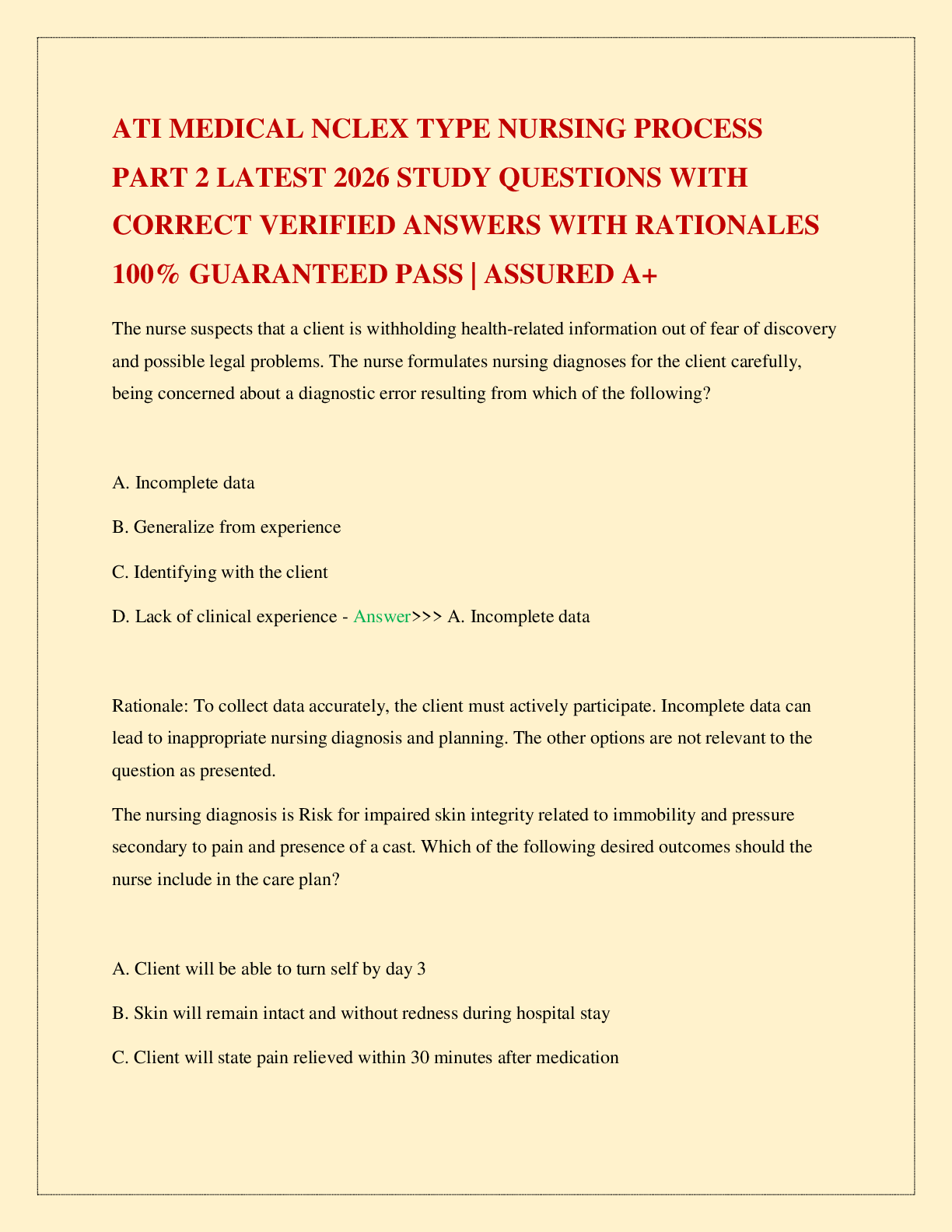
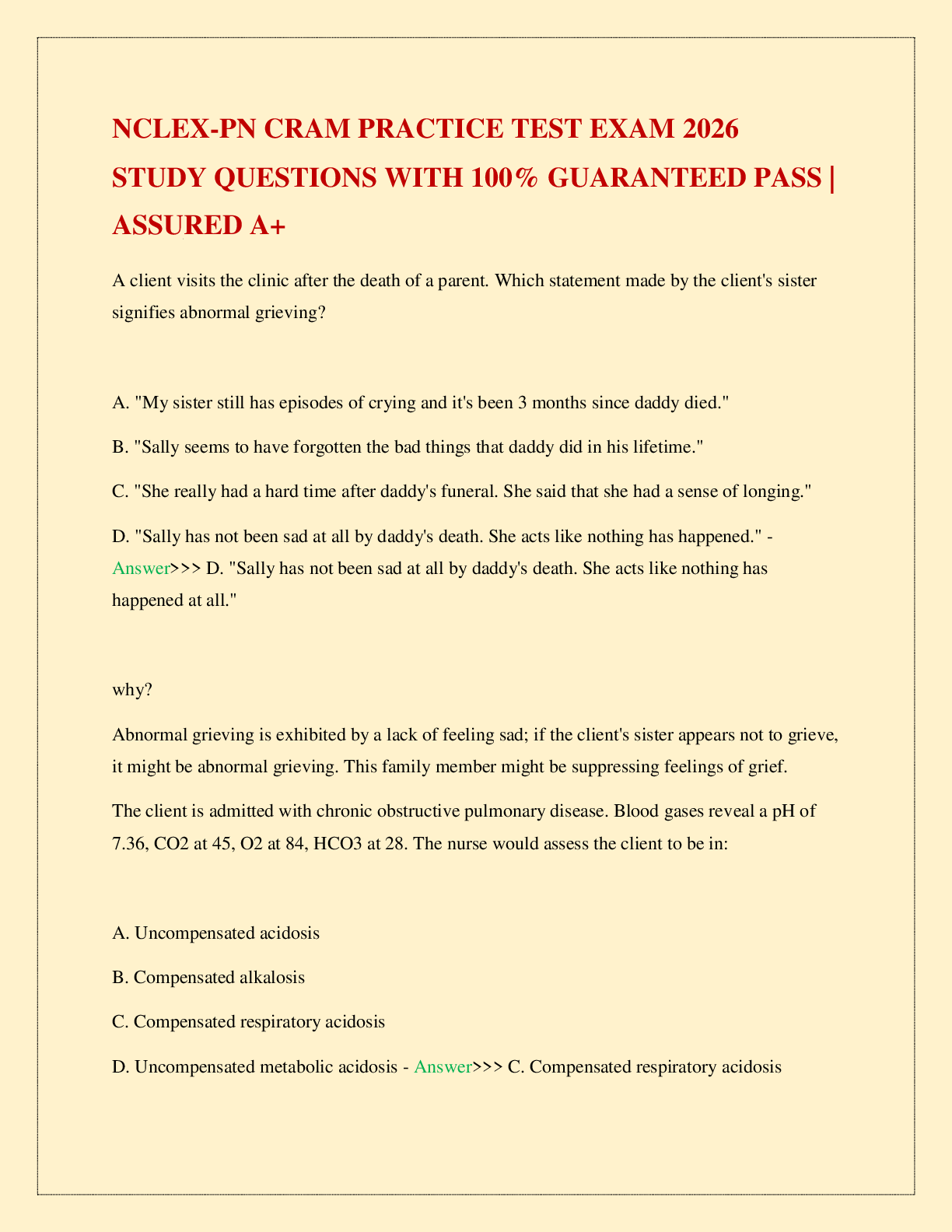
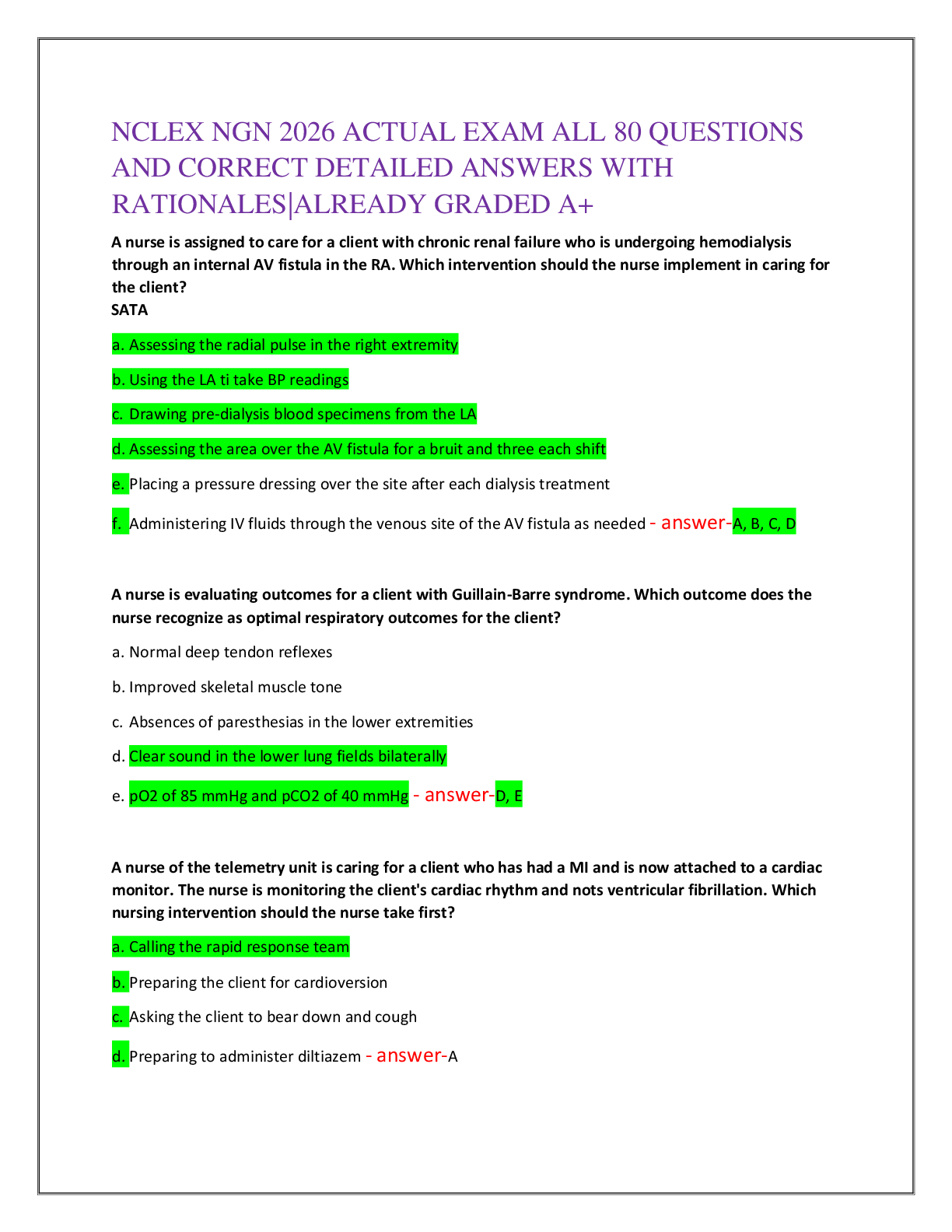
o A. A client with hepatitis A who states, “My arms and legs are itching.”
o B. A client with a cast on the right leg who states, “I have a funny feeling in
my right leg.”
o C. A client with osteomyelitis of the spine who states, “I am so nauseous that
I can’t eat.”
o D. A client with rheumatoid arthritis who states, “I am having trouble
sleeping.”
Correct Answer: E. A client with a cast on the right leg who states, “I have a funny feeling
in my right leg.”
It may indicate neurovascular compromise, requiring immediate assessment.
Option A: Bilirubin levels in hepatitis A may increase, and itching is a common
symptom.
Option C: A client feeling nauseous may require consultation but is not a
priority.
Option D: Clients with rheumatoid arthritis may feel pain in the affected areas at
night. They may need a prescription for painkillers but it is not urgent.
2. A nurse on the surgical floor is prioritizing care for clients after receiving the report from the
previous shift. Which of the following patients should the nurse assess first?
A. A 35-year-old patient admitted three hours ago for a gunshot wound, with
a 1.5 cm area of dark drainage noted on the dressing.
B. A 43-year-old patient who underwent a mastectomy two days ago, with 23
ml of serosanguinous fluid in the Jackson-Pratt drain.
C. A 59-year-old patient with a history of a collapsed lung from an accident,
with no drainage noted in the chest tube in the past eight hours.
E. A 54-year-old patient with a total knee replacement two days ago, with
moderate swelling at the surgical site.
E. A 47-year-old patient who had a laparoscopic cholecystectomy yesterday,
complaining of mild pain at the incision site.
F. A 62-year-old patient who had an abdominal-perineal resection three
days ago, now reporting chills.
Correct Answer: F. A 62-year-old patient who had an abdominal-perineal resection three
days ago, now reporting chills.
The client is at risk for peritonitis; should be assessed for further symptoms and infection.
3. A nurse in a post-surgical unit is monitoring a 46-year-old patient who underwent a
thyroidectomy 12 hours ago for the treatment of Grave’s disease. Which of the following
observations should most concern the nurse?
A. Blood pressure 138/82 mmHg, respirations 16 per minute, oral
temperature 37.2ºC or 99º F.
B. The patient carefully supports their head and neck when turning their head
to the right.
C. The patient expresses difficulty in swallowing but can manage liquids.
D. The patient appears drowsy and complains of a sore throat.
E. The patient shows involuntary flexion of their wrist when blood
pressure is measured.
F. The patient has a hoarse voice when speaking.
Correct Answer: E. The patient shows involuntary flexion of their wrist when blood
pressure is measured.
Carpal spasms (Trousseau’s sign) indicate hypocalcemia which can occur after thyroidectomy
due to accidental removal or damage to the parathyroid glands. Hypocalcemia is a serious
complication and requires immediate attention. The other options, while they might warrant
monitoring, are not as immediately concerning as a potential sign of hypocalcemia.
Option A: The vital signs are all within the normal range.
Option B: Supporting the head and neck while turning protects the surgical site
from dehiscence.
Option C: Common side effect of neck surgery.
Option D: Drowsiness may be a side effect of the anesthesia used during surgery
and will fade away eventually; a sore throat is a normal finding after thyroid
surgery.
Option F: Hoarseness of voice is a common side effect of post-op thyroidectomy
due to one or more of the nerves irritated during the procedure of due to
inflammation that occurs after surgery.
4. A 38-year-old patient is admitted to the emergency department with severe pain in the lower
right quadrant of the abdomen, nausea, and a low-grade fever, raising concerns about possible
appendicitis. The nurse is considering pain relief strategies. Which of the following actions
should the nurse prioritize?
A. Encourage the patient to change positions frequently in bed.
B. Administer Demerol 50 mg IM q 4 hours and PRN, as prescribed.
C. Apply warmth to the abdomen with a heating pad.
D. Use comfort measures and pillows to position the patient comfortably
[Show More]