*NURSING  >  EXAM  >  NURS 4403 Chapter 41: Gastrointestinal Dysfunction,100% CORRECT (All)

NURS 4403 Chapter 41: Gastrointestinal Dysfunction,100% CORRECT

Document Content and Description Below

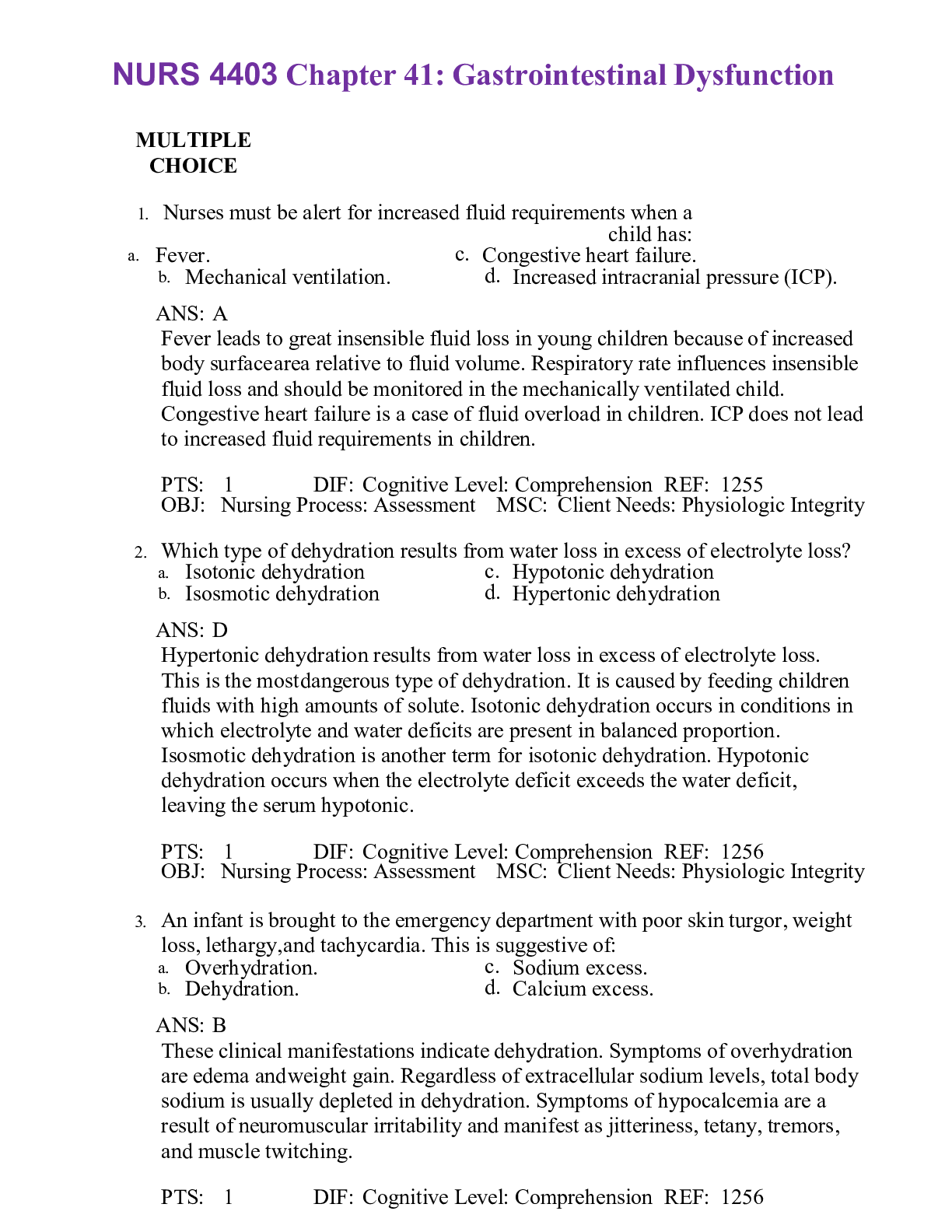
NURS 4403 Chapter 41: Gastrointestinal Dysfunction MULTIPLE CHOICE 1. Nurses must be alert for increased fluid requirements when a child has: a. Fever. c. Congestive heart failure. b. Mechan ... ical ventilation. d. Increased intracranial pressure (ICP). 2. Which type of dehydration results from water loss in excess of electrolyte loss? a. Isotonic dehydration c. Hypotonic dehydration b. Isosmotic dehydration d. Hypertonic dehydration 3. An infant is brought to the emergency department with poor skin turgor, weight loss, lethargy, and tachycardia. This is suggestive of: a. Overhydration. c. Sodium excess. b. Dehydration. d. Calcium excess. 4. Acute diarrhea is often caused by: a. Hirschsprung’s disease. c. Hypothyroidism. b. Antibiotic therapy. d. Meconium ileus. 5. The viral pathogen that frequently causes acute diarrhea in young children is: a. Giardia organisms. c. Rotavirus. b. Shigella organisms. d. Salmonella organisms. 6. A parasite that causes acute diarrhea is: a. Shigella organisms. c. Giardia lamblia. b. Salmonella organisms. d. Escherichia coli. 7. A stool specimen from a child with diarrhea shows the presence of neutrophils and red blood cells. This is most suggestive of which condition? a. Protein intolerance c. Fat malabsorption b. Parasitic infection d. Bacterial gastroenteritis 8. Therapeutic management of the child with acute diarrhea and dehydration usually begins with: a. Clear liquids. b. Adsorbents such as kaolin and pectin. c. Oral rehydration solution (ORS). d. Antidiarrheal medications such as paregoric. 9. A young child is brought to the emergency department with severe dehydration secondary to acute diarrhea and vomiting. Therapeutic management of this child will begin with: a. Intravenous fluids. b. Oral rehydration solution (ORS). c. Clear liquids, 1 to 2 ounces at a time. d. Administration of antidiarrheal medication. 10. Constipation has recently become a problem for a school-age girl. She is healthy except for seasonal allergies, which are now being successfully treated with antihistamines. The nurse should suspect that the constipation is most likely caused by: a. Diet. c. Antihistamines. b. Allergies. d. Emotional factors. 11. A high-fiber food that the nurse could recommend for a child with chronic constipation is: a. Popcorn. c. Muffins. b. Pancakes. d. Ripe bananas. 12. Therapeutic management of most children with Hirschsprung’s disease is primarily: a. Daily enemas. b. Low-fiber diet. c. Permanent colostomy. d. Surgical removal of affected section of bowel. 13. A 3-year-old child with Hirschsprung’s disease is hospitalized for surgery. A temporary colostomy will be necessary. The nurse should recognize that preparing this child psychologically is: a. Not necessary because of child’s age. b. Not necessary because the colostomy is temporary. c. Necessary because it will be an adjustment. d. Necessary because the child must deal with a negative body image. 14. The nurse is explaining to a parent how to care for a child with vomiting associated with a viral illness. The nurse should include: a. Avoiding carbohydrate-containing liquids. b. Giving nothing by mouth for 24 hours. c. Brushing teeth or rinsing mouth after vomiting. d. Giving plain water until vomiting ceases for at least 24 hours. 15. A 4-month-old infant has gastroesophageal reflux disease (GERD) but is thriving without other complications. What should the nurse suggest to minimize reflux? a. Place in Trendelenburg position after eating. b. Thicken formula with rice cereal. c. Give continuous nasogastric tube feedings. d. Give larger, less frequent feedings. 16. A histamine receptor antagonist such as cimetidine (Tagamet) or ranitidine (Zantac) is ordered for an infant with gastroesophageal reflux. The purpose of this is to: a. Prevent reflux. c. Reduce gastric acid production. b. Prevent hematemesis. d. Increase gastric acid production. 17. Which clinical manifestation would most suggest acute appendicitis? a. Rebound tenderness b. Bright red or dark red rectal bleeding c. Abdominal pain that is relieved by eating d. Abdominal pain that is most intense at McBurney's point 18. When caring for a child with probable appendicitis, the nurse should be alert to recognize that a sign of perforation is: a. Bradycardia. c. Sudden relief from pain. b. Anorexia. d. Decreased abdominal distention. 19. Which statement is most descriptive of Meckel’s diverticulum? a. It is more common in females than in males. b. It is acquired during childhood. c. Intestinal bleeding may be mild or profuse. d. Medical interventions are usually sufficient to treat the problem. 20. What is characterized by a chronic inflammatory process that may involve any part of the gastrointestinal (GI) tract from mouth to anus? a. Crohn’s disease c. Meckel’s diverticulum b. Ulcerative colitis d. Irritable bowel syndrome 21. What is used to treat moderate-to-severe inflammatory bowel disease? a. Antacids c. Corticosteroids b. Antibiotics d. Antidiarrheal medications 22. Bismuth subsalicylate, clarithromycin, and metronidazole are prescribed for a child with a peptic ulcer to: a. Eradicate Helicobacter pylori. c. Treat epigastric pain. b. Coat gastric mucosa. d. Reduce gastric acid production. 23. Which statement best characterizes hepatitis A? a. The incubation period is 6 weeks to 6 months. b. The principal mode of transmission is through the parenteral route. c. Onset is usually rapid and acute. d. There is a persistent carrier state. 24. The best chance of survival for a child with cirrhosis is: a. Liver transplantation. c. Treatment with immune globulin. b. Treatment with corticosteroids. d. Provision of nutritional support. 25. The earliest clinical manifestation of biliary atresia is: a. Jaundice. c. Hepatomegaly. b. Vomiting. d. Absence of stooling. 26. A newborn was admitted to the nursery with a complete bilateral cleft lip and palate. The physician explained the plan of therapy and its expected good results. However, the mother refuses to see or hold her baby. Initial therapeutic approach to the mother should be to: a. Restate what the physician has told her about plastic surgery. b. Encourage her to express her feelings. c. Emphasize the normalcy of her baby and the baby’s need for mothering. d. Recognize that negative feelings toward the child continue throughout childhood. 27. Caring for the newborn with a cleft lip and palate before surgical repair includes: a. Gastrostomy feedings. b. Keeping the infant in near-horizontal position during feedings. c. Allowing little or no sucking. d. Providing satisfaction of sucking needs. 28. The nurse is caring for an infant whose cleft lip was repaired. Important aspects of this infant’s postoperative care include: a. Arm restraints, postural drainage, and mouth irrigations. b. Cleansing of suture line, supine and side-lying positions, and arm restraints. c. Mouth irrigations, prone position, and cleansing of suture line. d. Supine and side-lying positions, postural drainage, and arm restraints. 29. The nurse is caring for a neonate with a suspected tracheoesophageal fistula. Nursing care should include: a. Elevating the head but giving nothing by mouth. b. Elevating the head for feedings. c. Feeding glucose water only. d. Avoiding suctioning unless the infant is cyanotic. 30. Which type of hernia has an impaired blood supply to the herniated organ? a. Hiatal hernia c. Omphalocele b. Incarcerated hernia d. Strangulated hernia 31. The nurse is caring for an infant with suspected pyloric stenosis. Which clinical manifestation would indicate pyloric stenosis? a. Abdominal rigidity and pain on palpation b. Rounded abdomen and hypoactive bowel sounds c. Visible peristalsis and weight loss d. Distention of lower abdomen and constipation 32. The nurse is caring for a boy with probable intussusception. He had diarrhea before admission but, while waiting for administration of air pressure to reduce the intussusception, he passes a normal brown stool. The most appropriate nursing action is to: a. Notify the practitioner. b. Measure abdominal girth. c. Auscultate for bowel sounds. d. Take vital signs, including blood pressure. 33. An important nursing consideration in the care of a child with celiac disease is to: a. Refer to a nutritionist for detailed dietary instructions and education. b. Help the child and family understand that diet restrictions are usually only temporary. c. Teach proper hand washing and Standard Precautions to prevent disease transmission. d. Suggest ways to cope more effectively with stress to minimize symptoms. 34. An infant with short bowel syndrome will be discharged home on total parenteral nutrition (TPN) and gastrostomy feedings. Nursing care should include: a. Preparing the family for impending death. b. Teaching the family signs of central venous catheter infection. c. Teaching the family how to calculate caloric needs. d. Securing TPN and gastrostomy tubing under diaper to lessen risk of dislodgment. 35. For what clinical manifestation should a nurse be alert when suspecting a diagnosis of esophageal atresia? a. A radiograph in the prenatal period indicates abnormal development. b. It is visually identified at the time of delivery. c. A nasogastric tube fails to pass at birth. d. The infant has a low birth weight. 36. What is the most important information to be included in the discharge planning for an infant with gastroesophageal reflux? a. Teach parents to position the infant on the left side. b. Reinforce the parents’ knowledge of the infant’s developmental needs. c. Teach the parents how to do infant cardiopulmonary resuscitation (CPR). d. Have the parents keep an accurate record of intake and output. 37. What is the major focus of the therapeutic management for a child with lactose intolerance? a. Compliance with the medication regimen b. Providing emotional support to family members c. Teaching dietary modifications d. Administration of daily normal saline enemas 38. What food choice by the parent of a 2-year-old child with celiac disease indicates a need for further teaching? a. Oatmeal c. Corn muffin b. Rice cake d. Meat patty 39. Which intervention should be included in the nurse’s plan of care for a 7-year-old child with encopresis who has cleared the initial impaction? a. Have the child sit on the toilet for 30 minutes when he gets up in the morning and at bedtime. b. Increase sugar in the child’s diet to promote bowel elimination. c. Use a Fleet enema daily. d. Give the child a choice of beverage to mix with a laxative. 40. Which description of a stool is characteristic of intussusception? a. Ribbon-like stools c. “Currant jelly” stools b. Hard stools positive for guaiac d. Loose, foul-smelling stools 41. What should the nurse stress in a teaching plan for the mother of an 11-year-old boy with ulcerative colitis? a. Preventing the spread of illness to others b. Nutritional guidance and preventing constipation c. Teaching daily use of enemas d. Coping with stress and avoiding triggers 42. Careful hand washing before and after contact can prevent the spread of which condition in day care and school settings? a. Irritable bowel syndrome c. Hepatic cirrhosis b. Ulcerative colitis d. Hepatitis A 43. A mother calls the clinic nurse about her 4-year-old son who has acute diarrhea. She has been giving him the antidiarrheal drug loperamide (Imodium A-D). The nurse’s response should be based on knowledge that this drug is: a. Not indicated. b. Indicated because it slows intestinal motility. c. Indicated because it decreases diarrhea. d. Indicated because it decreases fluid and electrolyte losses. 44. Which vaccine is now recommended for the immunization of all newborns? a. Hepatitis A vaccine c. Hepatitis C vaccine b. Hepatitis B vaccine d. Hepatitis A, B, and C vaccines 45. During the first few days after surgery for cleft lip, which intervention should the nurse do? a. Leave infant in crib at all times to prevent suture strain. b. Keep infant heavily sedated to prevent suture strain. c. Remove restraints periodically to cuddle infant. d. Alternate position from prone to side-lying to supine. 46. An infant with pyloric stenosis experiences excessive vomiting that can result in: a. Hyperchloremia. c. Metabolic acidosis. b. Hypernatremia. d. Metabolic alkalosis. MULTIPLE RESPONSE 47. Which statements regarding hepatitis B are correct (Select all that apply)? a. Hepatitis B cannot exist in a carrier state. b. Hepatitis B can be prevented by hepatitis B virus vaccine. c. Hepatitis B can be transferred to an infant of a breastfeeding mother. d. The onset of hepatitis B is insidious. e. Immunity to hepatitis B occurs after one attack. 48. Which interventions should a nurse implement when caring for a child with hepatitis (Select all that apply)? a. Provide a well-balanced, low-fat diet. b. Schedule playtime in the playroom with other children c. Teach parents not to administer any over-the-counter medications. d. Arrange for home schooling because the child will not be able to return to school. e. Instruct parents on the importance of good hand washing. 49. The nurse is preparing to care for an infant returning from pyloromyotomy surgery. Which prescribed orders should the nurse anticipate implementing (Select all that apply)? a. Nothing by mouth for 24 hours b. Administration of analgesics for pain c. Ice bag to the incisional area d. Intravenous (IV) fluids continued until tolerating fluids by mouth e. Clear liquids as the first feeding 50. A nurse is conducting dietary teaching on high-fiber foods for parents of a child with constipation. Which foods should the nurse include as being high in fiber (Select all that apply)? a. White rice b. Avocados c. Whole grain breads d. Bran pancakes e. Raw carrots 51. A mother who intended to breastfeed has given birth to an infant with a cleft palate. Nursing interventions should include (Select all that apply): a. Giving medication to suppress lactation. b. Encouraging and helping mother to breastfeed. c. Teaching mother to feed breast milk by gavage. d. Recommending use of a breast pump to maintain lactation until infant can suck. COMPLETION 52. A child has a nasogastric (NG) tube to continuous low intermittent suction. The physician’s prescription is to replace the previous 4-hour NG output with a normal saline piggyback over a 2-hour period. The NG output for the previous 4 hours totaled 50 mL. What milliliter/hour rate should the nurse administer to replace with a normal saline piggyback? Record your answer as a whole number. MATCHING The school nurse observes a child with a peanut allergy in obvious distress, wheezing and cyanotic, after ingestion of some trail mix containing peanuts. Place the interventions the nurse should implement in order of the highest priority to the lowest priority. a. Call Jason’s parents and notify them of the situation. b. Call Jason’s family practitioner to obtain further orders for medication. c. Promptly administer an intramuscular (IM) dose of epinephrine. d. Call 911 and wait for the emergency response personnel to arrive. 53. First priority 54. Second priority 55. Third priority 56. Fourth priority 53. ANS: C PTS: 1 DIF: Cognitive Level: Application REF: 1252 OBJ: Nursing Process: Implementation MSC: Client Needs: Physiologic Integrity NOT: The nurse should first administer epinephrine IM to a child with a food allergy who is in obvious distress, wheezing, and cyanotic. 911 should be called after the epinephrine is administered. The physician should be contacted for further orders and, last, the parents notified of the situation. 54. ANS: D PTS: 1 DIF: Cognitive Level: Application REF: 1252 OBJ: Nursing Process: Implementation MSC: Client Needs: Physiologic Integrity NOT: The nurse should first administer epinephrine IM to a child with a food allergy who is in obvious distress, wheezing, and cyanotic. 911 should be called after the epinephrine is administered. The physician should be contacted for further orders and, last, the parents notified of the situation. 55. ANS: B PTS: 1 DIF: Cognitive Level: Application REF: 1252 OBJ: Nursing Process: Implementation MSC: Client Needs: Physiologic Integrity NOT: The nurse should first administer epinephrine IM to a child with a food allergy who is in obvious distress, wheezing, and cyanotic. 911 should be called after the epinephrine is administered. The physician should be contacted for further orders and, last, the parents notified of the situation. 56. ANS: A PTS: 1 DIF: Cognitive Level: Application REF: 1252 OBJ: Nursing Process: Implementation MSC: Client Needs: Physiologic Integrity NOT: The nurse should first administer epinephrine IM to a child with a food allergy who is in obvious distress, wheezing, and cyanotic. 911 should be called after the epinephrine is administered. The physician should be contacted for further orders and, last, the parents notified of the situation. [Show More]

Last updated: 3 years ago

Preview 1 out of 33 pages

Buy Now

Instant download

We Accept:

Payment methods accepted on Scholarfriends (We Accept)
Preview image of NURS 4403 Chapter 41: Gastrointestinal Dysfunction,100% CORRECT document

Buy this document to get the full access instantly

Instant Download Access after purchase

Buy Now

Instant download

We Accept:

Payment methods accepted on Scholarfriends (We Accept)

Reviews( 0 )

$16.00

Buy Now

We Accept:

Payment methods accepted on Scholarfriends (We Accept)

Instant download

Can't find what you want? Try our AI powered Search

45
0

Document information


Connected school, study & course


About the document


Uploaded On

Mar 14, 2021

Number of pages

33

Written in

All

Seller


Profile illustration for securegrades
securegrades

Member since 5 years

118 Documents Sold

Reviews Received
24
3
3
0
5
Additional information

This document has been written for:

Uploaded

Mar 14, 2021

Downloads

 0

Views

 45

Document Keyword Tags

Recommended For You

Get more on EXAM »
$16.00
What is Scholarfriends

Scholarfriends.com Online Platform by Browsegrades Inc. 651N South Broad St, Middletown DE. United States.

We are here to help

We're available through e-mail, Twitter, and live chat.
 FAQ
 Questions? Leave a message!


Copyright © Scholarfriends · High quality services·