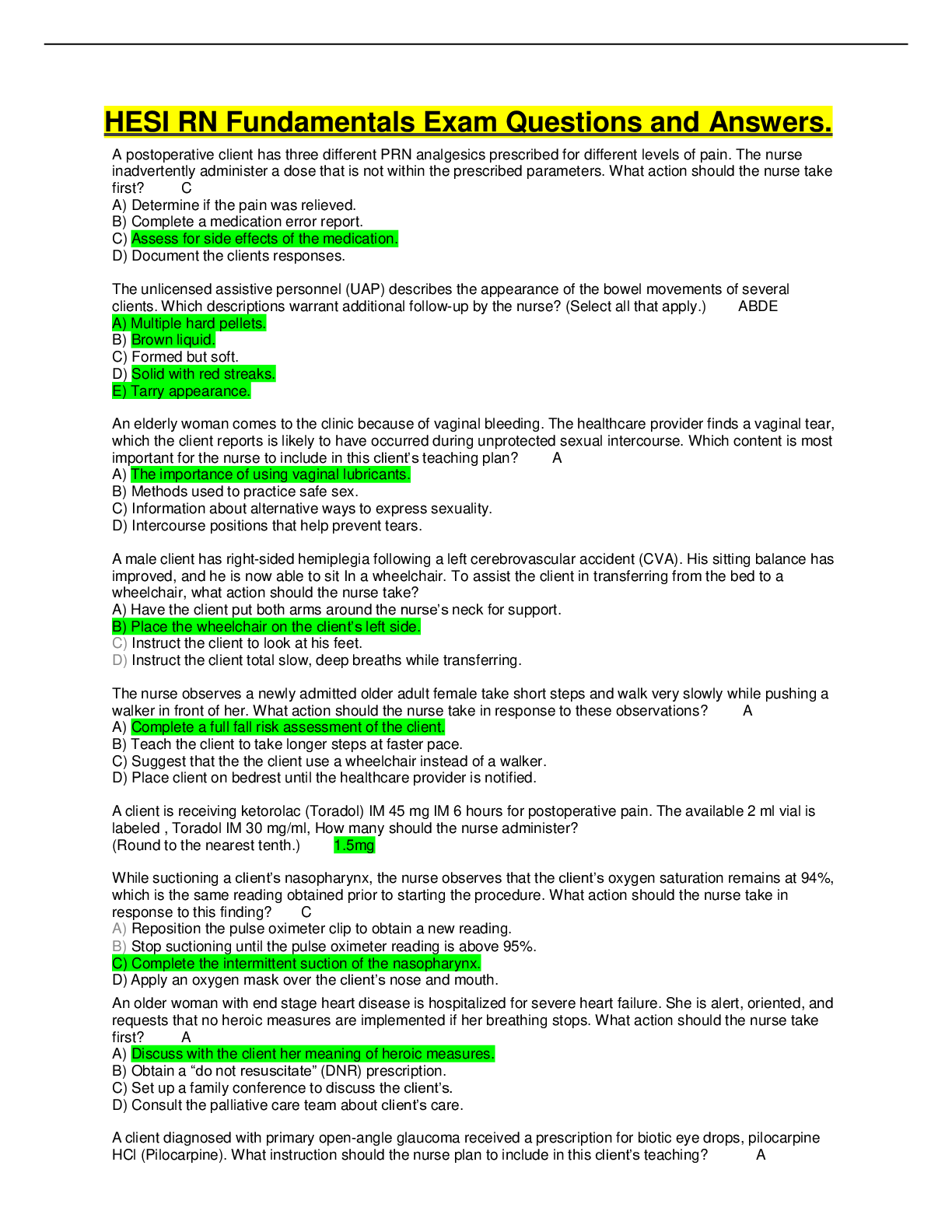
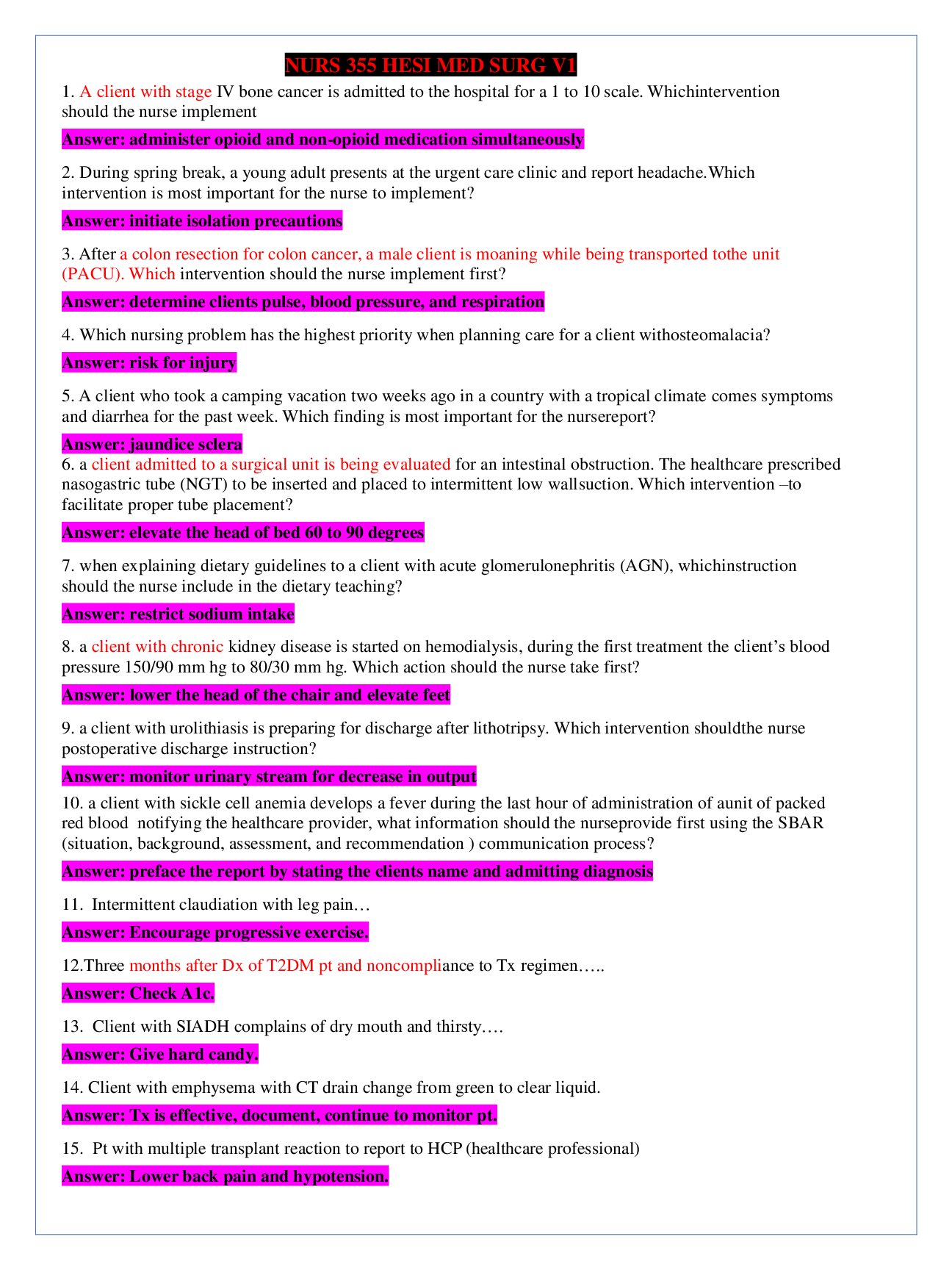
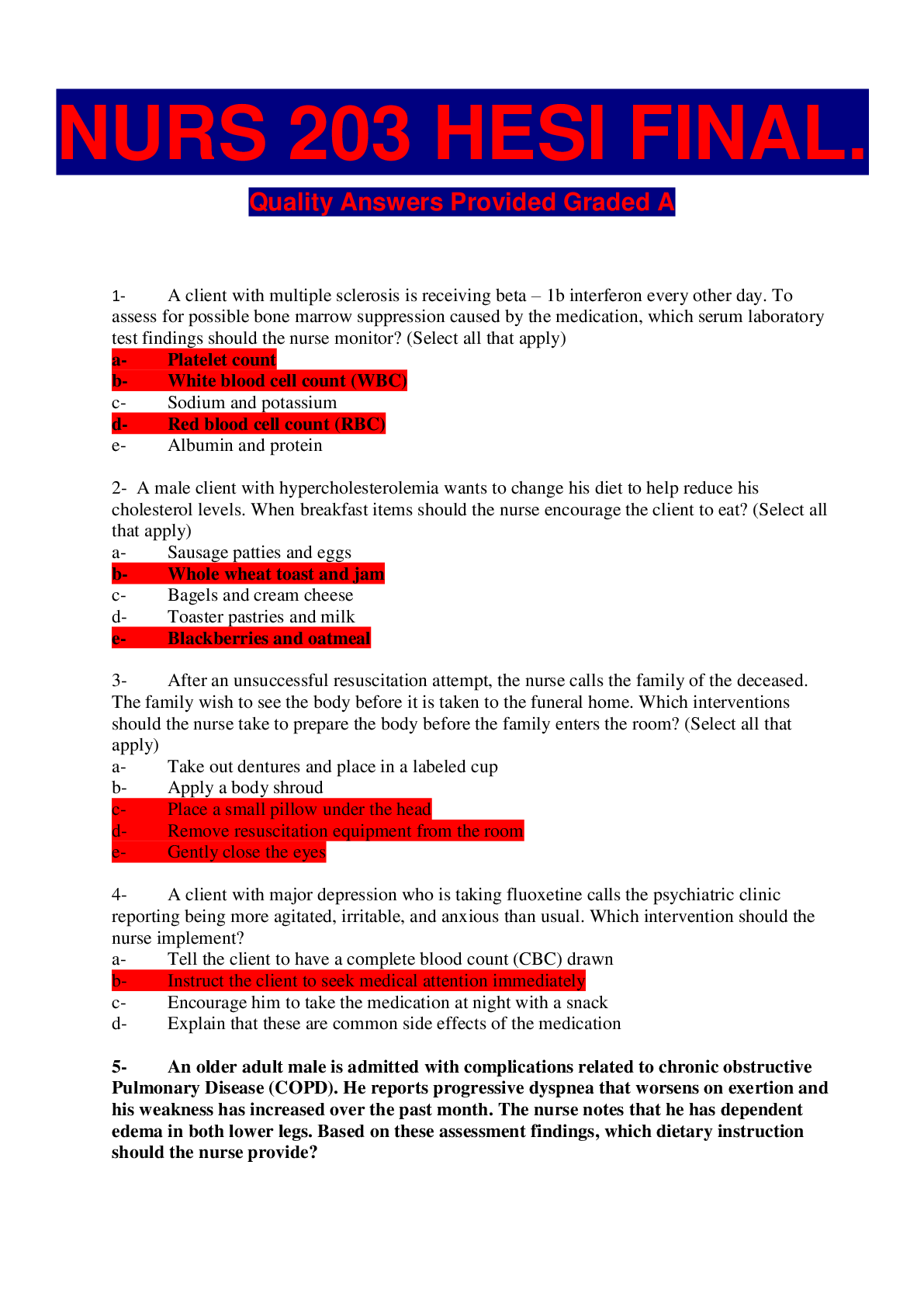
Question 1 0 out of 1 points A patient has experienced nausea and vomiting, headache, malaise, low grade fever, abdominal cramps, and watery diarrhea for 72 hours. His white count is elevated with a shift to the left. He
...
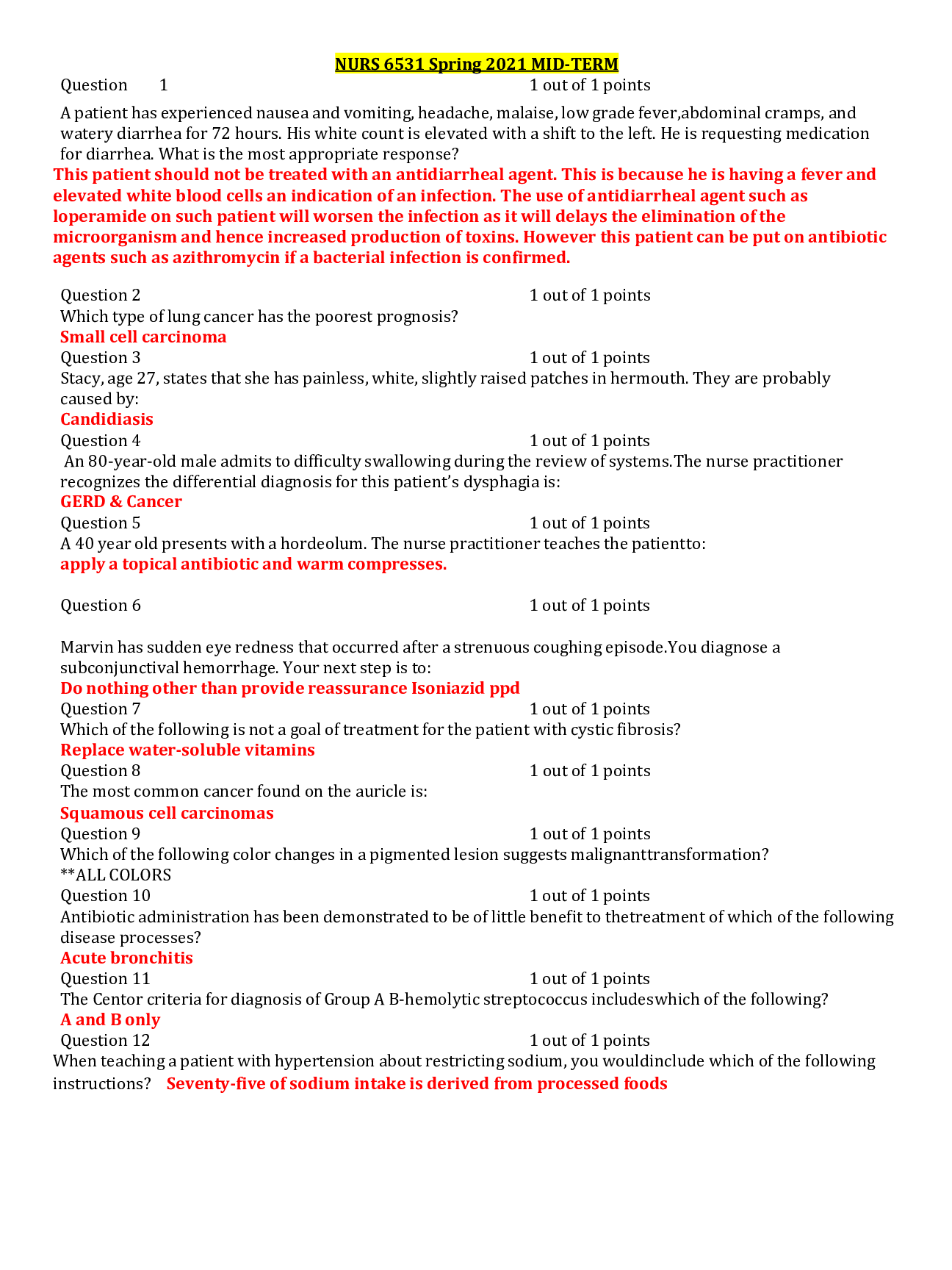
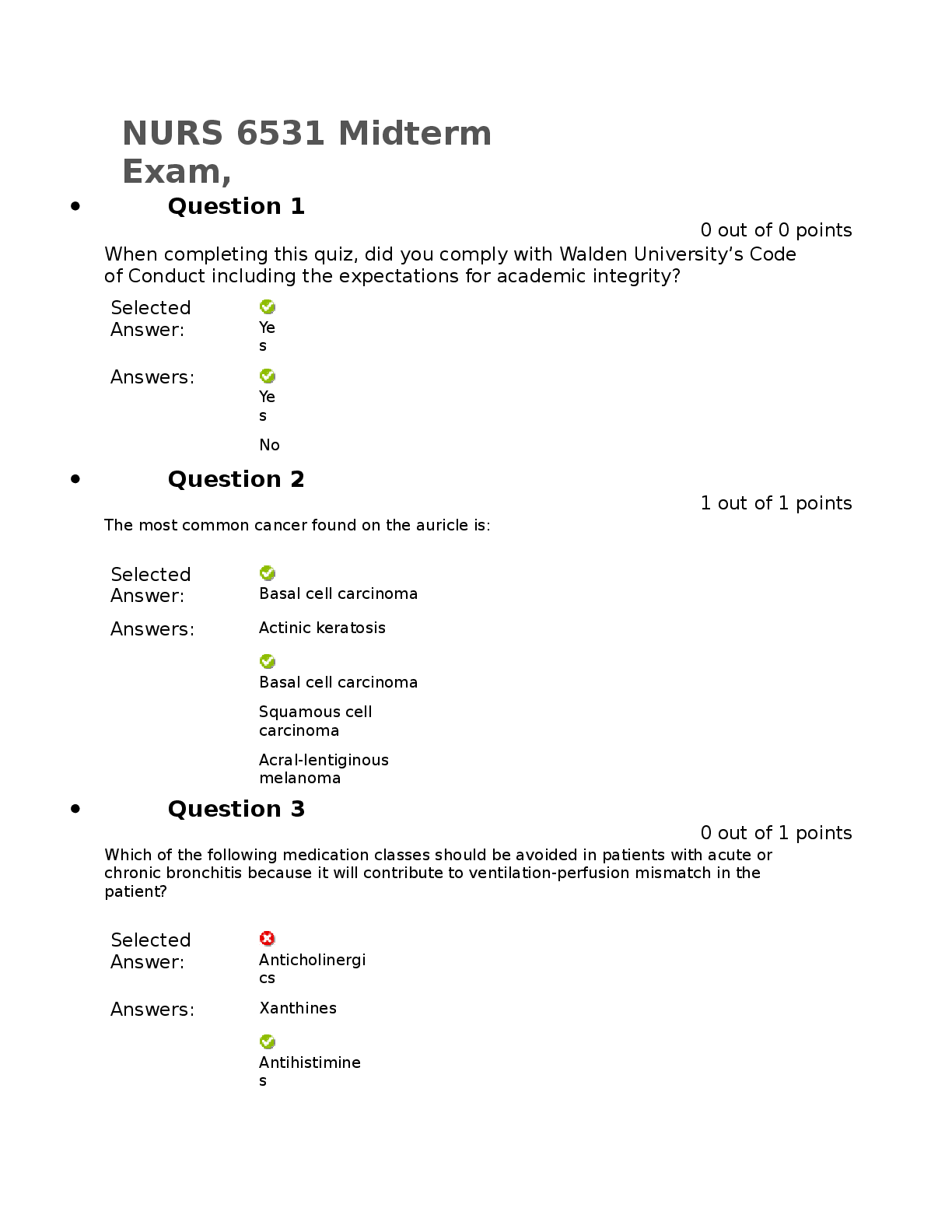
Question 1 0 out of 1 points A patient has experienced nausea and vomiting, headache, malaise, low grade fever, abdominal cramps, and watery diarrhea for 72 hours. His white count is elevated with a shift to the left. He is requesting medication for diarrhea. What is the most appropriate response? **The main focus of treatment is to prevent dehydration by drinking plenty of fluids. In severe cases, hospitalization and intravenous fluids are necessary. Over-the- counter oral rehydration solutions (OHS), such as Pedialyte, can be helpful in mild cases Question 2 1 out of 1 points Which type of lung cancer has the poorest prognosis? Small cell carcinoma Question 3 1 out of 1 points Stacy, age 27, states that she has painless, white, slightly raised patches in her mouth. They are probably caused by: Candidiasis Question 4 1 out of 1 points An 80-year-old male admits to difficulty swallowing during the review of systems. The nurse practitioner recognizes the differential diagnosis for this patient’s dysphagia is: GERD & Cancer Question 5 1 out of 1 points A 40 year old presents with a hordeolum. The nurse practitioner teaches the patient to: apply a topical antibiotic and warm compresses. Question 6 1 out of 1 points Marvin has sudden eye redness that occurred after a strenuous coughing episode. You diagnose a subconjunctival hemorrhage. Your next step is to: Do nothing other than provide reassurance Isoniazid ppd Question 7 1 out of 1 points Which of the following is not a goal of treatment for the patient with cystic fibrosis? Replace water-soluble vitamins Question 8 0 out of 1 points The most common cancer found on the auricle is: **basal cell carcinoma** Question 9 1 out of 1 points Which of the following color changes in a pigmented lesion suggests malignant transformation? **ALL COLORS Question 10 1 out of 1 points Antibiotic administration has been demonstrated to be of little benefit to the treatment of which of the following disease processes? Acute bronchitis Question 11 1 out of 1 points The Centor criteria for diagnosis of Group A B-hemolytic streptococcus includes which of the following? A and B only Question 12 1 out of 1 points When teaching a patient with hypertension about restricting sodium, you would include which of the following instructions? Seventy-five of sodium intake is derived from processed foods Question 13 1 out of 1 points Mark has just been given a diagnosis of congestive heart failure. Which of his medications should be discontinued
The differential diagnosis for a patient complaining of a sore throat includes which
of the following?
Sheila, age 78, presents with a chief complaint of waking up during the night
coughing. You examine her and find an S3 heart sound, pulmonary crackles that do
not clear with coughing, and peripheral edema. What do you suspect?
heart failure
The American Cancer Society recommends a flexible sigmoidoscopy for colorectal
cancer screening in persons at average risk every:
John, age 33, has a total cholesterol level of 188 mg/dL. How often should he be
screened for hypercholesterolemia?
Your well-nourished 75-year-old patient has come into the office for a physical exam
and states that she recently had two nosebleeds. She does not take any
anticoagulants, and you have ruled out any coagulopathies. The most likely cause of
these nosebleeds is:
A 33-year-old female is admitted with acute pancreatitis. The nurse practitioner
knows that the most common cause of pancreatitis is:
Carl, age 78, is brought to the office by his son, who states that his father has been
unable to see clearly since last night. Carl reports that his vision is “like looking
through a veil.” He also sees floaters and flashing lights but is not having any pain.
What do you suspect?
Which of the following is not a risk factor for coronary arterial insufficiency?
Risks are:
John, age 59, presents with recurrent, sharply circumscribed red papules and
plaques with a powdery white scale on the extensor aspect of his elbows and knees.
What do you suspect?
A 45 year old with diabetes has had itching and burning lesions between her toes for
2 months. Scrapings of the lesions confirm the diagnosis tinea pedis. What is the
best initial treatment option for this patient?
Sandra has celiac disease. You place her on which diet?
Larry, age 66, is a smoker with hyperlipidemia and hypertension. He is 6 months
post-MI. To prevent reinfarction, the most important behavior change that he can
make is to:
Group A β-hemolytic streptococcal (GABHS) pharyngitis is most common in which
age group?
Which of the following is a secondary cause of hyperlipidemia?
An employee picnic menu includes grilled hamburgers, potato salad, and homemade
ice cream sundaes. Within an hour after the meal, several children and parents begin
to have nausea, vomiting and stomach cramps. None of those affected have fever.
What is the most likely etiologic agent?
A 70 year old patient presents with a slightly raised, scaly, erythematous patch on
her forehead. She admits to having been a “sun worshiper.” The nurse practitioner
suspects actinic keratosis. This lesion is a precursor to:
squamous cell carcinoma.
The most common correlate(s) with chronic bronchitis and emphysema is(are):
Smoking
If a patient presents with a deep aching, red eye and there is no discharge, you
should suspect:
Treatment of H.pylori includes which of the following?
Which of the following is the most important diagnosis to rule out in the adult
patient with acute bronchitis?
pneumonia
What oral medication might be used to treat chronic cholethiasis in a patient who is
a poor candidate for surgery?
Margaret, age 32, comes into the office with painful joints and a distinctive rash in a
butterfly distribution on her face. The rash has red papules and plaques with a fine
scale. What do you suspect?
What is the Gold standard for the diagnosis of asthma?
-A 70 year old patient presents with left lower quadrant (LLQ) abdominal pain, a
markedly tender palpable abdominal wall, fever, and leukocytosis. Of the following
terms, which correctly describes the suspected condition?
-Sylvia, age 83, presents with a 3-day history of pain and burning in the left
forehead. This morning she noticed a rash with erythematous papules in that site.
What do you suspect?
-A 33-year-old female is admitted with acute pancreatitis. The nurse practitioner
knows that the most common cause of pancreatitis is:
-When a patient presents with symptoms of acute gallbladder disease, what is the
appropriate nurse practitioner action?
-A patient has experienced nausea and vomiting, headache, malaise, low grade
fever, abdominal cramps, and watery diarrhea for 72 hours. His white count is
elevated with a shift to the left. He is requesting medication for diarrhea. What is
the most appropriate response?
-Janine, age 29, has numerous transient lesions that come and go, and she is
diagnosed with urticaria. What do you order?
-A 16-year-old male presents with mild sore throat, fever, fatigue, posterior cervical
adenopathy, and palatine petechiae. Without a definitive diagnosis for this patient,
what drug would be least appropriate to prescribe?
-A 70 year old patient presents with a slightly raised, scaly, erythematous patch on
her forehead. She admits to having been a "sun worshiper." The nurse practitioner
suspects actinic keratosis. This lesion is a precursor to:
-An elderly patient is being seen in the clinic for complaint of "weak spells" relieved
by sitting or lying down. How should the nurse practitioner proceed with the
physical examination?
-What oral medication might be used to treat chronic cholethiasis in a patient who
is a poor candidate for surgery?
-A 46-year-old female with a past medical history of diabetes presents with a
swollen, erythematous right auricle and is diagnosed with malignant otitis externa.
The nurse practitioner knows that the most likely causative organism for this
patient's problem is:
-Which of the following is not a symptom of irritable bowel syndrome?
-A patient comes in complaining of 1 week of pain in the posterior neck with
difficulty turning the head to the right. What additional history is needed?
-Marvin, age 56, is a smoker with diabetes. He has just been diagnosed as
hypertensive. Which of the following drugs has the potential to cause the
development of bronchial asthma and inhibit gluconeogenesis?
-Before initiating an HMG CoA-reductase inhibitor for hyperlipidemia, the nurse
practitioner orders liver function studies. The patient's aminotransferase (ALT) is
elevated. What laboratory test(s) should be ordered?
-A patient with elevated lipids has been started on lovastatin. After 3 weeks of
therapy, he calls to report generalized muscle aches. The nurse practitioner should
-Carl, age 78, is brought to the office by his son, who states that his father has
been unable to see clearly since last night. Carl reports that his vision is "like
looking through a veil." He also sees floaters and flashing lights but is not having
any pain. What do you suspect?
-John, age 33, has a total cholesterol level of 188 mg/dL. How often should he be
screened for hypercholesterolemia?
-Harriet, a 79-year-old woman, comes to your office every 3 months for follow up
on her hypertension. Her medications include one baby aspirin daily, Lisinopril 5mg
daily, and Calcium 1500 mg daily. At today's visit. Her blood pressure is 170/89.
According to JNC VIII guidelines, what should you do next to control Harriet's
blood pressure?
-Add a thiazide diuretic to the Lisinopril 5mg daily
[Show More]