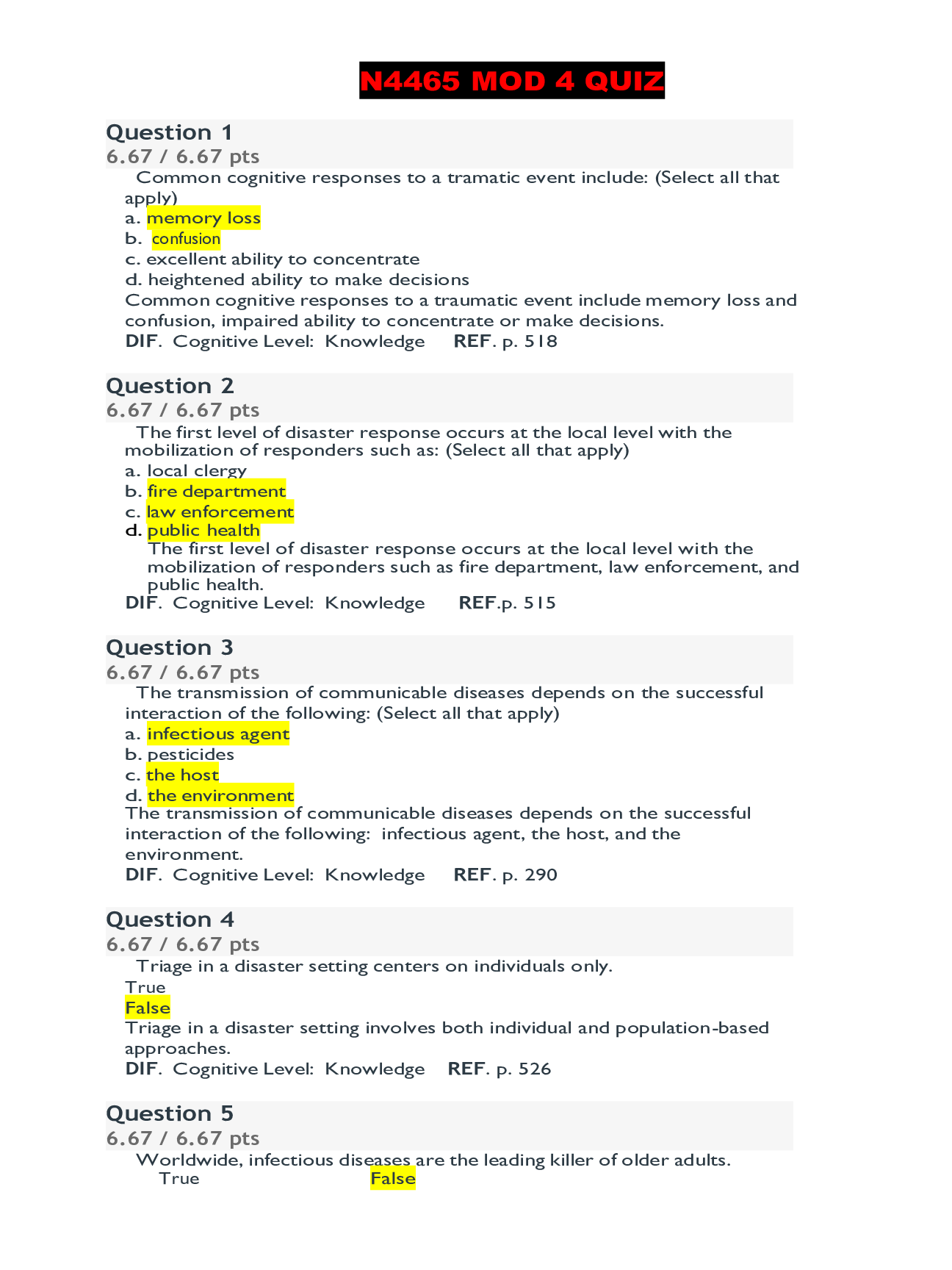
N4465 MOD 4 QUIZ | Covers all modules 1-4 With correct Answers | Common cognitive responses to a tramatic event include: (Select all that apply)
a. memory loss
b. confusion
c. excellent ability to concentrate
d. he
...
N4465 MOD 4 QUIZ | Covers all modules 1-4 With correct Answers | Common cognitive responses to a tramatic event include: (Select all that apply)
a. memory loss
b. confusion
c. excellent ability to concentrate
d. heightened ability to make decisions
Common cognitive responses to a traumatic event include memory loss and confusion, impaired ability to concentrate or make decisions.
DIF. Cognitive Level: Knowledge REF. p. 518
The first level of disaster response occurs at the local level with the
mobilization of responders such as: (Select all that apply)
a. local clergy
b. fire department
c. law enforcement
d. public health
The first level of disaster response occurs at the local level with the mobilization of responders such as fire department, law enforcement, and public health.
DIF. Cognitive Level: Knowledge REF.p. 515
The transmission of communicable diseases depends on the successful interaction of the following: (Select all that apply)
a. infectious agent
b. pesticides
c. the host
d. the environment
The transmission of communicable diseases depends on the successful interaction of the following: infectious agent, the host, and the environment.
DIF. Cognitive Level: Knowledge REF. p. 290
Triage in a disaster setting centers on individuals only.
True
False
Triage in a disaster setting involves both individual and population-based approaches.
DIF. Cognitive Level: Knowledge REF. p. 526
Worldwide, infectious diseases are the leading killer of older adults.
True False
Worldwide, infectious diseases are the leading killer of children and young adults.
DIF. Cognitive Level: Knowledge REF. p. 289
A method used by public health workers to track the source of an infection
in the Watersedge case is known as the:
a. multiple causation theory
b. DNA mapping
c. baseline screening
d. mapping technique
A method used by public health workers to track the source of an infection in the Watersedge case is known as mapping technique.
DIF. Cognitive Level: Knowledge REF. Course Video
Examples of infectious disease interventions based on primary prevention include: (Select all that apply)
a. restaurant inspections
b. rabies pre-exposure immunization
c. irresponsible sexual behavior
d. tetanus boosters and flu shots
Examples of infectious disease interventions based on primary prevention include: restaurant inspections, rabies pre-exposure immunizations, tetanus boosters, and flu shots.
DIF. Cognitive Level: Knowledge REF. p. 297
Following a disaster event, nurses can expect the victims to
exhibit behavioral and emotional responses such as: (Select all that apply) a. irritability
b. shock
c. numbness
d. being in control
Following a disaster event, nurses can expect the victims to exhibit behaviors including irritability, shock, and numbness.
DIF. Cognitive Level: Knowledge REF. p. 518
Human immunodeficiency virus (HIV) is transmitted through exposure to:
(Select all that apply)
a. contaminated air
b. blood
c. semen
d. transplanted organs
Human immunodeficiency virus (HIV) is transmitted through exposure to blood, semen, and transplanted organs.
DIF. Cognitive Level: Knowledge REF. p. 322
Nurses are prepared to use their skills in the following ways in the case of
disasters: (Select all that apply) a. assessment
b. priority setting
c. addressing both preventive and acute care needs
d. community resource referrals and liaison work
Nurses are prepared to use their skills in the following ways in the case of disasters: assessment, priority setting, addressing both preventive and acute care needs, and community resource referrals and liaison work.
DIF. Cognitive Level: Knowledge REF. pgs. 507-508
The most common reportable infectious disease in the United States is:
a. congenital syphilis
b. Herpes Simplex Virus 2
c. Chlamydia
d. Human papillomavirus (HPV)
The most common reportable infectious disease in the United States is Chlamydia.
DIF. Cognitive Level: Knowledge REF. 329
This country has a tax-supported health system that is owned and operated by the government. Services are available to all citizens without cost or for a small fee.
a. South Korea
b. Saudi Arabia
c. Cuba
d. The United Kingdom
The United Kingdom has a tax-supported health system that is owned and operated by the government. Services are available to all citizens without cost or for a small fee.
DIF. Cognitive Level: Knowledge REF. p. 74
Recent reports by expatriate visitors to this country indicate that the
greatest perk for foreign residents is the high-quality, low-cost health care. In the bigger cities, there are hospitals with state-of-the-art
equipment, as well as specialists in all fields and physicians with private clinics.
a. Brazil
b. Portugal
c. Ecuador
d. Romania
The World Health Organization has defined a community as: (Select all that apply)
The core functions of Public Health are: (Select all that apply)
Methods for data collection in conducting a community assessment include: (Select all that apply)
The basic principles of evidence-based practice can be applied only at the individual level. (True or False)
Applied to nursing, evidence-based practice includes the best available evidence from a variety of sources. These sources include: (Select all that apply)
Assessment refers to: (Multiple Choice)
Assurance refers to:
Public health nursing is a specialty and is distinguished by the following characteristics: (Select all that appy.)
Policy development refers to:
A nurse who was working in public health care has gotten a new job in primary care. A main difference to be seen by the nurse at the new job is a focus on individuals. (True or False).
Public health is defined as: (Multiple Choice).
Public health nursing, referred to in this textbook as population-centered nursing, has been impacted by: (Select all that apply)
Define Epidemiology, and apply examples, Describe Epidemiologist investigation, (Pgs. 258-259).
Define the following Epidemiological terms, and apply examples of each:
Proportions,
Risk, and
Rates.
Describe the Epidemiological Triangle, and apply examplesDefine toxicology, and provide examples, (Pgs. 221-222).
List the environmental multidisciplinary team members and their role, (Pg. 222).
Compare the environmental investigation process with the nursing process, (Pgs. 223-228.
Discuss the leading causes of pollution,Define each level of prevention (Pgs. 268-269, 922-925) ,and apply examples within the Community, (i.e. School: Pg. 925-929, Workplace: Church: Pg. 976-979, and Public Health DepartmentsDescribe the qualifications and role/functions of nurses in local, state, and national public health departments,
Tertiary prevention in the schools: (Select all that apply)
a. is the continued care of children who need long-term health care services, along with education within the community
b. making health referrals
c. performing urinary catheterizations, dressing changes, peripheral or central line intravenous catheter maintenance
d. teaching another person in the school how to care for the child in case the nurse is not in the building when the child needs help DIF: Cognitive Level: Knowledge REF. pp. 923, 926
The measurement of incidence: (Select all that apply)
a. describes the severity of a disease in young adults
b. does not take into consideration a specified time as part of an incidence rate
c. quantifies the rate of development of new cases in a population at risk
d. does take into consideration a specified time as part of an incidence rate
A windshield survey is a helpful first step in understanding the potential
environmental health risks in a community. Nursing observations can determine the following characteristics of the community: (Select all that apply)
a. urban or rural in nature
b. the age and condition of the housing stock
c. proximity to factories, dump sites, major transportation routes
d. the presence of contaminated waterways
As a counselor, the school nurse: (Select all that apply)
a. may assist withgrief counseling in the schools
b. must have a reputation of being a trustworthy person
c. should tell children if anything they reveal points out that they are in danger, the parents and school officials must be told
d. should inform parents and school officials if children reveal anything that points out that they are in danger
As a counselor, the school nurse may assist with grief counseling in the schools, must have a reputation of being a trustworthy person, should tell children, parents, and school officials if children reveal anything that points out that they are in danger.
DIF: Cognitive Level: Knowledge REF. pp. 920
Federal public health agencies: (Select all that apply)
a. develop regulations that implement policies formulated by Congress
b. provide a significant amount of funding to state and territorial health agencies for public health activities
d. neglect any evidence-based practices in the implementation of public health policies.
Risk refers to:
a. the probability that an event will occur within a specified time period
b. the probability that an event will not occur within a specified time period
c. a finite probability of an event occurring
d. none of the above
The Occupational Safety and Health Administration (OSHA): (Select all that apply)
a. determines and sets standards and permissible exposure limits for hazardous exposures in the workplace
c. educates employees and employers about occupational health and safety,
d. sets the age limts for the retirement of industrial workers
The three levels of prevention have always been a part of health care in the
schools.
True
False
Toxicology is defined as:
a. the study of the West Nile virus
b. the study of global warming
c. the basic science applied to uderstanding the health effects associated with chemical exposures.
[Show More]