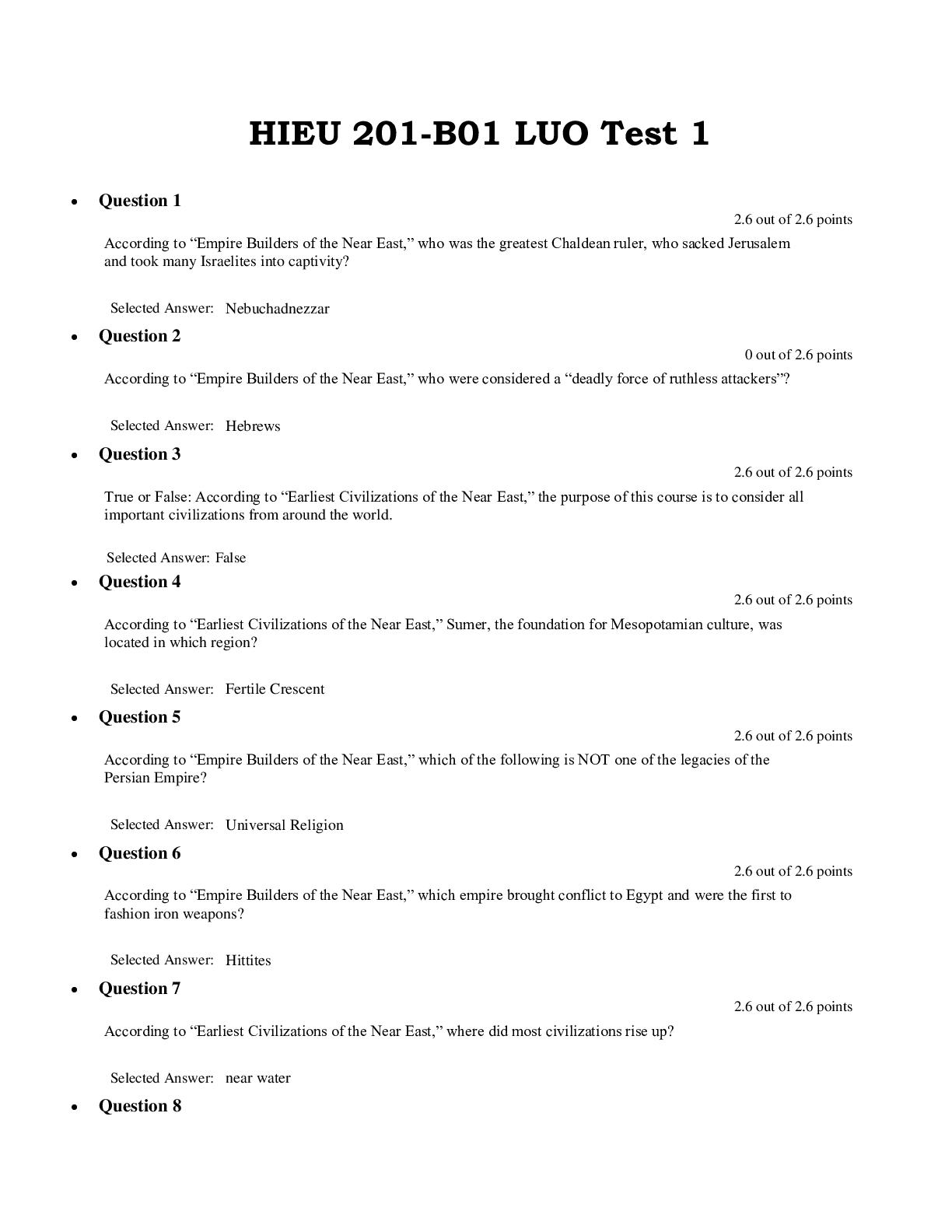
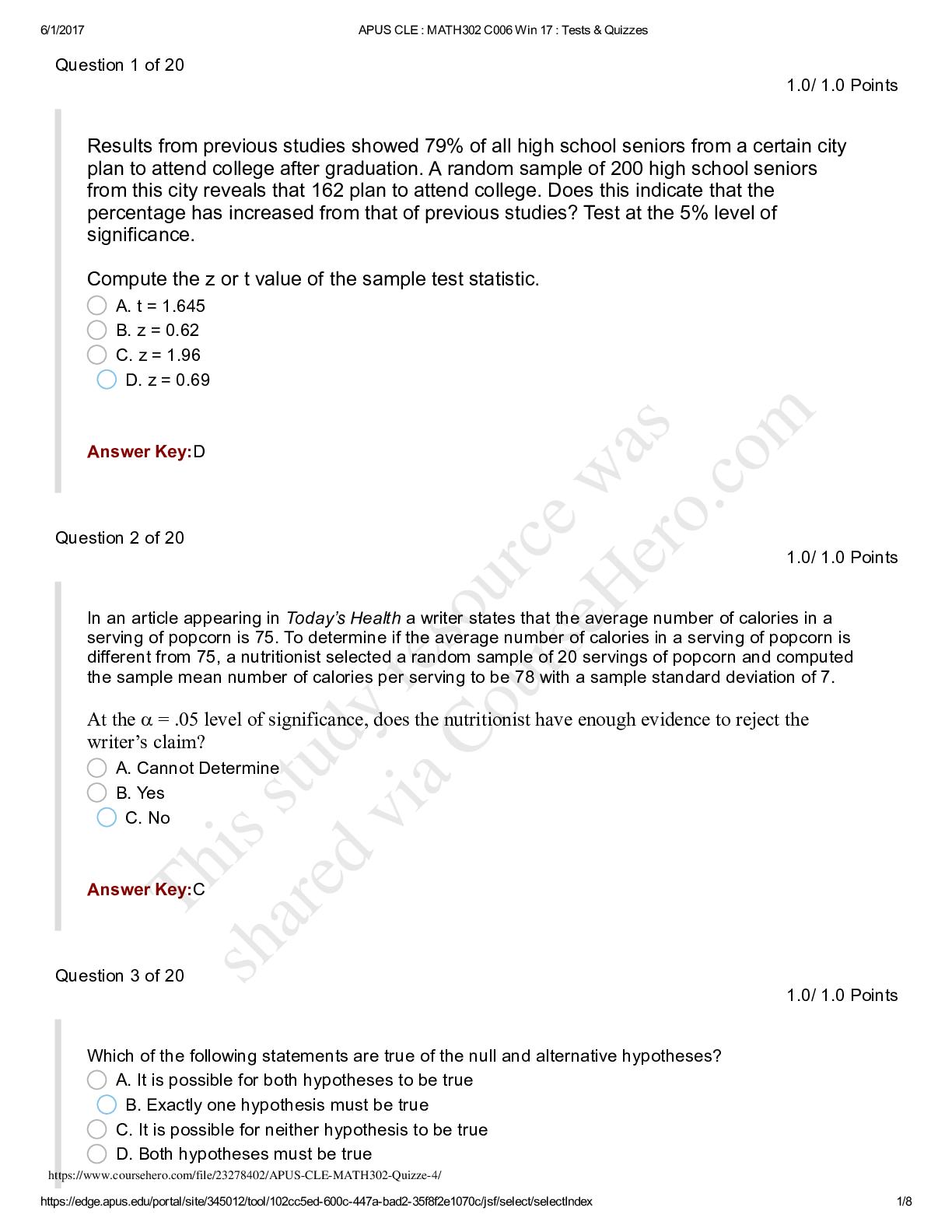
NR 602 NR quiz1
NR 602 NR quiz
1. The following are risk factors for hypertension in children and teens (choose all that apply):
being obese. being exposed to second-hand smoke.
2. In evaluating a 9-year-old child wi
...
NR 602 NR quiz1
NR 602 NR quiz
1. The following are risk factors for hypertension in children and teens (choose all that apply):
being obese. being exposed to second-hand smoke.
2. In evaluating a 9-year-old child with a healthy BMI during a well visit, a comprehensive cardiovascular
evaluation should be conducted by the following methods (choose all that apply):
Obtain fasting lipid profile. / Assess diet and physical activity.
3. At what age is it appropriate to recommend dietary changes to parents if overweight or obesity is a
concern?
12 months old
4. The following are risk factors for type 2 diabetes mellitus in children and teens (choose all that apply):
hyperinsulinemia: abnormal weight-to-height ratio.: Native American ancestry.
5. Screening children with a known risk factor for type 2 diabetes mellitus is recommended at age 10 or at onset of
puberty, and should be repeated how often?
every year.
6. Prediabetes in children is defined as (choose all that apply):
impaired fasting glucose (glucose level ≥100 mg/dL or 6.2 mmol/L) but ≤125 mg/dL or 7 mmol/L).
impaired glucose tolerance (2-hour postprandial ≥140-199 mg/dL or 7.8 mmol/L-11 mmol/L).
7. Risk factors for dyslipidemia in children include (choose all that apply):
family history of lipid abnormalities.
family history of type 2 diabetes mellitus.
8. Screening cholesterol levels in children with one or more risk factors begins at what age? .
2 years
8. An acceptable level of total cholesterol (mg/dL) in children and teens is:
<170 mg/dL or 9.4 mmol/L.
9. low birth weight, and poor infant growth are risk factors for type 2 diabetes
True
10. Prediabetes in children is defined as impaired fasting glucose (glucose level ≥100 mg/dL or 5.6 mmol/L but
≤125 mg/dL or 7 mmol/L) or impaired glucose tolerance (2-hour postprandial ≥140-199 mg/dL or 7.8 mmol/L-11
mmol/L) or an A1C of 5.7% to 6.4%.
True
11. Screening for type 2 diabetes begins at age _10___ or at onset of puberty and continues every 2 years until
adulthood; at that point, the adult guidelines should be followed.
12. The AAP screening guidelines for total cholesterol levels in children and adolescents aged 2 to 19 years old are
as follows: Acceptable level is < __170___ mg/dL (<9.4 mmol/L), borderline is 170-199 mg/dL (9.4 mmol/L-11
mmol/L), and high is >200 mg/dL (≥11.1 mmol/L)
13. Children should be screened for family history of cardiovascular disease (CVD) beginning at age _3___ and
should be periodically updated annually or as required by risk factors during non-urgent health visits.
14. For at-risk children, fasting lipid levels should be tested after __2__ years of age (but no later than 10 years of
age) and should be retested in 3-5 years if the values fall within the reference range.
15. Body mass index (BMI) should be measured beginning at age __2__.2
16. For children between 12 months and 2 years of age for whom overweight or obesity is a concern, the use of
__REDUCED___ fat milk would be appropriate.
17. Beginning at age _5__ if BMI is ≥ 85th percentile, intensify dietary and activity changes to the parent.
18. Infection with Corynebacterium diphtheriae usually causes:
Pseudomembranous pharyngitis
19. The tetanus infection is caused by ___CLOSTRIDIUM TETANI _____, an anaerobic, gram-positive, sporeforming rod. This organism is found in soil and is particularly potent in manure.
20. Sources of lead that can contribute to plumbism include select traditional remedies such as azarcon and greta.
True
21. Patients with plumbism present with which kind of anemia?
Microcytic, hypochromic
22. Intervention for a child with a lead level of 5 to 44 mcg/dL usually includes all of the following except:
Chelation therapy
23. Ingested lead inactivates heme synthesis by inhibiting the insertion of iron into the protoporphyrin ring. This
leads to the development of what kind of anemia?
microcytic, hypochromic
24. __Basophilic ________ stippling is often noted on red blood cell morphology in lead poisoning.
25. Lead is significantly toxic to the solid organs, bones, and nervous system
26. Long-term complications of __LEAD______ poisoning include behavior or attention problems, poor academic
performance, hearing problems, kidney damage, reduced IQ, and slowed body growth.
27. Unless deleading procedures have been performed, however, most homes built before __1957 contain lead-based
paint.
28. A diet low in calcium, iron, zinc, magnesium, and copper and high in fat, which is a typical diet for children
living in _____poverty_____, enhances oral lead absorption
29. In older homes, the point of greatest risk is the __window ___ because their sills and the putty have high lead
concentration. Because toddlers (age 2 to 3) are the ideal height to reach them and are often drawn to open ones,
they are at greatest risk and summer is the riskiest season.
window
30. Symptoms of elevated __LEAD____ levels include abdominal pain and cramping, aggressive behavior, anemia,
constipation, difficulty sleeping, headaches, irritability, loss of previous developmental skills in young children, low
appetite and energy, and reduced sensations. Very high levels can result in vomiting, staggering walk, muscle
weakness, seizures, or coma.
31. A measure of __5____ mcg/dL is now used to identify children with elevated blood lead levels.
32. Most children with lead levels of 5-44 mcg/dL are treated with removal from the source, improved nutrition, and
___IRON ___ therapy.
33. Those with lead levels of 45-50 mcg/dL are treated with a ___CHELATION__agent such as succimer, in
addition to the previously listed interventions.
34. For children with lead levels of greater than 51 mcg/dL, hospital admission with expert evaluation is likely the
most prudent course to avoid serious problems (including ___ENCEPHALOPATHY__) associated with markedly
elevated lead levels
35. Which of the following represents the best choice of clinical agents for a child who has had a history of
penicillin allergy who requires antimicrobial therapy?
Cefdinir3
36. The clinical presentation of UTI in children can be without the classic symptoms such as frequency, dysuria, or
flank pain.
True
37. In younger children, UTI often manifests as ___IRRITABLITY_, ___LETHARGEY __, and __FEVER___ with
no obvious focal infectious source.
38. Older children with UTI often present with __ABDOMINAL ___ pain, unexplained fever, or both; as children
approach puberty, flank pain becomes more common
40. UTI______ should be considered in infants and young children 2 months to 2 years old with unexplained fever,
particularly in boys younger than 6 months and girls younger than 2 years who have a temperature greater than or
equal to 39°C (≥102.2°F).
41. A _____URINALYSIS____ should be obtained in a child with unexplained fever or symptoms that suggest a
UTI; however, 20% from UTI cases return a false-negative result.
42. Any of the following findings are suggestive, although not diagnostic, of UTI: positive leukocyte esterase,
positive nitrite, more than __5____ white blood cells (WBCs) per high-power field in spun specimen, and bacteria
present in unspun Gramstained specimen.
43. An acceptable method because of the low rate of skin and fecal contamination is a urine specimen collection via
bag or from the diaper.
False, unacceptable because of the high rate of contamination
44. a single documented UTI in a child must be taken seriously. If an infant or young child 2 months to 2 years old
with suspected UTI is assessed as toxic, dehydrated, or unable to retain oral intake, ___HOPITALIZATION___is
advised.
45. Oral amoxicillin, TMP-SMX, or a second-or third-generation __CEPHALOSPORIN________ is recommended
as options for initial therapy for UTI in children
46. The use of _TMP-SMX______ has a small risk of treatment failure.
47. Current evidence-based practice recommendations for UTI in Children indicate a _7____ to ___14___ day
course of antibiotics because the outcomes are superior to a 1-to 3-day course in preventing spread of infection and
subsequent renal scarring.
48. Although fluoroquinolone antibiotics have not been widely used in children, ciprofloxacin is approved by the
U.S. Food and Drug Administration (FDA) for use in pediatric patients for the treatment of UTI; this use is approved
starting at age __1__ years old.
49. Urinary tract imaging should be considered for all children with UTI, particularly if this occurs before toilet
training.
true
50. The two mainstays for imaging for UTI in young children are _RENAL BLADDER ULTRACOUND
_____(RBUS) and voiding cystourethrography (VCUG)
51. RBUS is an easily obtained, noninvasive test but can miss a small number of high-grade ___REFLUX_____
cases
52. The benefits of ___RBUS_______ (no radiation exposure, non-invasive, minimal discomfort for child and
parents), however, outweigh the slight increase in specificity of VCUG
53. A __RENAL______ scan is useful for detecting renal scarring, a finding present after infection, but is not
recommended for routine, initial evaluation of young child with their first febrile UTI.4
54. ___VCUG_____ only is indicated if RBUS reveals hydronephrosis, scarring, or other findings that would
suggest either high-grade vesicoureteral reflux (VUR) or obstructive uropathy, as well as other atypical or complex
clinical circumstances.
55. A 4-year-old child presents with fever; exudative pharyngitis; anterior cervical lymphadenopathy; and a fine,
raised, pink rash. The most likely diagnosis : Scarlet fever
56. An 18-year-old woman has a chief complaint of "a sore throat and swollen glands" for the past 3 days. Her
physical examination reveals exudative pharyngitis, minimally tender anterior and posterior cervical
lymphadenopathy, and maculopapular rash. Abdominal examination reveals right and left upper quadrant abdominal
tenderness. The most likely diagnosis is: .
infectious mononeuclosis
57. Kawasaki disease most commonly occurs in what age group?
children aged 1 to 8 years
58. For acute phase illness (usually lasts about 11 days), fever with T104ºF (40ºC) lasting5 days, polymorphous
exanthem on trunk, flexor regions, and perineum, erythema of the oral cavity ("strawberry tongue") with extensively
chapped lips, bilateral conjunctivitis usually without eye discharge, cervical lymphadenopathy, edema and erythema
of the hands and feet with peeling skin (late finding, usually 1-2 weeks after onset of fever), no other illness
accountable for the findings.
Usually in children age 1-8 years Treatment with IV immunoglobulin and PO aspirin during the acute phase is
associated with a reduction in rate of coronary abnormalities such as coronary artery dilatation and coronary
aneurysm. Expert consultation and treatment advice about aspirin use and ongoing monitoring warranted.
Kawasaki disease
60. Rates of urinary tract infection (UTI) among uncircumcised infant boys are how much higher than those in
circumcised boys? as much as 20%
61. Which of the following is most likely to be part of the clinical presentation of UTI in a 20-month-old child?
Fever
62. Which of the following is considered the ideal method for obtaining a urine sample for culture and sensitivity in
an 18-month-old-old girl with suspected UTI?
Suprapubic aspiration
63. When choosing an antimicrobial agent for the treatment of UTI in a febrile female child who is 16 months old,
the NP considers that:
The use of an oral third-generation cephalosporin is acceptable if GI function is intact
64. When evaluating the urinalysis of a 10-month-old infant with UTI, the NP considers that:
. 20% of urinalysis can be normal
65. In children 2 months to 2 years old with UTI, antimicrobial therapy should be prescribed for:
7 to 14 days
66. The preferred urinary tract imaging study for a 22-month-old girl with first-time febrile UTI is:
Renal-bladder ultrasound
67. VCUG is indicated:
WHen UIT is recurrent
68. The urinary tract abnormality most often associated with UTI in younger children is: .
Vesicourethral reflux
69. Signs of severe dehydration include (choose all that apply):
Anuria, tear absent, capillary refill of approximately 3 seconds
70. The onset of symptoms of food poisoning caused by Staphylococcus species is typically how many hours after
the ingestion of the offending substance?
1-4
71. The onset of symptoms in food poisoning caused by Salmonella species is typically how many hours after the
ingestion of the offending substance?
12-24
72. What percentage of body weight is typically lost in a child with moderate dehydration?
6-10%
73.Clinical features of shigellosis include all of the following except:
Vomiting
74. acute gastritis usually does not have a fever
true5
75. Asking about the last urination is a helpful way of evaluating dehydration. If the child has voided within the
previous few hours, the degree of dehydration is minimal.
True
76. Because they contain inappropriate glucose and electrolyte composition, sports drinks such as Gatorade (tm),
soda, and most fruit juices are _______INAPPROPRIATE ___for rehydration.
inappropriate
77. The use of antidiarrheal agents is usually discouraged because of the risk of increasing the severity of illness if
toxinproducing bacteria are the causative agent.
true
78. Warning signs during acute gastroenteritis include ____FEVER___ coupled with _BLOODY__or __PUS__-
filled stools. If these are present, a bacterial source of infection such as shigellosis should be considered. Stool
culture should be obtained, and appropriate antimicrobial therapy should be initiated.
79. Precocious puberty in girls has long been defined as the onset of secondary sexual characteristics before the
child's __8TH _____ birthday.
80. In boys, precocious puberty is defined as the onset of secondary sexual characteristics before his _9TH_____
birthday.
81. Thelarche (the isolated appearance of breast development) is common as early as age __7__ .
82. . Pubarche (the appearance of pubic hair without other signs of puberty) as early as age __8_ in otherwise
healthy girls.
83. A subset of girls, particularly girls with pubertal changes noted before their ___6TH___ birthday, often has
significant health problems, however, such as ovarian or adrenal tumors. Expert evaluation and referral is indicated
in these children.
84. Delayed puberty is defined as no evidence of sexual maturation (Tanner stage 1) in girls older than age
_13___and in boys older than age ___14 __.
85. The most common reason for precocious puberty in girls is: estrogen.. early onset of normal puberty.
86. The most common reason for precocious puberty in boys is: .A select number of relatively uncommon health
problems
87. Which of the following is noted in a child with premature adrenarche? Breast development
88. Girls typically grow to their adult height by
1 year before menarche
89. A 15-year-old male is found to be at Tanner stage 1 on exam. The least likely cause of this finding is:
. a variation of normal based on ethnicity or familial factors
90. An innocent heart murmur has which of the following characteristics?
becomes softer when the patient moves from supine to standing position
91. The murmur of atrial septal defect is usually:
First found on a 2-to-6 month well-baby examination
92. A Still murmur: has a humming or vibratory quality
93. Grade 1-3/6 early systolic ejection, musical or vibratory, short, often buzzing, heard best midway between apex
and LLSB. Softens or disappears when sitting, when standing, or with Valsalva maneuver Louder when supine or
with fever or tachycardia Usual onset age 2-6 years; may persist through adolescence Benign condition
Still (vibratory innocent murmur)
94. Grade 1-2/6 systolic ejection, high-pitched, heard best in pulmonic and aortic areas. Heard only in presence of
increased cardiac output, such as fever, anemia, stress. Disappears when underlying condition resolves Usually seen
without cardiac disease Most often heard in children and younger adults with thin chest walls
Hemic Murmur
95. Grade 1-2/6 continuous musical hum heard best at upper right sternal border (URSB) and upper left sternal
border (ULS) and the lower neck. Disappears in supine position, when jugular vein is compressed Common after
age 3 years. Believed to be produced by turbulence in subclavian and jugular veins Benign condition
Venous Hum
96. Grade 1-3/6 systolic ejection murmur, heard best at ULSB with widely split fixed S 2. Accompanying middiastolic murmur heard at fourth intercostal space (ICS) left sternal border (LSB); commonly caused by increased
flow across tricuspid valve. Two times as common in girls Child is often entirely well or present with heart failure
Often missed in the first few months of life or even entire childhood Watch for children with easy fatigability
Cyanosis rare6
Atrial Septal Defect
97. Grade 2-5/6 regurgitant systolic murmur heard best at LLSB Occasionally holosystolic, usually localized. Thrill
may be present and a loud P 2 with large left-to-right shunt. Usually without cyanosis Children with small-to
moderate-sized left-toright shunt without pulmonary hypertension likely to have minimal symptoms Larger shunts
may result in CHF with onset in infancy
Ventricular septal defect
98. When counseling the family of an otherwise healthy 2-year-old child who just had a febrile seizure, you consider
the following regarding whether the child is at risk for future febrile seizures (choose all that apply):
The occurrence of one febrile seizure is predictive of having another.
Intermittent diazepam can be used prophylactically during febrile illness to reduce risk of recurrence.
99. A simple febrile seizure actually is most likely to occur as fever is ___INCREASING _(increasing or
decreasing) rather than at its peak; however, there is no evidence that the rapidity of the rate of increase is associated
with febrile seizures.
100. A familial tendency has been noted with febrile seizure, but is the condition predictive of the development of
epilepsy? No
101. A simple febrile seizure is a benign, although frightening, common event in children _6___months to
__5__years old; a child who has had one seizure is at increased risk for a recurrence.
102.Most children with febrile seizures do not need to be treated with medication. Daily phenobarbital and
valproate, reduce risk and could prevent occurrence but risks outweigh the benefits …. true
103.In situations in which parental anxiety about febrile seizures is severe, intermittent oral diazepam (Valium) at
the onset of febrile illness. True
104. Do antipyretics prevent febrile seizures?
No
105. You exam a healthy 2 month old boy and note that his foreskin cannot be retracted. You consider that:
In most instances the foreskin is not easily retractable until the child is about 3 years old.
106. You examine a thriving 4-week old boy, born at 39 weeks’ gestation, and note a painless, tense, non-reducible,
relatively symmetric scrotal enlargement that brightly and evenly trans-illuminates. The parents state the scrotum
always looks like this without change in size during the day. Bilateral testes 1 cm in length, are palpable and held
within the scrotum. The penis is about 4cm in length. You consider these findings are most consistent with:
Non-communicating hydrocele
107. Most of the time a non-communicating hydroceles will resolve on their own by the time the baby is 1 year old.
True
108. Communicating or Non-communicating Hydrocele: A Fluid-filled scrotal sac; transilluminates, nontender,
testes normal, however amount of fluid in scrotum (scrotal size) varies with position of neonate; larger with
dependent upright position (day) and smaller after lying flat (upon awakening) . Due to communication, an infant is
at risk for herniation of abdominal contents and should be referred to pediatric urologist or surgeon.
Communicating
109. A ___NON COMMUNICATING ___hydocele occurs due to sealing of the abdominal cavity during gestation
with residual trapped peritoneal fluid in the scrotal sac.
110. What does intussusception result in?
Bowel Obstruction
111. What does pyloric stenosis result in? Thickening of pyloric valve so stomach can not empty properly
112. Approximately 4:1 male to female ratio.
Pyloric Stenosis
113. Sudden onset colicky, severe, an intermittent abdominal pain.
Intussusception
114. Accompanied by loose stools that are often described as currant jelly appearance (Mixture of blood and
sloughed mucous).
Intussusception
115. Most common time for symptoms onset = Approximately Age 3 weeks.
Pyloric Stenosis
116. Post-fed projectile vomiting is present with the baby eager to eat again immediately post emesis
Pyloric Stenosis7
117. Accompanied by a sausage-shaped abdominal mass.
Intussusception
118. Olive Shaped abdominal Mass occasionally noted.
Pyloric Stenosis
119. Usually occurs in the first year of life
Intussusception
120. Intussusception is caused when a section of intestines invaginates into the adjoining intestinal lumen, causing
bowel obstuction, if left untreated is uniformly fatal in __2____ to _5____ days.
121. Intussesception symptoms are often preceded by an upper respiratory tract infection.
True
122. Puberty is the onset of Tanner Stage __2 _
123. In a boy Tanner Stage _2 __ consists of testicular enlargement, scrotal skin reddening, sparse growth of long
slightly pigmented pubic hair at base of penis.
123. Gynecomastia is usually found in males at which tanner stage/age?
A 14 year old male at Tanner Stage 3
(lasts for 6 - 12 months)
124. You see a 17 year old female, as part of the visit you consider her risk factors for T2 Diabetes would likely
include all of the following except:
Family History of Type 1 DM
125. When should you consider doing T2DM screening in Children:
- Overweight or Obese ( BMI > 85%)
- Family Hx of T2DM
126. If child is overweight or obese initiate testing at age _10___ years or at onset of puberty if puberty occurs
earlier. Frequency is every ___3 _ years.
127. Microcytic, Hypochromic, Elevated RDW is what kind of anemia?
iron deficiency
128. Iron deficiency is most common in children 12-30 months
True
129. For mild to moderate dehydration oral rehydration therapy with oral rehydration solution is as effective as
parenteral therapy, easier to administer and more cost-effective
True
[Show More]




![Preview of WEEK **5 [Chamberlain university]NR 602 IHUMAN Case Week #5 Deborah Arnaudin 54 Year Old](https://browseimages.nyc3.digitaloceanspaces.com/paper-images/2026/03/31/zbQKePwt2026-03-31-11-4669cc328fcad96.png)


 (Diane Pacitti etc.png)