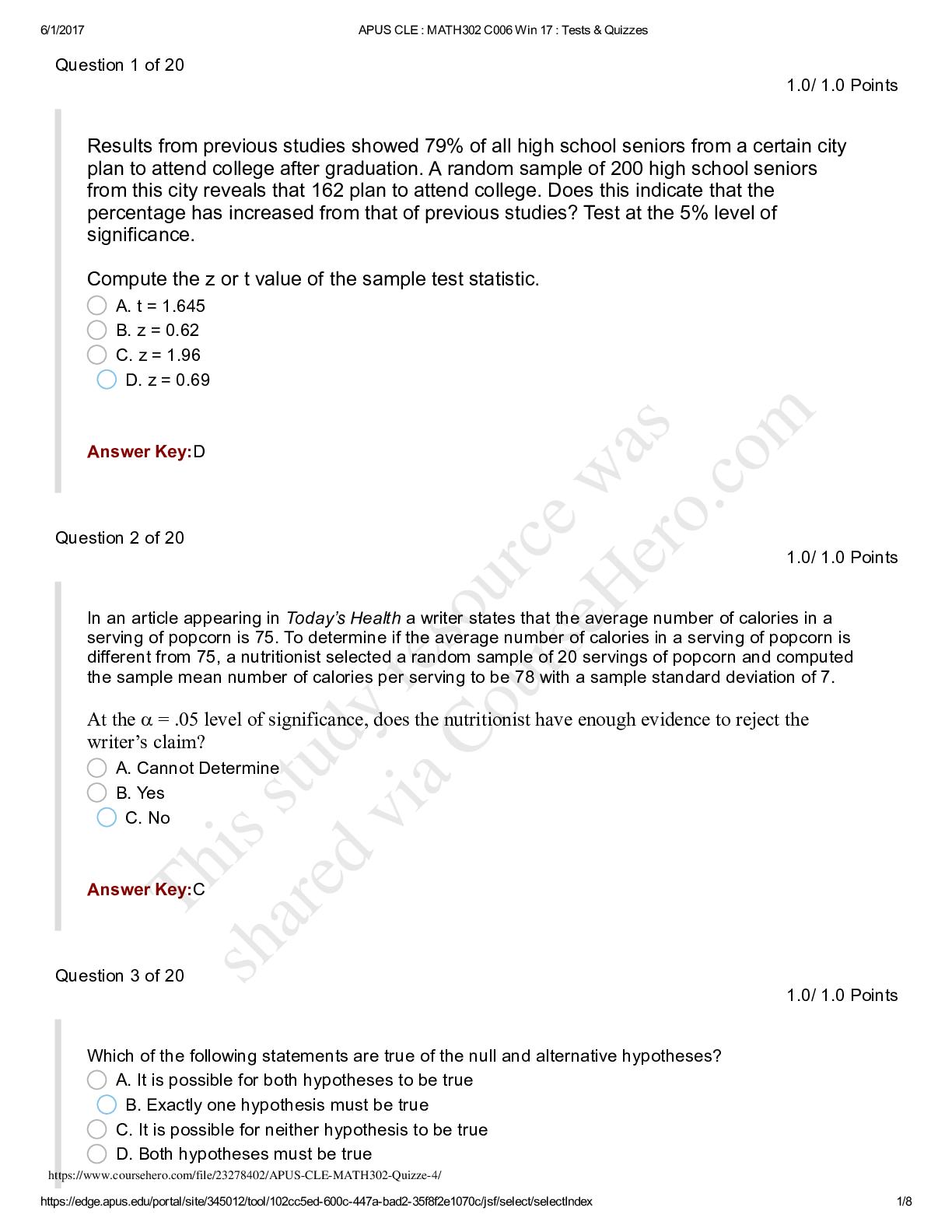
NR 507 Week 3 Quiz (Questions &
Answers)
1. A 72-year-old woman with a recent onset of syncopal episodes has been referred to a cardiology
group by her family physician. As part of the patient's diagnostic workup,
...
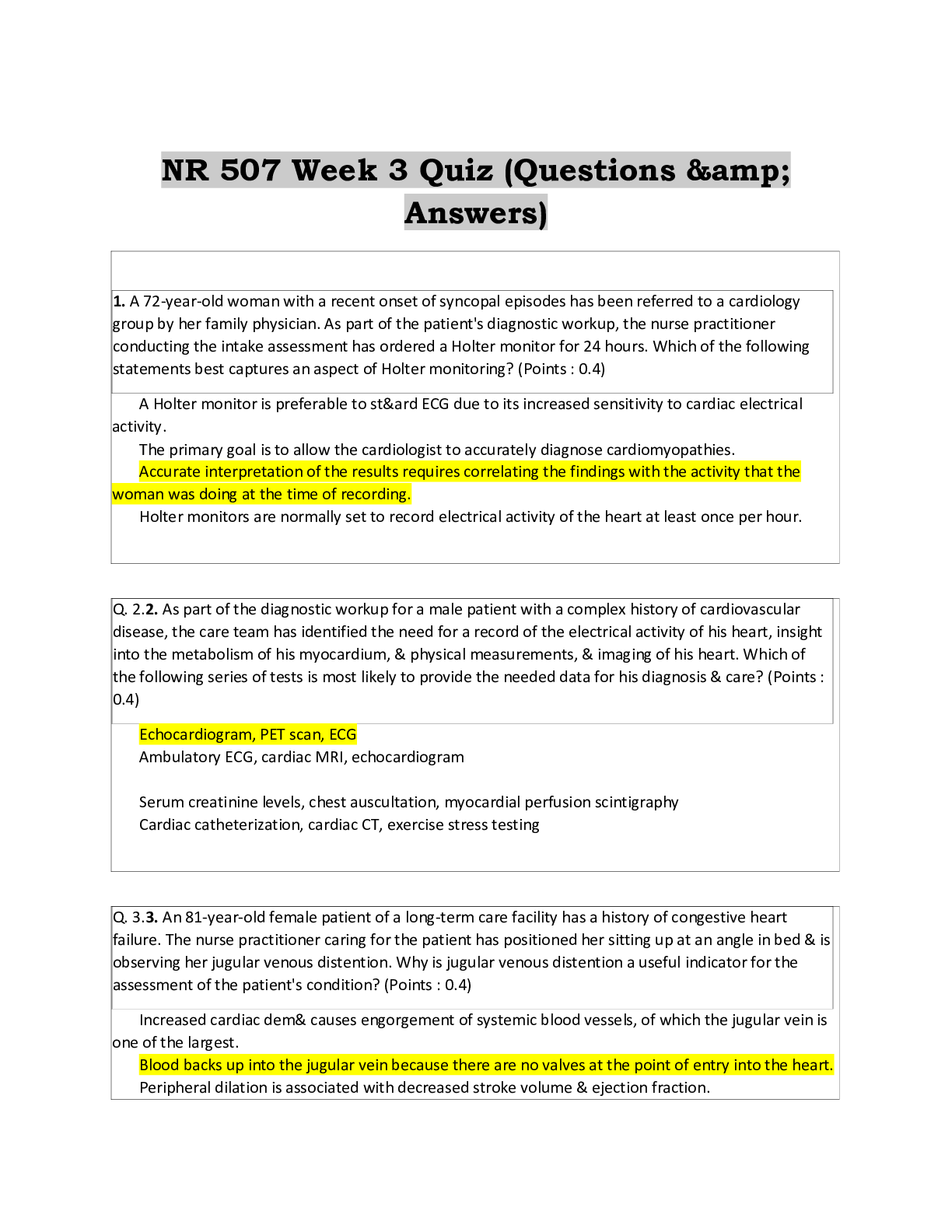
NR 507 Week 3 Quiz (Questions &
Answers)
1. A 72-year-old woman with a recent onset of syncopal episodes has been referred to a cardiology
group by her family physician. As part of the patient's diagnostic workup, the nurse practitioner
conducting the intake assessment has ordered a Holter monitor for 24 hours. Which of the following
statements best captures an aspect of Holter monitoring? (Points : 0.4)
A Holter monitor is preferable to st&ard ECG due to its increased sensitivity to cardiac electrical
activity.
The primary goal is to allow the cardiologist to accurately diagnose cardiomyopathies.
Accurate interpretation of the results requires correlating the findings with the activity that the
woman was doing at the time of recording.
Holter monitors are normally set to record electrical activity of the heart at least once per hour.
Q. 2.2. As part of the diagnostic workup for a male patient with a complex history of cardiovascular
disease, the care team has identified the need for a record of the electrical activity of his heart, insight
into the metabolism of his myocardium, & physical measurements, & imaging of his heart. Which of
the following series of tests is most likely to provide the needed data for his diagnosis & care? (Points :
0.4)
Echocardiogram, PET scan, ECG
Ambulatory ECG, cardiac MRI, echocardiogram
Serum creatinine levels, chest auscultation, myocardial perfusion scintigraphy
Cardiac catheterization, cardiac CT, exercise stress testing
Q. 3.3. An 81-year-old female patient of a long-term care facility has a history of congestive heart
failure. The nurse practitioner caring for the patient has positioned her sitting up at an angle in bed & is
observing her jugular venous distention. Why is jugular venous distention a useful indicator for the
assessment of the patient's condition? (Points : 0.4)
Increased cardiac dem& causes engorgement of systemic blood vessels, of which the jugular vein is
one of the largest.
Blood backs up into the jugular vein because there are no valves at the point of entry into the heart.
Peripheral dilation is associated with decreased stroke volume & ejection fraction.Heart valves are not capable of preventing backflow in cases of atrial congestion.
Q. 4.4. A physical assessment of a 28-year-old female patient indicates that her blood pressure in her
legs is lower than that in her arms & that her brachial pulse is weaker in her left arm than in her right.
In addition, her femoral pulses are weak bilaterally. Which of the following possibilities would her care
provider be most likely to suspect? (Points : 0.4)
Pheochromocytoma
Essential hypertension
Coarctation of the aorta
An adrenocortical disorder
Q. 5.5. A 6-year-old boy has been brought to the emergency department by ambulance after his
mother discovered that his heart rate was “so fast I couldn't even count it.” The child was determined
to be in atrial flutter & his mother is seeking an explanation from the health care team. Which of the
following points should underlie an explanation to the mother? (Points : 0.4)
The child is experiencing a reentry rhythm in his right atrium.
The resolution of the problem is dependent on spontaneous recovery & is resistant to pacing
interventions.
The child is likely to have a normal ECG apart from the rapid heart rate.
The boy's atria are experiencing abnormal sympathetic stimulation.
Q. 6.6. A 66-year-old patient's echocardiogram reveals a hypertrophied left ventricle, normal chamber
volume, & a normal ejection fraction from the heart. What is this patient's most likely
diagnosis? (Points : 0.4)
Mitral valve regurgitation
Aortic valve stenosis
Mitral valve stenosis
Aortic valve regurgitation
Q. 7.7. A 70-year-old male patient presents to the emergency department complaining of pain in his
calf that is exacerbated when he walks. His pedal & popliteal pulses are faintly palpable & his leg distal
to the pain is noticeably reddened. What would his care provider's preliminary diagnosis & anticipated
treatment most likely be?(Points : 0.4)
Acute arterial occlusion that will be treated with angioplastyRaynaud disease that will require antiplatelet medications
Atherosclerotic occlusive disease necessitating thrombolytic therapy
Giant cell temporal arteritis that will be treated with corticosteroids
Q. 8.8. A patient in the intensive care unit has a blood pressure of 87/39 & has warm, flushed skin
accompanying his sudden decline in level of consciousness. The patient also has arterial & venous
dilation & a decrease in systemic vascular resistance. What is this patient's most likely
diagnosis? (Points : 0.4)
Hypovolemic shock
Septic shock
Neurogenic shock
Obstructive shock
Q. 9.9. A 31-year-old woman with a congenital heart defect reports episodes of lightheadedness &
syncope, with occasional palpitations. A resting electrocardiogram reveals sinus bradycardia & she is
suspected of having sick sinus syndrome. Which of the following diagnostic methods is the best choice
to investigate the suspicion? (Points : 0.4)
Signal-averaged ECG
Exercise stress testing
Electrophysiologic study
Holter monitoring
Q. 10.10. A nurse practitioner is providing care for several patients on a medical unit of a hospital. In
which of the following patient situations would the nurse practitioner be most likely to rule out
hypertension as a contributing factor? (Points : 0.4)
A 61-year-old man who has a heart valve infection & recurrent fever
An 81-year-old woman who has had an ischemic stroke & has consequent one-sided weakness
A 44-year-old man awaiting a kidney transplant who requires hemodialysis three times per week
A 66-year-old woman with poorly controlled angina & consequent limited activity tolerance
Q. 11.11. A patient is experiencing impaired circulation secondary to increased systemic arterial
pressure. Which of the following statements is the most relevant phenomenon?(Points : 0.4)
Increased preload due to vascular resistance
High afterload because of backpressure against the left ventricleImpaired contractility due to aortic resistance
Systolic impairment because of arterial stenosis
Q. 12.12. A number of patients have presented to the emergency department in the last 24 hours with
complaints that are preliminarily indicative of myocardial infarction. Which of the following patients is
least likely to have an ST-segment myocardial infarction (STEMI)? (Points : 0.4)
A 70-year-old woman who is complaining of shortness of breath & vague chest discomfort
A 66-year-old man who has presented with fatigue, nausea & vomiting, & cool, moist skin
A 43-year-old man who woke up with substernal pain that is radiating to his neck & jaw
A 71-year-old man who has moist skin, fever, & chest pain that is excruciating when he moves but
relieved when at rest
Q. 13.13. A formerly normotensive woman, pregnant for the first time, develops hypertension &
headaches at 26 weeks' gestation. Her blood pressure is 154/110 mm Hg & she has proteinuria. What
other labs should be ordered for her? (Points : 0.4)
Plasma angiotensin I & II & renin
Urinary sodium & potassium
Platelet count, serum creatinine, & liver enzymes
Urinary catecholamines & metabolites
Q. 14.14. An older adult female patient has presented with a new onset of shortness of breath, & the
patient's nurse practitioner has ordered measurement of her BNP levels along with other diagnostic
tests. What is the most accurate rationale for the nurse practitioner's choice of blood work? (Points :
0.4)
BNP is released as a compensatory mechanism during heart failure & measuring it can help
differentiate the patient's dyspnea from a respiratory pathology.
BNP is an indirect indicator of the effectiveness of the RAA system in compensating for heart failure.
BNP levels correlate with the patient's risk of developing cognitive deficits secondary to heart failure
& consequent brain hypoxia.
BNP becomes elevated in cases of cardiac asthma, Cheyne-Stokes respirations, & acute pulmonary
edema, & measurement can gauge the severity of pulmonary effects.
Q. 15.15. The nurse practitioner for a cardiology practice is responsible for providing presurgical
teaching for patients who are about to undergo a coronary artery bypass graft. Which of the followingteaching points best conveys an aspect of the human circulatory system? (Points : 0.4)
“Your blood pressure varies widely between arteries & veins, & between pulmonary & systemic
circulation.”
“Only around one quarter of your blood is in your heart at any given time.”
“Blood pressure & blood volume roughly mimic one another at any given location in the circulatory
system.”
“Left-sided & right-sided pumping action at each beat of the heart must equal each other to ensure
adequate blood distribution.”
Q. 16.16. A 54-year-old man with a long-st&ing diagnosis of essential hypertension is meeting with his
nurse practitioner. The patient's nurse practitioner would anticipate that which of the following
phenomena is most likely occurring? (Points : 0.4)
The patient's juxtaglomerular cells are releasing aldosterone as a result of sympathetic stimulation.
Epinephrine from his adrenal gl& is initiating the renin-angiotensin-aldosterone system.
Vasopressin is exerting an effect on his chemoreceptors & baroreceptors, resulting in
vasoconstriction.
The conversion of angiotensin I to angiotensin II in his lungs causes increases in blood pressure &
sodium reabsorption.
Q. 17.17. A 22-year-old male is experiencing hypovolemic shock following a fight in which his carotid
artery was cut with a broken bottle. What immediate treatments are likely to most benefit the
man? (Points : 0.4)
Resolution of compensatory pulmonary edema & heart arrhythmias
Infusion of vasodilators to foster perfusion & inotropes to improve heart contractility
Infusion of normal saline of Ringer lactate to maintain the vascular space
Administration of oxygen & epinephrine to promote perfusion
Q. 18.18. A 66-year-old obese man with a diagnosis of ischemic heart disease has been diagnosed with
heart failure that his care team has characterized as attributable to systolic dysfunction. Which of the
following assessment findings is inconsistent with his diagnosis? (Points : 0.4)
His resting blood pressure is normally in the range of 150/90 & an echocardiogram indicates his
ejection fraction is 30%.
His end-diastolic volume is higher than normal & his resting heart rate is regular & 82 beats per
minute.
He is presently volume overloaded following several days of intravenous fluid replacement.Ventricular dilation & wall tension are significantly lower than normal.
Q. 19.19. A 68-year-old male complains to his nurse practitioner that when he tests his blood pressure
using a machine at his pharmacy, his heart rate is nearly always very low. At other times, he feels that
his heart is racing, & it also seems to pause at times. The man has also occasionally had
lightheadedness & a recent syncopal episode. What is this patient's most likely diagnosis & the
phenomenon underlying it? (Points : 0.4)
Sick sinus syndrome as a result of a disease of his sinus node & atrial or junctional arrhythmias
Ventricular arrhythmia as a result of alternating vagal & sympathetic stimulation
Torsades de pointes as a result of disease of the bundle of His
Premature atrial contractions that vacillate between tachycardic & bradycardic episodes as a
consequence of an infectious process
Q. 20.20. An autopsy is being performed on a 44-year-old female who died unexpectedly of heart
failure. Which of the following components of the pathologist's report is most suggestive of a possible
history of poorly controlled blood pressure? (Points : 0.4)
“Scarring of urethra suggestive of recurrent urinary tract infections is evident.”
“Bilateral renal hypertrophy noted.”
“Vessel wall changes suggestive of venous stasis are evident.”
“Arterial sclerosis of subcortical brain regions noted.”
Q. 21.21. During a routine physical examination of a 66-year-old woman, her nurse practitioner notes a
pulsating abdominal mass & refers the woman for further treatment. The nurse practitioner is
explaining the diagnosis to the patient, who is unfamiliar with aneurysms. Which of the following
aspects of the pathophysiology of aneurysms would underlie the explanation the nurse
provides? (Points : 0.4)
Aneurysms are commonly a result of poorly controlled diabetes mellitus.
Hypertension is a frequent modifiable contributor to aneurysms.
Individuals with an aneurysm are normally asymptomatic until the aneurysm ruptures.
Aneurysms can normally be resolved with lifestyle & diet modifications.
Q. 22.22. A patient has suffered damage to his pericardium following a motor vehicle accident. Which
of the following consequences should the nurse practitioner be most likely to rule out? (Points : 0.4)
Impaired physical restraint of the left ventriculeIncreased friction during the contraction/relaxation cycle
Reduced protection from infectious organisms
Impaired regulation of myocardial contraction
Q. 23.23. A nurse practitioner is instructing a group of older adults about the risks associated with high
cholesterol. Which of the following teaching points should the participants try to integrate into their
lifestyle after the teaching session? (Points : 0.4)
“Remember, the 'H' in HDL & the 'L' in LDL correspond to high danger & low danger to your health.”
“Having high cholesterol increases your risk of developing diabetes & irregular heart rate.”
“Smoking & being overweight increases your risk of primary hypercholesterolemia.”
“Your family history of hypercholesterolemia is important, but there are things you can do to
compensate for a high inherited risk.”
Q. 24.24. An 81-year-old male resident of a long-term care facility has a long-st&ing diagnosis of heart
failure. Which of the following short-term & longer-term compensatory mechanisms is least likely to
decrease the symptoms of his heart failure? (Points : 0.4)
An increase in preload via the Frank-Starling mechanism
Sympathetic stimulation & increased serum levels of epinephrine & norepinephrine
Activation of the renin-angiotensin-aldosterone (RAA) system & secretion of brain natriuretic
peptide (BNP)
AV node pacemaking activity & vagal nerve suppression
Q. 25.25. A 55-year-old male who is beginning to take a statin drug for his hypercholesterolemia is
discussing cholesterol & its role in health & illness with his nurse practitioner. Which of the following
aspects of hyperlipidemia would the nurse practitioner most likely take into account when teaching the
patient? (Points : 0.4)
Hyperlipidemia is a consequence of diet & lifestyle rather than genetics.
HDL cholesterol is often characterized as being beneficial to health.
Cholesterol is a metabolic waste product that the liver is responsible for clearing.
The goal of medical treatment is to eliminate cholesterol from the vascular system.
Retake #3
1. A nurse practitioner is teaching a student NP about the physiologic basis for damage to thecirculatory & neurological systems that can accompany hypotension. Which of the following
responses by the student would warrant correction by the nurse practitioner? (Points : 0.4)
“As vessel wall thickness increases, tension decreases.”
“Smaller blood vessels require more pressure to overcome wall tension.”
“The smaller the vessel radius, the greater the pressure needed to keep it open.”
“Tension & vessel thickness increase proportionately.”
Q. 2.2. A 31-year-old woman with a congenital heart defect reports episodes of lightheadedness &
syncope, with occasional palpitations. A resting electrocardiogram reveals sinus bradycardia & she is
suspected of having sick sinus syndrome. Which of the following diagnostic methods is the best choice
to investigate the suspicion? (Points : 0.4)
Signal-averaged ECG
Exercise stress testing
Electrophysiologic study
Holter monitoring
Q. 3.3. Which of the following assessment findings in a newly admitted 30-year-old male patient
would be most likely to cause his nurse practitioner to suspect polyarteritis nodosa? (Points : 0.4)
The man's blood work indicates polycythemia (elevated red cells levels) & leukocytosis (elevated
white cells).
The man's blood pressure is 178/102 & he has abnormal liver function tests.
The man is acutely short of breath & his oxygen saturation is 87%.
The man's temperature is 101.9°F & he is diaphoretic (heavily sweating).
Q. 4.4. An 81-year-old male resident of a long-term care facility has a long-st&ing diagnosis of heart
failure. Which of the following short-term & longer-term compensatory mechanisms is least likely to
decrease the symptoms of his heart failure? (Points : 0.4)
An increase in preload via the Frank-Starling mechanism
Sympathetic stimulation & increased serum levels of epinephrine & norepinephrine
Activation of the renin-angiotensin-aldosterone (RAA) system & secretion of brain natriuretic
peptide (BNP)
AV node pacemaking activity & vagal nerve suppression
Q. 5.5. A nurse practitioner is instructing a group of older adults about the risks associated with highcholesterol. Which of the following teaching points should the participants try to integrate into their
lifestyle after the teaching session? (Points : 0.4)
“Remember, the 'H' in HDL & the 'L' in LDL correspond to high danger & low danger to your
health.”
“Having high cholesterol increases your risk of developing diabetes & irregular heart rate.”
“Smoking & being overweight increases your risk of primary hypercholesterolemia.”
“Your family history of hypercholesterolemia is important, but there are things you can do to
compensate for a high inherited risk.”
Q. 6.6. A 55-year-old male who is beginning to take a statin drug for his hypercholesterolemia is
discussing cholesterol & its role in health & illness with his nurse practitioner. Which of the following
aspects of hyperlipidemia would the nurse practitioner most likely take into account when teaching
the patient? (Points : 0.4)
Hyperlipidemia is a consequence of diet & lifestyle rather than genetics.
HDL cholesterol is often characterized as being beneficial to health.
Cholesterol is a metabolic waste product that the liver is responsible for clearing.
The goal of medical treatment is to eliminate cholesterol from the vascular system.
Q. 7.7. A number of patients have presented to the emergency department in the last 24 hours with
complaints that are preliminarily indicative of myocardial infarction. Which of the following patients is
least likely to have an ST-segment myocardial infarction (STEMI)? (Points : 0.4)
A 70-year-old woman who is complaining of shortness of breath & vague chest discomfort
A 66-year-old man who has presented with fatigue, nausea & vomiting, & cool, moist skin
A 43-year-old man who woke up with substernal pain that is radiating to his neck & jaw
A 71-year-old man who has moist skin, fever, & chest pain that is excruciating when he moves but
relieved when at restQ. 8.8. A patient in the intensive care unit has a blood pressure of 87/39 & has warm, flushed skin
accompanying his sudden decline in level of consciousness. The patient also has arterial & venous
dilation & a decrease in systemic vascular resistance. What is this patient's most likely
diagnosis? (Points : 0.4)
Hypovolemic shock
Septic shock
Neurogenic shock
Obstructive shock
Q. 9.9. A formerly normotensive woman, pregnant for the first time, develops hypertension &
headaches at 26 weeks' gestation. Her blood pressure is 154/110 mm Hg & she has proteinuria. What
other labs should be ordered for her? (Points : 0.4)
Plasma angiotensin I & II & renin
Urinary sodium & potassium
Platelet count, serum creatinine, & liver enzymes
Urinary catecholamines & metabolites
Q. 10.10. An older adult female patient has presented with a new onset of shortness of breath, & the
patient's nurse practitioner has ordered measurement of her BNP levels along with other diagnostic
tests. What is the most accurate rationale for the nurse practitioner's choice of blood work? (Points :
0.4)
BNP is released as a compensatory mechanism during heart failure & measuring it can help
differentiate the patient's dyspnea from a respiratory pathology.
BNP is an indirect indicator of the effectiveness of the RAA system in compensating for heart
failure.
BNP levels correlate with the patient's risk of developing cognitive deficits secondary to heart
failure & consequent brain hypoxia.
BNP becomes elevated in cases of cardiac asthma, Cheyne-Stokes respirations, & acute pulmonary
edema, & measurement can gauge the severity of pulmonary effects.
Q. 11.11. A nurse practitioner has ordered the measurement of a cardiac patient's electrolyte levels as
part of the patient's morning blood work. Which of the following statements best captures the
importance of potassium in the normal electrical function of the patient's heart? (Points : 0.4)
Potassium catalyzes the metabolism of ATP, producing the gradient that results in electrical
stimulation.
Potassium is central to establishing & maintaining the resting membrane potential of cardiacmuscle cells.
The impermeability of cardiac cell membranes to potassium allows for action potentials achieved
by the flow of sodium ions.
The reciprocal movement of one potassium ion for one sodium ion across the cell membrane
results in the production of an action potential.
Q. 12.12. A 70-year-old male patient presents to the emergency department complaining of pain in his
calf that is exacerbated when he walks. His pedal & popliteal pulses are faintly palpable & his leg distal
to the pain is noticeably reddened. What would his care provider's preliminary diagnosis & anticipated
treatment most likely be? (Points : 0.4)
Acute arterial occlusion that will be treated with angioplasty
Raynaud disease that will require antiplatelet medications
Atherosclerotic occlusive disease necessitating thrombolytic therapy
Giant cell temporal arteritis that will be treated with corticosteroids
Q. 13.13. Which of the following situations related to the transition from fetal to perinatal circulation
would be most likely to necessitate medical intervention? (Points : 0.4)
Pressure in the pulmonary circulation & the right side of the infant's heart fall markedly.
Alveolar oxygen tension increases, causing reversal of pulmonary vasoconstriction of the fetal
arteries.
Systemic vascular resistance & left ventricular pressure are both increasing.
Pulmonary vascular resistance, related to muscle regression in the pulmonary arteries, rises over
the course of the infant's first week.
Q. 14.14. In which of the following patient situations would a nurse practitioner be most justified in
preliminarily ruling out pericarditis as a contributing pathology to the patient's health
problems? (Points : 0.4)
A 61-year-old man whose ECG was characterized by widespread T wave inversions on admission
but whose T waves have recently normalized
A 77-year-old with diminished S3 & S4 sounds, an irregular heart rate, & a history of atrial
fibrillation
A 56-year-old obese man who is complaining of chest pain that is exacerbated by deep inspiration
& is radiating to his neck & scapular ridge
A 60-year-old woman whose admission blood work indicates elevated white cells, erythrocyte
sedimentation rate, & C-reactive protein levelsQ. 15.15. During a routine physical examination of a 66-year-old woman, her nurse practitioner notes
a pulsating abdominal mass & refers the woman for further treatment. The nurse practitioner is
explaining the diagnosis to the patient, who is unfamiliar with aneurysms. Which of the following
aspects of the pathophysiology of aneurysms would underlie the explanation the nurse
provides? (Points : 0.4)
Aneurysms are commonly a result of poorly controlled diabetes mellitus.
Hypertension is a frequent modifiable contributor to aneurysms.
Individuals with an aneurysm are normally asymptomatic until the aneurysm ruptures.
Aneurysms can normally be resolved with lifestyle & diet modifications.
Q. 16.16. A patient is experiencing impaired circulation secondary to increased systemic arterial
pressure. Which of the following statements is the most relevant phenomenon?(Points : 0.4)
Increased preload due to vascular resistance
High afterload because of backpressure against the left ventricle
Impaired contractility due to aortic resistance
Systolic impairment because of arterial stenosis
Q. 17.17. A 66-year-old patient's echocardiogram reveals a hypertrophied left ventricle, normal
chamber volume, & a normal ejection fraction from the heart. What is this patient's most likely
diagnosis? (Points : 0.4)
Mitral valve regurgitation
Aortic valve stenosis
Mitral valve stenosis
Aortic valve regurgitation
Q. 18.18. A physical assessment of a 28-year-old female patient indicates that her blood pressure in
her legs is lower than that in her arms & that her brachial pulse is weaker in her left arm than in her
right. In addition, her femoral pulses are weak bilaterally. Which of the following possibilities would
her care provider be most likely to suspect? (Points : 0.4)
Pheochromocytoma
Essential hypertension
Coarctation of the aorta
An adrenocortical disorderQ. 19.19. A 72-year-old woman with a recent onset of syncopal episodes has been referred to a
cardiology group by her family physician. As part of the patient's diagnostic workup, the nurse
practitioner conducting the intake assessment has ordered a Holter monitor for 24 hours. Which of
the following statements best captures an aspect of Holter monitoring? (Points : 0.4)
A Holter monitor is preferable to st&ard ECG due to its increased sensitivity to cardiac electrical
activity.
The primary goal is to allow the cardiologist to accurately diagnose cardiomyopathies.
Accurate interpretation of the results requires correlating the findings with the activity that the
woman was doing at the time of recording.
Holter monitors are normally set to record electrical activity of the heart at least once per hour.
Q. 20.20. An 81-year-old female patient of a long-term care facility has a history of congestive heart
failure. The nurse practitioner caring for the patient has positioned her sitting up at an angle in bed &
is observing her jugular venous distention. Why is jugular venous distention a useful indicator for the
assessment of the patient's condition? (Points : 0.4)
Increased cardiac dem& causes engorgement of systemic blood vessels, of which the jugular vein is
one of the largest.
Blood backs up into the jugular vein because there are no valves at the point of entry into the
heart.
Peripheral dilation is associated with decreased stroke volume & ejection fraction.
Heart valves are not capable of preventing backflow in cases of atrial congestion.
Q. 21.21. As part of the diagnostic workup for a male patient with a complex history of cardiovascular
disease, the care team has identified the need for a record of the electrical activity of his heart, insight
into the metabolism of his myocardium, & physical measurements, & imaging of his heart. Which of
the following series of tests is most likely to provide the needed data for his diagnosis & care? (Points :
0.4)
Echocardiogram, PET scan, ECG
Ambulatory ECG, cardiac MRI, echocardiogram
Serum creatinine levels, chest auscultation, myocardial perfusion scintigraphy
Cardiac catheterization, cardiac CT, exercise stress testing
Q. 22.22. A 6-year-old boy has been brought to the emergency department by ambulance after his
mother discovered that his heart rate was “so fast I couldn't even count it.” The child was determinedto be in atrial flutter & his mother is seeking an explanation from the health care team. Which of the
following points should underlie an explanation to the mother? (Points : 0.4)
The child is experiencing a reentry rhythm in his right atrium.
The resolution of the problem is dependent on spontaneous recovery & is resistant to pacing
interventions.
The child is likely to have a normal ECG apart from the rapid heart rate.
The boy's atria are experiencing abnormal sympathetic stimulation.
Q. 23.23. A 66-year-old obese man with a diagnosis of ischemic heart disease has been diagnosed with
heart failure that his care team has characterized as attributable to systolic dysfunction. Which of the
following assessment findings is inconsistent with his diagnosis? (Points : 0.4)
His resting blood pressure is normally in the range of 150/90 & an echocardiogram indicates his
ejection fraction is 30%.
His end-diastolic volume is higher than normal & his resting heart rate is regular & 82 beats per
minute.
He is presently volume overloaded following several days of intravenous fluid replacement.
Ventricular dilation & wall tension are significantly lower than normal.
Q. 24.24. A 54-year-old man with a long-st&ing diagnosis of essential hypertension is meeting with his
nurse practitioner. The patient's nurse practitioner would anticipate that which of the following
phenomena is most likely occurring? (Points : 0.4)
The patient's juxtaglomerular cells are releasing aldosterone as a result of sympathetic stimulation.
Epinephrine from his adrenal gl& is initiating the renin-angiotensin-aldosterone system.
Vasopressin is exerting an effect on his chemoreceptors & baroreceptors, resulting in
vasoconstriction.
The conversion of angiotensin I to angiotensin II in his lungs causes increases in blood pressure &
sodium reabsorption.
Q. 25.25. The nurse practitioner for a cardiology practice is responsible for providing presurgical
teaching for patients who are about to undergo a coronary artery bypass graft. Which of the following
teaching points best conveys an aspect of the human circulatory system? (Points : 0.4)
“Your blood pressure varies widely between arteries & veins, & between pulmonary & systemic
circulation.”
“Only around one quarter of your blood is in your heart at any given time.”
“Blood pressure & blood volume roughly mimic one another at any given location in the circulatory
system.”“Left-sided & right-sided pumping action at each beat of the heart must equal each other to ensure
adequate blood distribution.”
Winl&-Brown, J.E. & Dunphy, L.M. (2013). Adult-Gerontology & Family Nurse Practitioner Certification
Examination: Review Q.s & Strategies.
Codina Leik, M.T. (2013). Adult-Gerotonolgy Nurse Practitioner Certification Intensive Review: Fast Facts
& Practice Q.s. 2ND Ed.
[Show More]









 (Diane Pacitti etc.png)