1) The Missile Defense Agency (MDA) works with the combatant commanders (CCDRs) of the _____. (Select all that apply.) b, c, d a) None of the answers are correct b) United States Strategic Command (USSTRATCOM) c) United
...
1) The Missile Defense Agency (MDA) works with the combatant commanders (CCDRs) of the _____. (Select all that apply.) b, c, d a) None of the answers are correct b) United States Strategic Command (USSTRATCOM) c) United States Northern Command (USNORTHCOM) d) United States Pacific Command (USPACOM) 2) The main difference between Dining-In and Dining-Out for members of the Air Force is that spouses and other non-military guests may attend a Dining-In. b a) True b) False 3) Which of the following are keys to success in joint assignments? (Select all that apply.) b, c, d a) Checking the work of members from other Services b) Knowing the people around you c) Having competence in your area of the Service d) Knowing how to solve problems 4) Today, the U.S. and its partners find themselves in an era in which they are unlikely to be fully at war or fully at peace. a a) True b) False 5) If something of an ethical nature is ever in doubt, commanders should contact their legal counsel for advice. a a) True b) False 6) There are a total of how many Reserve Components in the Armed Forces of the United States? d 1. 8 2. 5 3. 6 4. 7 7) The ______ is an interagency staff group that establishes or enhances regular, timely, and collaborative working relationships between other government agency (e.g., CIA, DOS, FBI) representatives and military operational planners at the combatant commands. c a) JIACG b) HAST c) CMOC d) POLAD 8) Which of the following are considerations when hosting a formal dinner? a a) all of the answers are correct b) identify unique cultural considerations in a foreign country c) begin planning months in advance with the proposed guest list d) print and mail invitations four to six weeks in advance e) plan the menu and walk through the upcoming evening's sequence of events 9) The cornerstone of ARSOAC, the _____, is organized into four like battalions and provides nighttime, all-weather, medium range insertion, extraction, and resupply capability in hostile or denied areas. c a) 106th Special Operations Helicopter Regiment b) 101st Airborne Division (Air Assault) c) 160th Special Operations Aviation Regiment d) 3rd Combat Aviation Brigade 10) The National Security Council comprises of which three levels of formal interagency committees for coordination and making decision on national security issues? c a) executive, deputies, and interagency coordination b) principals, deputies, and interagency policy c) strategic, operational, and tactical d) principals, deputies, and interagency working group 11) In a traditional cake-cutting ceremony the first piece of cake is given to the youngest Marine present, and the second piece of cake is given to the oldest Marine present. a a) True b) False 12) During the early 1990s, what event shifted the focus of the Army's activities toward the stopping old rivalries and conflicts? c a) the collapse of the Warsaw Pact b) the rise of global terrorism c) the end of the Cold War d) the breakup of the Soviet Union into smaller states 13) The U.S. continues to become more dependent on the global domain within the information environment consisting of the interdependent network of information technology infrastructures, including the Internet, telecommunications networks, computer systems, and embedded processors and controllers. It is imperative that we safeguard this domain known as _____. d a) space b) networks c) information d) cyberspace 14) In 1798, the U.S. Navy and U.S. Marine Corps were created. a a) True b) False 15) Receiving realistic training, understanding the types of situations encountered in war, eating well, getting enough rest, and having meaningful relationships and friendships are all helpful in building _____ to the challenges and strains of military service. a a) resilience b) opposition c) vulnerability d) indifference 16) Which of the following represent highlights of Air Force history? a a) Thall of the answers are correct b) expansion into space c) design of a doctrine of strategic bombing and one of organizational independence d) development of the Strategic Air Command 17) Under the U.S. Constitution, the Congress has the power to _____. d a) close the U.S. borders b) declare war, raise and support Armies, provide and support a Navy, make rules for the government and regulation of the land and naval forces c) provide tanks and other equipment of war for Canada and Mexico d) declare war, support allied armies, and provide ships for allied navies 18) Devised to survive on a potentially atomic battlefield, vertical envelopment enabled Marines to achieve which of the following? b a) night missions b) speed and dispersion c) beachhead assaults 19) Successful teamwork in the joint environment requires trust, confidence and _____. d a) close supervision b) time to develop c) clear rules of engagement d) cooperation 20) The Joint Task Force commander facilitates unified action and gains a greater understanding of the roles of IGOs and NGOs and how they influence mission accomplishment by establishing a _____. d a) Civil-Military Operations Center (CMOC) b) Joint Interagency Coordination Group (JIACG) c) Humanitarian Assistance Coordination Center (HACC) d) Interagency Policy Committee (IPC) 21) During joint operation planning, joint force commanders should begin to coordinate their activities with other agencies _____. c a) when the combatant commander authorizes the plan b) after the operation plan has been finalized c) as early as possible d) after the ambassador reviews the operation plan | Combatant Commanders and subordinate joint force commanders must work with U.S ambassadors (or diplomatic missions), Department of State, and other agencies to best integrate the military actions with the diplomatic, economic, and informational instruments of national power to promote .
Unity of command
Joint operations
Economy of force d) Unity of effort
The purpose of is to maintain legal and moral authority in the conduct of operations. It is based on the actual and perceived legality, morality, and rightness of the acions from the various perspectives of interested audiences.
Perseverance b) Legitimacy
Restraint
Security
helps prevent adversary action through the presentation of a credible threat is counteraction. It stems from the belief of a potential aggressor that a credible threat of retaliation exists, the contemplated action cannot succeed, or the costs outweigh any possible gains.
Military engagement
Security cooperation c) Deterrence
d) Deception
At the strategic level, encompasses those planning activities , such as continuity of operations and continuity of government, undertaken to ensure DoD processes, procedures, and resources are in place to support the President and SECDEF in a designated national security emergency.
Military engagement
Emergency preparedness
Security cooperation
Crisis action planning
Combating terrorism involves actions taken to oppose terrorism from wherever the threat exists, and encompasses -defensive measures taken to reduce vulnerability to terrorist acts-and - offensive measures taken to prevent, deter, preempt, and respond to terrorism.
Consequence management, emergency preparedness
Counterterrorism, antiterrorism
Force protection, counterinsurgency d) Antiterrorism, counterterrorism
An operation that employs coercive measures to interdict the movement of certain types of designated items into or out of a nation or specified area is known as .
Antiterrorism
Arms control
Enforcement of sanctions
Show of force
The DoD contribution to a unified action effort to support and augment the development of the capacity and capability of foreign security forces and their supporting institutions to facilitate the achievement of specific objectives shared by the USG is called .
Enforcing exclusion zones
Show of force
Security force assistance
Sanctions enforcement
Operations designed to demonstrate U.S. resolve, and involve the appearance of a credible military force in an attempt to defuse a situation that, if allowed to continue, may be detrimental to U.S. interests are known as operations.
Economy of force b) Show of force
Enforcement
Nation assistance
Joint force commanders must integrate and synchronize offensive, defensive, and stability operations that compromise major operations and campaigns. Planning for stability operations should begin .
Near the end of joint operation planning
Only after planning for offensive and defensive operations is complete
At the start of Phase IV Stabilize
When joint operation planning is initiated
Although may be the stronger posture, it is the that is normally decisive in combat. Therefore, commanders will normally seek to transition to the decisive operations et the earliest opportunity.
Joint, single-Service
Offense, defense c) Defense, offense
d) Attrition, maneuver
Major operation and campaign plans must feature a (n) offensive, defensive, and stability operations in all phases.
Equal proportion of
Similar degree of
Appropriate balance between
Effective sequencing of
Joint force commanders strive to isolate enemies by denying them . The intent is to strip away as much enemy support or freedom of action as possible, while limiting the enemy’s potential for horizontal or vertical escalation.
Movement and maneuver b) Allies and sanctuary
Airfields and seaports
Command and control
Preplanned, deterrence-oriented actions carefully tailored to bring an issue to early resolution without armed conflict are known as .
Peacekeeping
Flexible deterrent options
Diplomatic efforts
Smart power
A joint military operation conducted either as a major operation or a part of a larger campaign to seize and hold a military lodgment in the face of armed opposition for the continuous landing of forces is called . These operations may include amphibious, airborne, and air assault operations, or any combination thereof.
Joint reception, staging, onward-movement, and integration b) Forcible entry
Full spectrum superiority
Force protection
The ultimate measure of success in peace building is . Therefore, joint force commanders seek a clear understanding of the national and coalition strategic end state and how military operations support that end state.
Political, not military
Adversary military culmination
Economic sufficiency
Security sector reform
The responsibility to plan and coordinate U.S. government efforts in stabilization and reconstruction has been assigned to .
Department of State
Department of Defense
Geographic Combatant Command
U.S. Agency for International Development
Pursuant to Executive Order 12656, the is responsible for the protection and evacuation of American citizens abroad and for safeguarding their property.
Department of Defense
Department of Homeland Security
Geographic Combatant Command d) Department of State
Military operations that apply military force or threaten its use, normally pursuant to international authorization, to compel compliance with resolutions or sanctions designed to maintain or restore peace and order are known as operations.
Peacekeeping
Peace enforcement
Peace building
Peace making
In foreign humanitarian assistance operations, commanders usually establish a because it is critical to working with the participating intergovernmental organizations (IGOs) and nongovernmental organizations (NGOs).
Joint operations center (JOC)
Joint intelligence center (JIOC)
Civil-military operations center (CMOC)
Media operations center (MOC)
Operations conducted to search for, locate, identify, recover, and return isolated personnel, sensitive equipment, items critical to national security, or human remains are known as .
Noncombatant evacuation operations b) Recovery operations
Foreign humanitarian assistance
Consequence management
A military operation to temporarily seize an area, usually through forcible entry, in order to secure information, confuse an adversary, capture personnel or equipment, or destroy an objective or capability is called a . It ends with a planned withdrawal upon competition of the assigned mission.
Peace operation b) Raid
Recovery operation
Noncombatant evacuation operation
The North Atlantic Treaty Organization (NATO) is an example od a(n) .
Multinational force b) Alliance
Unified command
Coalition
Key considerations involved in planning and conducting multinational operations are affected by.
Financial resources constraints
Motives and values of the organization’s members
Media influence
Non-military organizations
Factors that enhance interoperability are .
Lack of coalition security teams
Conflicting personalities
Varying levels of experience among coalition partners
A command atmosphere that permits positive criticism and rewards the sharing of information
Developing and maintaining professional relationships with multinational partners means .
We must treat them as professionals with limited skills
We must continually reinforce our standards upon them
Recognizing that their training and education may differ, but does not mean they are less dedicated or professional
Continuously demonstrating our superiority over them
The vetting process for participation in multinational operations serves as a mechanism to .
Support and enhance individual efforts
Increase perceived legitimacy of operations domestically and internationally
Minimize clashes that may occur between intergovernmental agencies
Force all participants to authorize full range of employment of their forces
Factors affecting military capabilities of nations include .
Leader development and national interest
Religion and culture
North Atlantic Treaty Organization (NATO)
Non-governmental organizations (NGOs)
When employing local national support, appropriate security measures should be taken to .
Ensure that contracted linguists promote only U.S. interests
Ensure that contracted linguists do not jeopardize operations through espionage
Utilize contracted linguists with general knowledge of some areas but no specific knowledge of any one location
Only validate cross-cultural communications skills of select coalition partners
During the conduct of military operations, multinational personnel must be able to .
Develop guidance for detainee operations in a joint environment according to their respective laws
Target only a small percentage of individuals who fall into different categories under the law of war
Enforce local Rules of Engagement (ROE) without regard to approved coalition ROE
Properly control, maintain, protect, and account for all detainees according to applicable domestic law, regardless of their category
Main role is deterrence. Should hostilities arise, provides forces for prompt and sustained combat primarily on land.
United States Department of Army
United States Department of the Navy
United States Department of the Marine Corps
United States Department of the Air Force
United States Coast Guard
United States Special Operations Command
Fills the three main roles: Strategic nuclear deterrence, Deployment of forces overseas, Security of the Sea Lines of Communication (SLOCs).
United States Department of Army
United States Department of the Navy
United States Department of the Marine Corps
United States Department of the Air Force
United States Coast Guard
United States Special Operations Command
Provides fleet marine forces of combined arms, together with supporting air components, for two purposes: Service with the fleet in the seizure or defense of advanced naval bases, Conduct land operations essential to the prosecution of a naval campaign.
United States Department of Army
United States Department of the Navy
United States Department of the Marine Corps
United States Department of the Air Force
United States Coast Guard
United States Special Operations Command
Primary role is to provide prompt and sustained offensive and defensive air operations.
United States Department of Army
United States Department of the Navy
United States Department of the Marine Corps d) United States Department of the Air Force
United States Coast Guard
United States Special Operations Command
Protect the public, the environment, and U.S. economic interests in any maritime region offering service on five areas: Maritime Safety, National Defense, Maritime Security, Mobility, Protection of National Resources.
United States Department of Army
United States Department of the Navy
United States Department of the Marine Corps
United States Department of the Air Force e) United States Coast Guard
f) United States Special Operations Command
Organize, train, and equip Special Operations Forces (SOFs) for activities or missions for all the Services.
United States Department of Army
United States Department of the Navy
United States Department of the Marine Corps
United States Department of the Air Force
United States Coast Guard
United States Special Operations Command
The primary function of the Services and Special Operations Command is to provide forces, each of which is organized, trained, and equipped to perform specific roles.
True
False
What is the Army’s primary role?
To train and equip itself for the overwhelming and synchronized application of land combat power
To support the other Services
To train and equip itself for the overwhelming and synchronized application of both land and air combat power
All of the above
Army Special Operations missions can include which of the following? (Select all that apply.)
Humanitarian assistance
Cyberspace operations
What are the fundamental roles of the U.S. Navy, Marine Corps, and Coast Guard in the implementation of the National Security Strategy (NSS)? (Select all that apply.)
Secure the United States from direct attack
Secure strategic access and retain global freedom of action c) Strengthen existing and emerging alliances and partnerships d) Establish favorable security conditions
These capabilities compromise the core of the U.S. maritime power and reflect an increase in emphasis on those activities that prevent was and build partnerships.
Readiness, preparedness, technical prowess, and training
Peacekeeping and contingency operations
Forward presence, deterrence, sea and area control
Forward presence, deterrence, sea and area control, power projection, maritime security, and humanitarian assistance and disaster response (HS/DR)
Marine Corps forces exploit the Total Force Concept, employing combinations of Active Duty and Reserve Marines to ensure that missions are effectively and efficiently executed.
True
False
Which of the following are roles of the U.S. Marine Corps according to Title 10 U.S. Code?
Visit, board, search, and seizure (VBSS) training for embargo or interception operations
Develop tactics, techniques, and equipment-use phases of amphibious operations by landing
Narcotics/drug interdiction and illegal alien interdiction
All of the above
Which of the following best define the benefits of versatility in aerospace power? (Select all that apply.)
Versality allows aerospace forces to be employed at the strategic, operational, and tactical levels equally effectively.
Versality allows air operations to shift quickly and decisively from one campaign objective to another
Versatility allows aerospace forces to achieve objectives simultaneously at all three levels of war in parallel operations.
Aerospace Forces produce synergistic effects that are designed not to exceed separately employed individual forces.
True b) False
Which of the following are among the Coast Guard’s roles? (Select all that apply.) Being transferred by Presidential order to the U.S. Navy for operational purposes
Law enforcement
Environmental enforcement c) Environmental protection d) Ice Operations
e) Search and Rescue
The Army can trace its origins to colonial America.
True
False
Which of the following describes the Army’s regulations, including every detail of the Soldier’s life?
Blue Book of the Regulations for the Order and Discipline of the Troops of the United States b) The Army Regulations of 1821
The Constitution
All of the above
During the early 1990s, what event shifted the focus of the Army’s activities toward stopping old rivalries and conflicts?
The end of the Cold War
The collapse of the Warsaw Pact
The rise of global terrorism
The breakup of the Soviet Union into smaller states
Which of the lessons learned during the Mexican War did the Union Navy use?
Move forward from the sea and seize ports
Embargo trade and blockade
Extract without foundering and unload troops while maintaining stern to the surf
Choices 2 and 3 e) Choices 1 and 2
Which technological advancements turned the tide on the U-boats? (Select all that apply.)
Long-range reconnaissance planes b) Escort carriers
c) Destroyers equipped with advanced sonars d) Direction-finding equipment
e) Anti-submarine weapons
Through which of the following strategies has the U.S. Navy retained its traditional roles while expanding into expeditionary warfare?
Sea power concept
“From the Sea” and later “Forward from the Sea
U.S. Containment Policy
Why was the participation of the Montford Point Marines in the amphibious assault at Saipan such a historic event?
No Higgins boats were available
It represented the final trial and full integration of the Armed Forces
The marines were well-trained
Which of the following are examples of how the Marine Corps has adapted and evolved as an expeditionary force? (Select all that apply.)
Amphibious operations b) MPFs and MAGTFs
Close air support
Helicopter-borne vertical envelopment tactics
In the name of strategic mobility, the Marine Corps adopted prepositioning for which of the following purposes?
For speed and dispersion
To provide material needed to sustain a brigade for 30 days in a potential combat zone
For amphibious assault
During the 1930s, which two essential building blocks for an effective air force fell into place? (Select all that apply.)
A vision of a long-range, four-engine bomber that became reality with the first B-17 b) A comprehensive doctrine of air warfare
c) Clear tactics, techniques, and organization for air-ground cooperation
Which of the following problems faced the newly created Air Force in 1947? (Select all that apply.)
Establishing an organization adapted to air operations b) Transitioning from propeller-driven aircraf t to jet aircraft
Modifying doctrine, strategy, and tactics to accommodate nuclear weapons
Frequent incoming ballistic missiles e) Arranging for support services
Which of the following represent highlights of U.S. Air Force history?
Design of a doctrine of strategic bombing and one of organizational independence
Development of the Strategic Air Command
Expansion into space d) All of the above
What Services were established as precursors to the U.S. Coast Guard? (Select all that apply.)
Lighthouse Service and Revenue Cutter Service b) Bureau of Navigation
Life Saving Service
Steamboat Inspection Service
Transportation Security Administration
USCG has always served under the Security of the Treasury, reflecting its early historical mission.
True b) False
The offering of ceremonial toasts is a traditional Army custom at a formal Dining-In, which includes passing the wine “over the water,” a historical reference to James I, who was exiled by Oliver Cromwell.
True
False
Which of the following are considerations when hosting a formal dinner?
Begin planning months in advance with the proposed guest list
Printing and mailing invitations four to six weeks in advance
Planning the menu and walking through the upcoming evening’s sequence of events
Identifying unique cultural considerations in a foreign country e) All of the above
A group or person is honor-bound to do which of the following upon receiving a limerick at mess?
Ignore it as any self-generated entertainment
Refute the remark prior to the close of the dinner hour
Return the embarrassment in kind
Who are the caretakers of naval customs, traditions, honors, and ceremonies?
Admirals
Commanders
Chief petty officers
None of the above
Which core value does the following tenet represent: make decisions in the best interest of the Navy and the nation, without regard to personal consequences?
Honor
Commitment c) Courage
d) None of the above
Which of the following are among Marine Corps customs, courtesies and traditions? (Select all that apply.)
Dining-in and Mess Night
Addressing Enlisted Marines c) Hail and Farewell
d) Marine Corps Birthday Ball
Which of the following represents Marine core values?
Competence
Resolution
Courage
No wounded or dead Marine will ever be left on the field or unattended, regardless of the cost of bringing him in.
All of the above
While it is appropriate and strongly recommended to greet a person by name and grade, if you are unsure of an enlisted Marin’s name and grade, “Marine” is as appropriate as “Good morning, Sir,” in the case of an officer.
True
False
Promotions and Re-enlistments are ceremonies requiring formation in this order: (a) Personal awards presented first, (b) Promotion second, and (c) Re-enlistments third.
True
False
The fallen comrade’s toast at a mess night is the last toast to be given.
True
False
The newest and lest formal of the dinning traditions, requiring combat dress.
Dining-Out
Dining-In
Combat Dining-In
A newer custom than Dining-In, which includes spouses and other guests.
Dining-Out
Dining-In
Combat Dining-In
Formal dinner for the members of the military.
Dining-Out b) Dining-In
c) Combat Dining-In
Which of the following ceremonies affirms a “Leader among Leaders” in the USAF, using a symbol of truth, justice, and power rightly used?
Top 3 Induction
The order of the Sword
Grog Bowl
None of the above
Which of the following is the USCG motto?
“Semper Fidelis”
“Anchors Aweigh” 3. “Semper Paratus”
4. None of the above
The United States Coast Guard’s motto is Semper Paratus, meaning “always ready.”
True
False
Reserve Components now comprise almost what percent of the Total Force and are an integral part of the Armed Forces of the United States?
a) 30%
b) 40%
c) 50%
d) 60%
which of the following is NOT one of the major levels of mobilization?
Full mobilization
Limited reserve call-up
Partial mobilization
Presidential reserve call-up
Which mobilization authority provides the President a means to activate, without a declaration of national emergency, not more than 200,000 reservists for not more than 365 days to meet the support requirements of any operational mission?
Partial mobilization (PM)
SecDef call-up (SCU)
Presidential reserve call-up (PRC)
Selective mobilization (SM)
Which type of mobilization entails mobilizing all Reserve Component units in the existing approved force structure, as well as all individual reservists, retired military personnel, and the resources needed to meet requirements of a war or other national emergency involving an external threat to the national security, and is for the duration of the emergency plus six months?
Full mobilization (FM)
Partial mobilization (PM)
Selective mobilization (SM)
Total mobilization (TM)
is key to successful employment, readiness, and use of Reserve Component forces.
Adaptability b) Predictability
Transformation
Training
With over half of its forces in the Reserve Components, the Army relies heavily on the .
Army National Guard
Army Reserve
Both the Army National Guard and Army Reserve
None of the answers are correct
Reserve Component units train to a lesser standard than Active Component units.
True b) False
The primary responsibilities of the Air Force Reserve Components, the Air Force Reserve and the Air National Guard, include airlift and air refueling.
True
False
The following Reserve Components have both a Federal (Title 10) mission and a State (Title 32) mission, and therefore can be used to enforce State laws.
Army Reserve and Army National Guard
Air Reserve and Air National Guard
Navy Reserve and Maritime Corps Reserve d) Air National Guard and Army National Guard
Which of the following Reserve Component is NOT part of the Department of Defense?
Army National Guard b) Coast Guard Reserve
Marine Corps Reserve
Navy Reserve
Special Operations involve the use of small units of specially trained personnel using specialized tactics and equipment to achieve objectives.
Tactical
Strategic or operational
Insignificant
Intermediate
Most special operations forces are oriented. This allows them to maintain a cultural awareness and a language capability for their assigned areas.
Politically
Mission
Regionally
Special tactics
Short-duration strikes and other small-scale offensive actions conducted with specialized military capabilities to seize, destroy, capture, exploit, recover, or damage designated targets in hostiles, denied, or diplomatically and/or politically sensitive environments is called . It differs from other offensive actions in the level of diplomatic or political risk, the operational techniques employed, and the degree of discriminate and precise use of force to achieve specific objectives.
Special reconnaissance
Counterterrorism c) Direct action
d) Unconventional warfare
Reconnaissance and surveillance actions normally conducted in a clandestine or covert manner to collect or verify information of strategic or operational significance, employing military capabilities not normally found in conventional forces are called . These actions acquire information concerning the capabilities, intentions and activities of an enemy.
Strategic reporting
Foreign internal defense c) Special reconnaissance
d) Unconventional warfare
Operations and activities that are conducted to enable a resistance movement or insurgency to coerce, disrupt, or overthrow a government or occupying power by operating through or with an underground, auxiliary, and guerrilla force in a denied are known as . It is a core activity is special operations forces.
Unconventional warfare
Civil affairs operations
Special reconnaissance
Direct action
Special operations forces are organized under the , a functional unified command responsible for providing mission capable operations forces to the geographic combatant commanders.
United States Northern Command (USNORTHCOM)
United States Strategic Command (USSSTRATCOM) c) United States Special operations (USSOCOM)
d) United States Transportation Command (USTRANSCOM)
After the attacks if 9/11, USSCOM assumed an operational role in synchronizing the DoD effort in
.
Support of the U.S. government response to pandemic influenza b) Global operations against terrorist networks
Cyberspace operations
Combating weapons of mass destruction
The cornerstone of the Special Forces Group’s capability is the . A highly trained team of 12 SF Green Berets.
Army Special Operations Aviation (ARSOA)
Military Information Support Operations Command (MISOC) c) Operational Detachment-Alpha (ODA)
d) Ranger Regiment
The is a lethal, agile, and flexible, capable of executing a myriad of complex, joint special operations missions in support of U.S. policy and objectives.
101st Airborne Division (Air Assault)
160th Special Operations Aviation Regiment
82nd Airborne Division
75th Ranger Regiment
These units support military commanders by working with civil authorities and civilian populations in the commander’s area of operations during peace, contingency operations, and war and are known as
teams.
Foreign are officers
Political advisors c) Civil affairs
d) Special forces
The units manned by Special Warfare Combatant-craft Crewmen who operate and maintain a variety of combatant and other craft for maritime special operations are known as .
SEAL Platoons
Special Boat Teams
SEAL Delivery Teams
Special Tactics Groups
The 193rd Special Operations Wing of the Pennsylvania Air National Guard provides the holy
platform in the Department of Defense with the EC-130 Commando Solo.
Airborne early warning
Airborne psychological operations
Electronic warfare
Combat aviation advisor
The Air Force's Battlefield Airmen or Teams frequently operate with Navy Seals, Army Rangers, and Special Forces in direct action, airfield seizure, and personnel recovery missions in hostile territory.
Air commando b) Special tactics
Aero Scout
Special Warfare
This MARSOC element trains, advises, and assists friendly host nation forces – including naval and maritime military and paramilitary forces – to enable them to support their governments’ internal security and stability, to counter subversion, and to reduce the risk of violence from internal and external threats. It has the capability to form the nucleus of a Joint Special Operations Task Force.
Marine Special Operations Regiment (MSOR)
Marine Air-Ground Task Force (MAGTF)
Marine Expeditionary Brigade (MEB)
Marine Special Operations Support Group (MSOSG)
A special operations command-forward can transition to a .
Theater Special Operations Command (TSOC) b) Joint Special Operations Task Force (JSOTF)
Civil-Military Operations Center (CMOC)
Joint Special Operations Command (JSCO)
Special Operations Forces are a valuable asset for the joint planner, however, they comprise only a small part of the total force – a little over percent of the total force.
10
5 c) 2
d) 15
In joint SOF mission planning, a demanding fill-up, real-time can mitigate much of the inherent risks of many SOF missions. It is key to the success of complex joint SOF missions.
Battle rhythm b) Rehearsal
Training exercise
Firing course
Which of the following is NOT one of the SOF Truths?
Humans are more important than hardware b) Quality always beats quantity
SOF cannot be mass produced
Competent SOF cannot be created after emergencies occur
Regardless of when or where employed, the Armed Forces of the United States abide by U.S. vlues, the standards for the profession of arms, and .
Geneva convention
Constitutional principles
Military law
Uniformed code of military justice
This term refers to the aggregate of features and trails that form the individual nature of a person. In the context of the profession of arms, it entails moral and ethical adherence to our values. It is at the heart of the relationship of the profession with the American people, and to each other.
Competence b) Character
Justice
Leadership
The purposeful reliance by one Service on another Service’s capabilities to maximize complementary and reinforcing effects on both (i.e., synergy) is known as .
Mutual trust
Bilateral agreement
Joint interdependence
Joint requirement
The concept of "jointness" must be advanced through continual joint force development efforst. What does that statement imply?
Joint staff leaders do not endorse joint development b) “Jointness” is not an automatic Service state of being
Service members naturally embrace “jointness”
Joint force development is a “one time” occurrence on one’s career
prepares individuals, joint forces, or joint staffs to respond to strategic, operational, or tactical requirements considered necessary by the Combatant Commanders to esecute their assigned or anticipated missions.
Joint doctrine
Joint education c) Joint training
d) Joint concepts
Successful mission command demands that subordinate leaders at all echelons exercise disciplined initiative, acting aggressively and independently to accomplish the mission.
True
False
Successful mission command demands that subordinate leaders at all echelons exercise .
Regularly
Cautious power
Risk supervision
Disciplined initiative
Successful teamwork requires commensurate with responsibility.
Rank
Delegation of authority
Maturity
Experience
Taking steps and precautions to reduce the likelihood of something negative or hazardous happening, or reducing the extent of the exposure to a risk, is called risk modification.
True
False
This hostile environment often presents complex emotional and ethical dilemmas.
Irregular warfare environment
Major combat operations
Humanitarian assistance operations
Support for civil authorities
Which of the following is a technical or personal risk when using social media?
Network security intrusions
Espionage
Personal identity theft and impersonation d) All of the above
Military members are expected to maintain a higher standard of conduct than might be accepted in the larger society and are subject to the rules and regulations of the Uniform Code of Military Justice.
True
False
A state of well-being in which one is aware of personal abilities and limits, copes well with life stresses, works productively and effectively, and contributes [positively to his or her communities is known as . It describes a healthy body, mind, and spirit which can be seen in a person’s ability to deal with typical stressors.
Physical fitness
Psychological health
Post-traumatic stress disorder
Personal awareness
Exposure to stressful situations, trauma, and combat will cause a response and resulting change. These responses and changes will all be negative.
True b) False
Symptoms of include depression, substance abuse, problems of memory and cognition, and other physical and mental health problems. It is also associated with difficulties in social or family life, including occupational instability, marital problems, family discord, and difficulties in parenting.
Post-traumatic stress disorder
psychiatric disorder syndrome
Psychological trauma dysfunction
Traumatic brain injury
Symptoms of include headaches, memory gaps, confusion, attention problems, irritability, ringing in the ears, dizziness, nausea, fatigue, slowed reaction time, sleep difficulty, and performance difficulties.
Post-traumatic stress disorder
Psychiatric disorder syndrome
Phycological trauma dysfunction d) Traumatic brain injury
is an integrative and holistic framework to better understand, assess, and maintain the fitness of the joint force.
Wounded Warrior Program
Total Force Fitness (TFF) Program
Physical Fitness Testing (PTF) Program
Performance Evaluation Program
1) “The Noncommissioned Officer and Petty Officer: Backbone of the Armed Forces (2013)" states that, "To be successful in building and sustaining [a solid and trustworthy] relationship with officers, NCOs/POs must be ."
educated and empowered
properly trained and equipped
competent, credible, and capable
provided with intent and closely supervised
Which of the following is NOT a member of the Joint Chiefs of Staff?
Chief of Naval Operations
Commandant of the Coast Guard
Commandant of the Marine Corps
Vice Chairman of the Joint Chiefs of Staff
What are the Army's primary missions? (Select all that apply.)
Secure the United States from direct attack b) Preparing now for an uncertain future
Responding to crisis
Shaping the international environment
Exposure to stressful situations trauma, and combat will cause a response and resulting change. These responses and changes will all be negative.
True b) False
The is a lethal, agile, and flexible force, capable of executing a myriad of complex, joint special operations missions in support of U.S. policy and objectives.
82nd Airborne Division
75th Ranger Regiment
160th Special Operations Aviation Regiment
101st Airborne Division (Air Assault)
The pinning ceremony signifies which of the following?
transition from the role of a follower to that of a leader
completion of a successful mission
retirement of a sailor
The main idea of the Chairman's White Paper, "America's Military - A Profession of Arms" is to:
open an debate on whether the Armed Forces is a profession
establish a new way of thinking about the profession of arms c) renew our commitment to the Profession of Arms
d) identify the reasons why the Armed Forces is considered a profession
Between 1777 and 1778, Baron Friedrich Willhelm von Steuben taught the Continental Army what aspects of war? (Select all that apply.)
bayonet usage
rifle cartridges loading c) drill formations
d) proper care of equipment
Because not every nation will agree with proposed coalition actions, what is an acceptable work- arounds to accomplish the mission without offending other nations?
Rotating coalition partners through lead roles to promote their own political agendas
Establish a basis for coalition members to easily accept and advocate preferred coalition options
Openly show favoritism towards one nation over another nation
Establish temporary consensus through personal and professional relationships
are operations require independent actions involving a high degree of professionalism, self- discipline, flexibility, patience, and tact.
Support for civil authorities
Major combat operations
Humanitarian assistance operations d) Peacekeeping operations
Nongovernmental organizations are usually willing to quickly align themselves with intervening military forces in order to ensure their ability to achieve their objectives and for their physical security.
True
False
Which of the following would be initiated into the "Top 3"?
Sgt. Maj.
Master Sgt.
Col.
Resilience-based training contributes to the overall mission readiness of the Armed Forces.
True
False
The U.S. Army and U.S. Navy are under the same jurisdiction.
True b) False
Leaders in a joint environment have no reason to be familiar with the rules and regulations concerning maintaining good order and discipline within their commands including the punitive articles of the Uniform Code of Military Justice.
True b) False
Factors that inhibit interoperability are .
constant efforts to eliminate sources of confusion
visits to assess multinational capabilities
multinational training exercises
refusal to cooperate with partners; restricted access to national proprietary defense information
While its missions might include forcible entry operations and peace enforcement, humanitarian assistance is not within the Marine Corps' purview.
True b) False
The comprehensive doctrine of air warfare supported the conclusion that high-altitude, daylight bombing of an enemy's war-supporting industries and transportation systems could win a war.
True
False
There are eight distinct domains within the Total Force Fitness (TFF) Program. Which one of the following IS NOT one of the eight domains?
Psychological Fitness
Spiritual Fitness
Environmental Fitness d) Organizational Fitness
Which of the following are expected of every Marine in battle? (Select all that apply.)
Courage
no wounded or dead Marine will ever be lef t on the field or unattended, regardless of the cost of bringing him in
resolution d) competence
The direction or exercise of authority over subordinate or other organizations with respect to administration and support, including organization of Service forces, control of resources and equipment, personnel management, unit logistics, individual and unit training, readiness, mobilization, demobilization, discipline, and other matters not included in the operational missions of the subordinate or other organizations is known as .
Combatant Command (COCOM) b) Administrative Control (ADCON)
Operational Control (OPCON)
Tactical Control (TACON)
Who is considered the "Father of the Coast Guard?"
Douglas Munro
Ida Lewis
Sumner Kimball
Alexander Hamilton
The first step in solving a problem is to .
gather multiple perspectives on the problem
report the problem to the commanding officer c) define the problem
d) draft an action plan
-ever National Defense Strategy (NDS) was initiated by Secretary of Defense (SECDEF) Rumsfeld in 2005, and then updated in 2008 by SECDEF Gates. However in 2012, SECDEF Panetta released Sustaining
U.S. Global Leadership: Priorities for 21st Century Defense, sometimes referred to as the , and widely understood to be the replacement for the NDS. This strategic document was written to identify defense priorities in the face of budget cuts.
National Military Strategy
Defense Strategic Guidance (correct)
Joint Strategic Capabilities Plan
National Security Strategy
Joint provides the fundamental principles that guide the employment of U.S. military forces in coordinated action toward a common objective.
doctrine
What are the Army's primary missions? (Select all that apply.)
b) responding to crises c) shaping the international environment d) preparing now for an uncertain future
The principle of joint operations designed to ensure the commitment necessary to attain the national strategic end state is .
Perseverance
Which of the following actions may help overcome the staff organization challenge of integrating communication-related activities?
ensure these tasks are led only by the J3 or J5
ensure there is no divide between primary agency "inform" role and "influence" activities c) establish some form of communication directorate or cell
d) creating a passive communication posture
Which of the following statements concerning operational-level branch and sequel planning is TRUE?
Much of the information precipitating operational commanders' major decisions across all event horizons will likely come off the JOC floor, rather than through other venues.
Some branch and sequel planning at the operational level may not result in precise, detailed predictive decision points with associated CCIRs.
Branch and sequel planning, at the operational level, results in precise, predictive decision points with associated CCIRs
Decision points supporting branch and sequel execution are normally extremely well defined and quantitative requiring minimal commander interface for decision.
This critical path involves the use of a joint targeting working group (JTWG) that enables selecting and prioritizing targets and matching the appropriate lethal and supporting nonlethal responses.
lethal actions
inform and influence
stability
steering
Planning for communication strategy involves the careful alignment of themes and messages with interagency organizations and other stakeholders.
True
False
The direction or exercise of authority over subordinate or other organizations with respect to administration and support, including organization of Service forces, control of resources and equipment, personnel management, unit logistics, individual and unit training, readiness, mobilization, demobilization, discipline, and other matters not included in the operational missions of the subordinate or other organizations is known as .
combatant command
operational control
tactical control
administrative control
Force protection is a required activity throughout each joint operation or campaign phase. This type of operation is a(n) operation.
planning
offensive c) defensive
d) stability
The joint communications system includes synchronization of war fighting functions, such as locating and identifying friendly forces, and supports the conduct of operations. This contributes to
.
tactical flexibility
strategic agility
network-enabled operations d) operational reach
Which of the following are challenges commanders face in identifying key audiences? (Select all that apply.)
Key audiences may overlap local, regional, and global arenas. b) Key audiences may be adversarial, neutral, or friendly.
Key audiences do not include groups of people who are hostile to the mission.
Key audiences will all have the same reactions to words, actions, and images.
Key audiences could be any group of people who may impact the joint task force's operations.
What effect(s) can occur when commanders retain tactical level decision-oriented CCIRs at the operational level in lieu of decentralizing CCIRs associated with decentralized decision approval levels?
slows subordinates' agility
adds unnecessary reporting requirements
shifts HQ's focus away from setting conditions d) All of the answers are correct
Which of the following provides the necessary upfront direction for the synchronization of staff planning efforts for both lethal and nonlethal activities?
objectives, priorities, and commander's critical information requirements (CCIR) b) planning guidance, commander's intent, and an operational framework
targeting data, diplomatic information military and economic (DIME) data, and planning guidance
objectives, priorities, and an operational framework
The principles of personnel support are defined as having a that is .
command emphasis; responsive, and responsible
staff emphasis; responsive and responsible
command emphasis; synchronized, unified, and flexible
staff emphasis; synchronized, unified, and flexible
The operational chain of command runs directly from the President to the Secretary of Defense and then to the .
Service Chiefs
Chairman of the Joint Chiefs of Staff c) Combatant Commanders
d) Chairman of the Joint Chiefs of Staff and then to the Combatant Commanders
Commanders have recognized the need for some form of staff organization that can to inform or influence the audiences in support of desired outcomes. (Select all that apply.)
craf t the themes and messages
synchronize actions, words, and images
direct communication strategy through a stove-piped process
remain passive in the information environment
A key function of the J2 is to integrate outside stakeholders into intelligence planning and operations. The J2 can support the Joint Force Commander by integrating .
state and local militias
nongovernmental organizations
partner nation intelligence capabilities and assessments
interested UN countries
Automation technology can be used to reduce the burden of sorting through large amounts of
to enable an analyst to correlate various sets of to make an assessment.
data, information
information, intelligence
intelligence, data
data, intelligence
Which of the following joint reception, staging, onward movement, and integration (JRSOI ) elements are defined as "enabling"? (Select all that apply.)
Contract support
Multinational support
Force protection
Legal support
What is a target?
All enemy entities or objects
An offensive of defensive enemy weapon considered for engagement or action
An entity or object considered for lethal fires
An entity or object considered for possible engagement or action
Which of the following is a technical or personal risk when using social media?
network security intrusions
espionage
all of the answers are correct
none of the answers are correct
personal identity theft and impersonation
The serves as the diplomatically accredited defense attaché (DATT) and chief of the security assistance organization (SAO).
U.S. Defense Attaché Office
chief of mission
joint task force liaison officer d) senior defense official
Which of the following statements BEST defines the purpose of joint headquarters battle rhythms?
The joint headquarters battle rhythm is a deliberate daily cycle of command, staff, and unit activities intended to provide the commander with a method to track current operational events.
The joint headquarters battle rhythm is a deliberate daily cycle of command and staff activities intended to control the flow of future operations.
The joint headquarters battle rhythm is a deliberate daily cycle of command, staff, and unit activities intended to synchronize current and future operations.
The joint headquarters battle rhythm is a deliberate daily cycle of command and staff activities that enable the commander to accomplish mission objectives.
Which of the following statement(s) describes the benefit of the adaptive planning process? (Select all that apply.)
centers on a strategic-level "Capstone" plan that provides the framework for other plans that address contingencies that could happen in the geographic combatant command's areas of responsibility
allows for continual update and shared awareness of the plans
ensures each of the contingency plans take into account national interests so that actions addressing one contingency do not inadvertently impact U.S. national interests in another area
Which of the following can be described as the most powerful command relationship in terms of gaining access to additional capabilities?
support
tactical control (TACON)
operational control (OPCON)
Which of the following National Intelligence leadership positions advises the Secretary of Defense and Deputy Secretary of Defense, Chairman of the Joint Chiefs of Staff, combatant commanders (CCDRs), and USD(I) on all matters concerning military and military-related intelligence.
Director of the Defense Intelligence Agency
Under Secretary of Defense for Intelligence
Director of National Intelligence
Joint Staff Directorate for Intelligence, J2
is the routine contact and interaction between U.S. Armed Forces and another nation's armed forces, foreign and domestic civilian authorities, and agencies to build trust and confidence.
Security
Large-scale combat
Relief and reconstruction d) Military engagement
During , the Joint Force Commander will identify the operational problems to solve and determine where to focus the staff's efforts.
Mission Analysis
Course of Action Development
Planning Initiation
Plan or Order Development
How can the sustainment community provide better support to the components and the commander's decision-making?
The sustainment community provides better support when it comes together as a team that is fully integrated across the staff.
The sustainment community provides better support when its numbers of available staff personnel are commensurate with the size of the tactical force it is designated to support.
The sustainment community provides better support when it focuses closer on the tactical fight.
Which of the following statements is true regarding organizing the various staff sections as a sustainment team?
The sustainment team should always be organized under the oversight of a deputy commanding general - support (DCG-S).
The primary JFC staff sections that would make up the sustainment team include the J1, J4, J8, Engineer, Surgeon, Legal, and Chaplain.
Organizing the staff as a sustainment team is never effective at the component level and below.
The J2 has overall staff responsibility for consolidating and recommending .
priority intelligence requirements (PIRs)
host nation information requirements (HNIRs)
specific information requirements (SIRs)
friendly force information requirements (FFIRs)
Which of the following is a criterion in conducting assessments using measures of performance (MOP)?
straight forward and are drawn directly from assigned tasks in the plan
upfront correct determination of measures-of-effectiveness planning
enable an accurate visualization of progress toward mission accomplishment
used to assess changes in system behavior, capability, or operational environment
For the execution of a successful communication strategy, staff synchronization . (Select all that apply.)
requires cross-talk and cross-representation b) integrates products
breaks down staff planning into clearly defined major subsets
does not impact actions, words, and images e) relies on informed commander's guidance
f) begins at the execution phase of operations
Which of the following statements concerning staff assessment products is FALSE?
Recommendations are normally not developed by the assessment cell, but rather by the affected/responsible staff focused on specific lines of operation.
Staff assessments products do not necessarily have to support the commander's requirements, as long as the products provide meaningful information.
Staff assessments should provide recommendations to the commander based upon the assessment.
Which of the following statements describes characteristics of a well-written problem statement that can help focus the staff and subsequent planning process?
The problem statement should mirror the mission statement to avoid any ambiguity as to what the end state should be.
The problem statement should not allow external stakeholders to gain a shared, common understanding, but should lead the commander and planners to quickly narrow the focus.
The problem statement should not pose a solution, accounts for current circumstances, and does not predict what future actions may occur.
The problem statement should focus on solving the problem and should directly, or implicitly, propose solutions.
What is the primary goal of operational design?
Conceive and construct and the framework that underpins a campaign or major operation plan
Understand the ends, ways, and means
Link tactical action to strategic objectives
Visualize the ultimate operational approach
The is the principal assistant to the President in all matters relating to the DoD.
SecDef
Chairman of the Joint Chiefs of Staff
Inspector General of the DoD
JCS Vice Chairman
The purpose of field maintenance operations is to repair, modify, rebuild, and overhaul both entire systems and components and is directly linked to life cycle systems readiness.
True b) False
Which of the following are some of the key elements of the shape phase of joint operations? (Select all that apply.)
organizing and training
balance and simultaneity
stability operations
What information management (IM) activity is normally a theater-level decision because of its significant second order effects, such as interoperability within the joint force, fielding and pre-mission training?
battle rhythm development maintenance procedures
determination of the networks, databases, and software applications
use of commander's critical information requirements (CCIR) to guide and prioritize information flow
development of procedures into a formalized, authoritative document
Which of the following are key elements of a communication strategy?
narrative, theme, and message
words, actions, and audience
condition, opportunity, and audience
stability, peace, and prosperity
Which statement best describes what is meant by the term "battle for the narrative?"
ongoing "information war" between competing nations, entities, and/or ideologies to gain superiority over the adversary's narrative and align communication efforts
race to exploit and change the perceptions of our international partners in order to forward the goals and intentions of the U.S. Government and its allies
challenge of constructing similar strategic narratives distributed throughout multiple networks to reinforce the beliefs, perceptions, attitudes, and behaviors of our coalition partners and host nation governments
struggle to be first to control the messages that only the adversaries will hear in order to inform and/or influence their beliefs and perspectives
Knowledge management (KM) and information management (IM) are two distinct activities that are necessary aspects in today's headquarters decision-making. Which two overarching insights clearly delineate their distinctions?
KM is people-centric. IM is information technology-centric.
KM is technology-centric. IM is people-centric.
KM focuses on the rules, procedures, applications, and tools. IM focuses on the players gaining and sharing knowledge to aid decision making.
KM balances the need-to-share with the need-to-know. IM leverages the different perspectives of the myriad of players.
focus on the enemy or adversary and the operational environment and drive intelligence collection and production requirements.
Priority intelligence requirements
Friendly force information requirements
Tactical information requirements
Commander's critical information requirements
The use of capabilities oriented functional task forces, such as special operations and counter improvised explosive device (IED) task forces, is a significant evolution in joint task force organization.
True
False
How can headquarters staff personnel effectively deal with the challenge of unplanned demands from higher headquarters that may affect the battle rhythm?
The battle rhythm must be sufficiently flexible to provide the support to the commander in dealing with the event, and still be able to function in the commander's absence.
Headquarters staff personnel should maintain constant communication with higher headquarters in an effort to prevent unplanned events which may affect the battle rhythm.
The battle rhythm should be managed by a J-code director or deputy when necessary, so that the commander can deal with the unplanned event.
The battle rhythm should be packed with events that ensure all demands from higher headquarters are being met, thereby minimizing unplanned events.
is an operation that encompasses comprehensive civilian and military efforts taken to defeat an insurgency and to address any core grievances.
Counterinsurgency
Counterterrorism
Foreign internal defense
Stability
When framing the interorganizational coordination process, the first question to be asked will usually be:
Who are the appropriate mission partners?
How are you sharing interorganizational perspectives within your organization to enrich the Commander's decision making?
How are you coordinating with your mission partners?
How will you share information with mission partners?
Communication strategy is not a separate or parallel effort, but an integral part of the commander's overall strategy that ensures a shared understanding of the commander's vision, mission, and objectives.
True
False
During Crisis Action Planning, COA is an objective process where the staff considers COAs independently of one another, against a set of criteria established by the Joint Force Commander and staff.
analysis
elimination c) comparison
d) development
The mayor of San Antonio has asked the 502 Wing Commander for security forces and military police from Fort Sam Houston to assist the local police during the annual fiesta events. The mayor wants the military to assist with traffic and crowd control. Can Title 10 military personnel conduct this type of support?
yes, because this type of support is permissible under the provisions of the Posse Comitatus Act
yes, because the mayor requested the support only for traffic and crowd control
yes, but only for Army and Air Force personnel; Marines and Navy personnel cannot provide support
no, traffic control and crowd control is a violation of the Posse Comitatus Act
The authority to protect the resilience and redundancy of critical civilian infrastructure resides with the National Security Agency (NSA) under which U.S. Code?
Title 22
Title 14 c) Title 50
d) Title 10
Risk assessment, risk management, and recommending mitigating measures to the commander or others, are all steps that must be taken in order to properly mitigate risk.
True
False
is a violent struggle among state and non-state actors for legitimacy and influence over the relevant population(s). If favors indirect and asymmetric approaches, though it may employ the full range of military and other capacities, in order to erode an adversary’s power, influence, and will.
Asymmetric Warfare
Traditional War
Joint Warfare
Irregular Warfare
The ability of the U.S. to achieve its national strategic objectives is dependent on the effectiveness of the U.S. Government in employing the instruments of national power, which are .
Diplomatic, Informational, Military, and Economic
Diplomacy, Defense, and Development
Political, Military, Economic, Social, Informational, and Infrastructure
Culture, Industry, Technology, and Geography
The President of the United States provides guidance for developing, applying, and coordinating the instruments of national power to achieve objectives that contribute to national security in the .
National Defense Strategy b) National Security Strategy
Unified Command Plan
National Military Strategy
The , signed by the Chairman of the Joint Chiefs of Staff, provides guidance for distribution and applying military power to attain national strategic objectives. It describes the Armed Forces’ plan to achieve military objectives in the near term and provides the vision for ensuring they remain decisive in the future.
Joint Strategic Capabilities Plan
National Security Strategy
National Defense Strategy d) National Military Strategy
The statutory members of the National Security Council are .
President, Vice President, Secretary of State, Secretary of Defense, and Secretary of Energy
President, Vice President, Secretary of Defense, and Secretary of State
President, Vice President, Secretary od State, Secretary of Defense, and Secretary of Treasury
President, Vice President, Secretary of Defense, and Secretary of Homeland Security
The is the President's principle forum for considering national security maters with his senior national security advisors and cabinet officials.
Secretary of Homeland Security
Secretary of Defense
National Security Council
Joint Chiefs of Staff
The non-operational chain of command runs directly from the President to the Secretary of Defense and then to the .
Service Chiefs via the Chairman of the Joint Chiefs of Staff
Secretaries of the Military Departments and then to the Combatant Commanders
Combatant Commanders via the Service Chiefs
Secretaries of the Military Departments and then to the Service Chiefs
The outranks all other officers of the Armed Forces, but may not exercise military command over any of the Armed Forces. This officer is the principle military advisor to the President, the National Security Council, and the Secretary of Defense.
Chairman of he Joint Chiefs of Staff
Supreme Allied Commander
Combatant Commander
War Council
A Unified or Specified Command with a broad continuing mission under a single commander established and so designated by the President, through the Secretary of Defense and with the advice and assistance of the Chairman of the Joint Chiefs of Staff is called a .
Joint Task Force
Subordinate Unified Command c) Combatant Command
d) Component Command
A is a joint force that is constituted and so designated by the SecDef, a Combatant Commander, a Subordinate Commander, or an existing JTF Commander to accomplish missions with specific, limited objectives and which do not require overall centralized control of logistics. It is dissolved when the purpose for which it was created has been achieved or when it is no longer required.
Combatant Command
Subordinate Unified Command c) Joint Task Force
d) Service Component Command
The term Joint Force Commander refers exclusively to the following three (3) types of commanders:
Combatant Commander, Subordinate Unified Commander, and Joint Task Force Commander
Combatant Commander, Service Component Commander, and Functional Component Commander
Joint Task Force Commander, Functional Component Commander, and Subunified Commander
Service Component Commander, Combatant Commander, and Joint Task Force Commander
Joint Force Air Component Commander (JFACC) Joint Force Land Component Commander (JFLCC), and Joint Force Maritime Component Commander (JFMCC) are all examples of .
Joint Task Force Commanders
Subunified Commanders
Service Component Commanders
Functional Component Commanders
These commands are established by Combatant Commanders when authorized by the SecDef through the CJCS to conduct operations on a continuing basis in accordance with the criteria set forth for Unified Commands. They may be established on a geographic area basis such as United States Forces Japan or a functional basis such as Special Operations Command, Pacific.
Combatant Commands
Subordinate Unified Commands
Joint Task Forces
Functional Component Commands
Combatant Commanders exercise (command authority) over assigned forces. This is the broadest command authority and may NOT be delegated or transferred.
Administrative Control (ADCON)
Operational Control (OPCON)
Tactical Control (TACON)
Combatant Command (COCOM)
is the authority to perform those functions of command over subordinate forces involving organizing and employing commands and forces, assigned tasks, designating objectives, and giving authorization direction necessary to accomplish the mission. It includes authoritative direction over all aspects of military operations and joint training necessary to accomplish missions assigned to the command.
Combatant Command
Operational Control (OPCON)
Tactical Control (TACON)
Administrative Control (ADCON)
The four categories of support are .
General, tactical, operational, and strategic
Tactical, operational, direct, and common c) General, mutual, direct, and close
d) Reinforcing, mutual, complementary, and close
Command authority over assigned or attached forces or commands, or military capability of forces made available for tasking, that is limited to the detailed direction and control of movements or maneuvers within the operational area necessary to accomplish missions or tasks assigned is known as
.
Administrative Control (ADCON)
Operational Control (OPCON)
Tactical Control (TACON)
Combatant Command (COCOM)
The command authority established by a superior commander between subordinate commanders when one organization should aid, protect, complement, or sustain another force is called .
Combatant Command
Administrative Control
Operational Control
Support
The , signed by the Chairman of the Joint Chiefs of Staff, provides guidance for distributing and applying military power to attain national strategic objectives. It describes the Armed Forces' plan to achieve military objectives in the near term and provides the vision for ensuring they remain decisive in the future.
National Defense Strategy b) National Military Strategy
Joint Strategic Capabilities Plan
National Security Strategy
The statutory advisers to the National Security Council are the .
Director of National Intelligence and the Chairman of the Joint Chiefs of Staf f
Director of Central Intelligence and the Attorney General
National Security Advisor and the Economic Advisor
Secretary of Homeland Security and the Chairman of the Joint Chiefs of Staff
The document, approved by the President, which delineates the general geographical area of responsibility for geographic combatant commanders and specifies functional responsibilities for functional combatant commanders, is called the .
Joint Strategic Capabilities Plan
National Security Strategy c) Unified Command Plan
d) Guidance for Employment of the Force
The Joint Staff is under exclusive authority, direction, and control of the .
Joint Chiefs of Staff
Chairman of the Joint Chiefs of Staff
Combatant Commanders
Service Chiefs
Regardless of when or where employed, the Armed Forces of the United States abide by U.S. values, the standards for the profession of arms, and .
Geneva convention
Constitutional principles
Military law
Uniformed code of military justice
This term refers to the aggregate of features and trails that form the individual nature of a person. In the context of the profession of arms, it entails moral and ethical adherence to our values. It is at the heart of the relationship of the profession with the American people, and to each other.
Competence
Character
Justice
Leadership
The purposeful reliance by one Service on another Service’s capabilities to maximize complementary and reinforcing effects of both (i.e., synergy) is known as .
Mutual trust
Bilateral agreement
Joint interdependence
Joint requirement
The concept of “jointness” must be advanced through continual joint force development efforts. What does that statement imply?
Joint Staff Leaders do not endorse joint force development b) “Jointness” is not an automatic Service state of being
Service members naturally embrace “jointness”
Joint force development is a “one-time” occurrence in one’s career
prepares individuals, joint forces, or joint staffs to respond to strategic, operational, o tactical requirements considered necessary by the Combatant Commanders to execute their assigned or anticipated missions.
Joint doctrine
Joint education c) Joint training
d) Joint concepts
Successful mission command demands that subordinate leaders at all echelons exercise disciplined initiative, acting aggressively and independently to accomplish the mission.
True
False
Successful mission command demands that subordinate leaders at all echelons exercise .
Regularly
Cautious power
Risk supervision
Disciplined initiative
Successful teamwork requires commensurate with responsibility.
Rank
Delegation of authority
Maturity
Experience
Taking steps and precautions to reduce the likelihood of something negative or hazardous happening, or reducing the extent of the exposure to a risk, is called risk modification?
True b) False
This hostile environment often presents complex emotional and ethical dilemmas.
Irregular warfare environment
Major combat operations
Humanitarian operations
Support for civil authorities
If something of an ethical nature is ever in doubt, commanders should contact their legal counsel for advice.
True
False
Military member to maintain a higher standard of conduct than might be accepted in the larger society and are subject to the rules and regulations of the Uniform Code of Military Justice.
True
False
A state of well-being in which one is aware of personal abilities and limits, copes well with life stresses, works productively and effectively, and contributes positively to his or her communities is known as . It describes a healthy body, mind, and spirit which can be seen in a person’s ability to deal with typical stressors.
Physical fitness
Psychological health
Post-traumatic stress disorder
Personal awareness
Exposure to stressful situations, trauma, and combat will cause a response and resulting change. These responses and changes will all be negative.
True b) False
Symptoms of include depression, substance abuse, problems of memory and cognition, and other physical and mental health problems. It is also associated with difficulties in social or family life, including occupational instability, mental problems, family discord, and difficulties in parenting.
Post-traumatic stress disorder
Psychiatric disorder syndrome
Psychological trauma dysfunction
Traumatic brain injury
Typical signs of include headaches, memory gaps, confusion, attention problems, irritability, ringing in the ears, dizziness, nausea, fatigue, slowed reaction time, sleep difficulty, and performance difficulties.
Port-traumatic stress disorder
Psychiatric disorder syndrome
Psychological dysfunction d) Traumatic brain injury
Receiving realistic training, understanding the types of situations encountered in war, eating well, getting enough rest, and having meaningful relationships and friendships are all helpful in building to the challenges and strains of military service.
Teamwork
Tolerance c) Resilience
d) Unity of effort
is an integrative and holistic framework to better understand, assess, and maintain the fitness of the joint force.
Wounded Warrior Program
Total Force Fitness (TFF) Program
Physical Fitness Testing (PFT) Program
Performance Evaluation Program
The joint force commander has the operational authority and responsibility to tailor forces for the mission at hand, selecting those that most effectively and efficiently ensure success.
True
False
Within joint command organizations, leadership and ethics considerations require us to and consider not only personal experiences, but also the lessons learned from others' experiences - both positive and negative.
seek out professional assistance
know all of the facts
acknowledge our own prejudice d) critically think about
Concussion is a term many service members prefer to use instead of "brain injury" when discussing head injuries (mild traumatic brain injuries or mTBI).
True
False
U.S. Law, Title 10, USC, Section 153, gives the authority regarding joint force development, specifically providing authority to develop doctrine for the joint employment of the Armed Forces, and to formulate policies for the joint training of the Armed Forces to include policies for the military education and training of members of the Armed Forces.
Joint Chiefs of Staff
Service Chiefs
Chairman of the Joint Chiefs of Staf f
Secretary of Defense
U.S. military service is based on values that U.S. military experience has proven to be vital for operational success. These values adhere to the most idealistic societal norms, are common to all the Services, and represent the essence of military professionalism. The five values we discussed that entail "Joint Service" consist of: duty, honor, courage, integrity, and selfless service.
True
False
Recognizing potentially hazardous or negative situations in advance is crucial to being prepared to prevent them from occurring to begin with. With experience and maturity, the ability to instinctually recognize signs of potential trouble increases.
True
False
The foremost value of joint force leaders is .
experience b) integrity
competence
physical courage
The focuses on planning and execution of operations using operational art to develop strategies, campaigns, and operations and employ military forces by integrating ends, ways, and means.
Strategic level
Operational level
Tactical level
Political level
418. The system provides many things, including means by which the President and the SecDef can receive warnings and intelligence so that accurate and timely decisions can be made.
Nuclear Command and Control Defense Continuity
National Military Command
Joint Force Commander’s Communication
As an example of General vs. Specialized Forces, Navy and Air Force Service members, accustomed to working with enlisted personnel who are specialized technicians, may approach joint staff work from a more perspective than that of their ground Service member counterparts.
Technical or managerial
Centralized
Static
Assessing
[Show More]




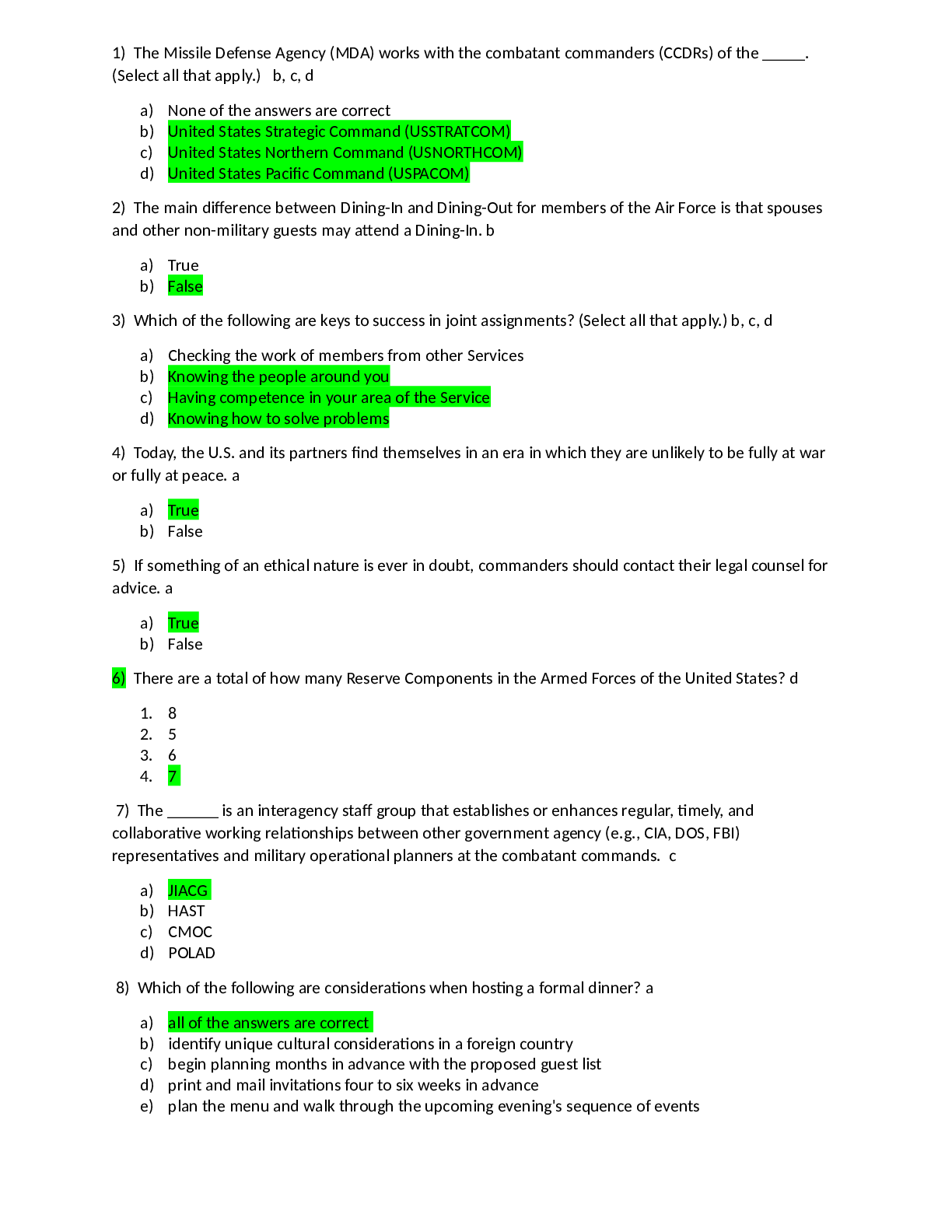

.png)
.png)
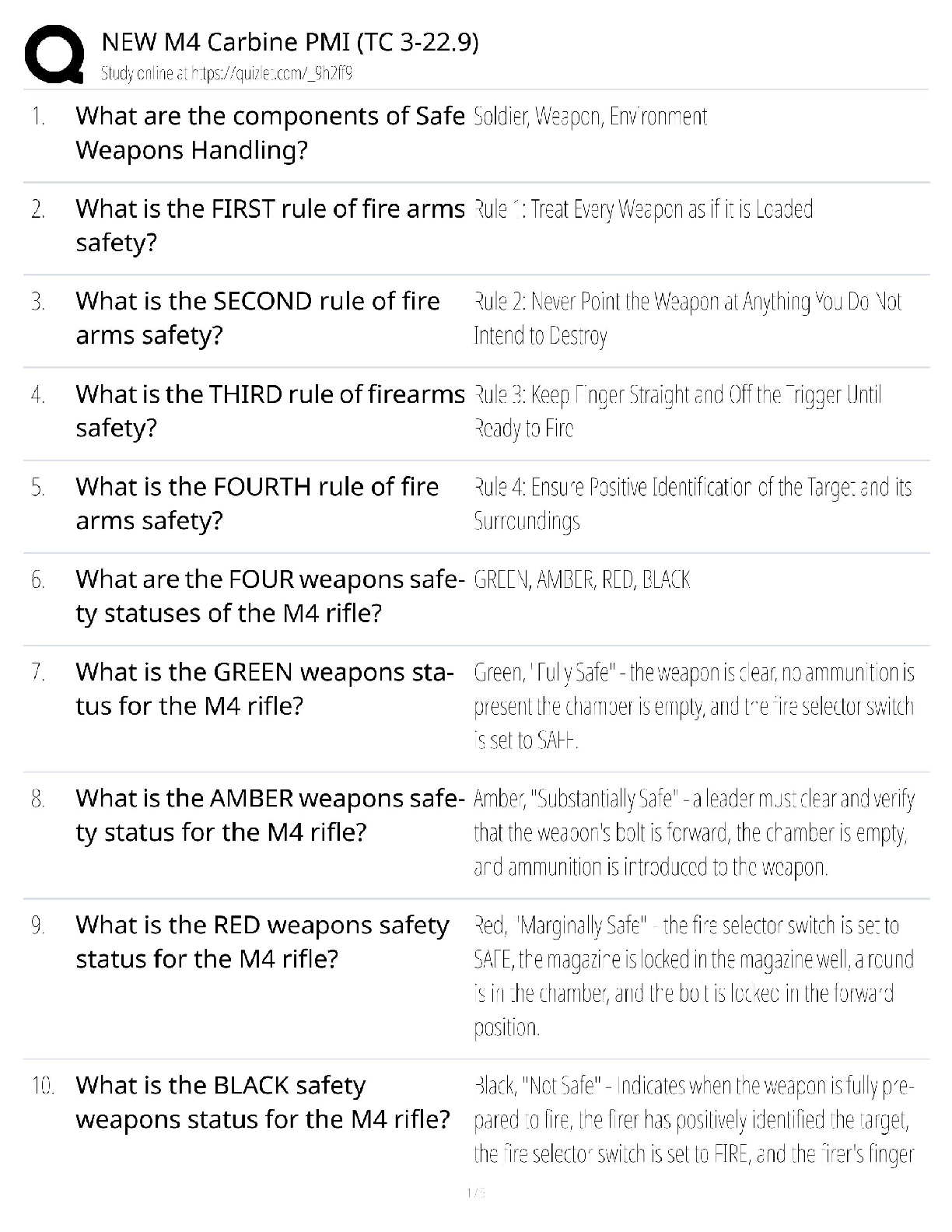
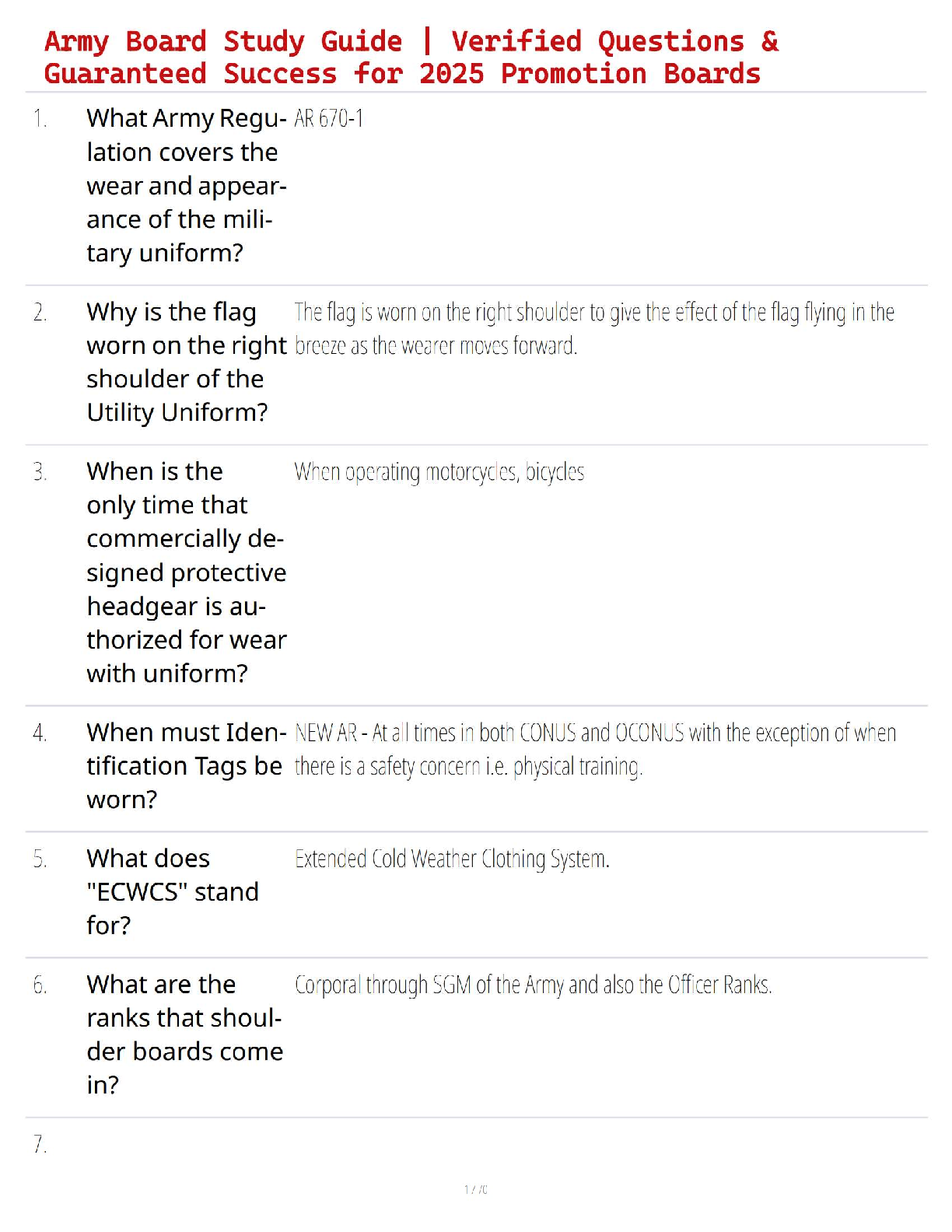
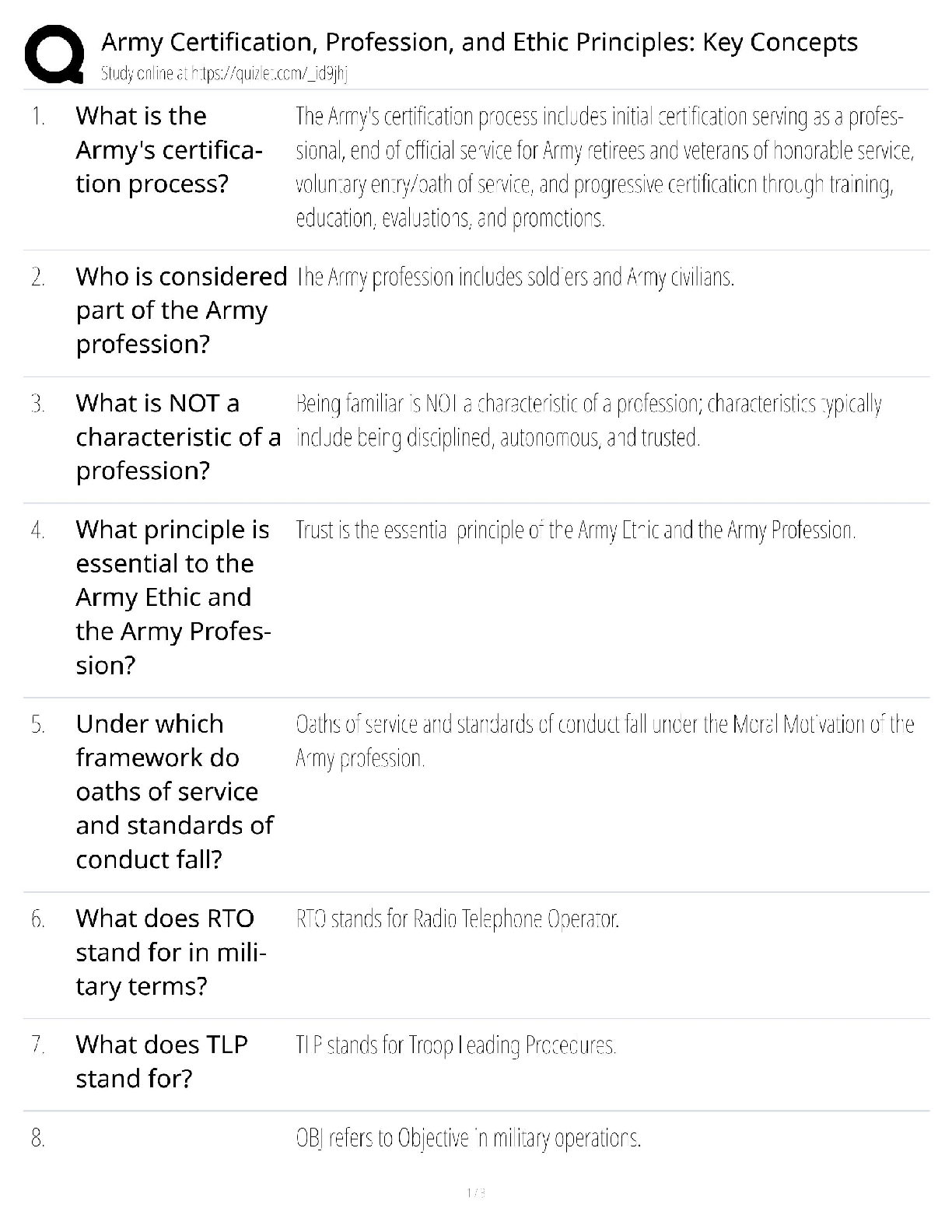

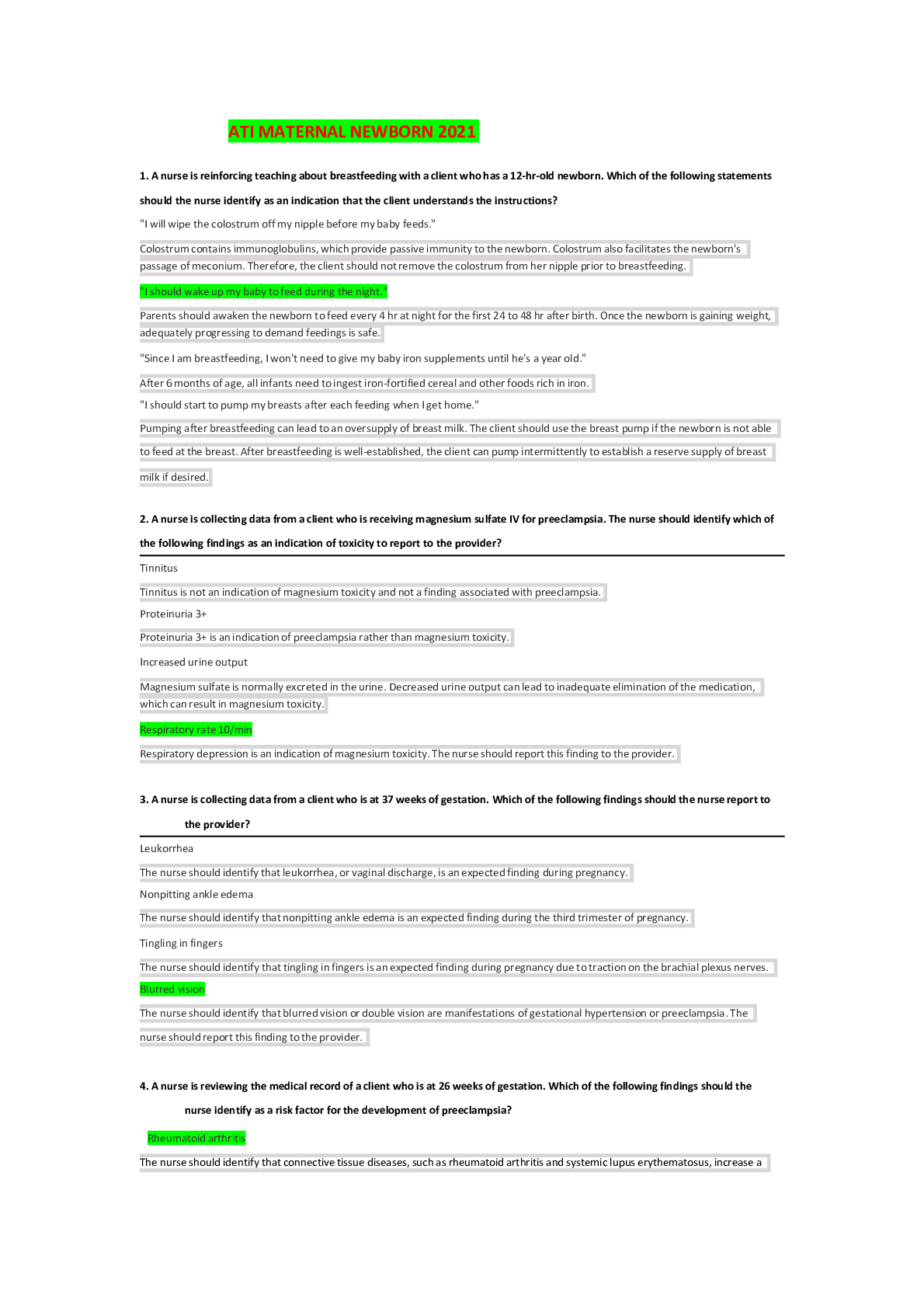

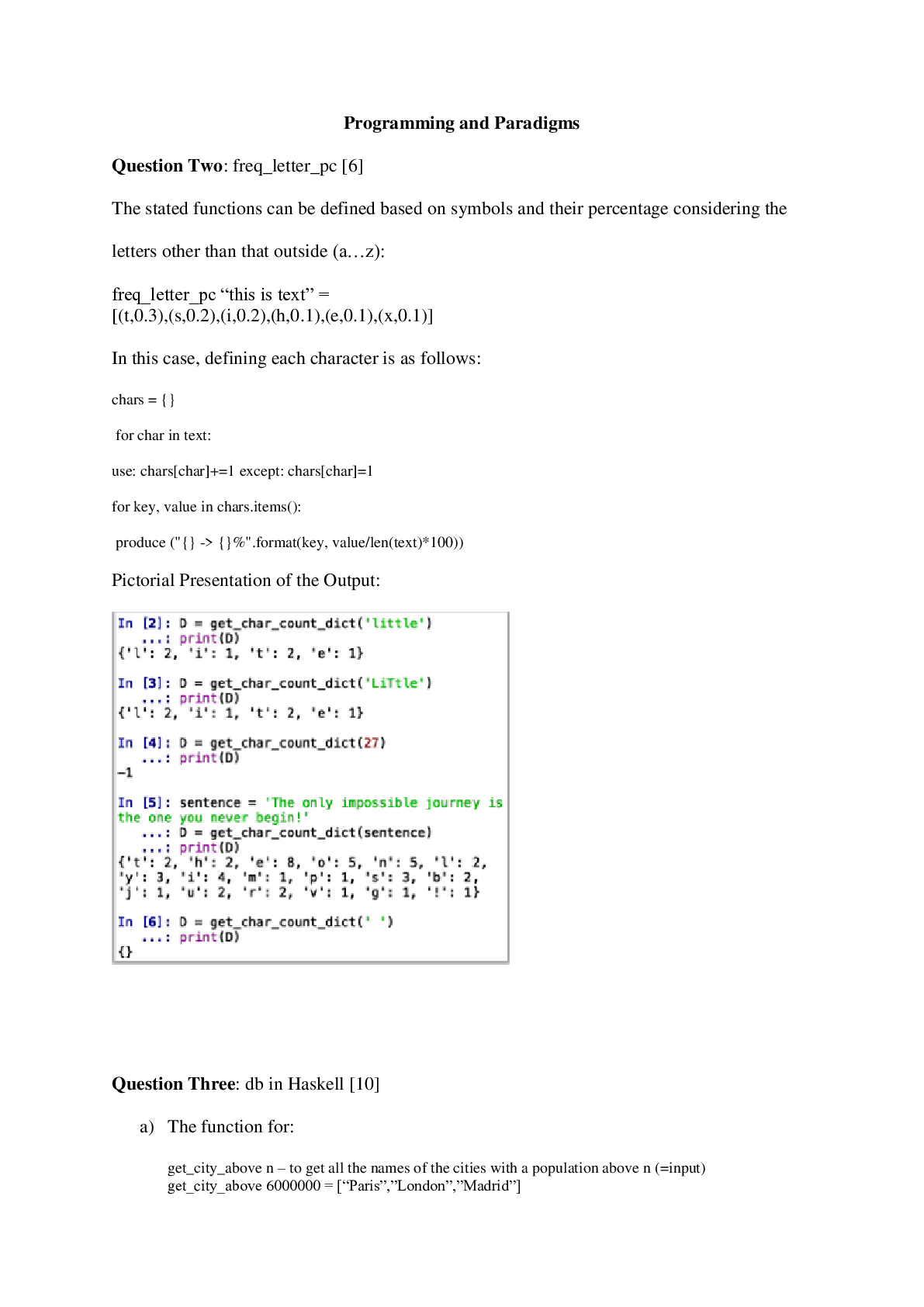


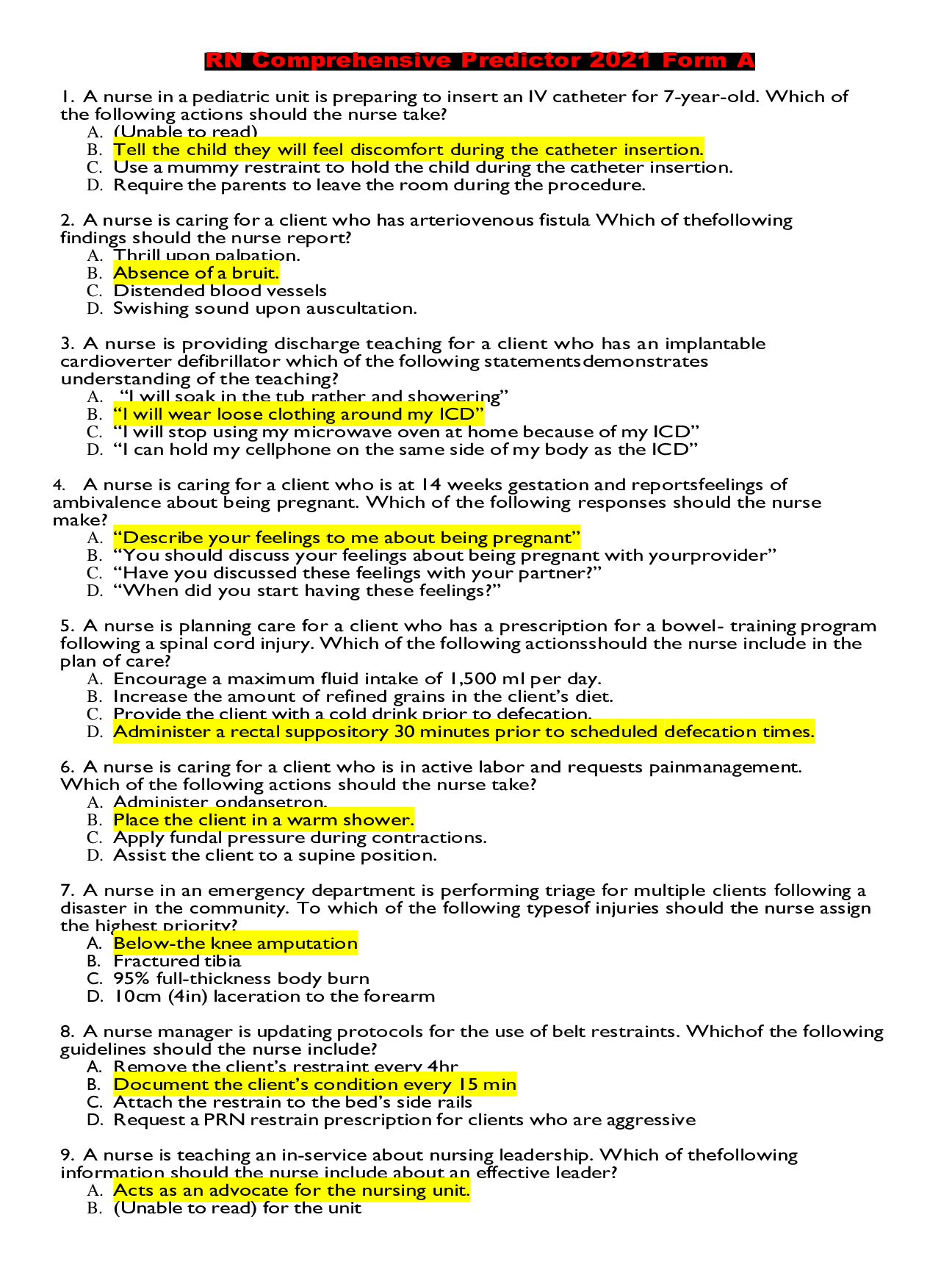
.png)