EXAM 2 KEY
PART A: EQUILIBRIA
1) Consider the Following OVERALL Reaction (15 pts)
2NO + 2CO < == > 2NCO + O2
In which the Rate of the forward reaction is equal to Rf = kf [NO][CO]2
and the Rate of the reverse (backw
...
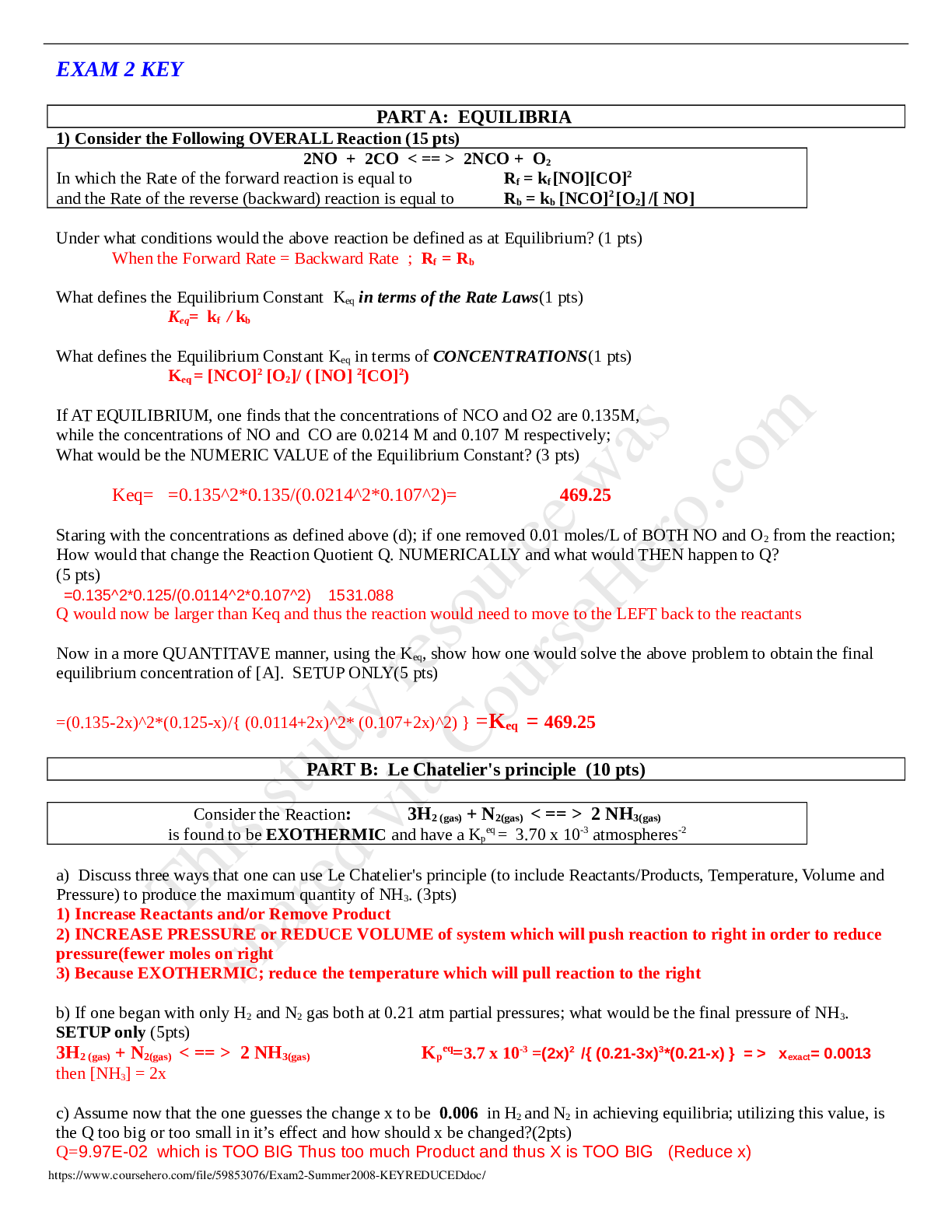
EXAM 2 KEY
PART A: EQUILIBRIA
1) Consider the Following OVERALL Reaction (15 pts)
2NO + 2CO < == > 2NCO + O2
In which the Rate of the forward reaction is equal to Rf = kf [NO][CO]2
and the Rate of the reverse (backward) reaction is equal to Rb = kb [NCO]2 [O2] /[ NO]
Under what conditions would the above reaction be defined as at Equilibrium? (1 pts)
When the Forward Rate = Backward Rate ; Rf = Rb
What defines the Equilibrium Constant Keq in terms of the Rate Laws(1 pts)
K
eq= kf / kb
What defines the Equilibrium Constant Keq in terms of CONCENTRATIONS(1 pts)
K
eq = [NCO]2 [O2]/ ( [NO] 2[CO]2)
If AT EQUILIBRIUM, one finds that the concentrations of NCO and O2 are 0.135M,
while the concentrations of NO and CO are 0.0214 M and 0.107 M respectively;
What would be the NUMERIC VALUE of the Equilibrium Constant? (3 pts)
Keq= =0.135^2*0.135/(0.0214^2*0.107^2)= 469.25
Staring with the concentrations as defined above (d); if one removed 0.01 moles/L of BOTH NO and O2 from the reaction;
How would that change the Reaction Quotient Q. NUMERICALLY and what would THEN happen to Q?
(5 pts)
=0.135^2*0.125/(0.0114^2*0.107^2) 1531.088
Q would now be larger than Keq and thus the reaction would need to move to the LEFT back to the reactants
Now in a more QUANTITAVE manner, using the Keq, show how one would solve the above problem to obtain the final
equilibrium concentration of [A]. SETUP ONLY(5 pts)
=(0.135-2x)^2*(0.125-x)/{ (0.0114+2x)^2* (0.107+2x)^2) } =Keq = 469.25
PART B: Le Chatelier's principle (10 pts)
Consider the Reaction: 3H2 (gas) + N2(gas) < == > 2 NH3(gas)
is found to be EXOTHERMIC and have a K
p
eq = 3.70 x 10⁻³ atmospheres-2
a) Discuss three ways that one can use Le Chatelier's principle (to include Reactants/Products, Temperature, Volume and
Pressure) to produce the maximum quantity of NH3. (3pts)
1) Increase Reactants and/or Remove Product
2) INCREASE PRESSURE or REDUCE VOLUME of system which will push reaction to right in order to reduce
pressure(fewer moles on right
3) Because EXOTHERMIC; reduce the temperature which will pull reaction to the right
b) If one began with only H2 and N2 gas both at 0.21 atm partial pressures; what would be the final pressure of NH3.
SETUP only (5pts)
3H2 (gas) + N2(gas) < == > 2 NH3(gas) Kpeq=3.7 x 10-3 =(2x)2 /{ (0.21-3x)3*(0.21-x) } = > xexact= 0.0013
then [NH3] = 2x
c) Assume now that the one guesses the change x to be 0.006 in H2 and N2 in achieving equilibria; utilizing this value, is
the Q too big or too small in it’s effect and how should x be changed?(2pts)
Q=9.97E-02 which is TOO BIG Thus too much Product and thus X is TOO BIG (Reduce x)
https://www.coursehero.com/file/59853076/Exam2-Summer2008-KEYREDUCEDdoc/
This study resource was
shared via C
[Show More]



.png)

.png)